
Why do cats respond to kitty-kitty?
Scientists attribute the reasons why cats respond to the familiar Russian "kitty-kitty" sound to ingrained habit and the peculiarities of these animals' auditory perception. Over time, pets develop positive associations with the sound, as this sound is often accompanied by affection, feeding, or attention from their owner.
Furthermore, cats are particularly sensitive to high frequencies, which resemble natural sounds in their environment. This is why "kitty-kitty" attracts their attention. In other countries, cats develop a similar reflex, but to different sound combinations, customary in a particular culture.
Content
Common hypotheses
Explaining why cats often don't respond to their own name, but almost always resort to "ksksks," scientists offer several theories:
- Practical experience. The sound is associated with pleasant memories—receiving a treat in the past, or being petted by its owner. Therefore, upon hearing "kitty-kitty," the pet rushes to get a treat or another dose of affection.
- Danger. The call contains whistling sounds and resembles the hiss a mother cat makes when her kitten is in danger. In this case, memory is also awakened, and the animal runs to its owner in search of safe shelter.
- Similarity to natural sounds. The combination of sounds produced by humans resembles those found in nature—the squeak of rodents, the whistle of birds, the rustling of leaves. When a cat is called by its owner, its hunting instinct or playfulness is awakened.
A positive response to this phrase is developed only in domesticated cats. A stray cat would be more likely to be frightened than attracted by such a call.
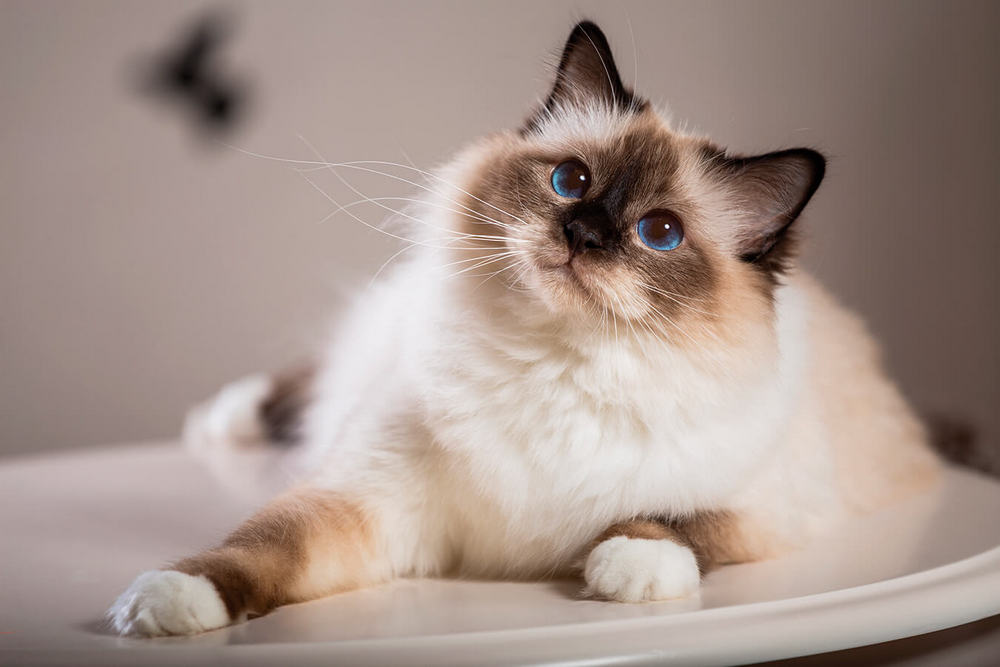
A cat's response to "kitty-kitty" is an acquired skill, developed using the classical training principle of command followed by reward. It's easiest to train a kitten to respond to a vocal signal, as they quickly learn the association between the sound and the subsequent reward. In most cases, after the familiar words, the pet receives food or affection, which reinforces the desired response.
Experienced owners, wary of pet theft, often use unconventional, non-standard commands. A cat can be trained to respond to virtually any command, but in practice, it's important to consider its ease of use. You'll agree that calling your pet with a phrase like "Viktor Pavlovich, come eat" isn't very practical. Furthermore, the speed and success of training directly depend on the length of the call, its complexity, and the presence of hissing elements, which cats perceive particularly well.
Why do cats respond to "kitty-kitty"?
Katherine Pankratz, a veterinary behaviorist, believes there's a physiological reason for the remarkable response to whistling and hissing sounds. Cats have a hearing range of up to 85 kHz, while humans have a hearing range of no more than 20 kHz. This allows cats to hear high-pitched, sharp "s" sounds very well. This ability allows them to successfully hunt mice—their ears easily detect subtle whistles that are inaudible to humans. The animal doesn't necessarily like the sound; it simply attracts its attention.
Cats have highly developed hearing organs; they can distinguish many more sound combinations than their owners. Cats also have directional hearing—they can "sort" surrounding noise, picking out the most interesting and disturbing sounds while ignoring background noise. Every owner is familiar with their pet's habit of turning its ears in different directions. Often, they are turned in opposite directions, the angle of rotation can reach 180º. At such moments, the cat's attention is drawn to two sounds at once.
Excellent hearing helps pets navigate in the dark. Thanks to 52,000 nerve endings, animals easily locate the source of external noise by analyzing its pitch, strength, and distance from their location.
What are cats called in other countries?
The sound combination "kitty-kitty" is widely used in Russia, the CIS countries, Germany, and Sweden. In other countries, other sound combinations are used, which may not contain hissing or whistling sounds. This fact proves that the cat simply gets used to a certain combination—a conditioned reflex is developed in its body, allowing it to respond to its name or any other set of sounds.
What calls are common in other countries:
- in Israel, a cat will ignore the typical Russian "xxxx" but will readily come running to "kiss-kiss";
- In Poland and the Czech Republic it is customary to call by saying "chi-chi-chi";
- In the USA and Great Britain, the sound combination "kiri-kiri" is common;
- In France, cat owners use the phrase "minu-minu";
- In Korea, cats are accustomed to repeating the word "nabiya" with the stress on the last syllable;
- In Japan, a cat is called "oyde-oyde";
- In the Netherlands, an animal will readily come up to you if you say "pus-pus";
- In Italy, the usual call became "michu-michu";
- In Finland they pronounce it similar to the Russian "kysu-kysu";
- in Serbia the pet is called "machek" or "machka" and is called "mats-mats";
- In India, they imitate the language most understandable to cats by saying "meow-meow."
The most original way to call pets exists in Arab countries. There, they pronounce the sound combination used in Russia to chase away a stray cat: "shoo-shoo."
Cats have incredibly sensitive hearing, but they don't understand human speech. Therefore, you can accustom your pet to any letter combination. Simply introduce the sound combination from early childhood, developing a conditioned reflex in the kitten based on pleasant memories associated with play, feeding, or petting. This habit develops through routine training, which is often overlooked by the pet owner.
Read also:
- Can cats think and what do they think about?
- Why do cats look out the window?
- Why do cats run around the apartment after using the toilet?


Add a comment