
Why do cats purr?
Most people perceive purring as a signal that their pet is content and affectionate. Zoologists have discovered that this sound actually has a much more complex function. To better understand your pet, it's important to understand why cats purr and how they do it.
Content
In what cases does this happen?
It's not just cats that purr. This characteristic is shared by most species of the cat family: lions, pumas, leopards, tigers, snow leopards, and many others. From this, scientists conclude that this mechanism arose long ago, when only one common ancestor existed on the planet.
Since purring has survived to this day, it must have been a useful skill. How and why cats purr has only recently begun to be studied in detail. Furthermore, this research is complicated by the fact that cats are less willing to cooperate with humans than, say, dogs. Nevertheless, some clues have been established.
Good mood
Many owners believe that pets purr only when when they are strokedIn fact, this isn't true; this belief stems from the fact that no one sees a cat purring when alone. However, video surveillance has revealed that cats often purr without human company. Every pet is unique and has its own personality, so the frequency and duration of purring varies, as do periods of high or low mood in different people.
A good mood, relaxation and pleasure – all this can cause purring even when a cat is completely alone.
Communication
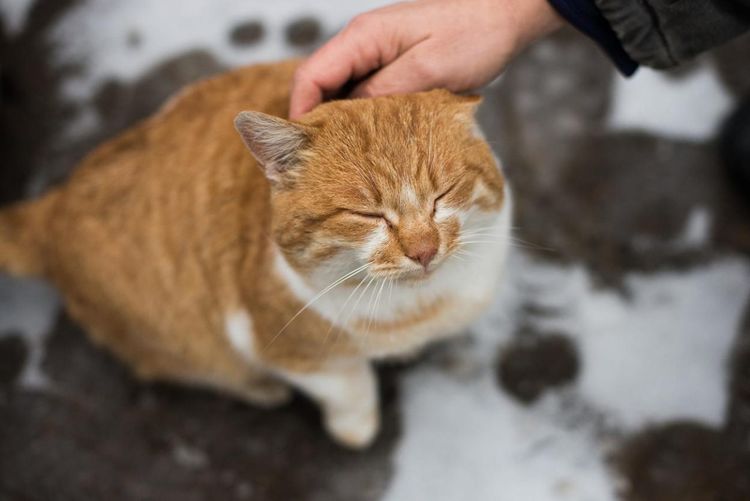
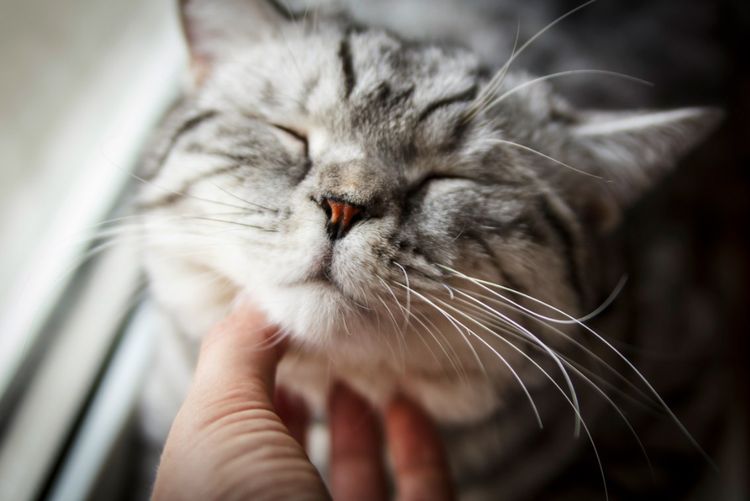
The most common response is for a pet to begin purring in response to petting. A cat may purr not only when petted, but also when spoken to in a pleasant manner or praised. While a cat may not understand all words, it can easily distinguish affectionate tones from indifference, and especially from anger. This is often how a cat greets a person who has returned home.
Cats express pleasure in communicating through purring not only with people but also with members of their own species. They often purr when grooming each other or lying down next to another animal. Sometimes this behavior is even observed when interacting with members of other species, such as dogs, guinea pigs, and others.
Eating behavior
Kittens typically begin purring within a few days of birth. While not as loud as meowing, which can attract predators and enemies, it helps the mother hear her kittens, as these vibrations are easily detected by cats.
This feeding behavior often persists into adulthood. It's most often observed in the morning: a hungry pet will attempt to wake a person by purring, headbutting, or pawing. Experience shows that this mechanism is quite effective, as most people feed their cats first and only then perform their usual morning routine.
Read on our website also about what to do if the cat is marking in the apartment.
Stress
Purring sounds can be caused by more than just positive emotions. One cause is stress or fear. It's known that cats' purring can reduce stress in humans; even stroke rates, despite other similar conditions, are lower in families with affectionate cats. Now, experts have discovered that these creatures help not only their owners but also themselves cope with stress in this way.
During these characteristic vibrations, their adrenaline levels drop, returning them to normal. A cat purring after being yelled at or chased by dogs is nothing out of the ordinary: it's simply trying to return to a normal emotional state using the means available.
Pain
Purring vibrations have also been found to have an analgesic effect. Pets may produce these sounds when they are in pain or injured, to reduce the sensation.
Veterinarians confirm this: during illness, various unpleasant medical procedures, or injuries, these animals can purr loudly until relief or death. This can be disturbing to doctors, as it's impossible to hear the heartbeat and breathing during the vibrations. Purring is often observed even after an injection during euthanasia.
Self-medication
Purring vibrations are one of the natural treatments for pets. They can help restore various tissues. Using specialized equipment, it was possible to measure that cats produce sounds with a frequency of 20-30 Hz when they purr. Experts found that purring in this range is very similar to the vibrations used in physiotherapy. Lower frequencies are associated with the greatest regeneration and restoration of bones, ligaments, and joints, while higher frequencies promote skin and soft tissue renewal.
This self-healing process can be observed when a cat is napping. Considering that cats sleep for approximately 20 hours a day, they have ample time for this restorative process.
How does it happen?
For a long time, zoologists were unable to understand how purring sounds are produced. This is because no specific organ for this action could be identified. However, it is now known that electrical impulses are first generated in the cerebral cortex and transmitted to the muscles of the larynx. These muscle fibers are located in close proximity to the vocal cords. The rhythmic contractions of these muscles cause a specific vibration. The sound, heard by others, is emitted by both the mouth and nose, spreading throughout the body.
Experts have determined that purring is a voluntary act, meaning a cat decides when to start purring and when to stop. So, when a cat is being petted and suddenly becomes silent, it means she's had her fill of "communication" and wants to lie down quietly.
Surprisingly, no correlation has been found between the volume, frequency, and duration of purring and the animal's gender, age, weight, or other characteristics. Nor is it related to the volume at which a cat typically meows. Even a quiet animal can purr loudly enough to cover half the house, and vice versa. A love of purring and the volume of this activity are a distinctive characteristic of this pet.
Read also:


Add a comment