
Papillomas in dogs
Papillomas in dogs are as common as in humans. But what causes them? Are they dangerous for your pet? How can they be treated? Which is more effective: folk remedies for removing papillomas in dogs or traditional medicine?
Content
Human papillomavirus
Let's figure out what causes papillomas in dogs?
Papilloma – is a small benign neoplasm that appears as a result of the growth of epithelial cells affected by a DNA virus of the Papillomaviridae family.
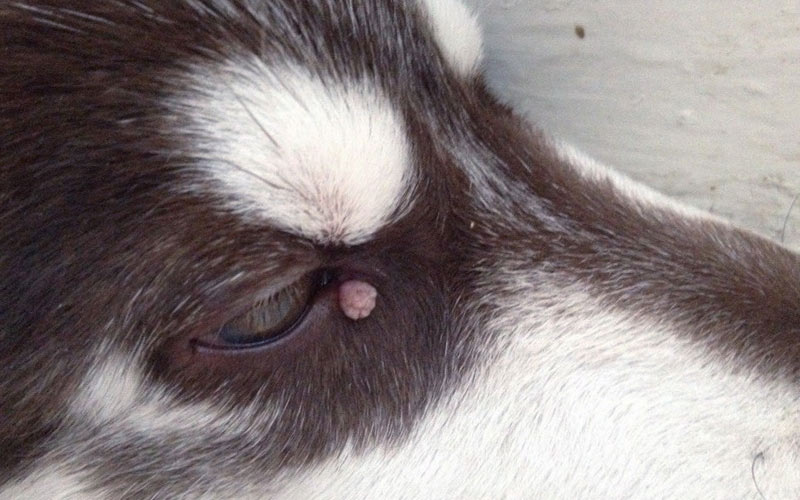
Currently, approximately 5 different types of the virus have been identified in dogs and 8 feline papillomaviruses, each of which causes a specific form of the disease. The course of the disease and
The course of the disease and the extent of the damage depend primarily on the animal's immunity. There are numerous cases of spontaneous recovery in cats and dogs infected with the Papillomavirus. However, modern veterinary medicine pays special attention to this problem, focusing owners' attention on issues such as:
- spread of the virus (even animals that are ill in a latent form are carriers of viral infection);
- risk of bleeding and secondary infection when the neoplasm is injured;
- the risk of uncontrolled growth of papillomas (due to injury or removal);
- the transformation of cells from benign to malignant.
These 4 reasons why papillomas appear in dogs are compelling reasons to address the problem at the first signs of papillomavirus infection.
The cause of papillomas in dogs is the activity of the Papillomaviridae virus, acquired through direct and indirect contact with a sick animal.
It's important for breeders to know that the disease has a fairly long incubation period. The first symptoms may appear 1-2 months after infection, or they may not appear at all if the disease remains latent (hidden).
Types and locations of papillomas
In dogs, there are several types of papillomas, each with its own location and characteristic features of the course of the disease.
Oral papillomatosis (in the mouth)
This type of disease is most common because the virus most easily spreads to mucous membranes through animal contact (playing together, fighting, licking). For this same reason, oral infection often affects young, active dogs.
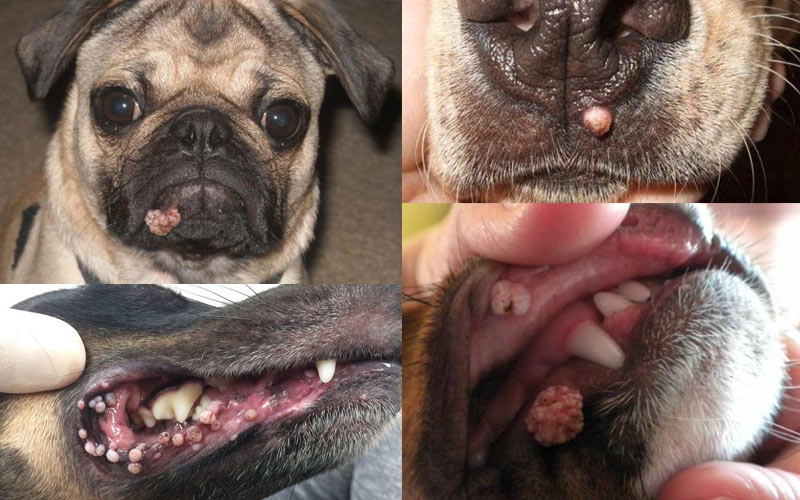
Growths can appear in areas such as:
- lips and cheeks, in the mouth;
- tongue and gums;
- conjunctiva of the eyes;
- external area of the nostrils.
In appearance, they are small, cone-shaped growths with a soft, crumbly consistency. Papillomas in dogs can range in size from barely noticeable to large growths the size of a bean. Smooth, flat plaques (papules) initially appear, then elongate. A fully formed papilloma resembles a cauliflower inflorescence. If the animal's immune system is strong, the condition resolves on its own within about three months. In pets with weakened immune systems and older dogs, the number of growths can increase rapidly, requiring specialized treatment.
For more information on the treatment of this type of papillomas, watch the video:
Cutaneous exophytic papillomas
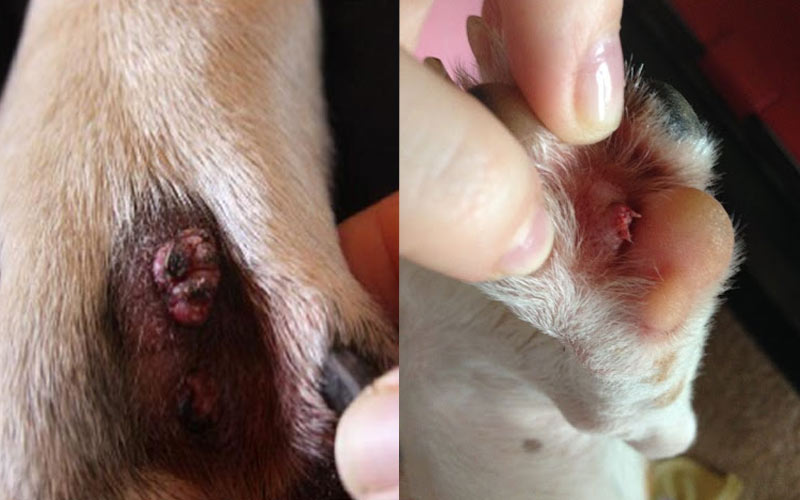
They most often appear on the paws, head, or eyelids. They can have a stalk or be cauliflower-like. They can be hard or soft in consistency, but are usually no more than 0.5 centimeters in diameter. They are usually smooth and not covered in hair.
Exophytic skin papillomas are most commonly reported in Cocker Spaniels and Kerry Blue Terriers. Older dogs are also at risk.
If the growth is located on the paw pad, the first symptom will be lameness, which the owner may notice even before the growth appears. You can see what this looks like in the photo below:
Prevention is better than cure. Dog shoes can be an effective way to protect paws.
Cutaneous inverted papillomas
Inverted (transitional cell) papillomas are often located in the groin or abdomen and appear in young individuals (8 months to 3 years). Inverted skin papillomas differ from the previous types in that they appear as low, round elevations with a sunken center. The body of the wart in this case is located internally, not externally. The problem can be single or multiple.
Transitional cell papillomas are very rare. They are dangerous because they can remain undetected for long periods of time, yet they have the potential to become malignant.Lentigo (pigmented plaques)
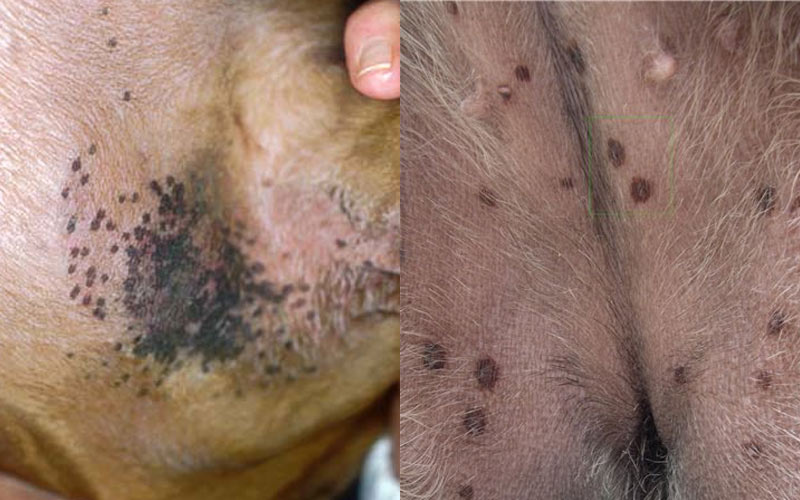
This type of disease occurs in both young and older animals. Plaques are most often localized on the abdomen and groin area. There is evidence of a genetic predisposition in breeds such as Schnauzers and Pugs. If the problem was diagnosed in one parent, there is a high probability of inheriting it.
Genital papillomatosis in dogs
Genital papillomatosis is uncommon in dogs. It is described as a sexually transmitted form of the papillomavirus, causing the development of tumors on the genitals.
Distinctive features of papillomas
An inexperienced dog breeder may wonder about the nature of a growth on their pet. Therefore, consider the distinctive signs of papillomas so that, if necessary, you can easily diagnose your dog correctly. Here are the signs:
- characteristic area of education (described above);
- characteristic uneven bumpy surface resembling cauliflower;
- the presence of a “leg” (narrowing at the point of junction with the skin).
The color of a papilloma can vary from light to crimson or black. The color of the growth largely depends on the dog's natural coat color.
As a rule, other types of warts and growths not associated with the activity of viruses of the Papillomaviridae family have a smooth surface.
The owner should be alerted by such manifestations as:
- a sharp increase in the number of neoplasms;
- large papillomas (they are easily injured);
- bleeding from a neoplasm;
- changes in the contours and structure of the papilloma.
In any case, the discovery of a neoplasm of unknown origin on your pet’s body is a reason to visit a veterinarian.
Diagnosis and treatment
Important! Treatment of papillomas in dogs and cats must be carried out under the supervision of a veterinarian. Never remove the growths yourself, as trauma can activate the cell degeneration process, leading to the development of malignant tumor.
In the vast majority of cases, papillomatosis in dogs is diagnosed by visual examination of the animal. Knowing where to look for signs of the problem, the breeder should regularly examine the animal. It's even better if this is done by a veterinarian during a routine checkup. If a growth, wart, or lump is detected, it's important to determine its nature. An inexperienced person can easily confuse a granuloma, a mole, a papilloma, and a malignant tumor. To establish a diagnosis, the veterinarian may recommend additional testing.
If there are no obvious manifestations on the skin or mucous membranes, but there is a suspicion that the dog is a carrier of the virus or is latent, Papillomaviridae can be detected through PCR diagnostics, which allows us to determine not only the presence of the virus itself, but also the type of virus.
Immunity correction
Solitary papillomas tend to resolve spontaneously within the first 2-5 months after their onset. If the animal has a strong immune system, its body will fight the virus on its own. Therefore, if isolated growths are detected, the veterinarian may take a wait-and-see approach and recommend immune-boosting medications.
For oral or isolated skin papillomas, dogs are prescribed interferon for a course of at least 2 months (and another month after all warts have disappeared).
Folk remedies
Important! Folk remedies should only be used on the advice of a doctor if the animal has been diagnosed with a single tumor in the early stages.
These tools include:
- celandine juice;
- dandelion juice;
- garlic;
- spurge.
Surgical intervention
If immunomodulatory therapy is ineffective, the number of warts increases, or the growth is bothering the animal, various surgical methods are used:
- traditional excision;
- laser therapy;
- cryodestruction;
- chemical coagulation;
- thermo and electrocoagulation;
- radiosurgery.
All methods are good, but often require a repeat visit to the veterinarian to “consolidate” the positive result.
Vaccine
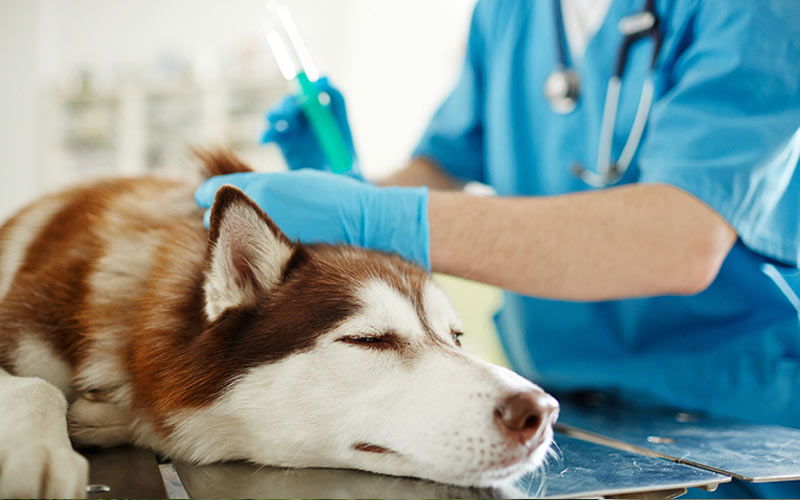
The most effective method for treating HPV infection in dogs is a vaccine tailored to the animal's specific pathogen. The vaccine is administered subcutaneously every 7-10 days. Significant improvements should be expected no earlier than after 3 weeks of treatment.
Conclusion
Typically, canine papillomas are painless and benign growths. But are they really that safe? One of the downsides of papillomas in a dog's mouth is discomfort. The warts interfere with the animal's ability to grasp, chew, and swallow food properly. They can also increase salivation and cause bad breath.
Among other things, dogs chew on papillomas located on their extremities, which leads to bleeding. The resulting wound is an open door for all sorts of bacteria and fungi.
Be vigilant with pigmented plaques. They often progress to cancer. Make sure nothing rubs or presses on the papillomas (like a collar or muzzle).
Any questions? You can ask our website's staff veterinarian in the comments below, who will answer them as quickly as possible.
Read also:
- Histiocytoma in dogs: symptoms and treatment
- Lipomas in dogs: what they look like and how to remove them
- Cytological examination of skin in dogs


30 comments
Valeria
My dachshund had a pimple on the outside of his ear at first, and now there's a small, hard, round bald spot. I applied iodine to it, but it didn't work. It doesn't bother the dog, but it's unsightly. It's also unclear what it is or why the fur isn't growing. It's the size of a pinky fingernail. I'd be very grateful for any advice. Valeria.
Daria is a veterinarian
Hello! Who advised you to apply iodine? Iodine and brilliant green should never be used on cats and dogs! They cause burns! It's possible that the iodine application caused the burn and hair loss at the site of application. This should be examined by a dermatologist. Fungal infections, mites, and skin diseases (including endocrine disorders) should be ruled out. Everything needs to be assessed systematically! And be sure to provide a full description of the animal: age, sex, diet, maintenance, treatments, any other complaints, past illnesses, presence of other animals or contact with other animals, etc.
Lida
Hello, could you please tell me? My dog has two lumps on her neck, about 2 cm in size. They are hairless and uneven in texture. I can't take them to the vet. I can't see what they could be from the photos. Thank you.
Daria is a veterinarian
Hello! You couldn't find a diagnosis from the pictures, even though you have an animal with lumps in front of you, but you want a definitive diagnosis from an online consultation? The animal needs to be seen and felt, and tissue from the lumps needs to be taken for histological examination to rule out a neoplasm. Furthermore, the animal's age, living conditions, and onset of the lumps are not specified, nor are any other accompanying clinical signs (e.g., significant weight loss, apathy, refusal to eat, itching, etc.). Dermatology is a very broad field. Unfortunately, no doctor can tell you what kind of lumps you have without an in-person examination.
Demidova Yulia
Hello. My English Cocker Spaniel, Pretty, is 8 years old. It all started with a single papilloma on her side. We cauterized it with a lapis (pencil). It started to go away, but then it appeared elsewhere. We gave her injections, but I don't remember the medication—it didn't help. Now she has about 10 more, and they're appearing (on her back, sides, and one paw). How can I help her? She scratches them and they bleed. It's a shame...
Daria is a veterinarian
Hello! Are you sure it's papillomatosis and not squamous cell carcinoma? Cutaneous papillomatosis doesn't clear up as quickly as mucous membrane papillomatosis. A course of immunostimulants/immunomodulators (Immunofan, Ribotan, Anandin, or at least interferon, Genferon, or Cycloferon) should be administered every other day for a month. A single injection isn't worth the miracles, as they won't work. The fact that it's itchy is bad enough, but it's even worse (they'll spread like crazy throughout the body if the growths are constantly traumatized).
Irina
Hello! My beagle is 1 year and 4 months old. I recently discovered papillomas on her cheeks. I went to the clinic and they prescribed antibiotics, but the papillomas continued to grow. We went to other doctors, and they prescribed antibiotics in pill form, which made my dog sick. The papillomas continued to grow, and new ones are even appearing. Could you tell me what else I can do? Is it possible to vaccinate against HPV while they are still present, or should I wait until they completely disappear? Thanks in advance.
Daria is a veterinarian
Hello! Young animals are very susceptible to this infection. I'll tell you one thing: 9 out of 10 animals recover on their own within a year, even without any treatment. Why prescribe antibiotics if such growths are caused by a virus? At most, immunostimulants are helpful. Improve your diet and add vitamins and minerals. The stronger your immune system, the better the chances of the papillomas disappearing faster. Sometimes they are surgically removed if they are bothersome, but even then they will return (pop up in a different location). The vaccine is given to healthy animals for PREVENTIVE purposes. Your pet is already sick.
Irina
Thank you
Daria is a veterinarian
You're always welcome =) But don't get sick again! Get well soon!
Svetlana
Hello. My 11-year-old male German Shepherd lives outside. Three months ago, a lump started growing on his head near his ear canal. It's now the size of a cherry. At first, nothing bothered him, but now it's bleeding, as if he's injured it. The lump is pink and not covered in hair. What does this look like?
Daria is a veterinarian
Hello! It could be a papilloma or a skin tumor (11 years is already advanced for a German Shepherd, so the risk of developing cancer is high). Ideally, an in-person examination by a veterinarian is necessary. For now, prevent scratching (use a special collar), treat open wounds with chlorhexidine first, then at least apply Levomekol (but not iodine or brilliant green, otherwise the animal will also suffer a tissue burn), and ideally, also administer antibiotics (preferably intramuscularly).
Anfisa
Good afternoon, Maltese.
I had a papilloma on my eyelid, they cut it out, it came back 3-4 months later, they cauterized it and it came back again, but this time on the upper eyelid. The doctors say it's a virus and they don't prescribe any medications. You can't cut a dog all the time! Please advise what to do, the dog is only a year old.
Daria is a veterinarian
Hello! Yes, it's true that a virus causes these skin growths (just like HPV in humans—almost everyone has it, but the strains vary. Some are dangerous, while others are suppressed by the body, and the person simply becomes a carrier without any visible skin growths). Young animals (under one year old) are most often affected. And now the most interesting part: in 9 out of 10 cases, papillomatosis resolves on its own (usually within a year), requiring no treatment. The only thing you might need to do is strengthen your pet's immune system (balance their diet, switch to super-premium or holistic commercial pet food, and give them vitamins, micro- and macronutrients, and immune stimulants).
Lvrisa
Hello. My pug has a small papilloma inside his upper eyelid. I'm wondering if it's bothering him. What should I do? I went to the doctor. My old pug had it cauterized before, but this one is young. He says you can't cauterize it—you'll have to cut it. He also says it's keratitis and cutting the lower eyelids is a bad idea. The dog has beautiful eyes, and the eyelids aren't bothering her. She's gone.
Daria is a veterinarian
Hello! It all depends on whether the wart is bothering the dog or not and how quickly it's growing. It's common in young dogs. And the stronger the immune system, the better. It can disappear on its own within a couple of months, sometimes within a year (unless it's bothering the dog or growing abnormally). You can try antiviral therapy and immunostimulants to help the body cope more quickly. Papillomatosis isn't just a disease for dogs; it can affect people too. For some, it's a real illness—they're covered in warts, while for others, they fall off on their own after a while.
Alexander
Hello, my 10-month-old Russell Terrier puppy developed a bump on the tip of her ear about three months ago. She shook her head, apparently causing discomfort. Then the bump started to grow pink. Now it's gotten bigger, darker, and its shape has changed, becoming less round. She doesn't scratch the area. What could this be? Thank you!
Daria is a veterinarian
Hello! You need to take a scraping and determine what exactly caused this growth. You need to rule out the presence of intradermal mites. Without seeing your pet, it's difficult to imagine what's bothering them. When you can see the problem in person and feel it with your hands, it's a little easier to make a diagnosis and begin a differential diagnosis.
Olga
My Labrador has a growth on his back leg that looks like a nipple. What is it?
Daria is a veterinarian
Hello! It's quite possible that the growth you described is a papilloma. It won't go away on its own (although there are rare cases where the immune system can fight off the virus that causes these growths, and the "bumps" disappear within six months). If you try to remove it yourself, you could harm the animal (it has a good blood supply, so bleeding may occur, or cells from the papilloma may spread through the bloodstream). This could trigger the growth of new ones in other areas. If the immune system weakens, papillomas could also start growing on other parts of the body. Don't risk it. Take it to a vet, where they can carefully remove it. If the animal is elderly, it's ideal to have it examined for histology to rule out malignancy. Without seeing the animal, I ASSUMED that's what happened to my pet based on your description. However, for a more accurate diagnosis, an in-person examination is necessary.
Svetlana
Hello! My 10 year old female Labrador has a large papilloma the size of a tennis ball growing under her arm. The papilloma was painless all the time, but now when I move I start rubbing it and the papilloma is hot to the touch and swollen. What should I do? I am very worried.
Daria is a veterinarian
Hello! Surely such a papilloma couldn't have grown overnight? Take it to the vet and have it removed! The animal is clearly distressed. They'll cauterize it, just like in humans, and the papilloma will fall off. Cancer must be ruled out! The dog is quite old, especially on the skin, and in an area subject to constant friction. A checkup is essential! Otherwise, it will become infected and get worse. There's nothing you can do to help the animal at home.
Julia
Good day! I have a Caucasian (5 years) on the shoulder there is a growth like half a bundle of the small finger, another on the left side of the shoulder blade like a soursop, and a third on the stomach like half a bundle of the little finger and all the growths of the hardness. Show me what you can do and how not to harm my friend
Dasha is a veterinarian
Hello! Please make an in-person appointment at a veterinary clinic. An examination and tests are required (a complete blood count, biochemistry panel, and, if necessary, a biopsy of the growths). It's so difficult to understand what's wrong with the animal. Are these growths hanging or are they like hard lumps? Could it be papillomatosis or cancer? In any case, without a diagnosis, it's impossible to say how dangerous it is for the animal. Cauterization may be sufficient, or a more complex surgery may be necessary.
Natalia
Hello. My 11-year-old spaniel has developed a shell-like growth on the outside of his elbow. It's no more than 3-4 mm in diameter, pink, and painless. Can you help me decide if it's worth treating?
Dasha is a veterinarian
Hello! To determine whether treatment is necessary, your pet needs to be examined. Take it to a vet. It could be old age, a vitamin deficiency, a wound, or something else entirely. Older pets can have hyperkeratosis, but it's usually dark (like rough, cracked growths on the skin). What are you feeding them? What does your dog sleep on? Is it just on one elbow, or are there similar lesions elsewhere on the body?
Igor
Hello! My dog (a 13-year-old male Shar Pei) recently developed a growth on his face. It looks like a thin white worm, 3-4 mm long, located on the side of his face, parallel to the skin. What could it be?
Dasha is a veterinarian
Hello! Your pet needs a physical examination and additional testing (a scraping may be necessary). Shar-Peis are prone to allergies and skin conditions, especially as they age. Older animals are more prone to illness. Without an in-person examination, it's impossible to tell what exactly your wrinkled family member has. Have your veterinarian examine the lump.
Yuri
Hello. My dachshund has a lump on his side that looks like a soft, hanging grape. It doesn't bother him and isn't painful. How can I get rid of it?
Daria is a veterinarian
Hello! Are you considering removing a growth of unknown etiology at home? Only in a clinic after an examination. To rule out cancer. It might be enough to simply excise the swelling, or it might need to be "cauterized" with nitrogen, like a papilloma, or it might even be an abscess. It's just that your description doesn't quite make it clear what kind of skin growth it is.
Add a comment