
Papillomas in cats
Papillomas (from the Latin "papillo" meaning nipple) are benign growths located on the skin or mucous membranes. These warts can range in size from a few millimeters to 2-3 cm and be the same color as the skin or range in color from flesh-colored pink to dirty brown. Typical locations for papillomas in cats include the inner ears, eyelids, lips, oral mucosa, neck, and abdomen. Genital papillomas in cats are rare.
Causes of papilloma formation
Papillomatosis is believed to be caused by DNA-containing non-enveloped viruses of the Papillomaviridae family, of which eight different subspecies have been identified in cats. Under the influence of the pathogen, epithelial cells mutate and begin to multiply uncontrollably, forming warty benign tumors resembling small, rounded growths with flattened tips. The papilloma may have a thin stalk or a dense, adherent base. As the warts grow, they form clusters resembling cauliflower inflorescences.
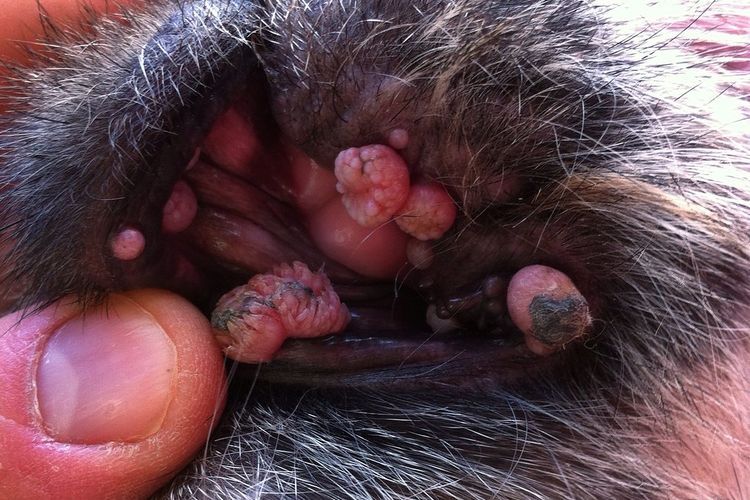
Although the DNA of all types of Papillomaviridae viruses is similar, the causative agent of feline papilloma is not dangerous to humans, and animals cannot become infected with the human papillomavirus (HPV).
A cat can become infected with papillomatosis through direct contact with an infected animal or through its grooming items. The incubation (latent) period of the disease is 1-2 months, after which clinical signs begin to appear.
The following factors contribute to the activation of the virus and the development of the disease:
- presence of chronic infectious diseases;
- underdeveloped immune system in kittens;
- weakened immunity in older cats or as a result of long-term use of certain medications;
- difficult labor;
- experienced stress;
- hereditary factors.
Diagnostics
Single or multiple wart-like growths found on a cat's skin or mucous membranes can have various causes. To diagnose papillomatosis, a biopsy sample of the growth is examined in a laboratory using immunohistochemical staining and electron microscopy. The cat is also given a blood test for Papillomaviridae DNA. The most reliable method is PCR, which uses the polymerase chain reaction, allowing for the detection of the virus even in its latent form.
Treatment of papillomas
If a cat has a small number of warts on its skin, they do not cause the animal any particular discomfort, and they are not growing rapidly, then such growths do not pose a threat to life and are usually not treated, and if they are removed, it is for the purpose of eliminating a cosmetic defect.
Reasons to consult a veterinarian include multiple papillomas, large growths or growths prone to bleeding, and warts located in areas prone to frequent trauma—in the mouth, on the lips, between the toes. In some cases, these papillomas can develop into malignant tumors (squamous cell carcinoma).
To treat papillomatosis in cats, symptomatic therapy is used, aimed at destroying the body of the wart; there are no drugs capable of killing the Papillomaviridae virus in the animal's body.
Surgical removal of papillomas (curettage) is rarely used in veterinary medicine today. The most popular method for removing isolated papillomas in animals is cryotherapy. Liquid nitrogen is applied to the tumor tissue, causing its rapid destruction and evaporation.
For the treatment of papillomatosis in cats the following are also used:
- Radio wave electroexcision. This is a contactless method of removing papillomas using high-frequency radio waves. The electric current causes thermal damage to the tissue, leaving a dry scab at the site of the "burned" wart.
- Chemical coagulation. Chemicals (nitric acid solution, Solcoderm, or Solkovagin) are applied to the papilloma to cause tissue mummification. A small dry scab forms at the site of treatment, which falls off on its own after a few days.
- CO2 laserThe infrared beam of a carbon dioxide laser acts like a surgical scalpel, and its use is effective in destroying even large papillomas.
- Novocaine injections. 0.5% novocaine with fospreneel is injected under the base of the papilloma 3-4 times with an interval of 5 days, as a result of which the supply of nutrients to the neoplasm is blocked, the wart dries up and falls off.
Papillomas typically don't cause itching, but cats may scratch them in an attempt to remove the "foreign object" from their skin. In such cases, to prevent infection, it is recommended to treat the growth with antiseptic and healing agents: chlorhexidine, hydrogen peroxide, 5% iodine solution, aqueous decamethoxin (Decasan), and Panestine or Betadine ointments.
Since the papilloma virus is active when the body's immune defenses are weakened, immunostimulants are usually included in complex treatment for papillomatosis. Cats may be prescribed: Gamavit, Roncoleukin, interferon inducer Maxidin, as well as vitamin complexes Canina Canivita, Polidex Immunity up, Farmavit Neo and others.
At home, you can try to eliminate isolated papillomas on cats by applying an iodine-based alcohol solution or acetic acid to them daily for a week. Applying celandine, garlic, or dandelion juice to the wart once a day for 2-3 weeks also has a good effect. Newly formed small warts can be removed by applying a paste of crushed rowan berries to them 2-3 times daily.
Read also:
- Dermatitis in cats
- Scabs on a cat's neck and body: causes and treatment
- Demodicosis in cats: symptoms and treatment


Add a comment