
Where can a domestic cat get fleas?
Cat fleas are the most common blood-sucking insects in the world, thanks to their high survival rate. They can adapt to any environmental conditions and reproduce very quickly. Even the most meticulous care for your pet won't guarantee it won't pick up parasites. To protect your pet, it's important to know where fleas can come from and the symptoms that indicate they've arrived.
Content
Where do fleas come from?
Some indoor cat owners believe that a pet that doesn't come into contact with stray animals can't become infested with fleas. However, this is a fundamentally misconception, as transmission from one animal to another is only one route of infection. Parasites, as well as their larvae, can be found on grass, soil, trees, and other objects near which a cat roams.
If your pet goes outside for walks, the risk of infection is almost 100%. The risk also increases if you have a dog or other animals in the house.
But even if an animal doesn't go for walks and is confined exclusively to the home, there are many ways for an infestation to occur. For residents of the ground floors of apartment buildings, the problem is particularly acute. Many buildings have basements inhabited by stray animals or rats, which carry fleas. In search of new food, fleas can venture into nearby apartments and even reach the second and third floors.

But even in apartments located on the upper floors, with no walks or contact with other animals, a domestic cat has every chance of becoming infected:
- through outdoor shoes or clothing of family members (usually flea larvae are transferred this way, but adult fleas may also be present);
- during an accidental exit into the entrance, especially considering the jumping ability of fleas and their ability to travel significant distances;
- when visiting a veterinary clinic, since homeless infected animals are often brought there;
- in the case of participation in competitions or exhibitions, where the risk of infection increases several times, since the owners of participating animals may not pay due attention to antiparasitic treatment, and some may not even suspect that they are infected;
- when visiting guests who also have pets infected with parasites;
- When traveling on public transport: even when using a special carrier, fleas can get inside through the holes in the body.

Parasite eggs fall onto various objects in the home, where they eventually mature, and the adult parasites immediately seek a host. For a time, this host may even be a human, who will sooner or later transfer the parasites to a pet.
Fleas have a complex development cycle: egg → larva → pupa → adult flea. The eggs fall from the cat onto surfaces such as carpet, bedding, floors, or furniture, where the larvae hatch, feed on organic matter, and then form a cocoon. As an adult, the flea can jump up to 30 cm and wait for a signal (heat, vibration) until1 year, before appearing on the host. This means that even after a long period of absence of attacks, sudden outbreaks of infestation are possible.
Routes of infection:
-
With human clothes and shoes after a walk, especially through entrances and basements.
-
Through other animals: domestic or stray cats, dogs, rabbits (ectoparasites can be transferred from host to host).
-
From the environment: carpets, upholstered furniture, cracks, bedding and paths become hotbeds where the pupae wait for the signal to get rid of the flea.
Symptoms of infection
If you carefully observe your pet's behavior, it's easy to detect a parasite infestation:
- a domestic cat often scratches itself and literally bites into its body, which may be associated with painful bites;
- behavior becomes restless and even aggressive;
- The pet loses its appetite and sometimes runs around the house meowing pitifully.
These signs are a clear signal to thoroughly inspect the animal's body: use a wide-tooth comb and, parting the fur, examine the skin, as fleas are visible on the skin, not the fur. The parasites have a laterally flattened, dark-brown body. You may also see flea droppings in the form of black-brown pellets, as well as bite marks.
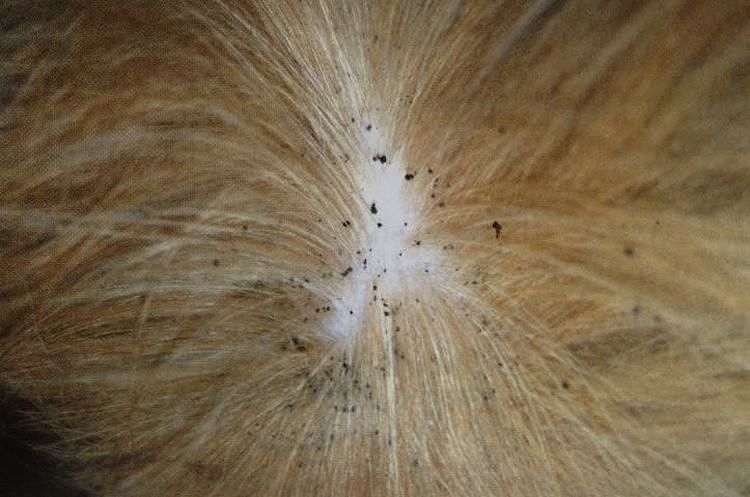
These parasites not only cause discomfort to pets but also pose a health risk to both the animal and its owners. They carry bacteria that cause dangerous diseases (infectious anemia, mycoplasmosis, anthrax, pulicosis, etc.). Fleas are also intermediate carriers for tapeworms: by biting a parasite, a cat can easily become infected with helminths. Therefore, if fleas are detected, it is necessary not only to exterminate the insects on the pet but also to thoroughly disinfect all areas.
Why fleas are dangerous not only for animals
-
Allergic flea dermatitis (AFD) – an immune reaction to flea saliva, expressed by itching, rashes and skin lesions.
-
Anemia – possible in kittens and weakened animals during mass infection.
-
Parasitic diseases– fleas are intermediate carriers of:
-
tapewormDipylidium caninum, found in cats and humans;
-
bacteriaBartonella henselae (cat scratch disease);
-
rickettsia, typhus, plague through rat fleas;
-
-
Bite people– itching and skin rashes in the owners are possible.
How to accurately diagnose an infection
Below is a table of diagnostic methods:
| Method | What are we looking for? | How to conduct |
|---|---|---|
| Inspection and combing | The fleas themselves (dark, jumping), eggs | Comb the wool on white paper or a towel. |
| Flea Dust | Black dots are excrement | We urinate - it becomes bright red (presence of blood) |
| Survey of the recreation area | Eggs and larvae on carpets and bedding | Inspection of bedding, under furniture |
Integrated extermination: home and pet
For complete cleaning, you need to act in two directions:
Apartment treatment
-
Vacuum furniture, carpets, and crevices daily for several days in a row, then weekly.
-
Wash floors with warm water and a mild detergent; alkaline solutions help break down cocoons.
-
Use sprays or powders withinsect growth inhibitors(IGR) - they block the development of larvae and pupae.
-
Wash bedding and linens at a temperature of ≥ 60 °C; vacuum and air out furniture.
Pet treatment
A combined approach is recommended:
-
Drops on the withers (permethrin/imidacloprid)- annual prevention and emergency therapy.
-
Long-lasting collars- suitable for environmental control.
-
Oral medications (spinosad, afoxolaner)- quickly destroy adult fleas.
-
Shampoos and sprays— are used in cases of massive infestation, but do not replace the main treatment.
Long-term prevention strategy
-
Treat your cat with medications seasonally - in spring and summer, more often when in contact with other animals.
-
Clean your home regularly, including under furniture, carpets and crevices.
-
Carry out pest control of the entrance, basement or balcony if the probability of parasite penetration is high.
-
Examine your pet every 2-3 weeks, especially after walks or if the number of pets is > 1.
-
Register the person feeding the stray cats in basements, if there are any, and treat the entrance with IGR products.
Read also:



Add a comment