
Oriental Shorthair cat
Without exaggeration, Orientals can be called some of the most graceful, refined, and unusual representatives of the feline world. Their apparent fragility is harmoniously combined with well-developed muscles and boundless energy. The character of representatives of the Oriental group deserves special mention: they are the most talkative, affectionate, and sociable cats with dog-like habits. These cats are popularly called "orientals" or "Georgian-like cats."
Content
History of the breed's origin
Oriental cat has many similarities with the Siamese breed. Their ancestors, like those of the Siamese, arrived in England from Thailand in the late 19th century. The 11th edition of the Encyclopedia Britannica contains information about colored Siamese cats, which were not recognized as a separate breed. This issue was the subject of constant debate and discussion until 1923, when the British Siamese Club decided not to encourage the breeding of other varieties of the breed, except for blue-eyed cats with Himalayan markings. Green-eyed cats with solid markings were excluded from the class, and breeding efforts were suspended. The Orientals were largely forgotten until the mid-20th century. In the 1950s and 1960s, British breeders decided to revive the Oriental-type cat breed with non-pointed markings. Thus began a new era in the breed's history.
The first Orientals began appearing in America in the mid-1950s. In 1958, a preliminary standard was adopted for Orientals in several colors (chestnut, lavender, white, black, and red), and in 1964, the breed received championship status. Bicolor cats were recognized later, in 1995.
The first representatives of the breed appeared in Russia in the late 1980s and quickly won the hearts of our compatriots. Thus, by the end of the 20th century, these former outsiders, unwelcome at shows, had become leaders, dictating fashion in the Eastern group.
Video review of the Oriental cat breed
Appearance and standards
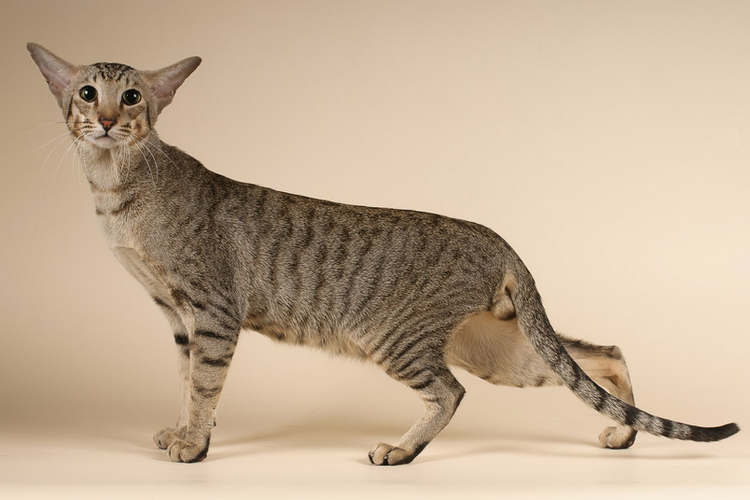
Oriental cats are elegant and very graceful, with well-developed muscles. Their entire appearance should convey activity and energy. Excess weight is strictly prohibited, but they should not appear thin either. They are medium-sized, with males typically larger and heavier than females. Females weigh 2.5-3.5 kg, and males up to 4.5 kg. An adult cat stands approximately 20-25 cm at the withers, and can reach a length of up to 90 cm.
Head and muzzle
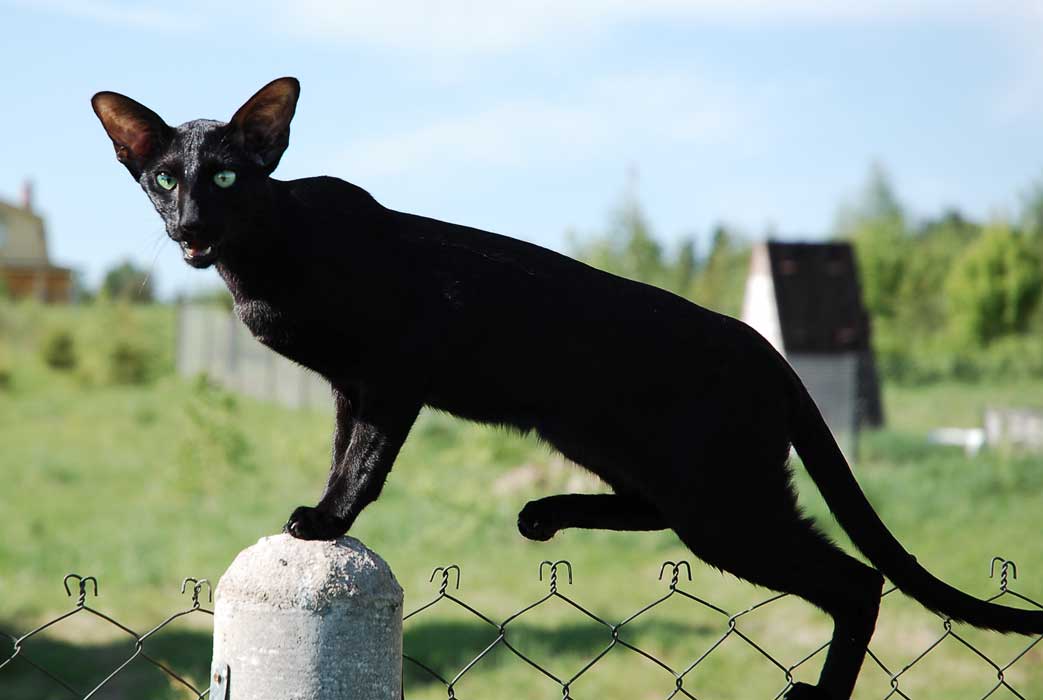
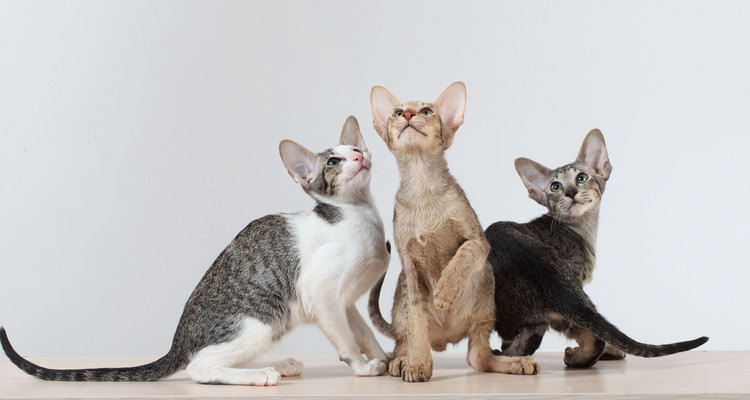
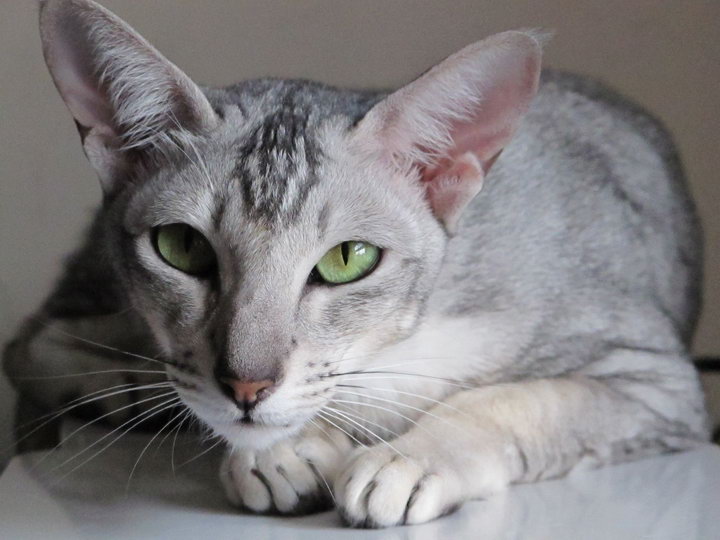
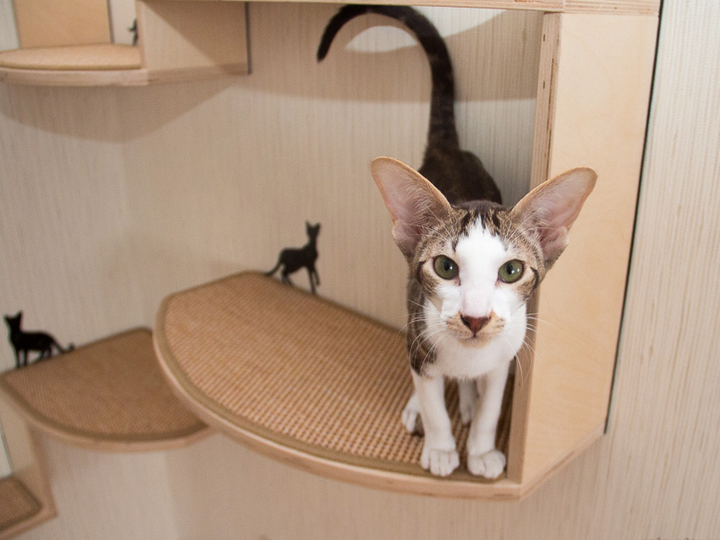
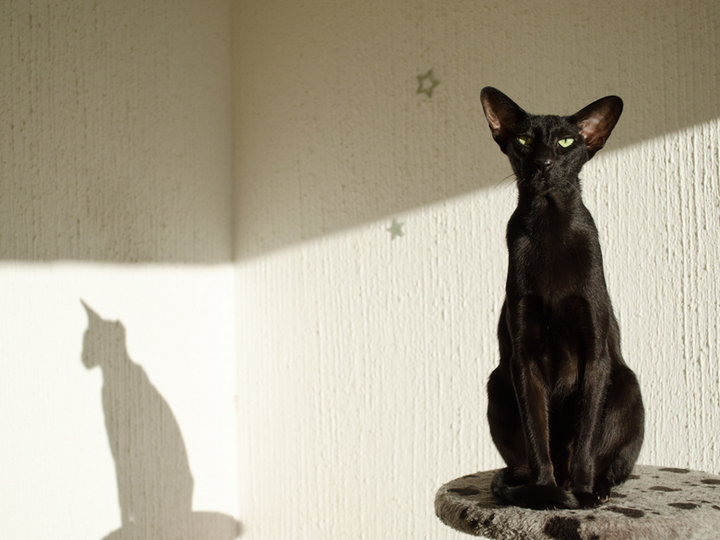
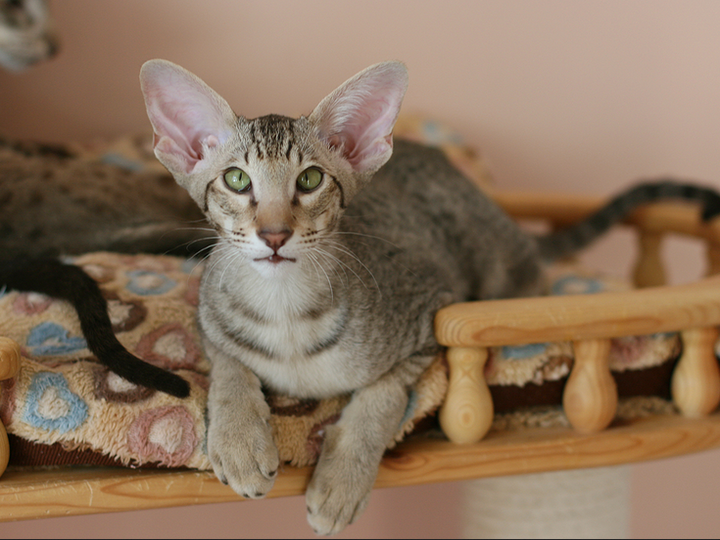
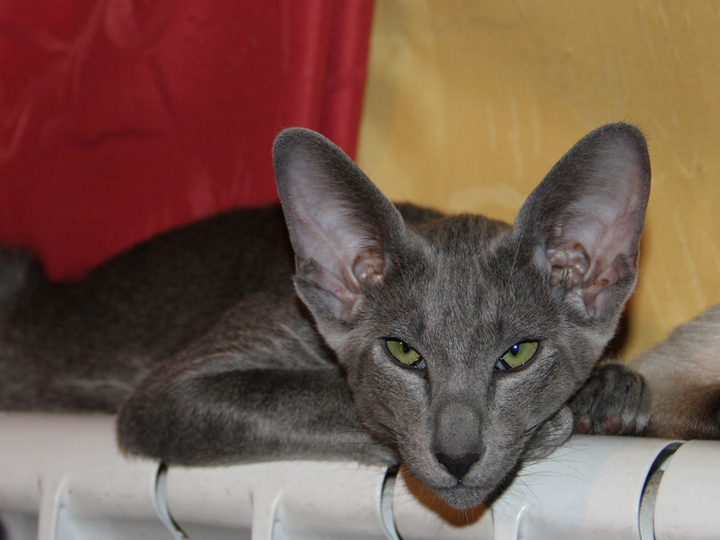
Oriental cats have a wedge-shaped head, a long, straight nose, and very large ears that are wide at the base and rounded at the tips. Their eyes are almond-shaped and set at an angle. Their coloring is predominantly green.
Physique
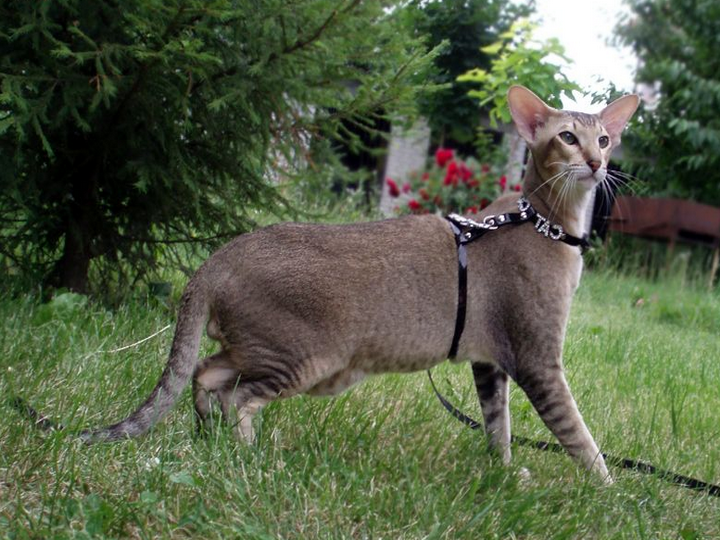
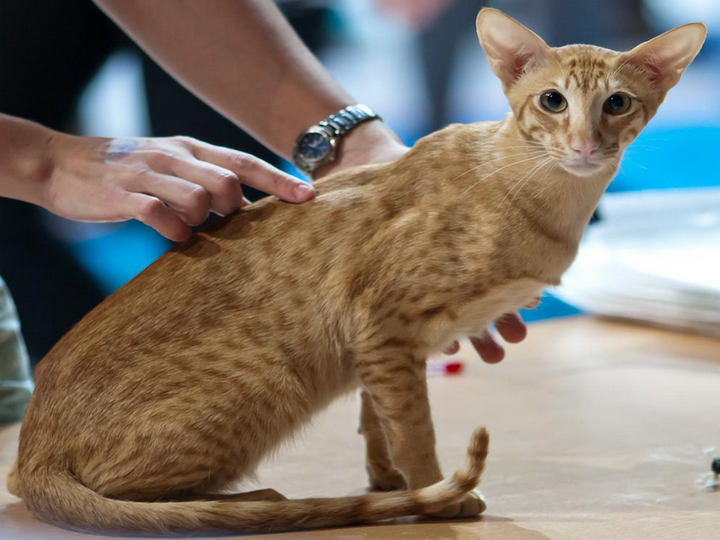
Representatives of the breed are distinguished by a long, muscular, tubular body with fine bones, gracefully set on long legs. The cats' hind legs are slightly longer than their front legs. The long tail tapers toward the tip.
Coat and colors
The Oriental Shorthair's coat is short, shiny, and fine. There is virtually no undercoat, and the outer coat lies flat and close to the body.
Oriental cats come in many colors. For convenience, the main shades are divided into several groups:
- Havana (dark chocolate);
- Lilac (lavender);
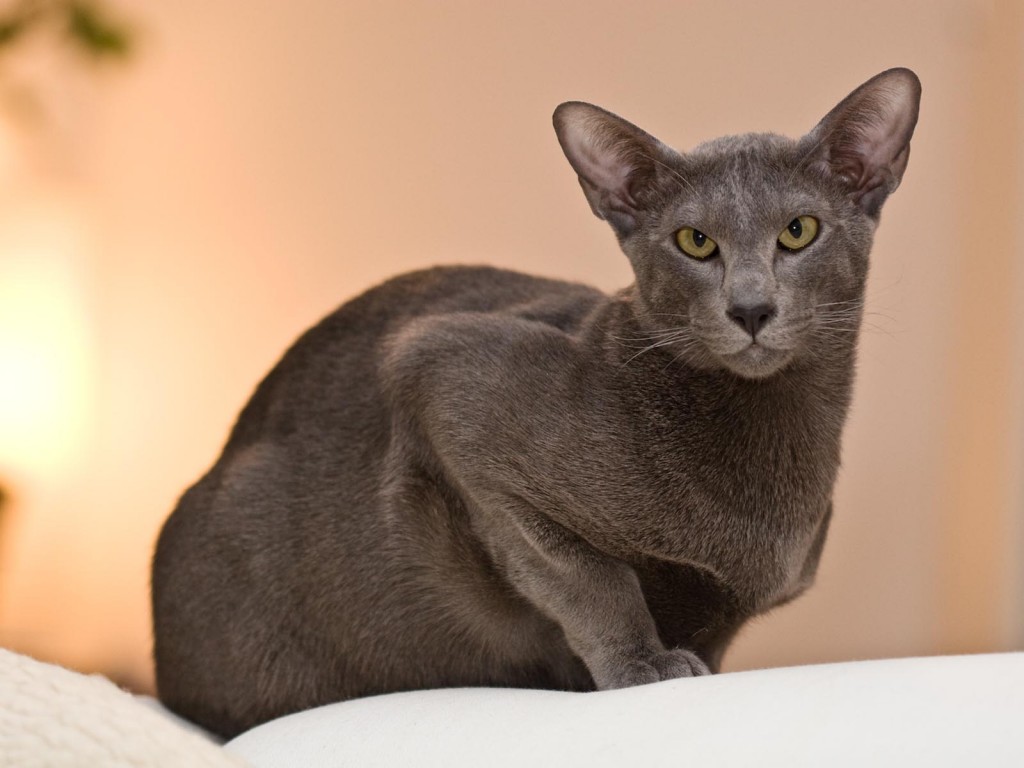
- Blue or gray;
- Cinnamon (the golden mean between chestnut and cream);
- Fawn (beige);
- Red (ginger);
- Cream (a soft pastel shade without dark tones);
- Ebony (black);
- White.
Most of these colors can be made into a pattern, of which there are also quite a lot:
- Solid (continuous uniform);
- Smoky (shaded);
- Tortoiseshell;
- Bicol;
- Tabby (marble, mackerel, ticked, spotted, silver).
Oriental Longhair Cats: New Breed or Recognized Variety?
Longhaired kittens sometimes appear in Oriental litters. Some breeders decided to work with them separately and create a new breed. This subsequently led to confusion, controversy, and disagreement.
Feline organizations have different names and recognitions for this variety. For TISA, they are called longhaired oriental cats. FIFE and CFA recognize them as a separate breed under the name JavaneseMany American organizations (CFA, ACFA, CFF) refer to them as Balinese with non-traditional coloring.
Oriental Siamese cat
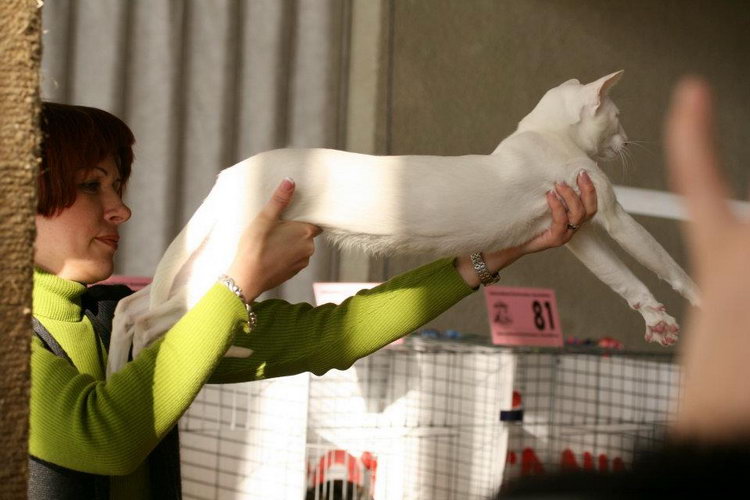
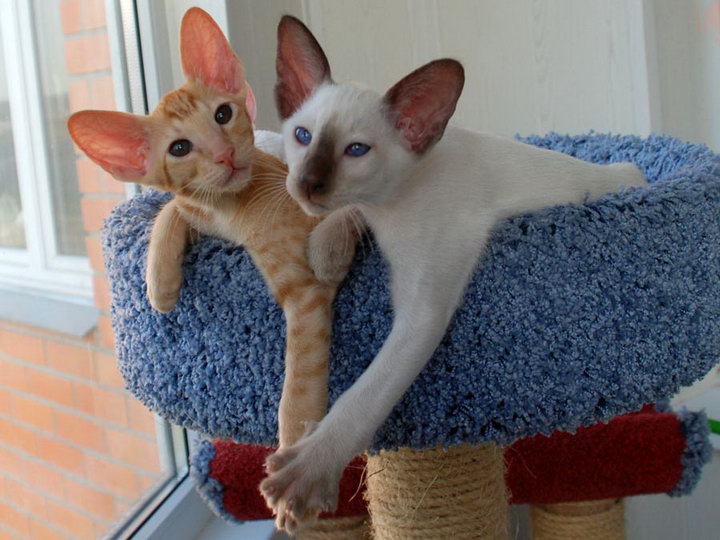
There's a common misconception that the Oriental cat is the same as the Siamese cat, with slight differences in eye color and coat color, and isn't considered a separate breed at all. This was previously the case, and Oriental cats with a Siamese coat were not recognized as a separate breed by feline organizations. They were not allowed to compete in shows, as they were considered a fault of the Siamese breed. As is well known, Siamese cats have strict breed standards. Eye colors other than blue and colors other than chocolate, red, and cream colorpoints are not allowed.
The Oriental Siamese cat has a solid coat of varying shades and green eyes. In all other respects, these breeds are identical. It's no wonder the Oriental Siamese cat breed has been around for so long.
Character
The unique, inimitable character of Oriental cats deserves special attention. They are quick-witted, intelligent, affectionate, and very attached to their family, curious and playful. Their interest in various activities persists into old age. Orientals love being the center of attention, and can even be somewhat stubborn. Possessing boundless energy, they will participate in any household chores, whether cleaning or washing dishes. One thing they struggle with is loneliness; Orikis become very bored when left alone for long periods, and if a cat is neglected by their family, its personality changes for the worse.
To ensure that all positive qualities are fully expressed, it is important that the kitten does not experience a lack of communication and love from birth.
Oriental cats are easygoing and trusting. They typically form strong bonds with one person. They are tolerant of small children and calmly accept their affections. They are highly intelligent, easily trained, and enjoy intellectual games and fetching. They are also very emotional and talkative. These qualities are especially important for those who prefer silence. Oriental cats will talk at all times and in all places, vocalizing many of their actions, and can vary the tone and pitch of their sounds to express different feelings and needs.
When acquiring a cat, you need to be prepared for a variety of experiences in your life together, both positive and negative, and remember that a healthy relationship is based on love and mutual understanding.
Content
Keeping Oriental cats doesn't require any experience or special knowledge. Simply provide them with the necessary pet items and give them some attention. Oriental cats tolerate a lack of outdoor exercise and living indoors without any problems. Given their high activity levels, it's recommended to provide them with play structures and a variety of toys to choose from.
Oriental breeds are very sociable and generally get along well with other pets. However, they sometimes try to assume a dominant position, most often with males.
Care
Due to the lack of an undercoat, shorthaired Oriental cats don't require special grooming. During shedding season, weekly brushing with a special rubber mitten or a natural bristle brush is sufficient. Orientals are very clean cats and don't require regular bathing. Therefore, the owner's primary responsibility is to keep their eyes, ears, and mouth clean.
Nutrition
Proper feeding is an important component of Orik care. As for the type of diet, the choice is up to the owner. Both natural and super-premium prepared foods are acceptable. In the former case, the diet consists primarily of meat products:
- beef;
- bird;
- rabbit meat.
Fermented milk products (low-fat sour cream, cottage cheese, kefir), eggs, and vegetables are also included. Meat can be lightly boiled or only frozen.
Breeders recommend feeding Orientals professional food that is fully balanced in nutrients and meets all their needs. Kitten food is used until the cat is one year old, and later, it's suitable for active adults. Fresh water should always be available near the food. Since Orientals are not prone to overeating, food can be offered in unlimited quantities. An automatic feeder is a convenient option.
The amount of food depends directly on the age and activity level of the pet. Adult animals should be fed twice a day. Little kittens should be fed 5 times a day in small portions. The food should be warm, as close to the temperature of breast milk as possible.
Health
Because Oriental cats are closely related to the Siamese, they are prone to similar health problems. A genetic predisposition to hepatic amyloidosis and cardiomyopathy has been noted. There is also a high risk of developing dental diseases and upper respiratory diseases, particularly asthma. To prevent illness, it is recommended to regularly take your pet to the veterinarian for preventive examinations. Proper care and feeding are equally important for their health. How long do Oriental cats live? The average lifespan is approximately 13-14 years.
Choosing a kitten and the price of an oriental cat
Oriental cats are quite common and are often bred alongside Siamese, so finding a breeder nearby shouldn't be difficult. If the cat's breed isn't important, but a physical resemblance is sufficient, you can look for a kitten at a pet market or online, but no one can guarantee its health or personality.
First, you need to decide what you want to do with a kitten. Do you want a pet or a breeding stock? Purchasing a kitten for family or children requires subsequent spaying or neutering. Breeders usually provide a pedigree only after the procedure is confirmed.
Some clubs allow cross-breeding of Siamese and Oriental cats, which can result in a litter of different breeds.
Kittens or adult animals with potential for breeding will cost significantly more. It's important that they are of good type and bloodline. You'll be lucky to find a kitten with an extreme type: low-set ears, a long muzzle, fine bone structure, a straight profile, and extremely short, flat coat. This is precisely the type that modern breeding is aimed at achieving.
The average price for Oriental cats ranges from 15,000 to 50,000 rubles. Each breeder sets their own kitten prices based on personal considerations, supply and demand, and the quality of their breeding stock. High-bred animals with rare colors can cost up to $1,000 or more, while kittens with defects or animals withdrawn from breeding are sometimes sold for a minimum price.
Reviews
When you have an Oriental cat in front of you, reviews are basically unnecessary—it's obvious how beautiful she is. But why not share reviews from other people who love Oriental cats as much as I do? So, let's get started!
Alla. Moscow.
I've had my eye on an Oriental cat for a long time. Loving them is a special feeling, impossible to explain in words, just as it's impossible to explain why I chose an Oriental cat. For over six months, I read reviews about the Oriental cat breed, researched all sorts of information, and finally made my decision. My husband and I finally got an Oriental. As soon as I saw this little girl, I knew she was mine. I don't want any other cat. You should have seen her eyes, so striking and expressive—the eyes of my little one.
Mrs. T. Russia.
We lived and lived, without a care in the world, and the children wanted a kitten. They wanted it so much that I wanted it too.
I kept an eye on the British Shorthairs and my husband, to see how he'd react. He finally agreed, but only for a purebred. So we started looking and searching. One that wouldn't shed, and would be with us, not wandering off on its own. My husband was still skeptical—yeah, those don't exist.
Then I happened to see a video on YouTube about an oriental cat named Dandy. I showed it to my husband, and he immediately said, "I need to get an oriental cat."
So we took her. So much grace, so incredibly affectionate, such big ears. Basically, we fell in love with the panther; she's never boring, but she just can't live without me. She truly loves me.
There are many reviews about Oriental cats, and most of them are positive. We've chosen these reviews because they're clearly heartfelt. If you own an Oriental cat, please share your story of friendship with your pet in the comments, and we'll be sure to publish it.
Breeding oriental cats
Breeding cats is interesting, but far from easy as it might seem. On the one hand, it seems like there's no problem—find an Oriental male to mate with and off you go. Or, conversely, find a suitable female for the male. In principle, this is true: for amateur breeding of Orientals, basic knowledge is sufficient:
- feeding rules;
- care features;
- preparation for childbirth and so on.
But breeding to meet the breed standard requires a slightly different approach. Here, minimal knowledge is no longer sufficient; you'll need:
- understand the nuances of breeding;
- take into account the characteristics of the breed;
- delve deeper into the issue;
- learn the subtleties.
Estrus
The Oriental cat's heat cycle is the same as that of other felines. Breeders recommend mating once a year, or more frequently, but it's best to maintain a period of at least six months.
On the other hand, the needs of the female pet should be considered. If the female cat begins to show signs of sexual activity while nursing her kittens, it's best to breed her. Otherwise, complications and potential health problems cannot be avoided.
Knitting
Mating an Oriental cat is a responsible process. The owner will have to:
- try to choose the right partner;
- calculate the optimal mating time;
- establish an appropriate atmosphere.
If the goal of the mating is to produce high-quality show-quality offspring, the partner must be suitable. However, even if the oriental male and female are perfectly compatible, there is no 100% guarantee of producing show-quality kittens in the litter.
Professional Oriental breeders sense an animal's potential from an early age and can immediately tell which animals have potential for further breeding, and which are destined for the pleasant fate of being a pet.
Pregnancy
If the mating process went smoothly, the next stage is the Oriental cat's pregnancy. This period lasts for 58-70 days. No special care is required for a pregnant cat.
The expectant mother needs to feed her growing litter, so her pet's diet needs to be increased. It's a good idea to buy food designed for pregnant cats. It contains more beneficial minerals and vitamins that the kittens need.
Childbirth
At the end of the seventh week, begin preparing for the birth. Choose a place for the cat to give birth and care for her kittens. It goes without saying that this should be a dry, warm, and draft-free area. The birth process for an Oriental cat is similar to that of most other cats. Before giving birth, the cat may lie down, or she may pace and meow incessantly. This depends on the individual characteristics of the Oriental cat. On average, the birth process itself takes up to six hours.
Photos
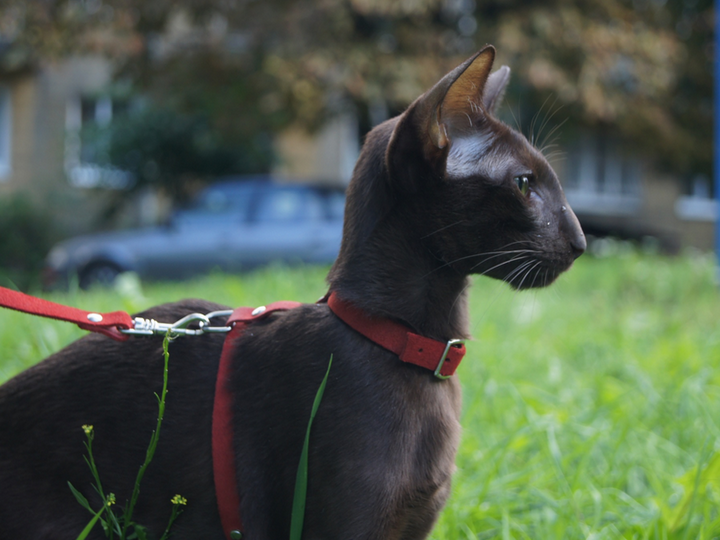
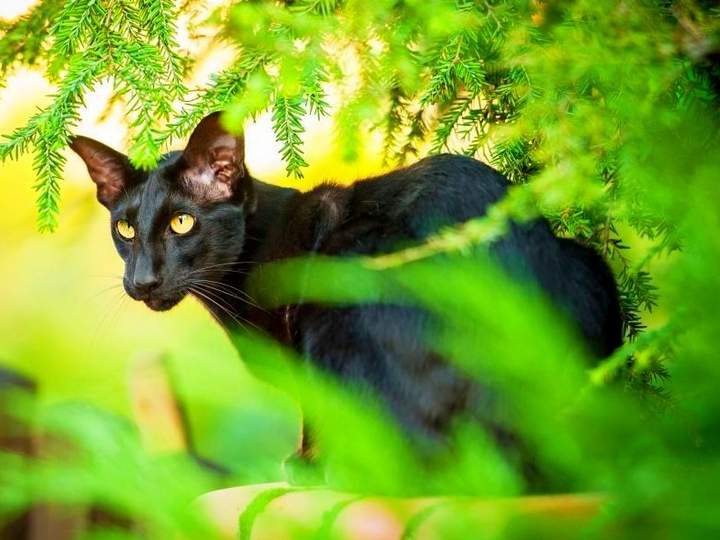
Photos of kittens and adult cats of the Oriental breed:
Read also:


-550x418.jpg)


Add a comment