
Opisthorchiasis in cats
Opisthorchiasis in cats is a fairly serious disease, most often caused by eating raw fish. Some pet owners believe that feeding their pets raw fish is very beneficial. On the one hand, uncooked fish is rich in vitamins and minerals, including phosphorus, which is essential for bones and teeth. However, raw meat always carries a risk of parasitic or even infectious infection. Today, we'll discuss an infestation called opisthorchiasis in cats.
Content
The causative agent of opisthorchiasis
A parasite, or more accurately, a flatworm. It's better known as a fluke. Adults are small, ranging from half a centimeter to 2 cm in length and only 1-4 mm in width. Their eggs, however, are dozens of times smaller than a millimeter (no more than 0.1 mm). Trematodes infect the liver, bile ducts, and pancreas.
The development cycle of the pathogen
The cycle is only seemingly complex. And that's only because it involves two intermediate hosts: a snail and a fish. It all begins with the helminth eggs, excreted in the feces, necessarily entering the water. Without water, the development cycle cannot occur. In the water, the eggs are ingested by snails, where they develop and reproduce. This stage is called cercariae. From the snail, they are released back into the water, and then ingested by a fish (usually a member of the carp family).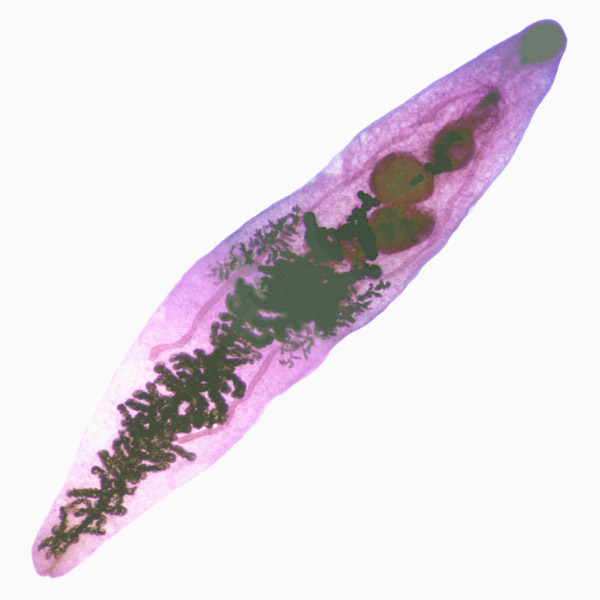
To reach the next stage, the raw fish must be consumed by a human or other predatory mammal (dog, cat, fox, or other fur-bearing animal). This is where the helminth matures. In the stomach, the metacercariae capsule dissolves, and from the duodenum, the larvae penetrate the gallbladder, from where they enter the ducts. Typically, about a month passes before the larvae begin to reproduce inside the host. The infected pet (or person) then sheds eggs in their feces, which can infect other susceptible predators.
Symptoms
The disease has several forms. Symptoms of opisthorchiasis in cats vary from case to case. In the latent form, which is often found in regions where most animals or people are infected, only a slight fever and eosinophilia are observed (a blood test will reveal this).
- In the acute form of opisthorchiasis, a cat's temperature rises to 39°C (102.5°F), sometimes even higher, and lasts from one to three weeks. In addition to the fever, severe pain is recorded in the hypochondrium (the right side, where the liver is located).
- In chronic cases, symptoms of inflammation in the liver and pancreas are observed. The sick animal experiences abdominal pain (in the upper part, although predominantly in the right half due to the location of the liver) and nausea. Since the liver has become inflamed (developed hepatitis), it cannot perform its functions normally.
Therefore, fatty foods are not digested at all after the cat eats them. may vomit, even with bileThis causes a bitter taste in the mouth, making you constantly thirsty, but your mouth still feels dry. Jaundice can develop in severe cases of infestation. Over time, depression develops, leading to complete apathy towards life.
If the parasites become so numerous that they clog the bile ducts, not only does jaundice develop (the mucous membranes and skin take on a yellow tint, and the sclera of the eye also reacts to bilirubin, which is significantly higher than normal in the blood), but abscesses (encapsulated purulent areas) also develop in the liver, which can then lead to necrosis (tissue death). Finally, there's biliary peritonitis. In this case, bile from ruptured ducts spills into the abdominal cavity. Treatment is ineffective. Death is painful and slow.
The easiest way to diagnose opisthorchiasis is a blood test. In parasitic infections, eosinophils are elevated above normal. Chronic opisthorchiasis is often diagnosed.
In addition to the symptoms listed above, frequent/loose stools, severe gas, and heartburn are also observed. Appetite almost completely disappears. Bronchial asthma may sometimes develop. Tremors of the eyelids, tongue, and limbs may occur, and sleep may become disturbed (restless, intermittent) – all of which indicate damage to the nervous system.
An allergic reaction is also a common symptom of opisthorchiasis. A rash appears on the skin—we usually call it hives.
How can you become infected with opisthorchiasis?
It's already clear that the primary way to become infected with opisthorchiasis is by eating raw, infected fish. But there's another, indirect way. Someone cuts an unsterilized fish carcass with a knife on a cutting board, and then uses the same cutting board (unwashed or poorly cleaned of muscle fibers) to cut fruit, bread, or meat, which they then eat. Helminth larvae remain on these foods.
Can a person become infected with opisthorchiasis from a cat? Although opisthorchiasis in cats is classified as a zoonotic disease, it is You cannot get the disease directly from your pet.In order for the parasite to develop, it needs water, a snail, and a fish.
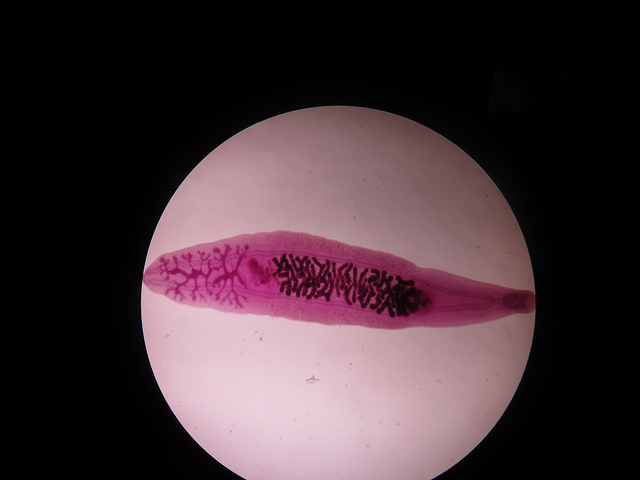
This is what this nasty thing looks like under a microscope:
Treatment
Treatment of opisthorchiasis in cats should always be comprehensive, that is, aimed not only at eliminating the underlying cause of the disease, but also at other symptoms.
- Praziquantel is a powerful anthelmintic. While this active ingredient is lethal to many parasites, it causes muscle paralysis in flukes. This prevents the fluke from remaining in the animal's body.
However, the dosage should only be prescribed by a veterinarian (or, in the case of humans, by the attending physician). Exceeding the dosage can further damage the liver or even cause a serious allergic reaction. Furthermore, there are numerous side effects and contraindications. Therefore, be sure to consult with your doctor.
- Antihistamines to relieve allergic reactions.
- Anti-inflammatory drugs to relieve inflammation of the liver, bile ducts, pancreas and other affected organs.
- Detoxification medications. Toxins are produced during the parasites' life cycle. If these poisons are not eliminated, internal organs will suffer greatly.
- Medications that help cleanse the intestines. This is necessary both to reduce the amount of toxins so they don't have time to be absorbed in the small intestine and to speed up the elimination of parasites from the body.
- Diet is essential. No fatty foods! At all! Only light, easily digestible, and nutritious foods. Be kind to your sick pet's inflamed liver and pancreas.
- Antispasmodics. They will reduce pain and relieve spasms. Your pet will feel much better.
- Probiotics. Remember, you've been "cleaning" your pet's intestines, so it's important to restore their intestinal microflora to ensure proper digestion. Without beneficial microorganisms, dysbiosis will set in. This will lead to further bloating, flatulence, abdominal pain, constipation, or even diarrhea.
- Choleretic medications. This will help clear the bile ducts more quickly and restore some liver function.
- Enzymes. These will help your pet better digest the food they receive.
All medications, their dosages, frequency, and duration of treatment are prescribed exclusively by a veterinarian after a definitive diagnosis has been made! Self-medication is prohibited!
Prevention of opisthorchiasis
To prevent opistarchosis in cats, you need to follow a few simple rules:
- Never feed animals (and do not eat yourself) raw, unsterilized fish.No matter how much they swear the fish is parasite-free, don't believe it. It only takes one fluke to cause infection.
- Disinfect fish by deep freezing. 7 hours at -40°C (the temperature the fish should be inside) or 32 hours at -28°C. But here's the problem. Our regular freezer rarely drops below 12°C, and in exceptional cases, it can reach -18°C. But it certainly won't drop to -28°C, and it certainly won't drop to -40°C. Therefore, simply freezing the fish in your freezer won't disinfect it. It's better to boil it. And boil it for at least 20 minutes, not just 5! It's a long time, but what can you do? Your health is more important.
- SaltingThe solution must be very strong (1.20 grams per liter of water). The fish should be kept at 2 degrees Celsius for 10 days (if the fish is small), but this period can be up to 40 days for larger fish.
- Set aside a separate board for cutting and cutting fish., which can be easily disinfected (in boiling water). Wash the knife thoroughly, paying particular attention to the area around the handle, where food debris often gets stuck. However, knives should never be washed in boiling water, as this will quickly dull them. Do not cut anything else on the cutting board. Wash it thoroughly after each fish.
Any questions? You can ask our website's staff veterinarian in the comments below, who will answer them as quickly as possible.
Read also:
- Liver cirrhosis in cats
- Cholangitis in cats: treatment and symptoms
- Hepatopathy in cats: symptoms and treatment


3 comments
Victoria
Good evening! My cat sometimes breathes with his tongue hanging out a little, but he's eating. His eyes are squinting, his nose is warm and dry, and the fur on his bottom and leg is a little matted. His nose and paw are scratched. Could you please tell me what this could be and how to help him? Thank you for your reply!
Daria is a veterinarian
Hello! Your cat needs a heart check. Check his temperature. How are his vaccinations and dewormings? Is he indoor-only or does he roam freely? Does this breathing occur after physical activity or stress? Does it occur more often in the evenings? Maybe after certain meals? Does he have a runny nose? We need to determine whether he's breathing this way because of a nasal obstruction or because he's short of air, breathing through his mouth as if short of breath. What's his age? Breed? Diet? Weight? More information about his life and medical history is needed before we can even speculate.
Daniyar
Hello, please tell me which drug is best for treating a cat from
insurance
Add a comment