
Onsior for dogs
Onsior is a nonsteroidal antihazard drug. It is prescribed to dogs for the relief of inflammation and pain, particularly in the postoperative period and for bone and joint conditions. Based on its effects on the body, Onsior is classified as a Class 3 substance (moderately hazardous). It is manufactured by Elanco, a division of the international pharmaceutical corporation Eli Lilly and Company.
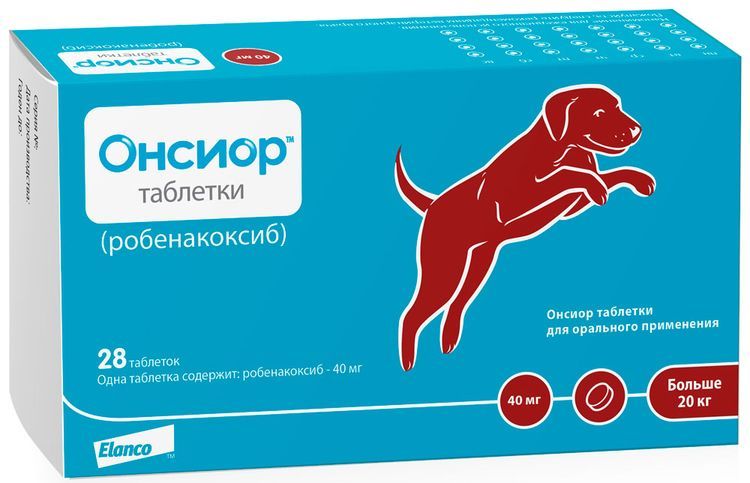
Composition and release forms
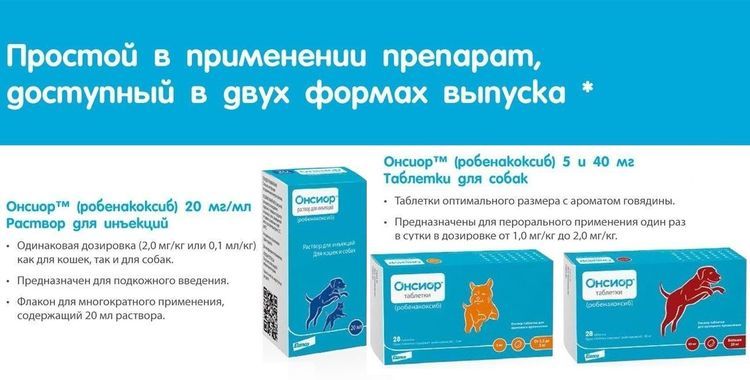
The drug's active ingredient is Robenacoxib. Its anti-inflammatory and analgesic effects are based on the inhibition of cyclooxygenase, an enzyme involved in nerve impulse transmission. Robenacoxib rapidly enters the bloodstream, and its metabolic products are excreted in bile and urine. Onsior is available as tablets and injection solutions.
Onsior tablets are round, beige or light brown, and contain 5, 10, 20, and 40 mg of the active ingredient. They also contain:
- yeast,
- fillers cellulose and magnesium stearate,
- stabilizer povidone,
- enterosorbent silicon dioxide,
- flavoring identical to natural meat.
Packaging: 1, 2, 5, or 10 tablets in foil blisters placed in cardboard boxes. The shelf life of the drug is 4 years.
The injection solution contains 20 mg of Robenacoxib per 1 ml. Excipients: absolute ethyl alcohol, sodium hydroxide, macrogol, and antioxidant E330. Packaging: 20 ml glass vials with rubber stoppers and aluminum caps.
Onsior for dogs is available over-the-counter at veterinary pharmacies or online. A 28-tablet pack containing 5 mg of Robenacoxib starts at 1,050 rubles, while a 40 mg pack costs between 2,200 and 2,330 rubles. A bottle of Onsior injection costs approximately 2,700 rubles.
Rules of application
According to the instructions, Onsior tablets are used to treat arthrosis, arthritis, synovitis, and other conditions associated with inflammation and pain in dogs. The tablets are given whole, without breaking, half an hour before or half an hour after feeding. The dosage is calculated based on the dog's body weight: 1-2 mg/kg. The standard course of treatment is 7 days. The injection solution is administered at a rate of 1 ml per 10 kg of body weight.
According to veterinarian reviews, side effects of Onsior in dogs may include dyspepsia or vomiting, which resolve spontaneously upon discontinuing the medication, so no additional treatment is required. If hypersensitivity to the drug occurs, discontinue use, and symptomatic treatment is prescribed to relieve the allergy.
Absolute contraindications to the use of Onsior for dogs are:
- puppies are under 4 months old;
- the animal's weight is less than 2.5 kg;
- pregnancy and lactation period;
- state of dehydration;
- low blood pressure;
- the presence of serious pathologies of the cardiovascular system, kidneys or liver.
Onsior should not be administered to dogs in combination with other NSAIDs, diuretics, and antihypertensive medications (ACE inhibitors). These restrictions are due to the potential for increased toxicity when administered concurrently.
Analogues
In some cases, Onsior must be replaced with other medications. This may be due to the drug being unavailable in veterinary pharmacies or the inability to use it due to individual intolerance. Onsior's alternatives are mostly NSAIDs. The treating physician should select a suitable alternative, as these medications have different side effects and contraindications.
The following have an effect similar to Onsior:
- Ketoquin. The active ingredient is ketoprofen. It is available as 1% and 10% injection solutions, manufactured by NVC Agrovetzashchita, Russia. The price of the drug starts at 250 rubles.
- Flexoprofen. The active ingredient is ketoprofen. Available as 2.5% and 5% solutions for intravenous or intramuscular administration. Manufactured by the private company "VIK - Animal Health," Belarus. The price for 100 ml of 5% solution is 670 rubles.
- Ainil. The active ingredient is ketoprofen. Available as 1% and 10% injection solutions. Manufactured by Investa (Spain). A 100 ml bottle of 10% Ainil solution costs 1,238 rubles.
- Ketofen. The active ingredient is ketoprofen. It is available as a solution in 20 ml glass vials and as 5, 10, and 20 mg tablets. Manufactured by Merial, France. A bottle of ketofen costs 720 rubles, a pack of 20 mg tablets costs 870 rubles, and a pack of 5 mg tablets costs 420 rubles.
- Rimadyl. The active ingredient is carprofen. The medication is available as both injection solutions and tablets. It is manufactured by Zoetis, a pharmaceutical company in the USA. The medication costs approximately 500 rubles.
- Norocarp. The main ingredient is Carprofen. It comes in tablet form, containing 20 mg of the active ingredient, and is manufactured by the British company Norbrook. A 100-tablet package starts at 1,000 rubles.
- Trocoxil. The main component is Mavacoxib. Available in tablets with active ingredient concentrations of 6, 20, 30, 75, and 95 mg. Manufactured by the Italian subsidiary of the international corporation PFIZER. The price of the drug depends on the active ingredient content: a blister pack of two Trocosil tablets of 6 mg each costs 650 rubles, while 95 mg tablets cost 1,450 rubles.
- Loxicom. The main component is Meloxicam. It is available in two forms: oral suspension and injection solution. Manufacturers are Bayer (Germany) and Norbrook (UK). A 100 ml bottle of injection solution costs approximately 60 rubles, while a 15 ml bottle of suspension costs 500 rubles.
Reviews
Irina Valerievna Perminskaya, veterinarian:
"In my practice, I often prescribe NSAIDs to dogs for joint pain, injuries, and post-surgery. They quickly reduce inflammation, relieve pain, and lower body temperature. I consider Onsior one of the best because, compared to other medications of this type, it has the fewest contraindications and side effects. Allergic reactions to Onsior are rare, but I always closely monitor my patients for the first 1-2 days of treatment. This is especially true for dogs with light-colored coats or breeds prone to sensitization, such as Dalmatians, Bulldogs, Staffordshire Terriers, and Shar-Pei."
Svetlana Marinina, Samara:
"I used Onsior for my older dog, Charlie, who suffers from chronic arthritis. Within a few hours of the first dose, he felt noticeably better: he became more active, could move more freely, and even tried to play. There were no side effects. I administered Onsior concurrently with cartilage regeneration stimulants; the veterinarian said the medications were compatible."
Pavel Novikov, Rostov:
"My dog was prescribed Onsior tablets when she developed a fever. I gave it to her mixed with a small amount of kibble. The medication worked quickly, and her fever subsided, though she had some stomach upset for the first 24 hours. Since the fever was caused by a bacterial infection, she also had to be treated with antibiotics. But I believe the use of this nonsteroidal anti-inflammatory drug was entirely justified—without the high fever and pain, my dog's recovery was much easier and faster."
Read also:
- Hemostatic drugs for dogs when trimming their nails
- The best chondroprotectors for dogs
- Konakion for dogs



Add a comment