
Maine Coon cat colors
Just one look at a Maine Coon is enough to understand that a more striking cat breed simply doesn't exist. Nature has created a beautiful, large cat with a magnificent, enormous tail and lynx-like ear tufts. In addition to this striking appearance, they have a wonderfully affectionate temperament and a variety of colors to suit every taste.
If you visit a cat show or simply Google "Maine Coon colors," you'll be dazzled by the sheer variety. You'll find a snow-white cat, a bright red one, even a jet-black one, and many other incredible coat colors.
Content
Description of the main colors of Maine Coons
Each cat breed has a characteristic pattern, which is much more common than others and serves as the signature color of these animals. The most common Maine Coon patterns are probably the red marble tabby and black tabby. There are also some color variations that are not recognized by the breed standard and are therefore considered unacceptable. These include chocolate, lilac, colorpoint (Siamese), brown, and fawn (straw-colored) patterns.
All colors of Maine Coon cats can be divided into groups:
- Monochrome (solid or solid)
- Patterned (tabby)
- Tortoiseshells
- Smoky
- Colors with white
Solid colors
There are only five such colors. This group includes Maine Coons with the following coat colors: black, red, white, blue, and cream. Solid-colored cats should be uniformly colored from head to tail. The presence of spots or markings of a different color or shade is considered a fault. The breed standard requires a deep and rich coat color, with each hair intensely colored both at the base and along its entire length. Faults in solid-colored cats include: a lighter undercoat, the presence of hairs of a different color on the cat's body, and residual (shadow) patterns in the form of stripes or spots on the body or head.
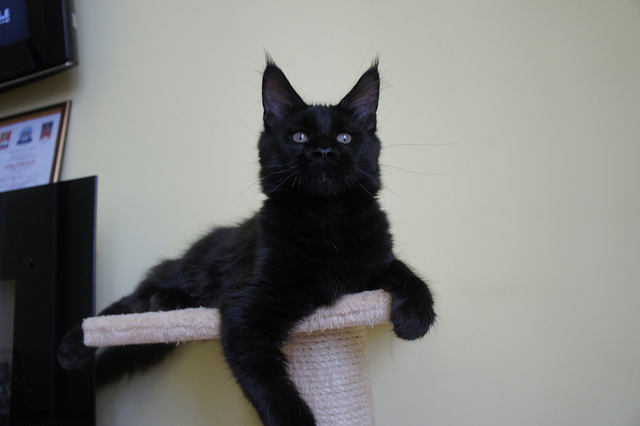
The black color of the Maine Coon breed is striking. The entire coat of these animals becomes smooth and heavy, giving the appearance of being parted in the middle. Black Maine Coons are difficult to prepare for shows because it's important to ensure that the "pants" and "collar" don't have a gray or brown cast. Black Maine Coons are typically bred in specialized catteries, where selection is made for animals whose coats are the least contaminated with white hairs. This is because in this breed, kittens born to genetically black parents can have a white spot on the groin or chest, which would make the animal appear bicolor.
Preparing a black Maine Coon's coat for a show is no easy task. It requires a comprehensive approach. Most often, owners of such pets face the problem of graying and browning of their fur. The secret to success lies in proper nutrition and frequent brushing, as the black coat changes color just before shedding, or if the pet has just finished shedding. Procedures such as bathing and brushing stimulate the removal of dead brownish hair and promote the growth of new gray fur, which over time will turn a jet black color.
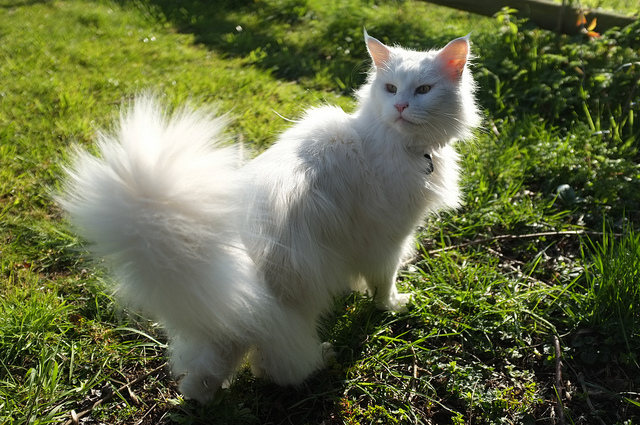
It's impossible to ignore a white Maine Coon. Especially since encountering one is extremely rare. However, this color often carries a risk of congenital deafness. For this reason, many feline organizations prohibit breeding two white cats. Although white Maine Coon kittens are very attractive, don't rush to buy one from an unknown breeder—you could fall victim to an unscrupulous breeder who is driven by profit at the expense of the animals' health.
White Maine Coon puppies may have faint markings on their faces, which fade with age. This coloring doesn't require much grooming; regular brushing and cleaning of the ears and eyes are sufficient.
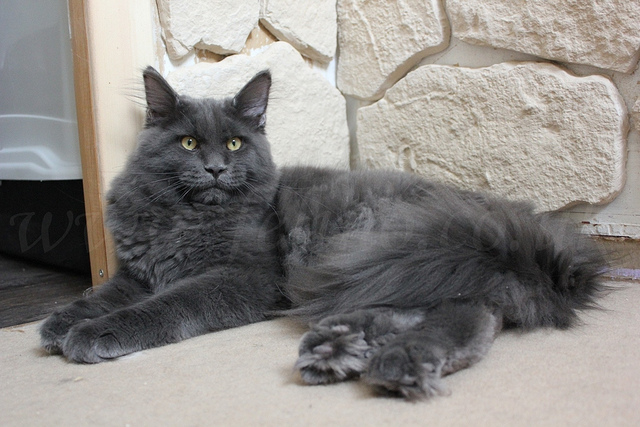
The blue coloring of this breed is still quite rare, but it is becoming more popular every day. In Europe, there's already a real boom in blue Maine Coons. These cats are very beautiful, with ash-gray fur tinged with blue. Because the genes responsible for the pattern in Maine Coons are very difficult to suppress, stripes and patterns may be slightly visible on their coats.
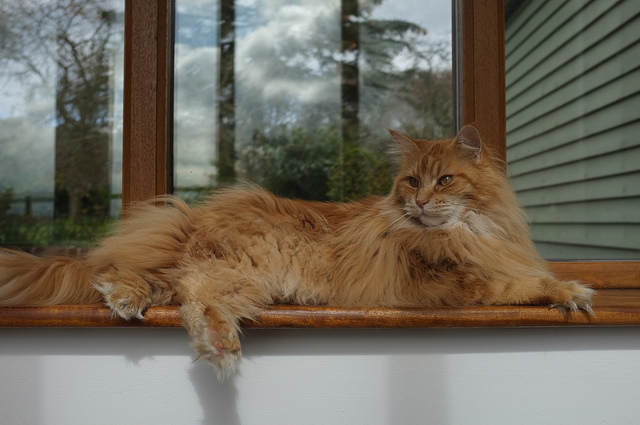
In everyday life, the red color is more commonly known as "red." The Maine Coon's coat is an intense red-orange. One of the nuances of this coloring is the difficulty of removing the pattern and achieving an even color distribution throughout the animal's coat. This is due to the strong tabby gene, which is virtually impossible to suppress in red Maine Coons. Therefore, the pattern is always present to a greater or lesser degree in the coat of red Maine Coons.
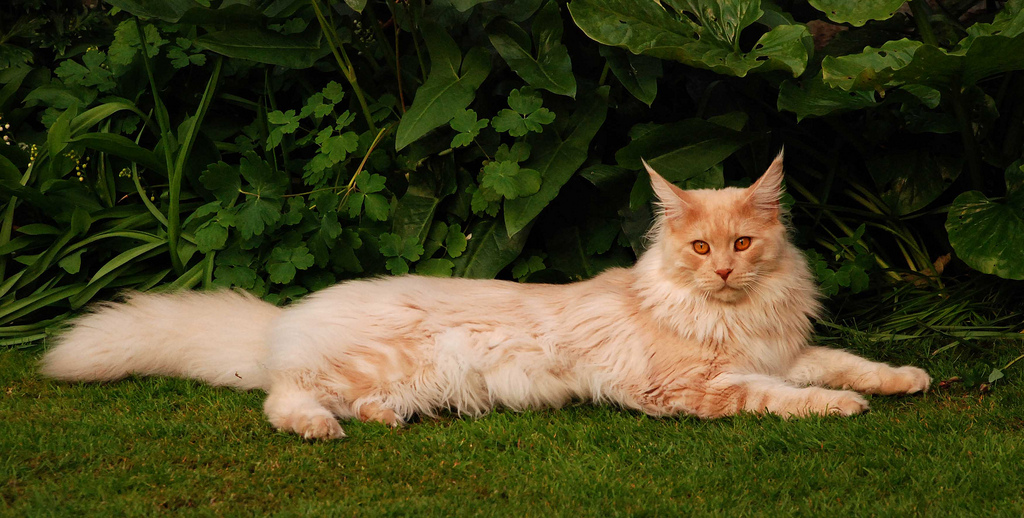
Cream is a lightened or washed-out red, characterized by a soft, warm ginger hue. Complete suppression of the genes responsible for the pattern is also impossible, so the blurred outlines of stripes or patterns will almost always be visible in cream-colored Maine Coons.
Patterned colors (tabby)
The rich variety of Maine Coon colors is the result of the extensive work of breeders and enthusiasts. However, nature has also gifted this cat breed with a beautiful pattern known as the classic tabby, which is the signature of these animals.
There are only three variations of tabby color in Maine Coon kittens and adult cats: tiger, marble and spotted.
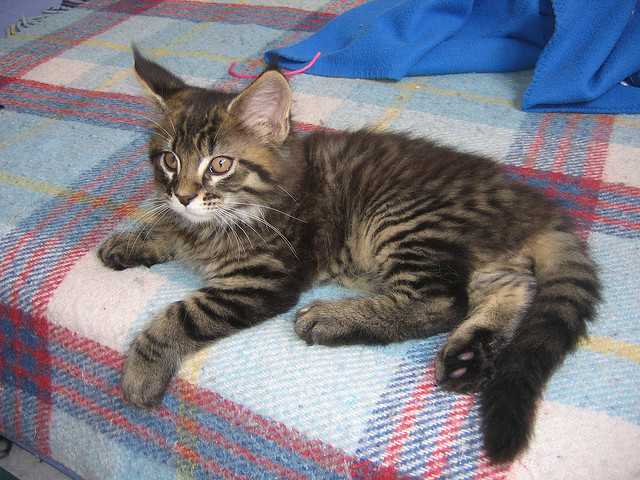
The brindle pattern is characterized by thin, non-intersecting vertical stripes running down the back. Each stripe should be distinct and unbroken. The belly is marked with spots. The paws and tail are also decorated with stripes or rings.
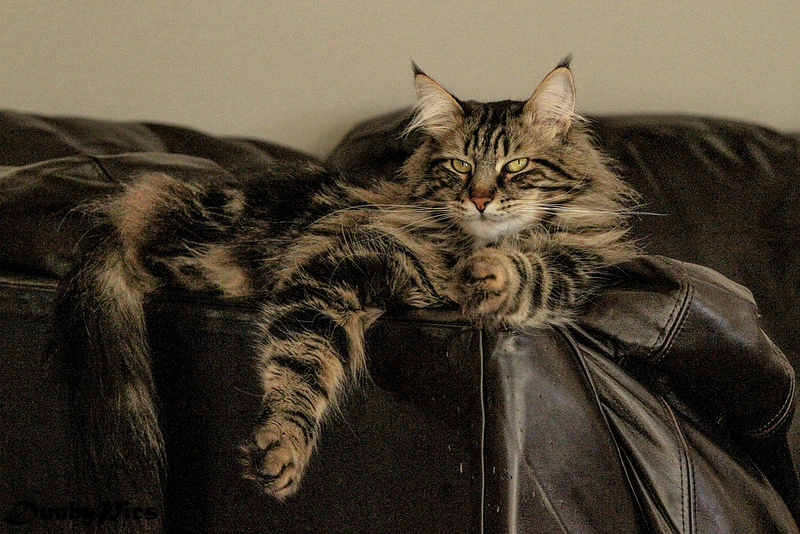
The marbled pattern is characterized by rings or semi-rings on each side, complemented by various smooth stripes. The overall appearance resembles marbled patterns. The contours should be well defined, with a dark spot within each ring. The more distinct and expressive these patterns are, the higher the Maine Coon's color is valued. Black marbled tabby is also called "wild" or "forest" coloring, as this is what the aboriginal cats that formed the breed looked like.
The distinctive feature of the Maine Coon cat's spotted coat is the small spots that decorate the animal's entire body. They resemble the broken stripes of this breed's tiger pattern.
All three tabby patterns share common features: an "M"-shaped marking on the forehead, and markings on the nose leather and around the eyes that match the markings. Several stripes run along the sides of the muzzle, the most prominent being the stripe running from the edge of the eye. There are also one or two decorative stripes on the neck and chest, like a necklace. Tabby Maine Coons can be black, blue, red, or cream. To determine the color of the tabby pattern, simply look at the color of the markings or the tip of the cat's tail.
Tortoiseshells
Maine Coon cats have two types of tortoiseshell coat: without white and with white patches.
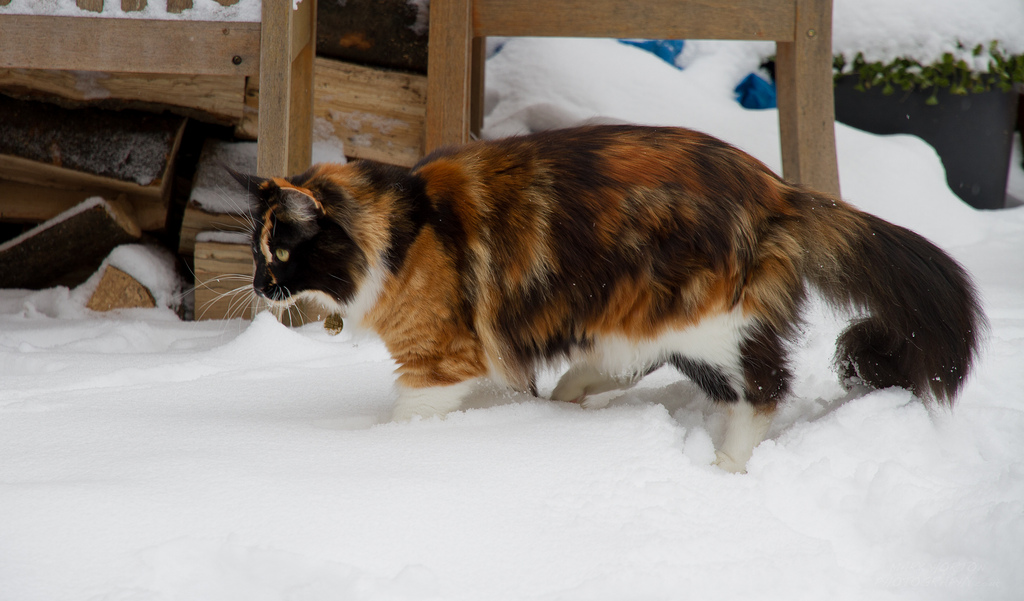
Among the variations without white, there is a color pattern that combines black, red, and cream—called tortie. These colors are evenly mixed throughout the animal's coat and can be more or less distinct.
The torbie coloring involves red and black or brown tabby segments on a mixed background. Moreover, two cats with the same coloring can look completely different.
Blue-cream appears as a diluted or lightened tortoiseshell. This color variation means the cat's coat has patches of blue and cream mixed together.
If we add to the previous color the presence of a pattern on the blue and cream areas, we get another variant called blue-cream tortoiseshell tabby.
Furthermore, each of these colors can have white added to it. In this case, the phrase "with white" is simply added to the color name. The white spots can be located in different places and occupy larger or smaller areas. Tortoiseshell Maine Coons with white always attract attention, as they seem like nothing special, yet they're hard to take your eyes off. There are also smoke and silver varieties of tortoiseshell Maine Coons.
Smoky and silver colors
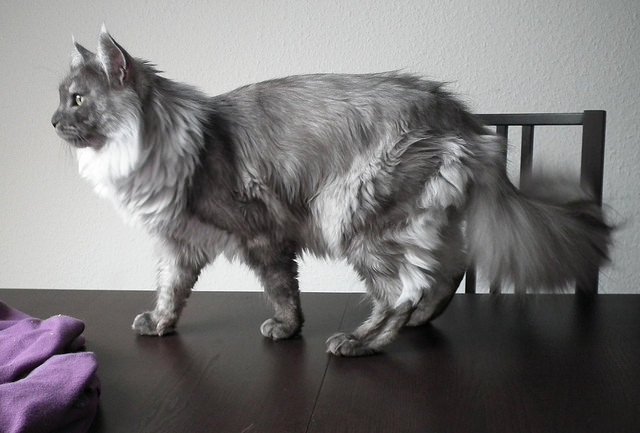
Very unusual coloring occurs when an animal's coat, regardless of the base color, is completely white at the roots. This type of coloring is divided into three types depending on the amount of white.
If the hair is colored only at the tip, covering only 1/8 of the base color, it is called chinchilla (shaded), 1/3 to 1/4 is shaded, and 1/2 is smoky. Owners of solid-colored cats are often mistaken when they see a grayish or lighter undercoat at the base, assuming it is a "smoky" color. In fact, a smoky cat's hair roots are perfectly white. Any color can be smoky; if it is a solid color, the word "smoky" is added to the base color, for example: black smoke or blue smoky. All animals with a tabby pattern and white base hair are silver, for example, a black silver tabby.
For animals belonging to the smoky or shaded group, red or cream color, it is customary to add "cameo" to the color name.
Smoke Maine Coons are striking in appearance; as the animal moves, their coloring reveals itself, shimmering and changing shades in an incredibly beautiful way. It's simply impossible to stop looking at these beauties.
Colors with white markings
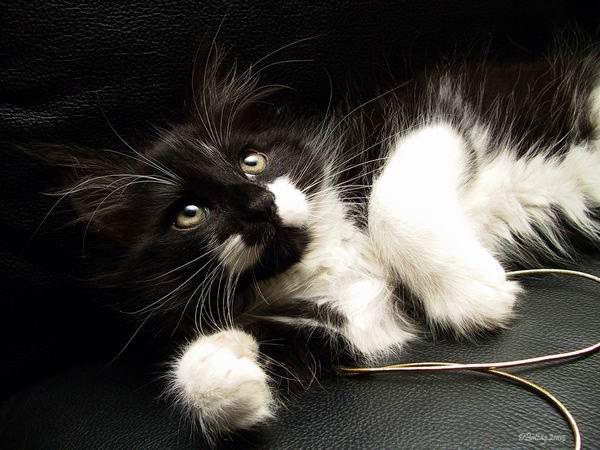
It's hard to even imagine the variety of colors that would arise if white were added to all the above. Depending on the amount of white in the animal's coat, there are several classifications:
- white medallion - a white spot on the chest
- white buttons - a few small spots
- white gloves - socks on the paws
- white tuxedo – white slippers and a bib
- bicolor - fifty percent white
- Harlequin - several spots of the main color are located on the body on a white background
- van - the main color is present only on the tail and head
Of course, the Maine Coon's exquisite appearance or rare coloring are far from its primary attributes. Their popularity is rightfully earned by their friendly and affectionate nature, high intelligence, and remarkable devotion to their families.
Read also:


Add a comment