
Merle color in dogs
Sometimes dogs develop a unique pattern known as merle or marbled. This pattern, while attractive, is prohibited in most breeds. This ban is due to the risk of puppies being born with serious developmental defects. In some breeds, marbling is a serious violation of the standard conformation and is grounds for disqualification from international competitions.
Content
Merle color - what does it mean?
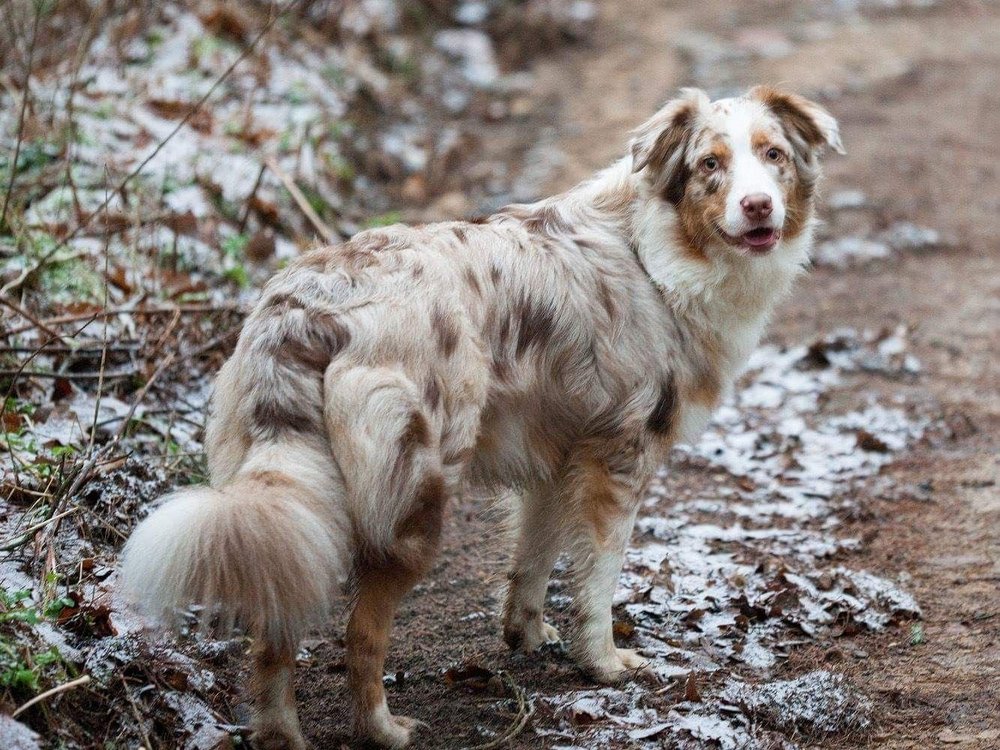
The exterior description always includes the coat color. Sometimes a dog exhibits a distinct marbled pattern, also known as merle, where random light-colored spots appear on a dark base coat. Symmetrical spots are much less common.
The marbled pattern can appear in the offspring of any dog, and it looks very attractive. However, in some breeds, this trait is an indicator of defects, significantly reducing the value of a puppy intended for further breeding. Marbling also often affects the iris, resulting in heterochromia, a condition in which the choroid of the eye is unevenly colored. Sometimes, breeds with merle markings have speckled or multicolored eyes.
How do dogs develop marbled coats?
The pattern appears as a result of a weakening of the base color, appearing as blurred spots. The beautiful pattern is caused by the presence of a gene (M) responsible for albinism, which blocks pigmentation in certain areas of the skin. This gene is dominant; if present in the DNA chain, the animal will inevitably have a marbled coloration.
Merle puppies are produced by mating merle-patterned puppies with tricolor puppies that lack the albinism gene in their DNA. As a result, half of the puppies are born with merle markings, while the other half are tricolor. However, breeding two merle parents is not advisable.
Twenty-five percent of their offspring exhibit a dominant albino gene—two M genes are present. Fifty percent have a single dominant gene, so the spotting is a recessive trait for them, causing no pathological consequences. However, if individuals with one gene are further crossed, a quarter of the offspring will again have developmental defects.
Why was merle banned?
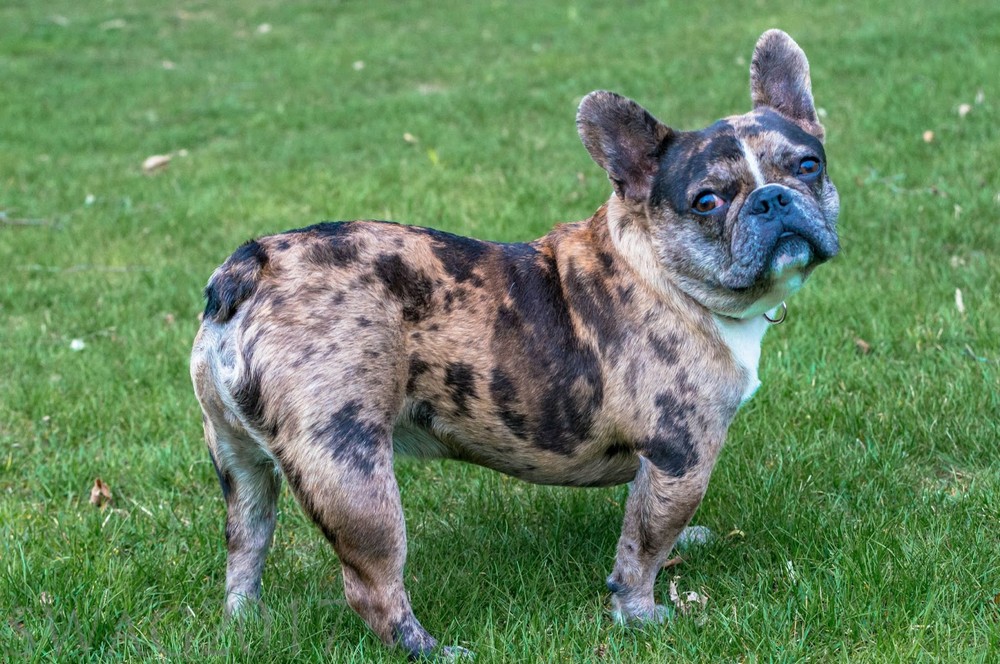
In addition to spotted coats, the gene causes a number of pathologies, of which heterochromia is one of the mildest forms. Animals with a marbled pattern, caused by a single dominant gene, often have flattened fundi, night blindness, cataracts, and complete or partial deafness. Those with two genes suffer from the most dangerous defects—the pathologies manifest in early childhood, and puppies often die in the womb.
Deafness is the most common problem, caused by a lack of pigment in the tiny hairs growing in the inner ear. If the nerve fibers around these hairs die, the animal becomes deaf within the first three weeks after birth. The onset of deafness later is unrelated to color.
Blindness, whether partial or total, is a congenital defect and is not treatable. A serrated pupil, where the black lumen of the eye has sharp ridges extending into the iris, may be present. In this case, the animal experiences increased sensitivity to light. A mild defect is corectopia, or lateral displacement of the pupil. Cataracts are common, but may not be visible and can lead to blindness in an adult dog.
What problems are typical for spotted puppies:
- diseases of the eyes, ears, atrophy of these organs;
- cardiovascular pathologies;
- infertility or low fertility;
- mental disorders, aggressive behavior.
In planned breeding programs, animals undergo special diagnostic testing to rule out the hidden inheritance factor of marbling—genetic analysis. In the case of unplanned mating of individuals with spotted coats, it is necessary to exclude the possibility of crossbreeding between individuals from the same litter.
What types are there?
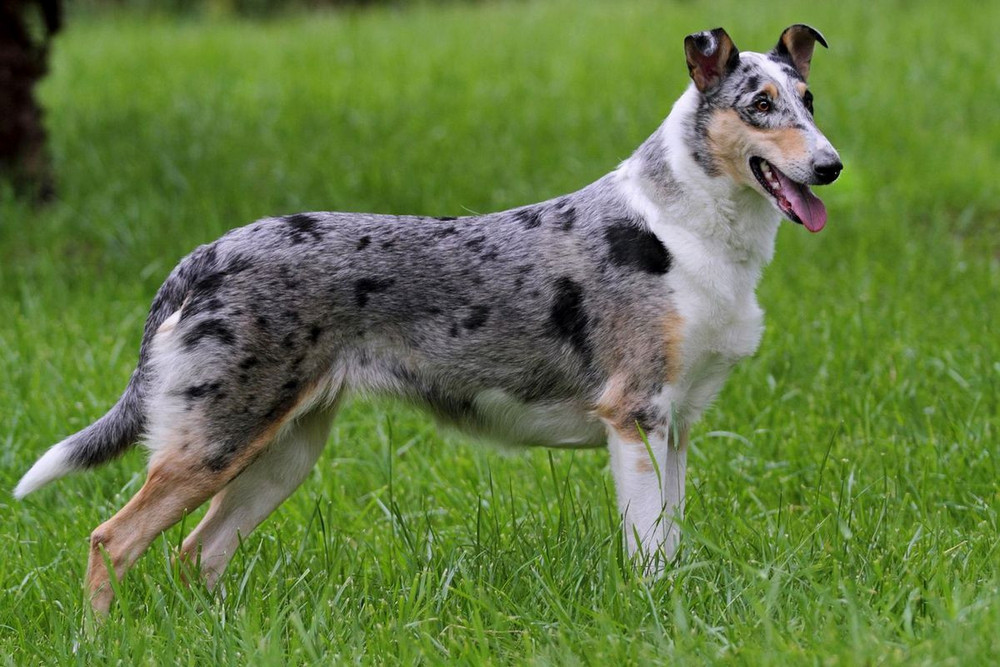
In the photo you can see that the spot pattern always appears lighter than the base color of the coat.
There are several varieties:
- Blue merle or blue. In blue, the black blends into light gray spots.
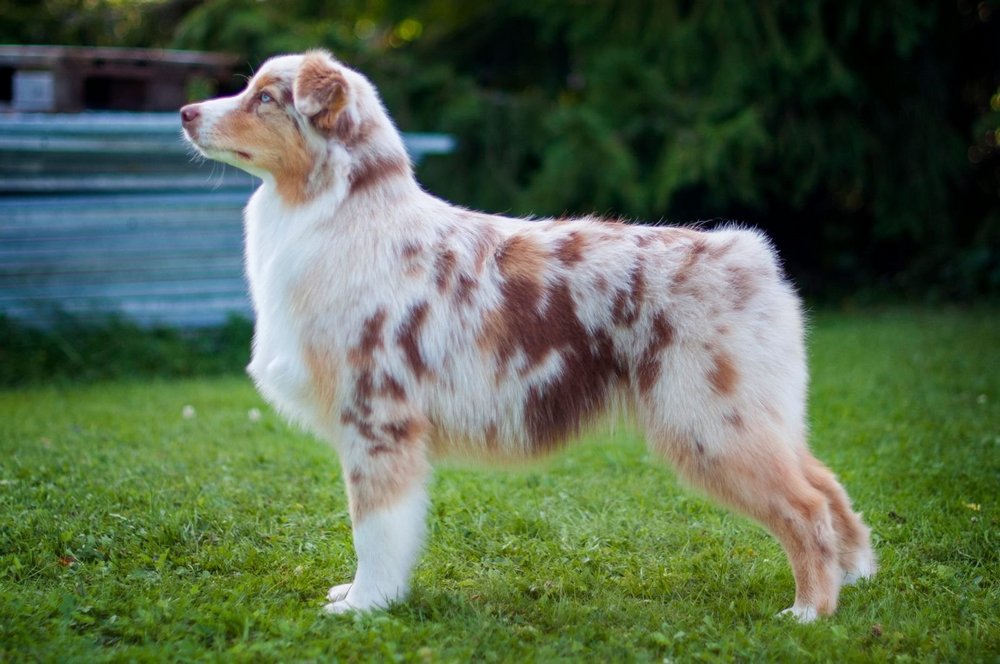
- Red or red. Red hair is bleached to light brown or cream.
- Sable, also known as sable, is a newborn kitten with a white coat that gradually darkens, revealing patches of blue and sable.
- Cryptic or hidden. The hidden coloration in tricolor offspring is detected through genetic analysis. Sometimes, a single silvery spot can be visually identified.
- Double, double, or white. Almost the entire body is painted white, the spots are almost invisible.
The most dangerous coloring is the double, which is most often achieved by mating spotted individuals. You can tell that an animal is merle by the lack of skin pigment. In this case, the puppies will have a distinct pink tint to their eyelids, lips, and nose. In pure white puppies without marbling, the skin in these areas is black.
Who is not contraindicated for merle?
There are no restrictions in the exterior standard for marble coloring in a number of breeds.
The main ones are shepherds:
- AussieBlue merle Australian Shepherds have black eye rims, while red merle Australian Shepherds have brown eye rims. Black or red eye rims with a few white markings are acceptable.
- Border Collie. All colors are permitted except the predominantly pure white.
- Collie, a Scottish Shepherd. There are only three varieties: blue, sable, and tricolor.
- Sheltie, a Scottish Shepherd. These four-legged dogs are typically blue, sable, black and white, black and brown, or tricolor.
- Cardigan Welsh Corgi. All varieties are accepted, including brindle and blue.
- Dachshund. Spotting can occur on any of the characteristic base colors—black, brown, red.
- Great Dane. The permitted patterns in the standard are black, blue, brindle, and fawn.
The absence of a ban on merle does not mean that breeding with both merle sires is permitted. Mating offspring with complex genetics also results in the birth of puppies with defects. However, the merle coloring does not imply a defect in the exterior; the dogs are considered purebred.
Who is merle prohibited for?
In a number of breeds, spotting is considered a significant defect in the exterior and becomes a reason for disqualification of the animal when participating in competitions.

Any type of spotting is prohibited for the following representatives of four-legged animals:
- Pembroke Welsh Corgi;
- Chihuahua;
- American Cocker Spaniel;
- Pomeranian;
- American Pitbull;
- Yorkshire Terrier.
Unlike Bulldogs, Yorkies, and Chihuahuas, the French Bulldog enjoys a concession: some cynological organizations recognize the blue color variant. However, dogs with this coloring are not allowed to compete internationally.
Merle is an attractive yet dangerous color, discouraged in most breeds. Crossing individuals with a dominant trait can result in dangerous defects in the offspring. Therefore, breeders are responsible for genetic testing of the parents to ensure healthy offspring.
Read also:
- What is a big-eyed dog breed?
- Dog halter: what it is and what it's for
- What are dogs most afraid of?


Add a comment