
Ocicat: cats and male cats
History of the origin of the cat breed Ocicat The breeding of Siamese cats originated in the American state of Michigan. Virginia Dale, a resident of the state, bred Siamese cats and, as an experiment, tried crossing a Siamese cat with an Abyssinian-Siamese crossbreed.
Content
History of the breed's origin
The successful outcome of this experiment was the birth of a sweet kitten with a cream-colored coat adorned with golden spots. This beautiful feline creation was named Tong, and he became the first representative of the Ocicat breed.
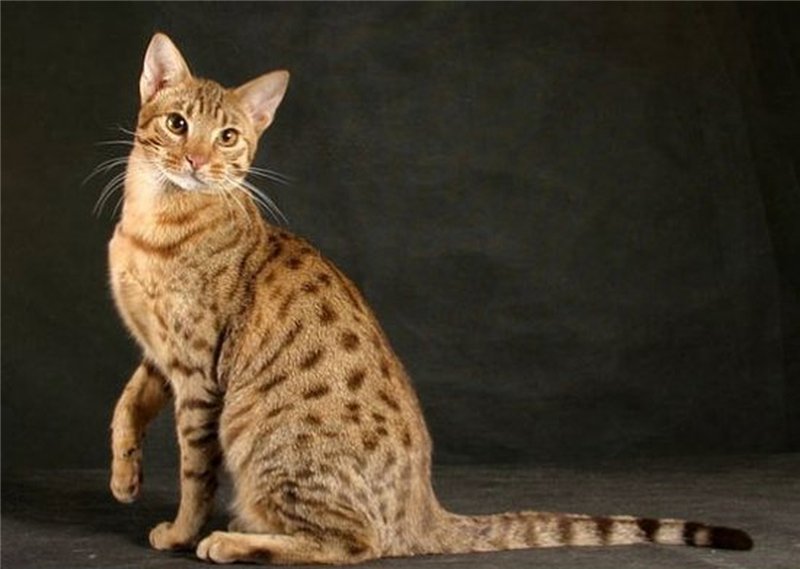
The breed received its name due to the fact that the cats’ appearance strongly resembles their ancestors – wild cats called ocelots, only in miniature.
General characteristics of the breed
What is the character and appearance of the Ocicat?
Character
Ocicat cats are known for their gentle and affectionate nature, are quite playful, and are devoted to their owners. Members of this breed are often associated with dogs, as they actually exhibit canine-like behavior.
They love to be thrown a ball and brought back to their owner, respond to their name, and quickly come running to be petted, just like dogs. Ocicats love being the center of attention and won't hide from visitors. They adapt easily to unfamiliar surroundings, love to travel, and are great at moving.
Active, intelligent, and friendly, Ocicats are a perfect fit for active cat lovers. These cats become truly attached to their beloved owners, demonstrating their devotion to just one special family member in every way possible.
Of course, this doesn't mean the Ocicat is a cat that can never love other family members and pets living nearby. She loves everyone who treats her well, but she singles out only one person she truly loves, and obeys them unquestioningly.
These confident and proud creatures easily dominate other household members, but they do so tactfully and almost unnoticed. This is facilitated by their natural cheerfulness, which they use to entertain both themselves and everyone around them.
If you're visiting a friend and spot a charming Ocicat kitten, you're guaranteed to have a photo to share with your friends online. They're not shy or timid; they'll never hide or run away from strangers, and, on the contrary, will be eager to interact with them.
This breed is distinguished by its well-developed voice. If they are expecting a full bowl or human attention, they can "chatter" incessantly, raising their voices when their desires are not satisfied for a long time.
Their naturally high intelligence allows cats to quickly remember their names and perform unusual actions. These animals are renowned for their ability to learn on their own, so they easily learn to open doors and even remove the lids from dishes containing their favorite treats.
Appearance
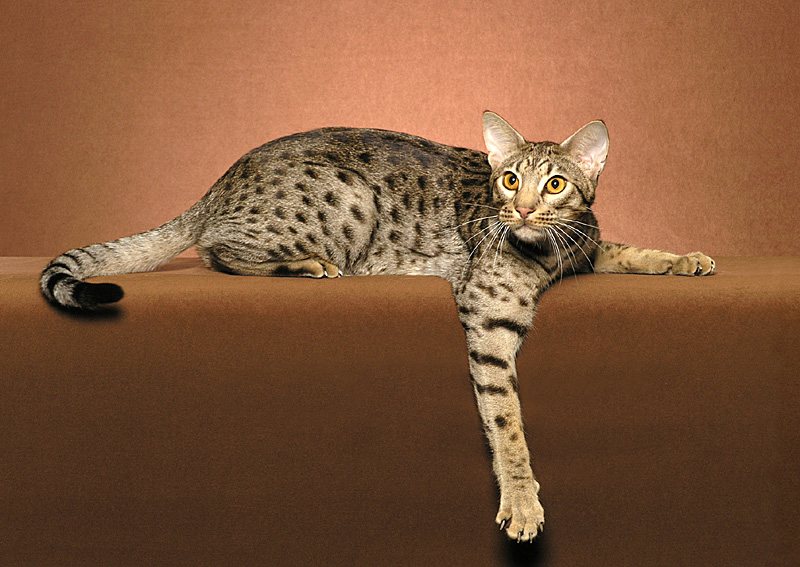
Ocicats are characterized by a powerful and strong body with well-developed muscles and bone structure. They have an arched chest with a large chest. The backline rises slightly toward the rear, giving them a commanding and powerful gait.
The paws of these cats are strong, well-muscled, and medium in length. The feet are oval. The wedge-shaped head is slightly rounded where the cheeks and muzzle meet. There is a noticeable, slight convexity from the base of the nose to the eyebrows. The muzzle is fairly broad, with regular contours, a strong chin, and powerful jaws.
Medium-sized ears are set on the outside of the head at a 45-degree angle. Tufts are typically visible at the tips, but this is not a required feature.
The almond-shaped eyes of Ocicats are slightly slanted toward the ears. Eye color is acceptable, except blue. Ocicats also come in a variety of colors:
- blue with dark spots;
- chocolate, where the main color is warm orange and the spots are cocoa-colored;
- silvery, with dark gray spots;
- brown, where light beige spots are visible against an ivory background;
- purple, where purple spots are visible on the same background.
Ocicat cats have short, dense fur that's soft to the touch, with a beautiful glossy sheen and lies close to the body. All hairs are bicolored, except for the hair at the end of the tail. The spots on the tail, paws, and face are darker than those on the body.
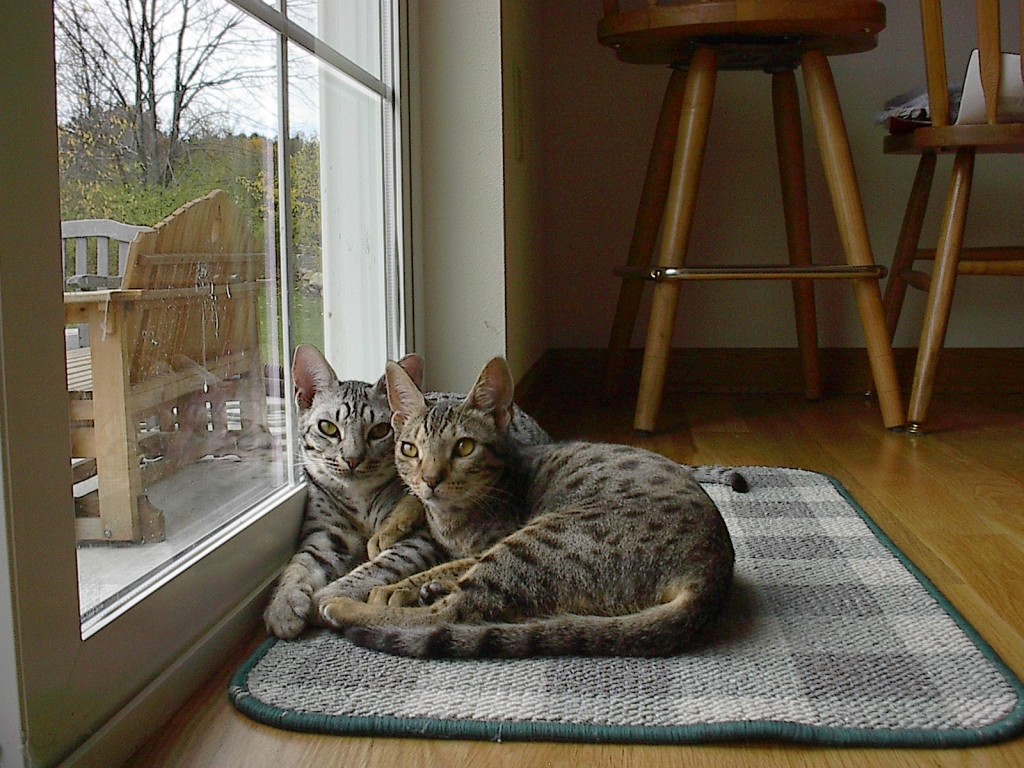
The weight of an adult pet can reach 7 kg.
Rules of care and nutrition
How to care for and feed an Ocicat cat correctly:
Care
To properly care for Ocicat cats, you need to know a few simple rules. Because their fur is short and smooth, brushing it once a week to remove dead skin is sufficient. It's also important to monitor their teeth. Not every cat will tolerate having their teeth brushed at home, so it's recommended that this procedure be performed by a veterinarian.
Also, once a week, wash your cats' eyes with a moistened swab and clean their ears with cotton swabs.
Ocicats should be bathed as needed. Typically, they only need one bath every two to three months, unless they get very dirty. When preparing for a show, schedule a bath two to three days before the competition.
The shampoo for washing the coat is selected individually, based on your pet's coloring. Silver coats require a clear shampoo, while blue or brownish-red coats require a colored shampoo in a matching shade. After washing and rinsing, dry the cat with a soft towel and allow it to rest in a warm, dry room for a while. Once the cat is completely dry, gently brush it with a soft brush.
Nutrition
A balanced diet will fully meet all the nutritional needs of Ocicat cats. Proper nutrition ensures a beautiful, healthy coat.
Raising Ocicat Kittens
Females carry their kittens well, and births occur without complications.
Ocicat mothers are known for their caring and affectionate nature, and they raise their kittens well. If kittens are raised indoors, they grow up friendly and affectionate.
Young kittens have a strong possessive instinct and are jealous of their toys. To ensure they grow up balanced and calm, they need to be introduced to various sounds from an early age.
Ocicat kittens also need to get used to human presence from birth, so owners are advised to pet them more often, hold them, and talk to them as they grow. Furthermore, they need to be taught house etiquette, and if you plan to participate in shows in the future, you'll need to acclimate them to noise and strange smells, and introduce them to other cats and new people.
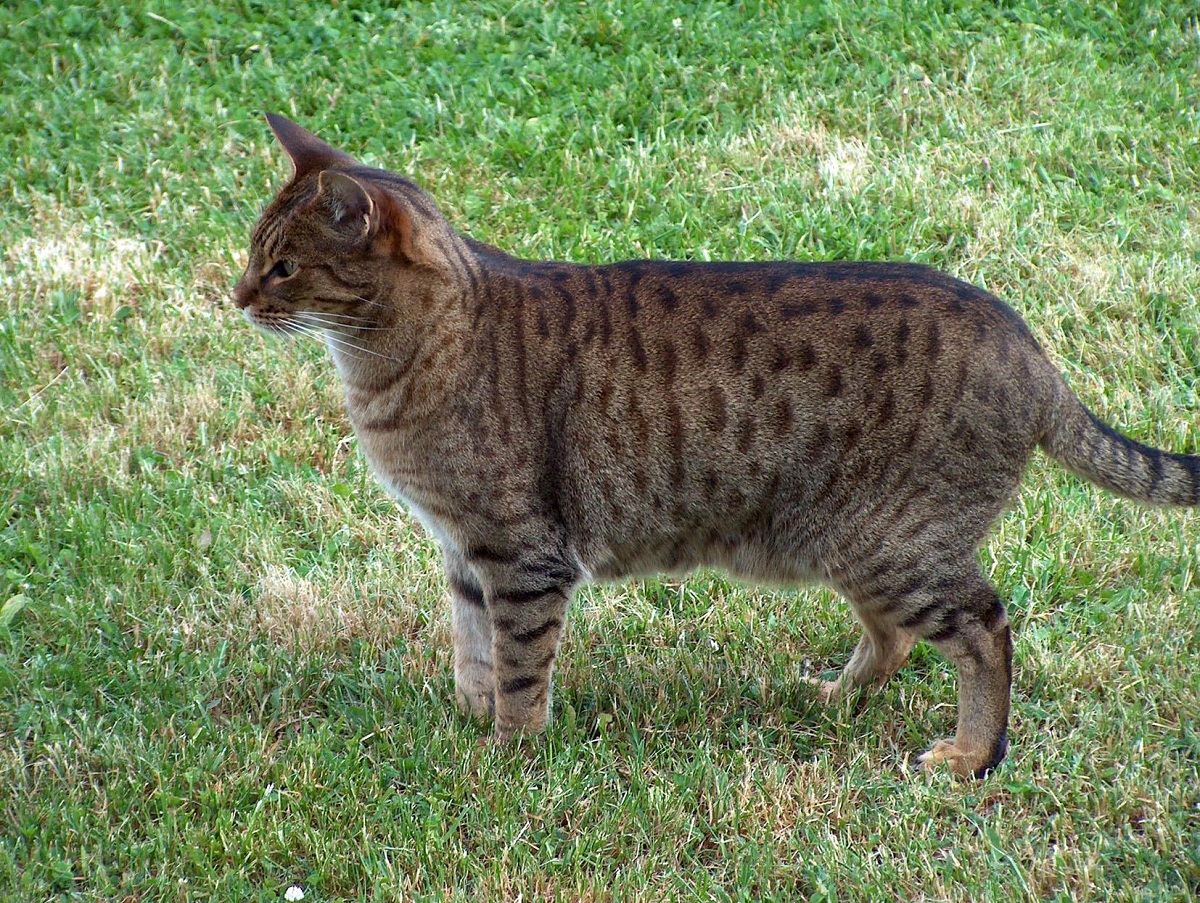
Young kittens have a highly developed possessive instinct and are very jealous of their toys. To ensure they grow up well-balanced and calm, they need to be accustomed to various sounds from an early age.
Health
Ocicats live a long life, approximately 18 years or more, but only if they are properly cared for and fed a balanced diet. It's important to remember that Ocicats were bred by crossing three breeds, each with its own predisposition to health problems.
It's impossible to say that Ocicats are guaranteed to inherit every disease, but a few are worth noting. They are prone to plaque, tartar, and gingivitis.
Gingivitis, in turn, most often leads to the development of periodontal disease, which leads to tooth loss and bone loss. This is why Ocicat grooming guidelines include mandatory brushing with a special toothpaste and toothbrush.
Some Ocicats may inherit renal amyloidosis, which causes kidney failure.
In addition, they may inherit RK deficiency, which causes the development of anemiaEvery cat is an individual. Therefore, it's impossible to say exactly what disease your cat has inherited. It's recommended to regularly take your exotic pet to the veterinarian, who will conduct a proper examination and advise you on how to provide proper care to prevent any illnesses from developing.
In addition, they can inherit RK deficiency, which causes anemia. Each individual cat is unique. Therefore, it's impossible to accurately predict which disease your cat has inherited. It's recommended to regularly take your exotic pet to a veterinarian, who will conduct a proper examination and advise you on how to provide proper care to prevent any illnesses from developing.
The cost of an Ocicat kitten
The Ocicat breed is widespread throughout the world and is extremely popular. Purchasing an Ocicat kitten with a distinctive color pattern is easy.
If Ocicat kittens have caught your eye, their price won't be too much of a stumbling block.
The cost of a kitten ranges from $500 to $2,600, depending on its gender and breed characteristics.
If you see an ad for a purebred Ocicat kitten for sale for 15,000 rubles, it's most likely a scam. Professional breeders can't sell such an exclusive breed for so little. At such a low price, you'll only be getting an animal with defects or underlying health issues. As the saying goes, "don't buy a pig in a poke."
Ocicat breeders: where to find them
The Ocicat cat breed, popular in the West, hasn't gained widespread popularity in Russia, so finding an Ocicat cattery can be challenging. For example, since 2012, only one cattery, "Alma Mater Cattery," has been open in Moscow, breeding Ocicats and Toygers.
In Ukraine, there is a nursery called "Marchi", located in Kyiv.
There are no known catteries in Belarus, but there is a Minsk-based cattery specializing in Abyssinian cats—the parent of the Ocicat. Its staff arranges meetings for cat lovers who buy cats with sellers—professional Ocicat breeders.
A detailed video review of the Ocicat cat breed
Read also:


Add a comment