
General dog training course without a trainer
General dog training (GDT) sounds distant and daunting to a new pet owner, but don't worry—it's much closer and more understandable than you might think. When buying a dog as a pet, remember that every dog is not a toy, but an animal with its own personality and behavior. To control your dog, you should teach it at least a few basic commands that will allow you to control it.
But often, owners don't know how to teach their dog to obey commands. In that case, the best option is to enroll them in a general dog training course.
Content
What is a general training course?
OKD (October 1945) is a set of standards for dog obedience and the ability to follow commands. It was developed by V.V. Yazykov almost 100 years ago, but remains relevant to this day. It can be said to be the foundation for further training of dogs, as all service animals undergo a mandatory general course before receiving specialized training. However, it wouldn't hurt to also give your pet an OKD course.
All major canine organizations hold OKD competitions. They test a dog's unconditional compliance with the trainer's commands, as well as all skills and reflexes acquired during training. At OKD competitions, evaluations are conducted by qualified judges who are able to spot even the most minor errors in a dog's performance.
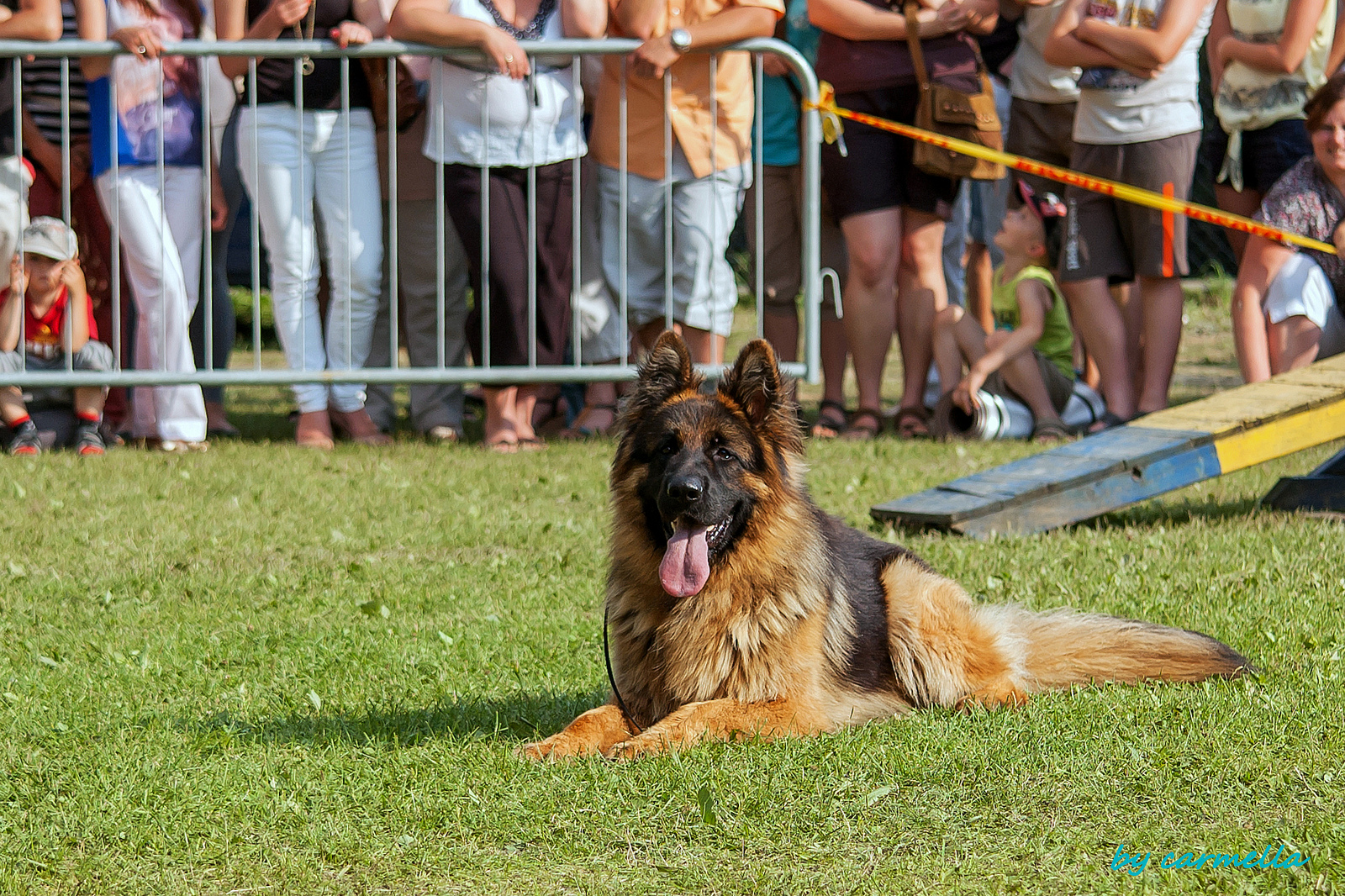
What is included in the OKD for dogs?
The general dog training course teaches your dog ten basic skills and commands it must obey. Here's what's included in the general dog training course:
- Movement next to the owner on command “Heel!”;
- The dog's approach after the command "Come to me!";
- Return to place on command “Place!”;
- Execution of commands “Lie down!” “Sit!” “Stand!” given by voice and gesture from a distance;
- Bringing an object thrown by the trainer on command “Bring!”
- Calm attitude towards muzzle;
- Neutral, passive reaction to spilled food. Cessation of unwanted actions on command "No!"
- Dog's reaction to a gunshot;
- Showing the bite to a stranger (judge);
- Overcoming an obstacle course consisting of a boom, a ladder, a blind fence and a barrier.
Let's take a closer look at what each of these points means and how a dog should respond correctly to commands after mastering the general training course:
The "Nearby" team
After giving the "Heel" command, the handler turns on the spot left, right, and around. The dog must move in sync with the handler's movements. While moving, the dog must also follow the handler's left leg, stopping with them and changing direction. When stopping, the dog may sit next to the handler's left leg. The exercise is considered unsuccessful if the dog moves 2 meters or more away from the handler.
The command "Come to me!"
General Training for Dogs (OKD) courses require the "Come!" command to be given both verbally and by hand. Upon receiving the command, the dog must quickly approach the trainer and sit at their left leg.
The dog doesn't necessarily have to walk around the person. When performing this exercise, it's acceptable for the dog to sit in front of the person and, upon receiving the additional command "Heel," move to the left foot. The skill is not completed if the dog doesn't approach the trainer within 15 seconds of receiving the command. Calling the dog's name to get its attention is permitted.
Team "Place!"
The OKD command for dogs, "Place!", can be given both verbally and by gesture. The essence of the exercise is as follows: on command "Down," the trainer places the dog down and places an object near it. After moving 15 meters, and after no less than 30 seconds of the judge's permission, the dog is given the command "Come!", accompanied by a gesture. No less than 15 seconds later, the dog, having run up, is returned to its previous position with the command "Place!"
The dog must run to the trainer, then return to its place and lie down no further than one meter from the dropped object. After 30 seconds, the trainer approaches the dog and commands "Sit." Until then, the dog must remain down. The exercise is not counted if the dog lies more than two meters from the dropped object.
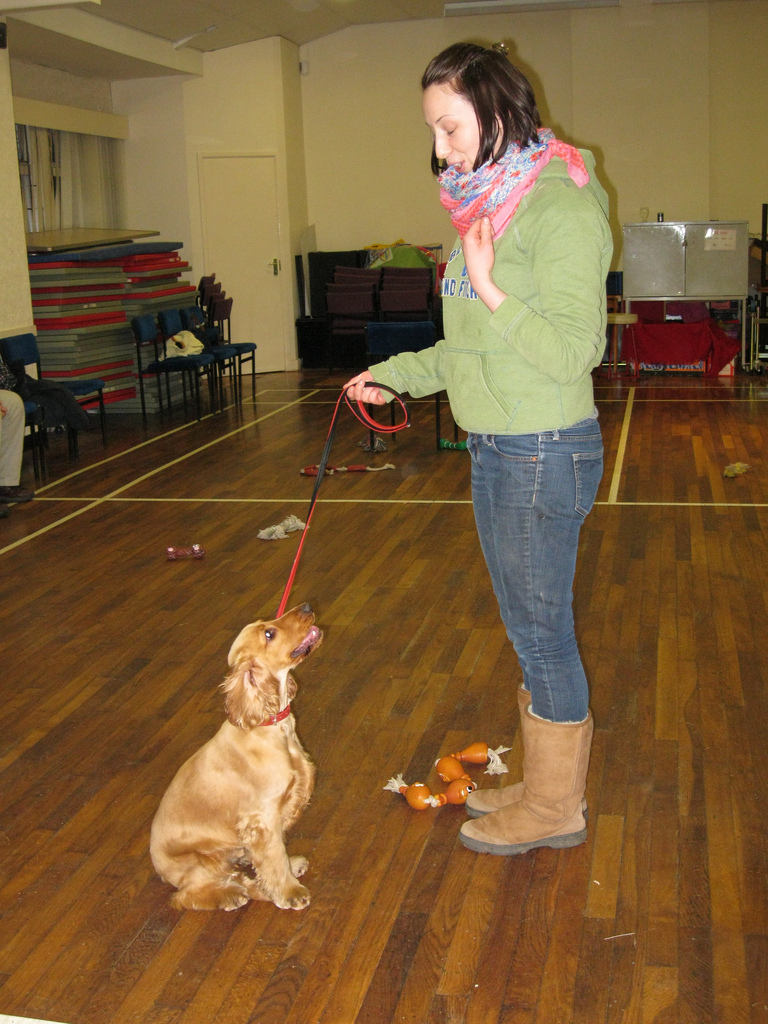
Execution of the commands "Lie down!", "Stand!" and "Sit!"
The next step in OKD training for dogs is performing the commands "Down!", "Stand!", and "Sit!". These commands are given verbally and accompanied by hand signals. The trainer leaves the dog sitting and moves 15 meters away. Using these commands, the trainer coaxes the animal into the desired position. Each command must be performed twice from different positions. The dog must obey the commands the first time and remain in the desired position without moving toward the handler. If the trainer gives the command at the wrong time (for example, when the dog turns away), the dog's points are not deducted. A dog moving 5 meters or more from any position is considered a failure.
Fetch
Training a dog in OKD requires practicing the "Fetch" or "Retrieve" skill. The dog starts at the handler's left foot. After showing the dog an object and giving the command "Sit," the handler throws the object forward, but no less than 10 meters. After a short pause, the handler gives the command "Fetch" or "Retrieve" and repeats the command with a hand signal. The dog must run after the object, bring it in its mouth, and sit at the handler's left foot or in front of the handler.
After a brief pause, on the command "Give," the dog must hand the object over to the handler. If the dog sits in front of the handler, the handler must then command "Heel" to place the dog next to the handler's left leg. A failure is considered if the dog does not hand over the object, places it more than 1 meter away from the handler, or simply fails to retrieve it.
Muzzle
The general dog training methodology for disciplinary courses requires the dog to remain calm while wearing a muzzle. The exercise involves placing the muzzle on the dog and giving the command "Walk." Then, calling the dog to his side, the trainer removes the muzzle. The dog should not react to the muzzle in any way. Showing displeasure or aggression while the muzzle is being placed is considered a failure to meet the standard.
Reaction to treats on the ground
General obedience training (OKD) requires teaching a dog to react appropriately to food or tasty treats lying on the ground. A dog should not pick up anything outside its bowl without its owner's permission. This could save your dog's life and health in the future. As for the "No!" command, upon receiving this command, the dog must stop any action. This skill is tested in two ways: by forbidding the dog to take a treat from your hand and by forbidding the dog to take any object.
- In the first case, the trainer repeatedly gives the dog a treat from the palm of the hand, and on the judge's command, the dog is forbidden from eating another treat with the command "No!" After 5 seconds, the hand with the treat is removed, and the test is passed.
- In the second case, any object is thrown away, and the dog is given the command "Fetch!" The command "No!" can be given at any time, and the dog must immediately cease its actions. If it is running after the object, it must stop; if it is already carrying the object in its mouth, it must drop it and wait for the next command.
If the dog does not stop its actions after the command “No!” is repeated twice, the test is considered failed.
Reaction to a gunshot/loud sound
In OKD, dog training requires the animal to calmly react to a gunshot (a loud, sharp sound). This reaction is permitted during any exercise except the "Heel" and "Fetch" commands. After completing a skill, the judge asks the dog to repeat the exercise. During this exercise, a shot is fired from a starting pistol at a distance of 15 meters from the animal, unnoticed by the dog. If the dog stops responding to the command at the moment the shot is fired, it is considered to have failed the test. Frightening the dog or moving away from the handler after the shot is fired is also unacceptable.
Bite demonstration
Each exercise in the OKD for dogs tests a particular skill. However, the bite demonstration is a purely psychological procedure. To perform this standard, the judge must examine the animal's bite. To do this, the owner must bring the pet to the judge and demonstrate the bite. The dog must behave calmly, showing no concern whatsoever about this procedure. If the dog turns away, unwilling to show its teeth, the task is considered unsuccessful.
Overcoming obstacles
The general training course for German Shepherds, like that of any other dog, involves negotiating obstacles. Commands are given verbally and also reinforced by the trainer's hand signals. The obstacle course procedure is as follows: after the judge gives the go-ahead, the trainer brings the dog to the obstacle and, with a hand signal, sends the dog over the barrier.
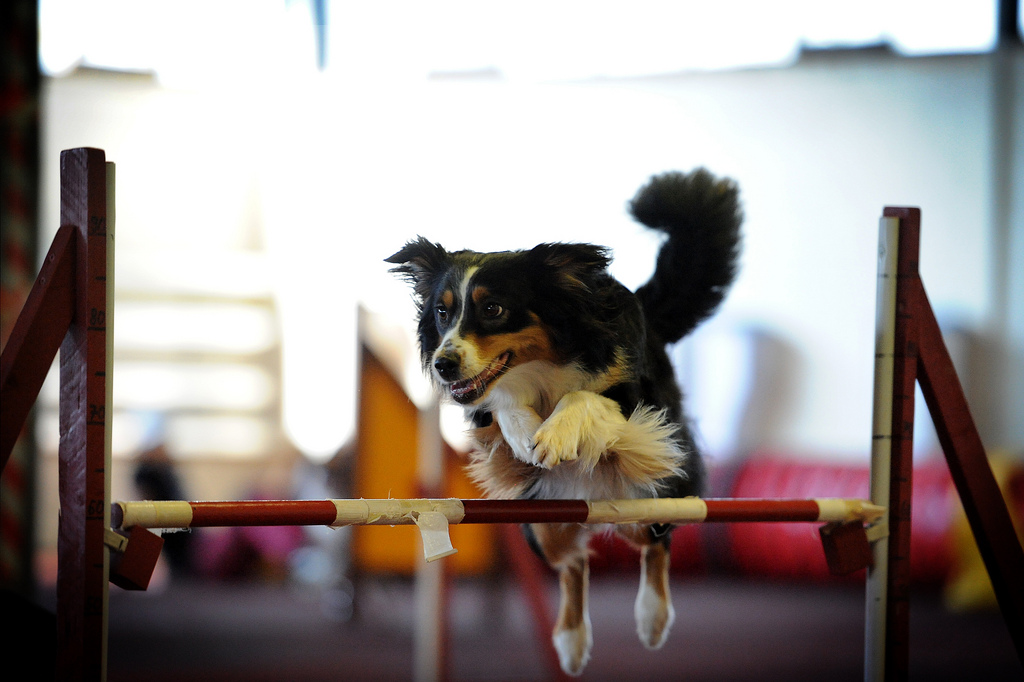
After the dog clears the obstacle, the handler walks around the obstacle to the right, but not until the dog lands. After calling the dog, the handler moves to the next obstacle. If the dog fails to clear the obstacle on the first try, two more attempts are allowed.
Assisting an animal over hurdles is strictly prohibited. As for the track and field hurdle, the dog must overcome it without contact. The dog overcomes the boom independently, ascending and descending only via ramps. The trainer is permitted to walk alongside or behind the dog. The exercise is considered failed if the dog received assistance from a human or simply fails to clear at least one of the obstacles within three attempts.
Price for the general training course
Many owners, deciding to teach their dog the basics of obedience, often wonder where to find a general training course that won't break the bank, and how much it might even cost.
After reviewing numerous sources, we found the average price for a course of lessons to be around 7,000 rubles. Naturally, this is only a rough estimate, as trainers in each region and each club may charge whatever they deem appropriate. For this price, you get 16 group lessons at a training ground, where everyone trains together. If you require personal training, the instructor will likely be happy to accommodate you, but be prepared for the cost of general dog training to be approximately 1,000 rubles per lesson.
So, you'll spend a total of 16,000 rubles for private lessons. Whether it's worth acquiring the same skills for your dog at a cost more than twice the average is up to you. It's worth noting that, regardless of the cost of dog training in a particular group, sick dogs and female dogs in heat are strictly prohibited from participating in classes. This distracts other dogs and can provoke conflict on the training grounds.
Is it possible to train a dog in OKD on your own?
More and more often, breeders are attempting to conduct basic dog training courses themselves, without a trainer. In some cases, this ends in victory, with the dog brilliantly performing all commands. In others, no matter how hard the owner tries, no results are visible. What determines the success of such efforts?
First and foremost, it depends on the dog itself: if your dog is intelligent and quick-witted, it will quickly understand what's expected of it and will happily comply. The result also depends to a large extent on the owner's persistence and patience—it's impossible to successfully conduct OKD training at home if the owner lacks the patience to repeatedly demonstrate what they expect. If you have the patience, you'll likely be able to teach your pet basic commands.
What accessories are needed to complete the general obedience training course?
If you decide to conduct OKD training for your puppy, you will need the following accessories:
- Soft, custom-fit collar;
- A leash about 2 meters long (a retractable leash is not recommended, although it is acceptable);
- Muzzle for practicing skills (any type except loop);
- A bag with treats (optional, but very convenient);
- Any object for retrieval;
- A mat that can be used to practice the “Place” command.
Even if you don't have all of this equipment, the instructor will advise you on what you can do without and what you should definitely buy. In any case, a leash, muzzle, and collar are essential for any training session.
After completing all 16 general training sessions with your dog, you will learn to fully control him, as well as understand much better what your dog wants.
Read also:
- How to teach a dog the command "Attack"?
- How to teach a dog the "lie down" command
- UGS for dogs: what is it and what does it include?


Add a comment