
Intestinal obstruction in cats
Intestinal obstruction in cats is scientifically called ileus. However, saying that coprostasis is an obstruction is not entirely accurate. In fact, coprostasis is more like constipationBut with constipation, feces are formed and passed, albeit with difficulty (dry, compacted, and small). But if a cat has ileus, there will be no feces at all; they simply cannot pass out of the intestines because the lumen is closed (gases, by the way, also cannot leave the gastrointestinal tract). So what should you do if your cat is diagnosed with intestinal obstruction? Let's find out.
Content
Reasons
The causes of intestinal obstruction in cats may be the following.
Coprostasis
Sometimes constipation is the cause of intestinal obstruction. But these are different conditions. When stool becomes too dry and "clumps" together, it becomes difficult to pass. It accumulates and clogs the intestines. It doesn't pass on its own, and new stool is prevented from leaving the digestive tract.
This condition is dangerous because the body is "poisoned." The animal develops severe intoxication (the digestive tract is cleansed of feces for a reason; it's waste that's no longer needed). If this "waste" remains in the body for a long time, the toxins are absorbed into the blood through the intestinal mucosa and distributed throughout the circulatory system to all cells.
Intestinal parasites
When a cat has a high-grade infestation, the intestinal lumen is too small. The parasites attach themselves very firmly to the intestines (they have special hooks and suckers near the mouth for this purpose). In this case, removing the worms must be done very carefully, otherwise, the dead worms can tangle into a single, large lump that gets stuck in the intestines. The animal will then develop further intoxication (and not only because feces are unable to leave the intestines).
Foreign body in the intestines
Yes, sometimes cats swallow things they can't digest. For example, string or tinsel. These won't dissolve in the stomach and will end up in the intestines, where they'll become tangled, making it very unlikely that they'll pass on their own. Giving laxatives can cause intestinal rupture. Therefore, the only correct solution is to immediately seek veterinary help, who can perform surgery to remove the foreign object that shouldn't have entered the animal's gastrointestinal tract.
Intestinal volvulus
Or intussusception (when one intestinal loop becomes trapped within another and compressed). In this case, not only is the obstruction itself dangerous, but also the fact that the twisted section doesn't receive enough blood (vessels are compressed). The longer the animal remains untreated, the more severe the consequences. Intussusception can occur due to increased motility and irregular peristalsis.
Pilobezoar
This "scary" name literally means "hair ball." This ball can form because a cat licks its coat and swallows loose hairs. Hair accumulates in the intestines (if there's a lot of it and it hasn't been regurgitated by the cat), as it's not digested. The gastrointestinal tract becomes clogged. That's it, feces can't pass. The intestinal contents can only move as far as the hair plug; they can't dislodge the bezoar. As a result, severe intoxication occurs, stretching the intestinal walls, even rupturing them. This condition is most often seen in long-haired cats. Age (older cats and young kittens shed more hair), health (sick pets shed more than healthy ones), time of year (annual shedding is still a thing), and diet (if it's not balanced, hair loss is inevitable) also play a role.
Neoplasms in the intestines
Sometimes tumors grow very large and completely block the intestinal lumen. If the owner gives the animal laxative, not only will this not help, but it could actually worsen the animal's condition. Without surgical intervention, the pet cannot be saved.
Types
As surprising as it may sound, there are several types of intestinal obstruction in cats.
- MechanicalWith this type, the intestines become blocked or compressed by something. For example, intestinal volvulus, the gastrointestinal tract is clogged with a foreign object or hair,
- FunctionalIt's also known as paralytic. It's caused by peritonitis, intestinal atony (when the intestinal walls are weak and there's no tone or peristalsis), nervous system dysfunction, or during the animal's recovery from anesthesia. This is why it's important not to feed the animal after surgery. Even if the cat begs, it should not be fed during the first hours after recovery from anesthesia.
Symptoms
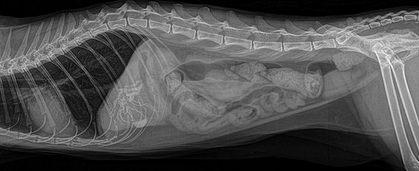
The photo shows an x-ray of intestinal obstruction in a cat.
How can you identify intestinal obstruction in a cat? Signs and symptoms of this condition can vary from cat to cat. For example, some cats may be depressed and extremely lethargic, while others, on the contrary, are very active, running around the house, meowing loudly, and trying to get their owners' attention. Let's look at the main symptoms.
| Regardless of behavior, appetite disappears | The animal is in pain, as each new portion of food only moves as far as the point where it blocks the intestinal lumen. The intestinal walls stretch, causing the whiskered animal severe pain. |
| Vomit | It occurs both immediately after eating and drinking, and half an hour to an hour later. |
| The tummy is very painful and hard. | Sometimes you can feel something stuck in the intestines (if it's mechanical). However, don't press too hard to avoid harming your pet. |
| The belly is swelling (but the gas doesn't come out) | The cat may roll on the floor, lick its belly, look at it, and try to somehow draw your attention to its tummy, which is very painful. |
| No feces in the litter tray | The animal is unable to defecate. While problems with bowel movements are also observed with constipation, feces eventually appear in the litter box. |
Important! An X-ray can confirm the diagnosis. As you can imagine, you can't do this at home, even if you notice symptoms of intestinal obstruction in your cat. To help your pet, you need to contact a veterinarian immediately. Don't delay seeking professional help, otherwise your pet could die. Self-medication is not only ineffective but can also be dangerous.
Treatment
A cat with intestinal obstruction must be treated only at a veterinary clinic. No home treatments, herbs, massages, or anything else. It's one thing for a cat to have coprostasis (constipation) or flatulence (a large accumulation of gas in the intestines). But if your cat has an obstruction, you need to first determine the cause.
- If the ileus is mechanical, surgical intervention is required. This is the fastest and safest way to save the animal. Using a laxative can lead to intestinal rupture, peritonitis, and ultimately, the death of the beloved four-legged family member.
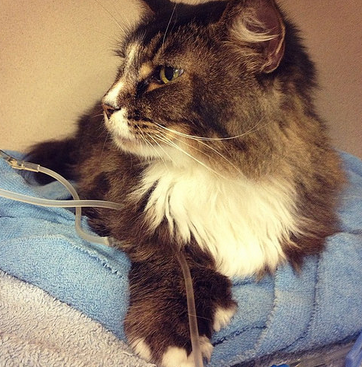
- If coprostasis has resulted in the cat being unable to defecate (although loose stools may occur for the first 24 hours, as the body attempts to flush the foreign body from the intestines), the veterinarian will administer an enema, starting with a saline drip or administering it subcutaneously (to prevent dehydration). However, before doing so, the veterinarian must ensure that the enema will not harm the animal or cause intestinal rupture! Several additional tests (ultrasound, x-ray) should be performed.
Effective dacha Vaseline oilThe animal's diet should be supplemented with wet food and plenty of fiber (vegetables). However, this is only recommended if the obstruction is caused by dry feces. It is contraindicated for other causes of obstruction!
After the foreign object has been removed from the digestive tract, the animal may be prescribed anti-inflammatory, antibacterial, and even pain-relieving medications.
Don't delay treatment! Without it, your pet can die within a week! Sometimes, death occurs as early as two days after the first symptoms appear!
Prevention
Preventing intestinal obstruction in cats is extremely important. Let's look at the three key components of effective prevention.
Review your pet's diet
If you feed dry food, remember to always provide your pet with access to clean, fresh water. And look for foods that help remove hair from the digestive tract. This type of food is especially good for long-haired cats, older cats, or those that shed heavily.
Brush your whiskered friend
Don't neglect this. Invest in special brushes, combs, and gloves. The more thoroughly you groom your pet, the better their coat will look and feel. Admittedly, if you brush your cat's coat, they'll ingest a minimum of hair when licking themselves.
No small and inedible items
Don't let your purring pet play with small or inedible objects (plastic bags, tinsel or Christmas tinsel, string, paper, candy wrappers, etc.). While playing, your cat may swallow them, but they won't be digested, and their digestive tract will become blocked. Keep your pet away from your shoelaces, buttons, and locks. Also, put away toys with small parts, as your cat could chew them up and choke on them while playing. Hide the trash can, too! Skins, bones, and sausage casings are all easily found in the trash. Your cat will eat these poisons and clog their digestive tract.
Any questions? You can ask our website's staff veterinarian in the comments below, who will answer them as quickly as possible.
Read also:


14 comments
Diana
Hello! My cat vomited three times in the last 24 hours. The first time was partially digested food, then just liquid. A day has passed, she's not eating, drinking water, sleeping a lot, and her activity has decreased. She hasn't vomited again, but she refuses food and is drinking a little meat broth. She pees, but doesn't have any bowel movements—as far as I can tell, there's not much to do. I'm giving her Enterosgel, but I can't take her to the vet. Can you tell me what else I can do for her?
Daria is a veterinarian
Hello! I need to induce a bowel movement. Give an enema (approximately 100 ml) with warm water or equal parts Vaseline oil and warm boiled water. Check either by placing a drop on the back of your wrist or using a thermometer. You can look up how to give an enema online; it's not that difficult. Also, give Vaseline oil (5-10 ml) orally—pour it into the mouth with a syringe without a needle. Unlike other oils, Vaseline oil is not absorbed but coats the intestines. If there is no bowel movement after 15-20 minutes, repeat in 2-3 hours. Vaseline oil can be replaced with any other vegetable oil (castor, olive, or sunflower).
Irina
My 1-year-old Maine Coon cat hasn't eaten for 5 days. His main food is raw chicken wings. He can't pee. I think his intestines are clogged with bones. He drinks water. He ate some boiled boneless fish with broth. He digs holes in the toilet and can't pee. His entire butt is wet and something is leaking. There's no veterinary clinic nearby. How can I help him? He won't let me pet him, he hisses, bites, and won't come home. Please help.
Daria is a veterinarian
Hello! Everyone knows you shouldn't feed chicken bones! And yet, they still do. Why? Well, the cat's intestines are now clogged with fragments of tubular bones, which will NEVER be digested, but their sharp edges can injure and even damage the intestinal wall, leading to peritonitis and death. To confirm or refute this suspicion, an X-ray is necessary. You can't do one at home. This debris cannot be removed naturally; surgery is the only way. Find a way and take him to a clinic immediately.
Irina
Hello! My cat is about 5-6 years old (I'm not sure exactly, as he's a kitten). He was dewormed 10 days ago. He hasn't eaten for several days, apparently due to severe intoxication. I gave him Gamavit and Ringer's injections, and he started drinking milk and eating pâté and a little meat. His litter box was fine. Two days ago, he stopped eating, yesterday he drank a little milk, and today he's even refusing water. He's constantly lying down. I started petting his belly and found a hard lump inside. Could these be parasites that haven't been released, causing the intoxication to reoccur? What can I do? We live in the middle of nowhere, and the nearest hospital is 100 km away.
Daria is a veterinarian
Hello! If there was no normal bowel movement after deworming, there may be toxicity. It's best to have your pet defecate within the first 24 hours after deworming, as dead worms decompose and release toxins. Laxatives should be given: vaseline/castor oil, or at least Duphalac. Detoxification therapy is needed now. Charcoal and IV fluids (at least continue administering saline solutions subcutaneously) are recommended, as this reduces the concentration of toxins in the blood. There are special medications, such as Antitox, that are effective in such situations.
Natalia
Hello. I'm a normal, fluffy black kitten, 7 months old. He hasn't eaten for 3 days, and drinks a little milk. When he eats solid food, he meows loudly and regurgitates undigested pieces. What should I do?
Daria is a veterinarian
Hello! First, rule out gastritis. Also, tell your pet what you're feeding, how often, deworming, and vaccinations. Avoid milk. Give water, and instead, fermented milk products. What other symptoms has the animal developed? Is it vomiting immediately after eating? Is there foamy vomiting before eating (usually in the morning)? Have you given the animal any medications?
Svetlana
Hello! My British shorthair kitten is 6 months old and hasn't had a bowel movement. We took him to the vet, where they cleaned his intestines and gave him IVs. Today at the appointment, they told us again that his stomach is hard and that he needs Microlax enemas. We don't know what to do.
Daria is a veterinarian
Hello! Investigate the cause of constipation. Review the diet. Get a biochemistry panel. Have the liver examined; it may be producing insufficient enzymes, causing intestinal motility problems. Your pet may not be drinking enough fluids, so consider introducing wet food. There's not much information on feeding and care, so it's difficult to give advice.
Elena
Hello! My British Shorthair cat is 7 years old. She had surgery two weeks ago (for a hairball in her intestines). On the fifth day after the surgery, we took her back to the vet. She wasn't eating on her own, only drinking, and was barely moving her hind legs anymore. They said she wasn't eating because she had sharpened keratin in her mouth. We kept her for treatment. On the fourth day, the vet called and said she was constipated again and gave her a laxative. He said if that didn't help, she'd need another surgery (to determine the cause of the constipation). We're not sure what to do. Could it be intestinal atony after the surgery and medications?
Dasha is a veterinarian
Hello! Yes, atony is possible after surgery. Besides, the animal isn't eating, so the intestines aren't working properly (why have normal peristalsis when only liquid is coming in, which is absorbed well)? Can't you get an X-ray or ultrasound? Why just cut it right away? But the veterinarian can see your pet, so surgery may be necessary...
Oksana
Hello! My 11-month-old cat chewed off half of a nylon tie from her blanket yesterday (about 6-8 cm). At first, it was there, but two hours later, we noticed it was gone. She may have swallowed it—we didn't see it ourselves, but we couldn't find the tie anywhere. About 20-30 minutes after we saw it, she had a bowel movement. Today, around lunchtime, she also had a bowel movement, but there was no tie in her stool. She's still eating and active. Could you please advise us on our next steps? Is it possible the tie is still in her intestines?
Dasha is a veterinarian
Hello! Yes, there may still be some left, but she could have chewed it up and swallowed it in small pieces, as it's not easy for a kitten to swallow 6-8 cm of tissue at once. Either it's already passed, but the pieces are too small (you were probably looking for a large, solid knot), or there's still some left. Monitor what's coming out of her and into the litter box. For 2-3 days, it's a good idea to take her for an x-ray to rule out a foreign body in the intestines (a veterinarian is unlikely to detect a soft cloth by touch). If you notice any unusual symptoms typical of intestinal obstruction, take her to the vet immediately (sometimes it takes several hours from the first symptom to the animal's death). In general, a cloth is not food and will not pass through the gastrointestinal tract as quickly. Laxatives should only be given after an in-person examination by a veterinarian.
Add a comment