
Malocclusion in a dog
Malocclusions in dogs are quite common, and while veterinarians were previously unable to help animals, today, in some cases, correcting the malocclusion is possible. Owners often face the question of what to do if their dog has a malocclusion: should they seek professional help or leave it as is? But what negative consequences might follow if they leave it alone? We'll discuss this today.
Experts' opinions on this matter are divided. Some believe that such problems not only make it difficult to eat and chew food, but also contribute to the development of many diseases. Furthermore, malaligned teeth can cause oral injuries, premature tooth wear, and fractures. Others believe that malocclusion is simply a flaw. exterior and there's no need to fix anything. So who should you trust and what should you do?
Content
Consequences of a malocclusion in a dog
A veterinarian should determine the need and appropriateness of correction in each individual case. Based on the facts, the consequences of a malocclusion in dogs often lead to injuries to the palate, tongue, gums, and other dental problems. And poor chewing puts unnecessary strain on the digestive system.
But sometimes a minor deviation doesn't interfere with the animal's normal life or cause harm. In such cases, there's no need to correct the bite. In any case, such dogs are no longer shown or used for breeding.
How does the deviation develop?
- Playing games that put a lot of strain on teeth. This is a common mistake among owners of fighting breeds, who believe that from early puppyhood, their pet should be allowed to carry bricks, rocks, or hang from a stick.
- Impaired development of the jaw and teeth can be caused by poor nutrition, or more precisely, a lack of minerals in the diet.
- Childhood jaw trauma often results in disruption of bone formation and changes in bite.
- And, of course, heredity plays an important role.
A dog that has even minor pathologies is not allowed to participate in breeding work.
Puppies are always born without teeth. The first baby tooth appears only after a few weeks. However, after two to three months, the baby teeth are fully formed and number 28. Almost immediately, replacement of milk teeth with permanent teeth.
By 7-8 months of age, an animal should have a fully formed dentition consisting of 42 permanent teeth. However, some animals may have fewer, which is called oligodontia. If there are more teeth, it's called polyodontia.
Correct and incorrect bite in dogs
First, let's review the norm. The small teeth located between the canines are called incisors. Canines and incisors are used to grasp food. Immediately following the canines are the premolars and molars, or molars. Their function is chewing.
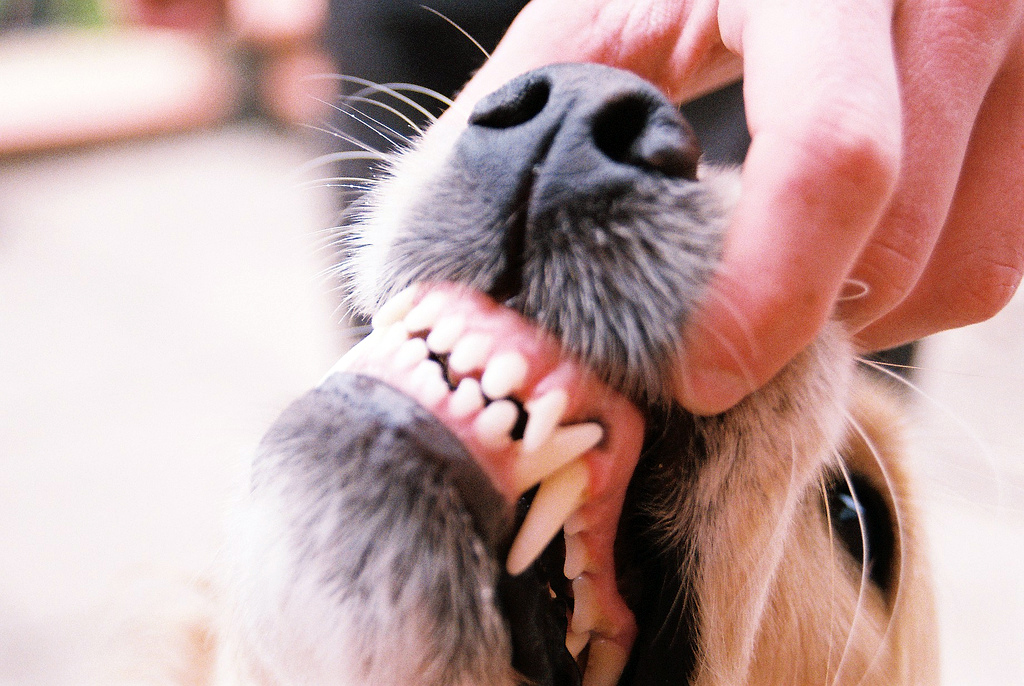
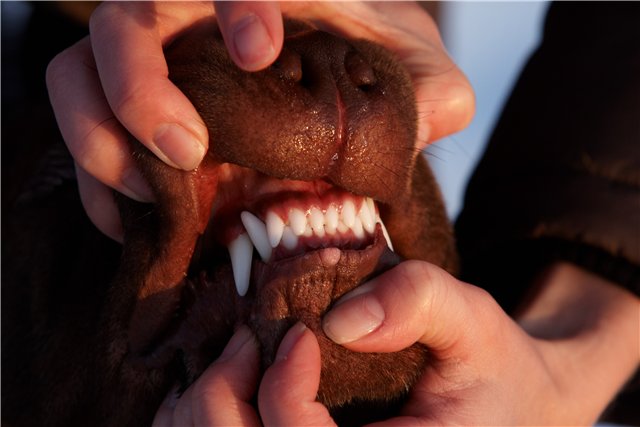
The correct bite in dogs is scissor-shaped., is the standard for most breeds. When the jaws are closed, the lower incisors overlap slightly beyond the upper ones, and the canines touch each other tightly, with the lower canine fitting into the space between the upper and the incisor. When it comes to malocclusion, there are several different types:
- Underbite – the lower jaw is underdeveloped or the upper jaw is overdeveloped, which is why the lower incisors do not touch the upper ones.
- An underbite is when the lower jaw is longer, causing the lower incisors to protrude forward. For some breeds, such as Boxers, Shih Tzus, and French and English Bulldogs, this type of bite is normal.
- A pincer bite occurs when the teeth meet end to end when the jaws are closed. This leads to premature wear and loss of teeth.
- Open bite – when the mouth is closed and the teeth do not touch.
- A crooked bite is considered a severe hereditary defect and occurs when one side of the jaw develops faster than the other. One of the lower canines is often displaced inward, causing damage to the upper palate.
Bite correction in dogs
What should you do if you decide to treat your dog's malocclusion? Veterinary orthodontics is a branch of dentistry that specializes in preventing malocclusion and explores possible treatment options. Some breeders suggest that massage can help correct malocclusion.
But let's face it, this is nonsense. Neither upper nor lower jaw massage has any effect on tooth alignment, much less bone development. Correcting malocclusion is the responsibility of a veterinary orthodontist. If malocclusion requires intervention, removable and fixed systems are used. Fixed braces, or brackets, are similar to those used in medical dentistry. Special locks are affixed to the enamel and connected by a taut wire, creating the necessary pressure on the tooth to correct its alignment. Throughout the entire period of wearing the system, the doctor adjusts the tension of the plates as needed.
Removable braces include so-called invisible braces. These are essentially acrylic aligners that fit snugly against the teeth but are removed when eating or cleaningsHowever, due to the complexity and cost, rubber rings are more commonly used. They produce good results for children up to one year of age. Effectiveness always depends on the diagnosis and the chosen treatment method.
Here's how to properly examine a dog's bite:
Any questions? You can ask our website's staff veterinarian in the comments below, who will answer them as quickly as possible.


11 comments
Vladimir
Good afternoon. I noticed my Toy Terrier's lower jaw is slightly protruding. I read on your website that it's due to stress—the puppy was carrying a tennis ball in his teeth. Now, will it go back into place when his baby teeth change?
Olesya
Hello, we bought a Chihuahua. Judging by the description, she has an open bite. Her lower jaw and baby teeth are about a centimeter lower and touch the roof of her mouth. Is there any chance of fixing it at least a little? And can the dog live with this?
Daria is a veterinarian
Hello! Well, she'll definitely be able to live. It's fatal, after all. Yes, there might be some discomfort. But these are just baby teeth. The permanent ones will be a little larger. But your pet, apparently, has a defect in the jaw itself, not the tooth. It's difficult to assess whether something can be corrected without seeing your specific case. Have you seen a vet? Have you taken your baby to the vet?
Elena
Hello. My 13-month-old male Akita Inu has a correct bite, but there are gaps between his lower incisors. Not huge, of course, but there are some. And one incisor is slightly lower than the others. Does this affect the expert's conclusion? Thank you.
Dasha is a veterinarian
Hello! The expert who examines the animal will tell you this. They will then give their opinion. Unfortunately, I don't encounter such breed-specific details before shows (we don't have many show or purebred animals), and without seeing the animal, it's difficult to determine how far it deviates from accepted breed standards.
Xenia
Hello. 5.5 month old American Spaniel puppy.
The veterinarian noticed that the bite is not developing very correctly, at least for shows.
How can I make some minor adjustments? Does chewing on a turkey shoulder or a rubber slipper affect this? Since we don't play tug-of-war with it?
Dasha is a veterinarian
Hello! Your dog was examined by a veterinarian. Didn't they give you any recommendations or any warnings about potential complications after the examination? I haven't seen your pet, so I can't comment on its suitability for shows. It's best to remove hard objects, and tubular bones (and any bones from birds or fish) are especially prohibited for dogs! Don't let them chew on your slippers; you'll teach them not to ruin your shoes. It's best to avoid such factors, as they can cause abnormal tooth growth (especially risky during teething). Enrich their diet with calcium and phosphorus to strengthen their teeth.
Elvira
Hello,
I have a female Jack Russell Terrier puppy. She's almost 6 months old. Her teeth started changing very early, at about three months. At 4 months old, the vet removed her lower baby canine tooth. It was in an abnormal position. It was between the second and third upper incisors. The surgery was performed under general anesthesia. The doctor said this would prevent further damage to the permanent teeth, but he's not sure. He told me to come back in 70 days for a checkup. My appointment is next week. Now the situation is as follows: All her teeth have changed. This canine has grown in and is in the same abnormal position, resting between the second and third upper incisors. This is why the third upper incisor has started to deviate upward. The canine itself is shorter than the other canines. The lower incisors are slightly offset because there's not enough space between the canines. I forgot to mention that I live in the Netherlands and, unfortunately, don't have access to Russian veterinarians directly. This is my first dog. I'm doing what the doctor says. The next question is: what should I do next? What would you personally recommend? Should I remove it again or perhaps ask for braces?
Dasha is a veterinarian
Hello! It depends on the situation, but you should understand that even if this tooth is pulled, a new one won't grow in its place. A baby tooth being removed at 3 months isn't that early; the body adapts (perhaps they were fed hard food). If the clinic you choose offers braces, take advantage of this service as soon as possible (the teeth are still young and will be easy to remove). But again, you need to consider the situation: are these crooked teeth causing significant interference or affecting the bite?
Don't worry about the lack of Russian doctors. Veterinarians abroad are just as skilled at working with small animals; veterinary medicine is more developed, and they've made significant strides (even in terms of clinic equipment). So grow up healthy!
Olga
Could you please tell me how a toy terrier's underbite (progenia) poses a health risk? I'm very worried. I've already chosen a puppy; he's two months old, but is it worth buying one with this defect? Will he get sick? I simply don't have the means to see an orthodontist. Thank you in advance.
Sergey
There is no health risk, but you should be aware that this is a defect and the cost of a puppy is significantly reduced, sometimes by up to half. Depending on the degree of progenia, you may later see your dog's lower teeth from under the lips.
Add a comment