
German Pinscher (Standard Pinscher)
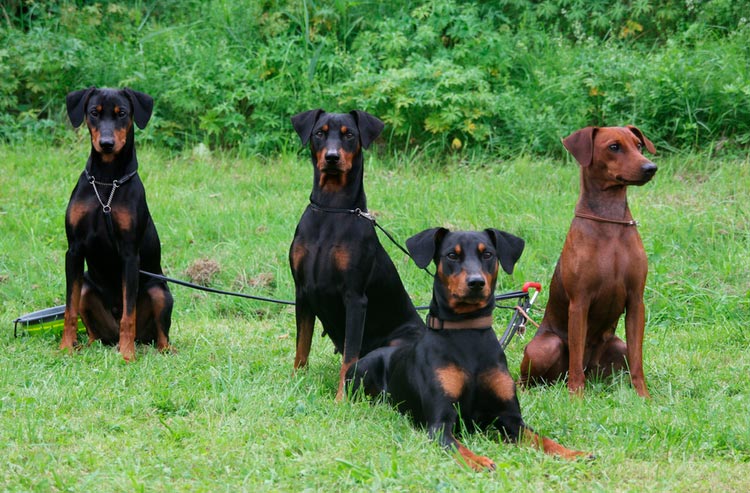
German Pinscher (Standard Pinscher)The Pinschers are a medium-sized, smooth-coated companion dog bred in Germany. They once accompanied stagecoaches, guarded stable hands, and worked as ratters. Although they have not been working dogs for over 100 years, many of the character traits of their courageous and serious ancestors are still evident. Pinschers have many advantages and a number of disadvantages that every potential and current owner should be aware of.
Content
History of the German Pinscher breed
The history of the German Pinscher spans hundreds of years. They most likely descended from ancient peat dogs native to southwestern Germany, and subsequently spread throughout the country. In the Middle Ages, they served as stagecoach companions, faithfully accompanying carriages throughout the day. They guarded coachmen and their property from intruders, looked after horses, and caught rats, which is why they were sometimes called Stable Pinscher. Over time, the dog population diverged into several distinct breeds, differing in size, color, character, and coat type.
Until the mid-19th century, the German Pinscher was just a separate line of the breed group. schnauzersIn one litter, wire-haired puppies were born, which were called schnauzers, and smooth-haired ones, which were called pinschersBoth types were considered a single breed. In 1879, breeders determined that it was appropriate to separate them into two distinct breeds. Today, Schnauzers and Pinschers share only a common ancestor.
The first breed standard was developed in 1880. The breed was officially recognized in 1884. In 1890, a show was held in Stuttgart, where 93 Pinschers were exhibited. The first Pinscher Club was founded in Cologne, Germany, in 1895. Its founder was Josef Bertha, a renowned Schnauzer breeder. Several breeders simultaneously began breeding Pinschers. Some of them attempted to breed dogs with a "pepper and salt" color, which was unsuccessful and put an end to their work. In the post-war years, the Pinscher completely lost popularity. Its breeding was practically reduced to zero. While about 900 dogs were registered in Germany in the 1920s and 1940s, not a single litter was bred from 1952 to 1957.
The president of the Pinscher Schnauzer Club, Karl Werner Jung, without the support of breeders, decided to personally restore the nearly extinct breed. In 1958, he registered five dogs in the Club's stud book. Of these, only one was born to Pinschers; the rest were overgrown Miniature Pinschers. In the 1980s, to increase genetic potential and reduce aggression, a female was added to the breeding program. DobermanOverall, it can be considered that the breed restoration effort has been a success.
Video review of the German Pinscher dog breed:
Appearance according to standard
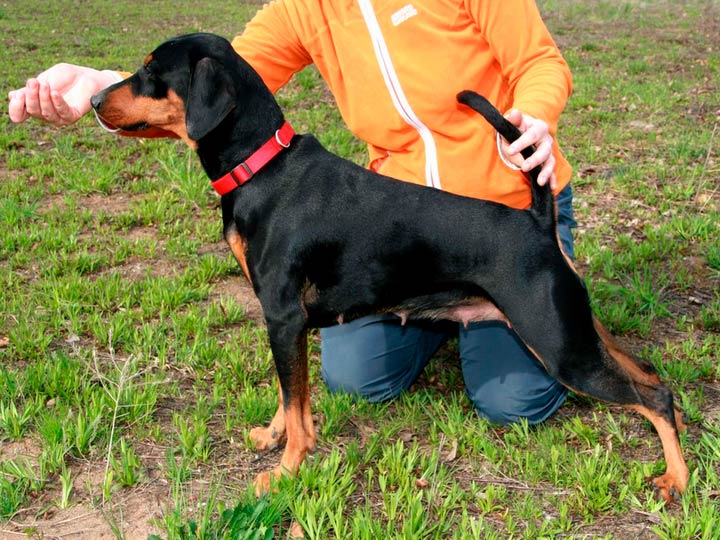
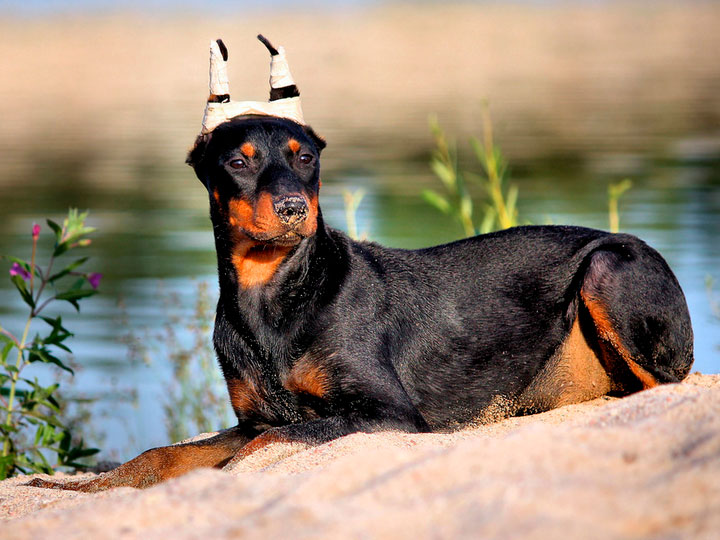
The German Pinscher is a medium-sized, smooth-coated dog with a proud stance, graceful lines, and well-developed, defined muscles that are particularly noticeable when moving. The height at the withers is 45-50 cm, and the weight is 14-20 kg. Sexual dimorphism is moderate.
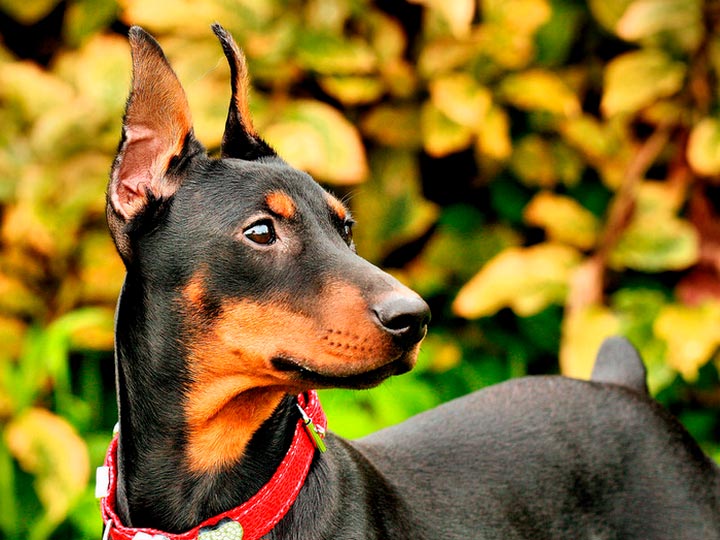
The skull is strong and elongated, the occipital protuberance is not prominent, the forehead is flat, and the stop is slightly defined. The muzzle is shaped like a blunt wedge with a straight bridge of the nose. The nose leather is black and well developed. The lips are dry, close-fitting, and black. The jaws are strong, with a scissor bite. The eyes are oval, dark, with black, tight-fitting eyelids. The ears are triangular in shape, hanging on cartilage, and set high. The inner edges of the ears lie close to the cheekbones. The folds of the ears should not be higher than the top of the skull and should be parallel to each other.
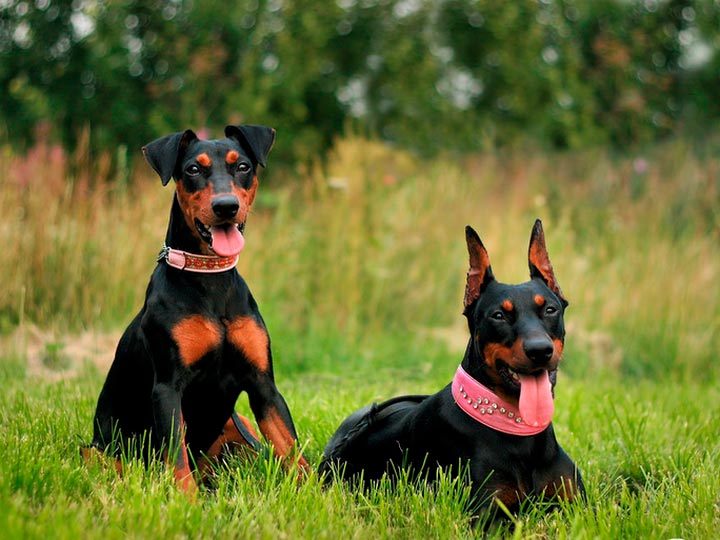
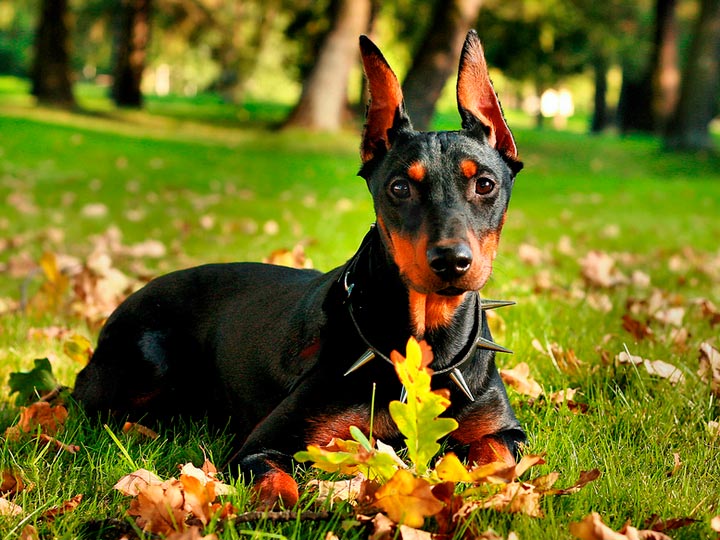
The German Pinscher's ears and tail can be docked or left natural.
The neck is arched, of normal length, blending smoothly into the withers, without dewlap. The body is strong, approaching a square format. The topline slopes slightly toward the tail. The back is short and strong. The loin is deep and short. The croup is slightly rounded, blending smoothly into the base of the tail. The chest is oval in cross-section and wide. The underline is moderately tucked up, forming a smooth line. The tail is sickle or saber-shaped. The legs are strong, straight, and parallel. When viewed from the side, the hind legs are slanted; when viewed from the rear, they are parallel. The paws are rounded, short, with tightly knit toes. The hind legs are slightly longer than the front ones. The pads and nails are black.
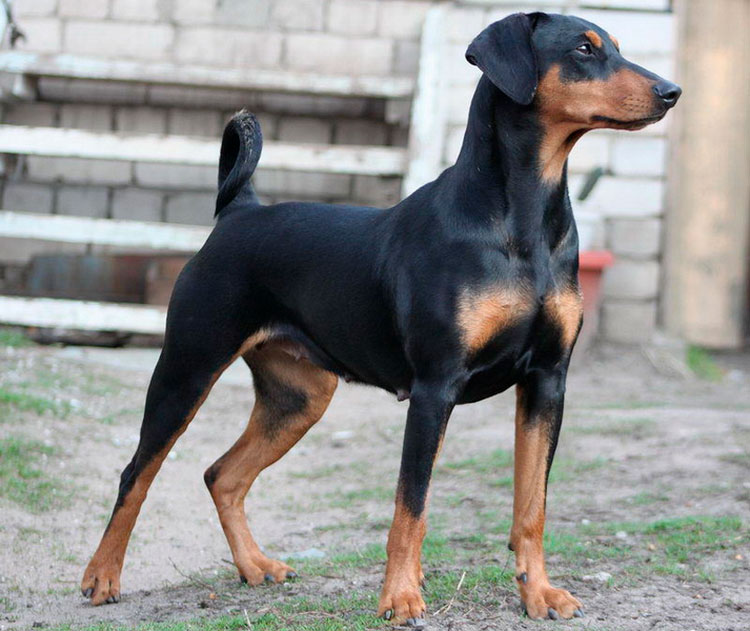
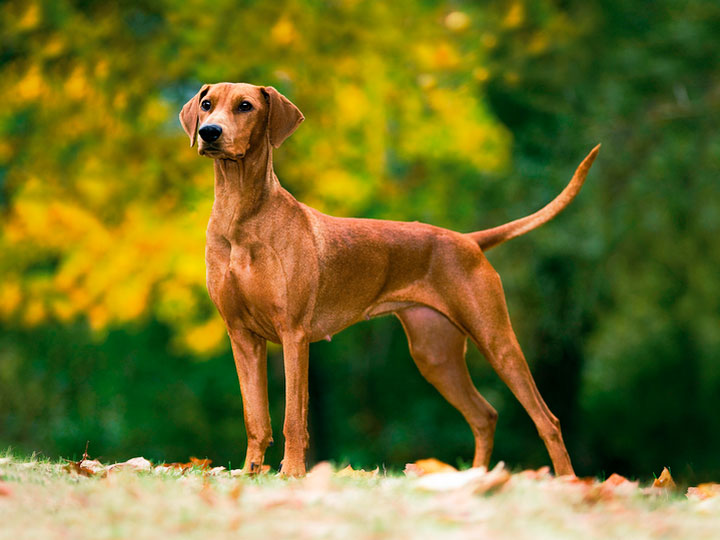
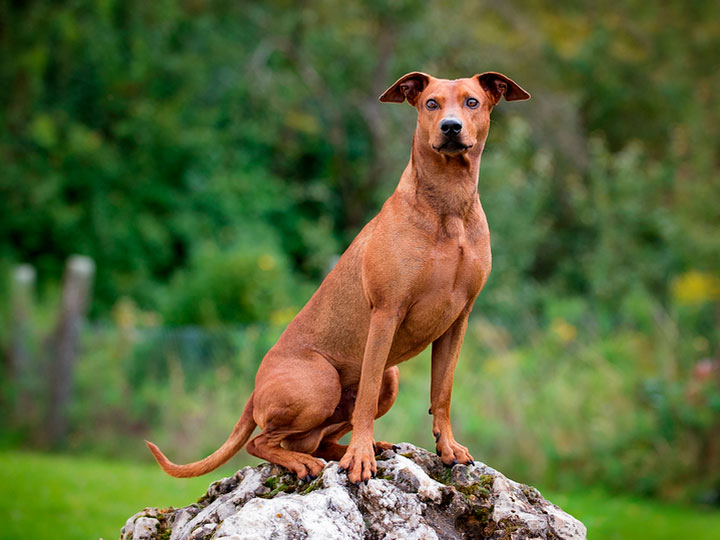
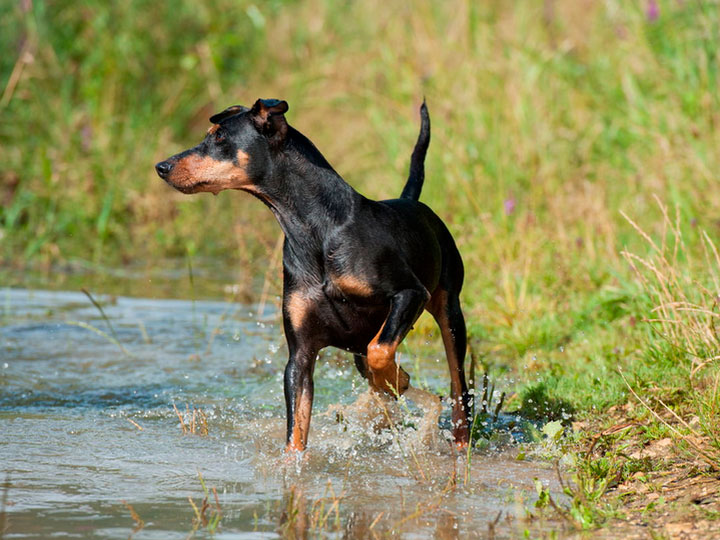
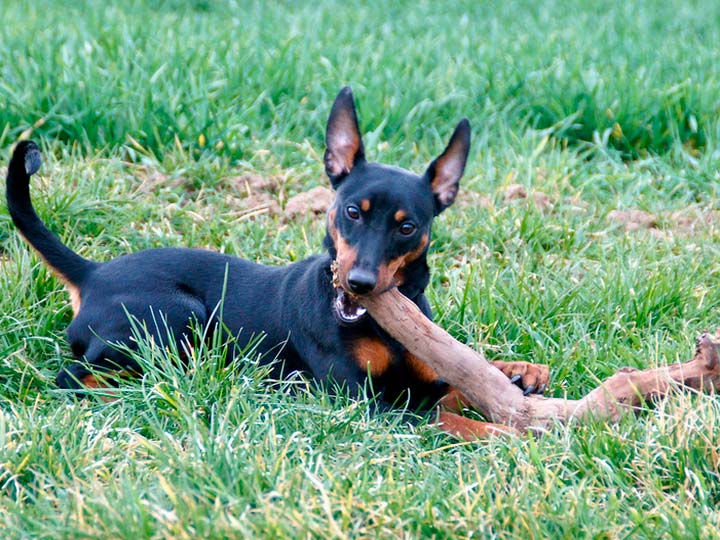
The skin is tight and elastic. The coat is thick, dense, short, smooth, and shiny. The coat can be solid (brown, red-brown, or red) or black and tan. Red or brown markings, clearly defined and rich in color, are located above the eyes, on the throat, chest, paws, inside of the hind legs, and under the base of the tail.
Character
The German Pinscher has a balanced personality, harmoniously combining intelligence, energy, independence, courage, and endurance. Qualities such as reliability, loyalty, sociability, and playfulness make him a wonderful companion. companionThe Pinscher has a strong territorial instinct and a strong sense of ownership. It is a vigilant guard dog and does not bark unnecessarily. Due to its size, the Pinscher cannot be a bodyguard, but if necessary, it will do everything possible to protect its owner and its territory from intruders. It often jealously guards food and toys, even from its own kind. It is wary of strangers and rarely aggressive.
The Standard Pinscher has a strong hunting instinct. While it's not commonly used as a hunting dog, this trait should be taken into account during training and walking.
The German Pinscher is known for its stubbornness, independence, and cunning. Overindulging the dog will negatively impact its character. The Pinscher will become overly independent, disobedient, and possibly even aggressive. It will try to become the head of the family from the moment it arrives in a new home, and if successful, it will climb on everyone's neck and shape the world to its own liking. The owner must demonstrate who is boss, establish authority, and assert its leadership position.
German Pinschers dislike loneliness and routine. They enjoy noisy, active games and travel. A well-trained dog is friendly and affectionate in the family circle, but requires respect for itself and its personal space. It will happily play with older children, but is not always tolerant of the antics of small children. If a child is born to a family with an older dog, their interactions should be strictly supervised.
Relationships with other animals vary. Pinschers have difficulty bonding with cats due to their excessive activity. They get along well with other dogs, but conflicts can arise due to jealousy, territorial disputes, and hierarchical relationships. Pinschers view small animals and birds as potential prey and rarely survive to old age when housed together.
Education and training
The Pinscher is very intelligent and easily trained. The challenge is that the dog won't do anything unless it wants to. It's important to find the right motivation and teach it to focus. The Pinscher dislikes harsh training methods. When used, they become withdrawn. During training, the owner must be consistent and stern, maintaining their position. Once a command has been given, it must be followed.
Owners note that their dogs are skilled manipulators. Their quick reflexes, high intelligence, and independence force their owners to always be on their toes, more persistent, stronger, and faster than their dogs. For this reason, a Pinscher cannot be controlled by a soft-natured person.
The Pinscher is people-oriented, but not everyone-oriented. It recognizes only one owner, with whom it develops a close bond. The owner must teach the dog proper interactions with people. Show it that it can avoid petting and ignore strangers, but it should not growl or bite. It is crucial to socialize the puppy from an early age. Without skills in interacting with people and animals, the puppy may grow up timid or, conversely, aggressive.
Content Features
The German Pinscher is not suitable for kennels due to its poor tolerance for cold, but it thrives in a house or even a small apartment, provided it receives adequate exercise. This is a dog for energetic people who are willing to not only take their pet for walks twice a day, but also engage in daily activities with them. The Pinscher is persistent and requires a lot of attention, following its owner everywhere. While some find this enjoyable and amusing, for others the constant pursuit can be tiring and irritating. At home, the Pinscher should have its own private area for sleeping and resting, including a bed, its own bowls, and toys.
Pinschers are highly intelligent dogs who don't like to be left alone at home. To prevent destructive behavior, provide several toys to choose from. Interactive toys and those that are intelligent and reward them with treats are ideal.
The German Pinscher's past is reflected in their behavior today. They are natural-born ratters with a keen sense of smell, hence their passion for digging. A dog that smells a mouse in their yard can dig a huge hole in the middle of a flowerbed in a matter of seconds. The Pinscher is prone to chasing cars, attempting to follow them as they once did carriages, showing no fear and often getting run over.
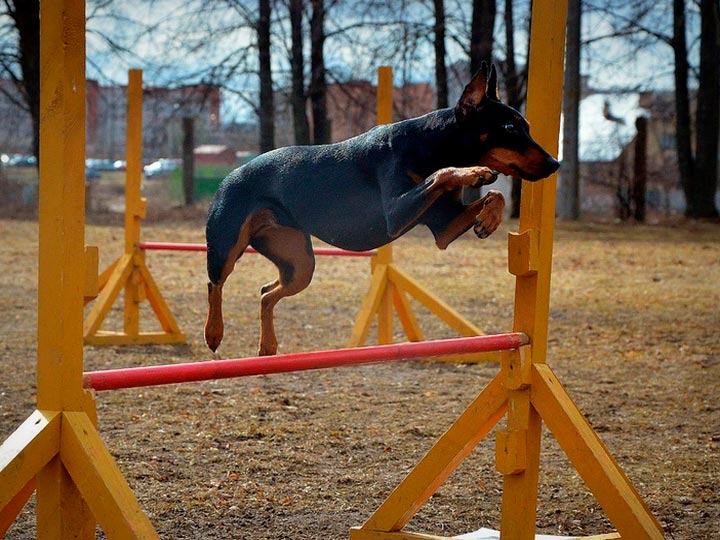
The Pinscher is very active and energetic, requiring long walks and vigorous play. He can be a great companion for jogging or cycling. Many dogs enjoy playing with a bowl or a ball, but they are unable to perform the same task monotonously, making them poorly suited for serious sports.
Care
German Pinschers are easy to care for; they require regular, simple hygiene procedures. Brush their coat with a special brush or mitten for short-haired breeds 2-3 times a week. Bathe them once a month. Regularly inspect their eyes and ears for dirt and clean them as needed. Pinschers rarely have oral health issues; however, it's best to acclimate them to having their teeth brushed at an early age and brush them at least once a week. It's also important to monitor their nails and trim them every 3-4 weeks.
Nutrition
A German Pinscher can be fed natural or commercial food. The owner chooses the type of diet. Both options are acceptable as long as the food is high-quality. A natural diet is formulated according to standard dog guidelines. Commercial food is selected based on the dog's size, age, and activity level. A standard Pinscher should be fed a food above the super-premium level for active, medium-sized dogs.
Health and life expectancy
In general, German Pinschers are strong, hardy dogs with good immunity. However, they are not without hereditary problems. The presence of genetic diseases is a concern for breeders and owners alike. Dogs with poor genetics are discouraged from breeding, but a number of pathologies and predispositions to certain diseases have not yet been completely eradicated:
- Von Willebrand disease;
- Hip and elbow dysplasia;
- Ophthalmological diseases (cataract, corneal dysplasia);
- Disruption of the digestive system (pancreatitis, enterocolitis);
- Bursitis.
Many other illnesses are also common, but most often they are caused by improper care, maintenance, or nutrition, and therefore depend entirely on the owner. Standard Pinscher requires routine vaccinations and regular treatment for external and internal parasites. The issue of diluted coloration is also important for breeders. Life expectancy is usually 13-15 years.
Choosing a puppy
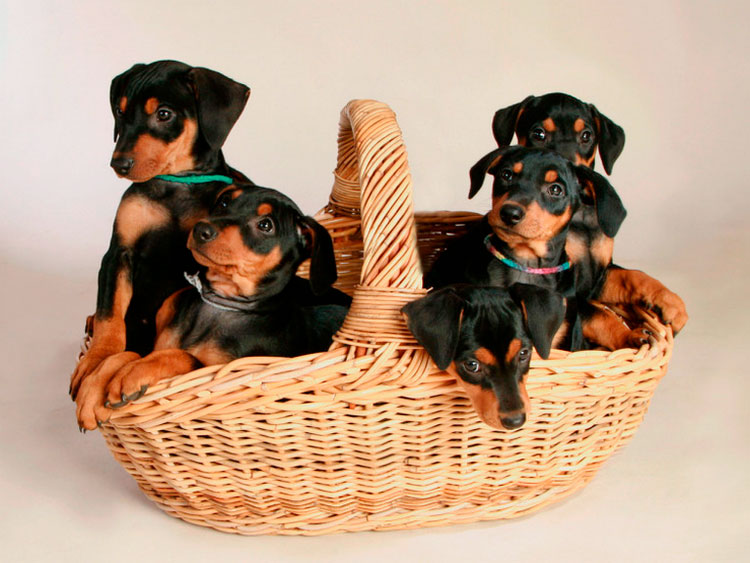
When choosing a German Pinscher puppy, it's important to decide on several important factors in advance: the desired color, gender, appearance, and personality. Some Pinschers are more energetic and active, while others are better suited to apartment life and are much calmer and friendlier. Of course, it can be difficult to predict a two-month-old puppy's personality, especially since much depends on the conditions in which the dog was raised and how well it was trained. When it comes to temperament, it's best to trust the breeder. And be sure to pay attention to the character and behavior of their dogs. Heredity is known to play a significant role. Regarding appearance, puppies' tails are docked at 3-5 days of age, so the desired length should always be discussed with the breeder in advance. Ears are cropped after 3 months.
A pedigree confirms the puppies' origins and allows for the tracing of their parents' relationships. Historically, all modern Pinschers descend from a small group of dogs and are therefore more or less related to each other. Further inbreeding significantly increases the risk of hereditary diseases and pathologies.
When it's time to choose a puppy from a litter, it's worth considering the dogs' living conditions and their level of socialization. If the breeder has devoted significant attention to the puppies and their training before they were two months old, this increases the chance of raising a well-balanced, obedient dog. And of course, the puppies should be healthy in appearance. Behavior-wise, they should be active and inquisitive, not shy or aggressive.
Price
The average price of a German Pinscher puppy in a breeder is 35,000 rubles. Puppies without a pedigree, but from parents with documents, usually cost around 10,000-15,000 rubles. The price of a Standard Pinscher crossbreed usually does not exceed 1,000 rubles.
Photos
This gallery features photographs of Standard German Pinscher puppies and adult dogs. The photos show dogs of various colors, with docked and natural tails and ears.
Read also:


Add a comment