
Multikan 8 for dogs
Multikan 8 is a domestically produced vaccine used in dogs to prevent various infectious diseases. Its unique advantage is that it contains live, but weakened, viruses. When used correctly, these viruses help develop immunity to the pathogens that cause plague, enteritis, leptospirosis, rabies, and other fatal diseases.
Content
Dosage form
Multikan 8 consists of two components, each of which is packaged in a separate glass bottle:
- The dry component is a yellow-pink powder with a porous structure. It is obtained by drying viruses using a special technology. It contains strains of distemper virus, parvovirus, coronavirus, and adenovirus.
- The liquid component is a yellow or pink suspension. The liquid is usually clear, but may be slightly cloudy. A gray or white sediment forms during storage, so shake the liquid well before mixing with the dry component. The liquid component contains strains of the rabies and leptospirosis viruses.
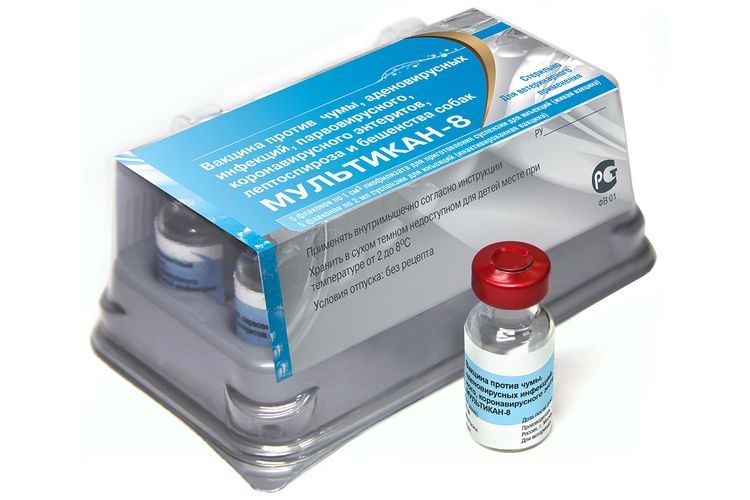
Each vial contains 1 ml of the dry component and 2 ml of the liquid component. When mixed, the components yield one dose of vaccine.
At the factory, glass vials are packaged in plastic containers, but at the pharmacy you can easily buy one or more doses depending on the need, for example, the number of animals to be vaccinated.
How it works
When vaccinated with Multikan 8, the dog's body is injected with pathogens that cause various viral diseases. These pathogens are sufficiently weakened to be ineffective against a healthy animal. At the same time, the body develops a strong immunity to them. The vaccine's effectiveness, which means the body develops resistance to the viruses, begins 2-3 weeks after vaccination. The effect lasts for 12 months. A second dose is then required.
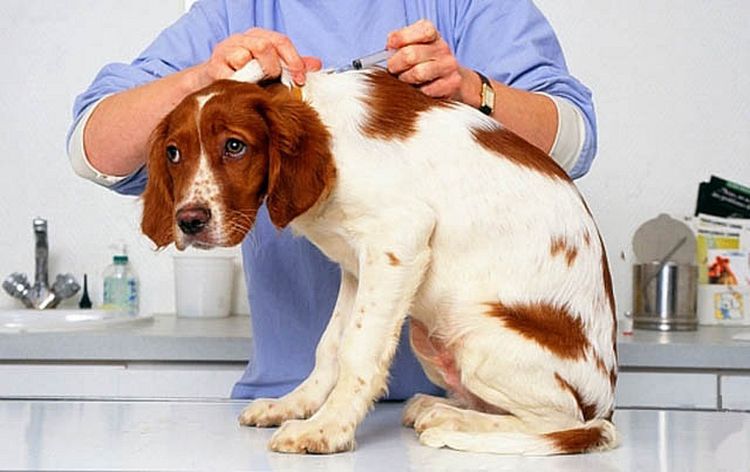
The vaccine is harmless if all animal vaccination rules and recommendations are followed. It cannot be used for therapeutic purposes; it is only suitable for preventing the development of viral diseases.
What is it used for?
According to the instructions, the Multikan 8 vaccine for dogs is used to prevent the following pathologies:
- plague of carnivores;
- respiratory diseases caused by adenovirus;
- enteritis caused by parvovirus;
- coronavirus enteritis;
- rabies;
- leptospirosis.
The product is used for both puppies and adult pets. Its key advantage is that it reduces the risk of developing diseases that can be fatal to pets. Furthermore, if infected, pets tolerate the disease better, have a greater chance of recovering, and recovering faster if treatment is started promptly.
What is the price?
A single dose of Multikan 8 for dogs, which consists of two bottles—one dry and one liquid—costs approximately 250-330 rubles in Moscow and other regions. You can purchase the product at your nearest veterinary pharmacy, animal clinic, or online. Since it is produced domestically, there are no shortages in pharmacies.
Application scheme
Puppies are vaccinated with Multikan 8 twice. The first injection is given at 8-10 weeks of age, followed by a repeat injection 3-4 weeks later. Many people wonder where exactly to administer this solution; it is administered intramuscularly in the thigh. The dose for puppies is 2 ml. Since puppies maintain immunity for 6-8 months, a booster shot is given at 10-12 months of age.
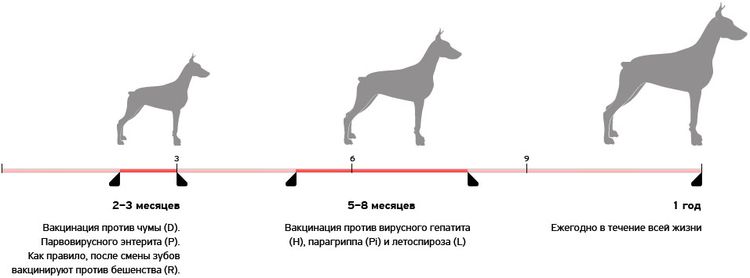
For adult dogs, use the product once a year. For large pets, use 2 ml, and for small and toy dogs, use 1 ml.
Please note! It is important to adhere to the recommended schedule. Failure to administer the vaccine promptly may reduce its effectiveness. If you miss a dose, it should be administered as soon as possible.
How is the vaccination done?
At dog vaccinations The following sequence of actions must be followed with Multikan 8:
- The liquid component must be heated to a temperature of 36-38°C. This will help the dry component dissolve better.
- The liquid in the bottle is shaken well until the sediment disappears.
- Then you need to draw the liquid component into a syringe and use it to dilute the dry component.
- Shake the ingredients well. No sediment should form at the bottom. If the sediment cannot be dispersed, siphon the solution through the syringe several times.
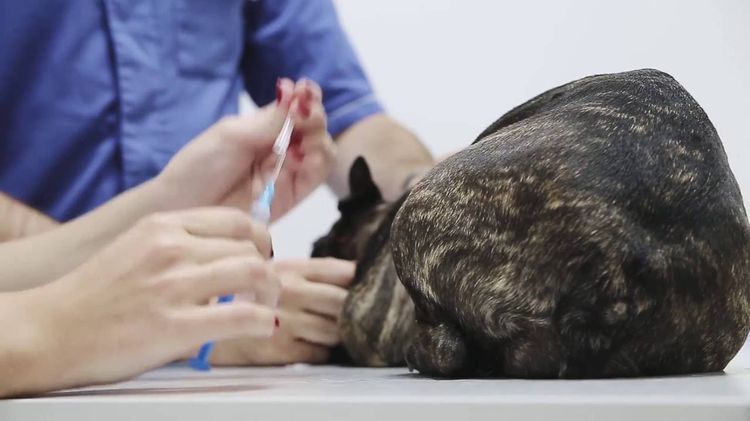
- The prepared solution is injected into the femoral muscle, after wiping the area with medical alcohol.
Before vaccination, puppies and dogs must be dewormed. This is done a week before vaccination to allow parasites to die and leave the body. The use of antiparasitic medications is necessary because the presence of worms significantly reduces the effectiveness of Multikan 8. This is because the waste products of parasites are toxins. The body focuses all its energy on eliminating these toxins from the body, rather than on building immunity against the introduced viruses.
Features of use and precautions
When administering vaccinations, it is essential to observe antiseptic and aseptic techniques. Only disposable or sterile syringes should be used for injections. If immunizing multiple animals at the same time, a new syringe should be used for each pet. Used syringes should be disposed of.
Important! Multikan 8 should be stored at a temperature no higher than 8˚C, but it should not be frozen. Storage conditions must also be observed during transportation, using a cooler bag or refrigerated container.
If the storage temperature is not correct, the vaccine should not be used. If any remaining vaccine remains unused within 30 minutes of opening, it should be sterilized by boiling for half an hour. It can then be disposed of without further precautions.
The product cannot be used in the following cases:
- the integrity of the packaging is damaged and the bottle is not sealed;
- the powder or liquid changed its color during storage;
- There is no marking or information on the bottle about the composition, name, manufacturer, or expiration date;
- the expiration date has expired.
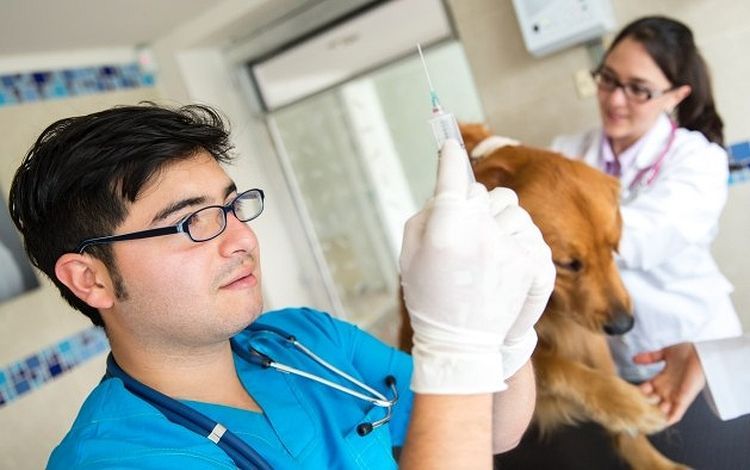
The person administering the vaccine must wear protective clothing and gloves during all procedures. If the solution accidentally comes into contact with a person's body, it must be rinsed with running water. If the solution is accidentally injected, the injection site should be cleaned with alcohol and medical attention sought.
Contraindications
The instructions state that Multikan 8 cannot be used to immunize the following categories of dogs:
- for puppies up to 2 months of age;
- for pregnant bitches in the last month of gestation;
- for females in the first month after giving birth;
- for weakened animals;
- for pets with exacerbated chronic diseases;
- for sick dogs with infectious and other pathologies.
The vaccine should not be used within two weeks after the use of drugs containing chlorine or phosphorus.
Important! Do not administer this medication in the same syringe with biologics or other medications.
Side effects
The vaccine is generally well-tolerated by animals and does not cause side effects. Even in case of overdose, it does not cause symptoms of plague, rabies, leptospirosis, or diseases caused by adenoviruses, parvoviruses, or coronaviruses.
A slight swelling may appear at the injection site. This usually resolves on its own and does not require special treatment. In rare cases, Multikan 8 can cause allergic reactions in animals. In such cases, antiallergic medications should be used.
Owner reviews
Marina, owner of mastiffs:
"I've been breeding mastiffs for several years now. I've been using Multikan 8 for vaccinations for about five years now. I like it." vaccine "It's for its broad spectrum of action—it provides protection against many diseases, and most importantly, rabies. The veterinarian recommended using the product in combination with antihistamines. No problems or complications arose."
Julia, the owner of a St. Bernard:
"Multican 8 is one of the most affordable rabies vaccines. It also protects against other dangerous diseases. Despite the price, it works perfectly. I've been using it on my dog for several years now and have always had positive results. I recommend it to all dog owners."
Margarita, owner of a toy terrier:
"Excellent protection for dogs against distemper, rabies, and other dangerous diseases. Among the advantages are its broad spectrum of action, effectiveness, and reasonable price. The Russian vaccine is as good as its foreign counterparts. My dog had no fever or other side effects."
Veterinarian Reviews
Olga, a veterinarian with 12 years of experience:
"Multican 8 is a domestically produced vaccine. In my practice, I prefer foreign products. I use Nobivac most often. I don't recommend using it on puppies, as rabies viruses can be difficult for animals to tolerate, but a veterinarian should give you specific recommendations after examining your pet."
Evgeniy, a veterinarian with 9 years of experience:
"Our clinic has long used Multikan 8 to immunize dogs. In over 99% of cases, the vaccine is effective and helps the body develop strong immunity against various viral diseases. However, this vaccine, like any medication, does not provide a 100% guarantee, so if you suspect an infection, you should immediately seek medical attention."
Read also:


20 comments
Anastasia
At 2 months and 2.5 months, we gave our toy terrier the Multitakan 6 treatment. Now we want to treat rabies and bought the Multitakan 8. How long after the Multitakan 6 treatment can we give it? Is it also given twice?
Daria is a veterinarian
Hello!
It's great that you care about your pet and have decided to get vaccinated to keep your pet healthy.
We hope you've already figured out the diagrams, but I'll still answer your question in case it's useful to someone in the future.
Multikan's vaccination schedule is quite complex. I wouldn't recommend owners administer the initial vaccinations themselves, as you don't know how your pet will react to the injection, allergic reactions are possible, and you won't be able to help. Later, when your pet is older, you can administer them yourself.
Multikan 8 contains rabies, unlike Multikan 6, and according to the vaccination schedule, rabies is administered twice, which means it requires the administration of 2 doses of Multikan 8 with an interval of 3-4 weeks.
But let me warn you again! If possible, get vaccinated at a clinic. They'll monitor your pet's condition after the shot and, if an allergic reaction occurs, they'll be able to provide prompt assistance. Allergic reactions can occur even after the fourth or fifth dose of the vaccine.
Let your tail be healthy and happy!
Anna
We gave our Multika 8 vaccine. He's a 3-year-old Chinese Crested. He's a very sensitive dog. The next day, he started licking his penis and had trouble walking. The next day, things got worse, he was whining, everything was swollen, and his eye started leaking. We went to every doctor, from a general practitioner to an ophthalmologist and a dermatologist, had all the tests and an ultrasound, and thought he might have inflammation or cystitis. They concluded he was allergic to the vaccine.
We were on treatment for a month, and he's still on a diet and wearing a collar to keep him from licking. This vaccine didn't work for us at all.
Evgeniya, Caucasian Shepherd puppy
We gave our 2-month-old puppy Multican 8. It's been 5 days now. She's lost weight, barely eats, has difficulty standing on her hind legs and whines, has a bowel movement disorder, and is snotty. What should I do?
Daria is a veterinarian
Hello! Run to the clinic and treat your puppy. There's a risk that your puppy has contracted an infectious disease. Either the quarantine period wasn't maintained until immunity had developed (2-3 weeks after the booster vaccine), or you brought the infection in from outside, or the puppy contracted it at the clinic while waiting for its vaccination. In any case, treatment is necessary.
Galina
Hello, Daria! My Toy Terrier got his vaccination yesterday, and he's whining badly and afraid to stand up. He's never had it before. What should I do?
Irina
We had a Multican injection done on April 14th. A week has passed and the bump hasn't gone away. We don't know what to do.
Daria is a veterinarian
Hello! If the lump isn't growing and isn't painful, don't panic. Sometimes the process can drag on for several weeks, rarely longer than a month. In rare cases, the lump may remain permanent. The main thing is to ensure that the lump doesn't grow and doesn't bother the animal.
Irina
Last year the dog felt bad after this vaccine, at first
Vomiting, then hair loss for six months and treatment, of course I agreed myself when the doctor suggested this vaccine, I used Nobivac before, I will not use this nasty thing anymore, I have friends who also suffered from Multikan
Marina
My Pomeranian weighs 7.7 kg. I gave him the full dose of Multkikan 8. The syringe contained just over 1.5 ml. We injected him into his hind thigh. Now he's pulling up his paw and limping. What should I do? Did I overdose?
Daria is a veterinarian
Hello! No, you didn't exceed the limit. You most likely just hit a nerve. This is not uncommon; even experienced vets can miss a nerve if the animal is twitching or straining the muscles of a limb. It will heal, and within 2-3 weeks, the lameness will disappear. Don't worry.
Andrey
We gave Multikan 8 vaccine to three toy terriers, two are fine, but the third is limping.
Daria is a veterinarian
Hello! It's possible the needle hit the puppy, or the vaccine itself is compressing a nerve, causing the lameness. It's important to note whether the puppy is limping or actually limping severely. These are two different things. If the puppy is limping slightly, it will likely "get going" within a week or two. If the puppy is limping severely, there's a risk of hitting the sciatic nerve or another major nerve (depending on the injection site), which is more serious and requires a consultation with a neurologist. However, most likely, these puppies have very little muscle mass in their thighs, which makes it difficult to administer intramuscularly without causing any side effects (puppies fidget, may twitch their paws, tense their muscles at the injection site, or get startled, which can cause the needle to veer slightly off-target).
Irina
We vaccinated our one-year-old Yorkie and he was screaming like crazy! 12 hours have passed and he still won't put his foot down and screams if he touches it.
Daria is a veterinarian
Hello! It's possible your pet may have tense muscles due to fear, and the injection may have hit a nerve. He may also be limping. This usually resolves on its own within 7-14 days. You can apply heat, but massage is not recommended due to the pain. Swelling at the injection site is also possible. Every pet is different.
Lyudmila
The question remains: how to breed for small dogs? The vaccine's instructions for use are not clear enough.
For small dogs, we make it (like Hexacanivak): we take 1/2 fl. (1 ml) of the liquid component for small dogs, add it to the dry component, and inject everything?
Or do we administer 2 ml of the liquid component dry and give small dogs (up to 5 kg) half a bottle (1 ml)?
Daria is a veterinarian
Hello! Everything is simple and clear. However, vaccination should be performed by a veterinarian, who will examine the pet before administering the biological product. Also, the animal should be observed for 15-20 minutes after vaccination to prevent the development of an allergic reaction (due to individual hypersensitivity to one of the vaccine components).
So, the vaccine itself (the dry "viruses") is the dry residue in the vial, and the second vial of liquid is the diluent. Therefore, 1 ml of the READY SOLUTION is injected. Everything is diluted as directed: all the diluent is used for dissolution. Then, 1 ml of the prepared solution is injected. If you take 1 ml of the diluent and inject the entire diluted solution, the resulting 1 ml of solution will essentially contain the same concentration of viruses, meaning there's simply no point in reducing the dosage from 2 ml to 1 ml.
Olga
Draw up 2 ml of the liquid component and add it to the ampoule containing the dry substance. Stir. Draw up 1 ml into the syringe and discard the rest.
Olga
We administered Multican 8, and the dog had a fever, diarrhea, and lethargy for four days. It all went away, but the doctor warned about possible side effects.
Daria is a veterinarian
Hello! Any vaccination can cause minor side effects, such as lethargy, refusal to eat, and a slight increase in body temperature. Puppies and kittens are just like babies and react to vaccinations the same way human children do. Adults, too, are likely vaccinated (you've probably had flu shots too), and a fever can also occur. The vaccine contains a weakened virus. It won't infect your dog, but it will stimulate the immune system (without this stimulation, antibodies won't develop). Such side effects are considered normal for up to three days.
Add a comment