
MRI of the brain in a dog: what is the procedure for and how much does it cost?
In veterinary practice, accurate diagnostics often play a more important role than in human medicine. While a person can describe their sensations and pain in detail to a doctor, when treating dogs, a specialist relies solely on their own experience and the results of previous examinations. In this context, MRI in some cases provides the most informative data and significantly improves the accuracy of the examination.
Content
Why do you need to do an MRI of your dog's head?
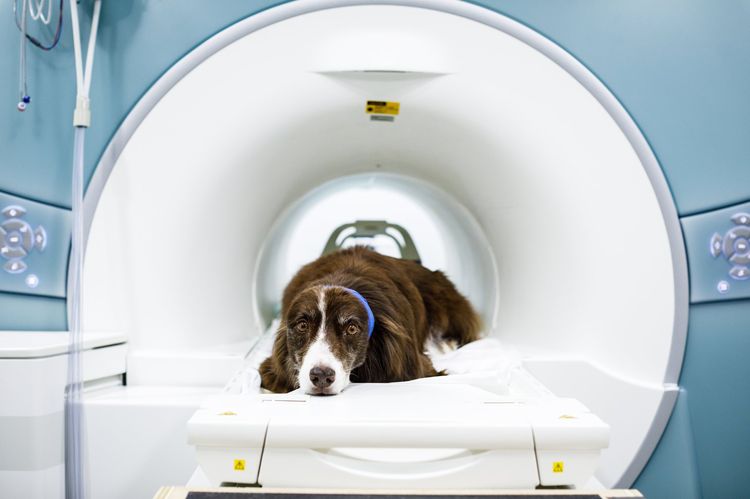
Magnetic resonance imaging (MRI) uses electromagnetic fields to examine soft tissue, particularly those inaccessible to other diagnostic methods due to their location. Therefore, MRI examination of the head in dogs is an indispensable method, allowing for the detection of tumors, vascular abnormalities, and changes in brain structure long before external symptoms of disease appear.
MRI of the head is indicated for dogs in the following cases:
- Nervous system lesions. MRI allows for examination of nerves, identifying pathological activity in specific areas and degenerative lesions of the brain.
- Blood supply problems. Images can show the intensity of blood supply to different areas, the condition of the vessel walls, the presence and location of pathologies, and the size of aneurysms or cholesterol plaques. Any congenital or acquired disorders can cause serious consequences, including rupture of aneurysms or plaques, leading to heart attack, stroke and fatal outcome.
- Inflammatory tissue changes or suspicion of oncology. The presence of pathology (inflammatory processes, oncological tumors) The tomograph determines this by the increased metabolic rate in the affected area: the altered cells begin to divide uncontrollably, thereby consuming more energy.
This diagnostic method allows for a spatial image (anatomical cross-section) of the object being examined in black and white. With a thorough understanding of anatomy, the veterinarian can detect any pathologies that cause structural changes.
Advantages of MRI:
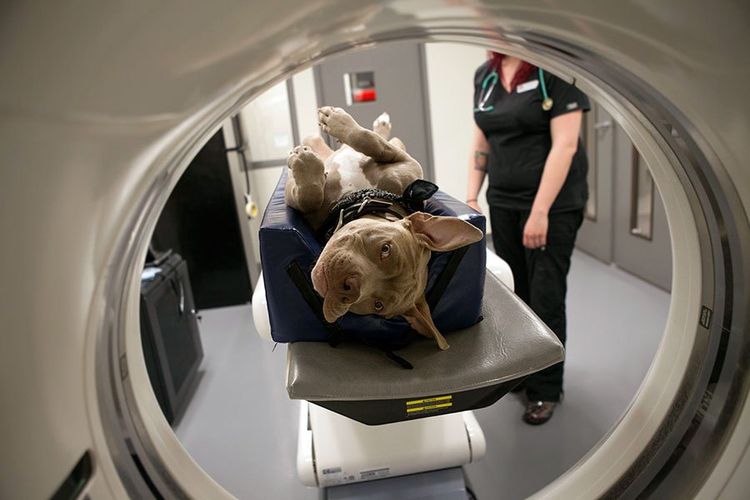
- Non-invasive (no damage). Compared to computed tomography, MRI does not use ionizing radiation.
- High-contrast resolution soft tissue images. This allows for the detection of even the slightest tissue differences.
- Precision and informational. The equipment allows for cross-sectional views in all possible planes and the detection of pathologies as small as 2 mm.
- High penetrating power due to uniform penetration of the object under study by a magnetic field.
But the procedure also has a number of contraindications, including obesity, intolerance to anesthetic drugs and the presence of metal implants (screws or pins in bones, pacemakers).
How does the procedure work?
An MRI of the head in dogs requires the animal to remain completely still throughout the procedure. The animal must lie still during the scan, otherwise the entire series of images will be unreadable. While humans are capable of remaining still for extended periods, the same cannot be required of an animal. Therefore, general anesthesia is required for the scan.
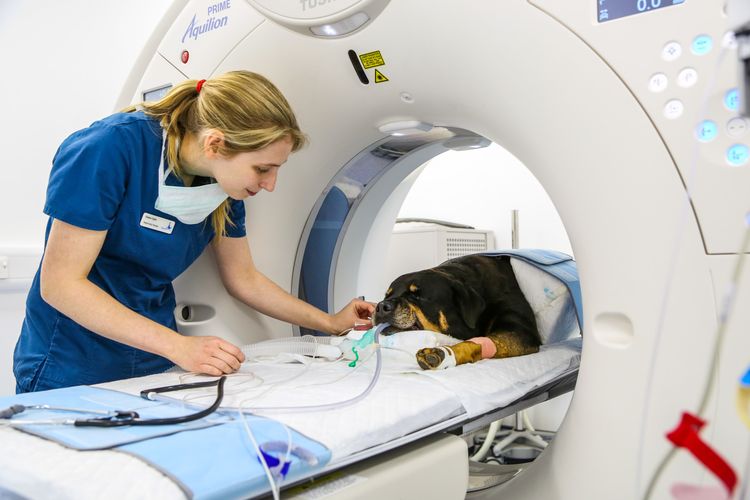
Although the most gentle forms of anesthesia (gas or short-acting intravenous sedatives) are typically used for dogs, their use is always associated with risk. Induction of anesthesia requires preliminary preparation and the exclusion of respiratory and cardiovascular diseases before administering medications.
These complexities are the reason why MRI scans for dogs are significantly more expensive than similar scans for humans. As a result, the scan takes about 15 minutes for humans, while for dogs, it takes 40-60 minutes.
Advantages of MRI
- Penetrating ability - the magnetic field penetrates the patient's body evenly and imperceptibly, with only metal elements being an obstacle.
- Non-invasive—the method does not involve needles or surgical instruments and does not involve ionizing radiation. To date, no negative effects of magnetic fields on living organisms have been identified.
- High soft tissue contrast - the main advantage of MRI is its excellent contrast resolution, which allows detecting even the smallest differences between tissues.
- Accuracy – the equipment provides detailed and accurate images of the areas being examined.
- Informativeness - the method allows studying sections of organs and tissues in any plane.
How much does an MRI cost?
Prices at Moscow clinics offering brain MRIs for dogs start at 5,500-6,000 rubles. Anesthesia costs range from 1,600 to 3,400 rubles. The final price will be affected by the pet's weight and the need for contrast agents to enhance visualization of the tissue being examined. In the latter case, an additional 2,500-3,500 rubles should be added to the price.
Following the examination, the dog's owner receives the results recorded on a CD with a full description of the clinical picture and diagnosis, based on which the most optimal treatment plan can be selected and, if necessary, surgery can be recommended.
Thus, an MRI of a dog's brain is a reliable, sometimes indispensable, diagnostic method in the hands of a competent veterinarian. However, it should be performed promptly and only when indicated, so that the costs are worth the desired results. This procedure allows for an accurate diagnosis, which is the key to a quick recovery and a full life for your pet.
Read also:
- Pinched Nerve in Dogs: Symptoms and Treatment
- Anemia in Dogs: Symptoms, Causes, and Treatment
- What kind of nose should a healthy dog have?


Add a comment