
Can a cat be spayed during heat?
When you decide to get a cat, decide immediately whether you expect to have offspring. If not, to spare the animal the unnecessary stress that is inevitable during estrus in female cats and heat in male cats, you should consider deferring the animal's fertility (the ability to reproduce). Otherwise, you'll have to accept the territorial nature of sexually mature cats and, from time to time, tolerate a screaming creature day and night instead of a gentle and well-balanced pet.

Content
Types of defertilization of cats
Hormonal pills can be used to stop a male or female cat from going into heat. However, they must be administered every time the animal enters estrus, which is almost monthly and lasts from 6 to 20 days. Medication is bound to have a negative impact on your pet's health: even infrequent use of pills also increases the risk of developing genitourinary diseases. Therefore, veterinarians recommend surgical methods of ending the animal's reproductive capacity, such as spaying or neutering.
Research confirms that neutered and spayed animals live 1.5–2 years longer than their unevalded counterparts. Surgical defertilization significantly reduces the risk of ovarian inflammation or cysts in female cats and prostatitis in male cats.
In medicine, sterilization refers to the ligation of the fallopian tubes in females and a vasectomy (severing the spermatic cord) in males. After this procedure, animals lose the ability to reproduce, but the production of sex hormones is preserved. For this reason, sterilization is primarily used as a contraceptive. Castration, which involves the resection (removal) of the reproductive organs, can completely rid a cat of its sexual instinct.

In cats, the ovaries are removed (ovariectomy surgery) or the ovaries, uterus, and fallopian tubes (ovariohysterectomy surgery). If it is abdominal, not laparoscopic surgery, it is performed under general anesthesia. In male cats, the testicles are removed and the spermatic cord is ligated. This requires only an incision in the scrotal skin, so the procedure is usually performed under local anesthesia.
In everyday life, it is common to use the term “sterilization” when removing the ovaries and uterus in cats, and “castration” when removing the testicles in cats.
When can a cat be spayed?
Cats typically begin to go into heat at 6-8 months of age, and male cats reach sexual maturity at 7-9 months. It's best to spay or neuter cats when they're finishing their heat cycle. the process of puberty, that is, at 5-7 months. At this age, the animal's body is already strong, and it can easily tolerate the surgery. Defertilization of young cats significantly reduces the risk of tumor formation and inflammatory processes in the future.
Some veterinarians practice early spaying of cats, at 2-3 months of age. This procedure is recommended for cats over 8 years of age only if indicated (for example, if there is a uterine tumor or purulent ovarian cysts). Older animals tolerate anesthesia much less well and have a slower recovery.
Most often, cats are spayed between heat cycles, but many veterinarians believe that it is perfectly acceptable to do this during estrus as well.
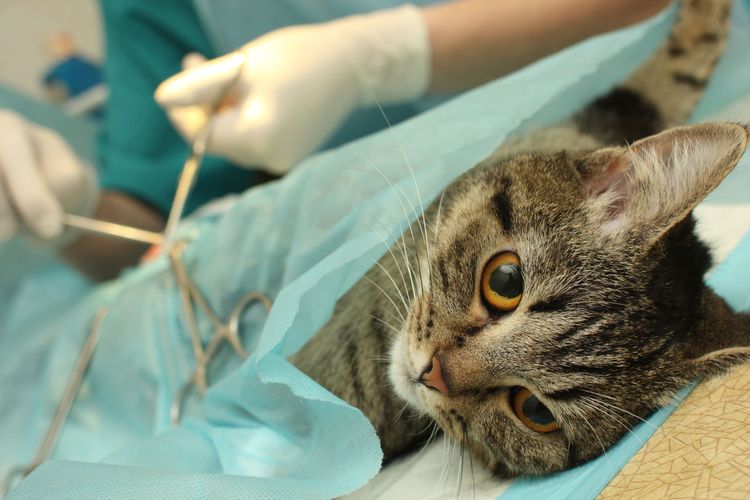
Sterilization during heat: veterinarians' opinions
Veterinarians both support and oppose spaying cats in heat. Most opponents of the procedure during heat cite the risk of bleeding due to increased uterine tone caused by dilated blood vessels as the main argument. However, experience shows that blood loss is no different between spaying during heat and spaying outside of heat.
When deciding when to spay, consider several factors. If your pet is not in good health, has a weak immune system, or is no longer young, it's best to perform the surgery a week after the end of a female's estrus cycle or a male's heat cycle. However, sometimes a female cat goes into heat several times a month, exhausting her body with frequent hormonal fluctuations. In these cases, it's not advisable to "take a break" between heat cycles.
Currently, many veterinary clinics perform spaying and neutering of cats using microlaparotomy (entry into the abdominal cavity is performed through small incisions) and laparoscopy (access is through a puncture in the abdominal wall). These minimally invasive methods minimize surgical risks, making it possible to spay cats during heat without any concerns for their health.
Read also:
- How to prepare a cat for sterilization
- DIY cat bandage after sterilization
- An alternative to sterilization of cats


Add a comment