
Can dogs eat cheese?
Most dog owners enjoy treating their pets with homemade treats. But it's important to know whether they're harmful to their pet's health. For example, can dogs be given cheese, which most canines are partial to, and if so, what kind and in what quantities.

Content
Experts' opinion
Cheese is a fermented milk product rich in nutrients, including those essential for dogs' health, including energy reserves and the normal functioning of organs and systems. Cheese contains high-quality protein, phosphorus, calcium, zinc and other trace elements, vitamins B, A, D, C, and PP, as well as essential fatty acids.
However, using cheese in dog food on a regular basis is not recommended, as it can cause allergies or disrupt the functioning of the gastrointestinal tract and other internal organs.
Hard cheeses contain large amounts of salt, various additives, and spices that are contraindicated for animals. Regular consumption of these foods can overwhelm the animal's liver and pancreas. Veterinarians recommend introducing cheese into dogs' diets infrequently, primarily as a reward, a stimulus to reinforce learned skills, or to improve the animal's emotional state during stressful situations.

As for whether it's safe to give cheese to a puppy under one year old, the answer is clear: absolutely not, even in minimal doses. For an immature body, this product can be toxic.
What kind of cheese can you give to dogs?
Cottage cheese, a product of milk fermentation by lactic acid bacteria, is the most easily digested cheese. Of the hard varieties, dogs can be given low-fat and low-salt cheeses (Dutch, Russian, Adyghe, Gaudette, Tilsit, Edam), as well as semi-hard whey cheeses such as Mozzarella, Ricotta, and Suluguni. Their fat content is no higher than 45%, and their salt content is up to 800 mg Na per 100 g.
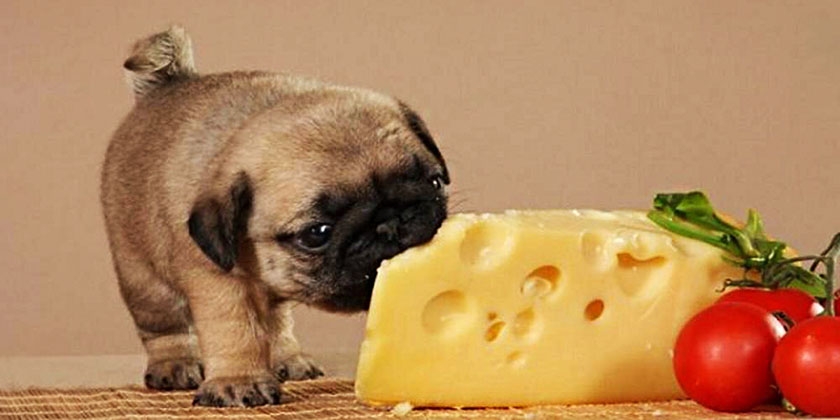
If your pet experiences flatulence or mild digestive upset after eating a piece of cheese for the first time, this may be due to natural fermentation processes that accelerate the evacuation of intestinal contents. This condition is usually short-lived and does not require treatment, but veterinary supervision is still advisable.
What cheeses are prohibited for dogs?
The following cheeses are absolutely prohibited:
- Blue cheeses (Brie, Le Bleu, Camembert, British Blue). Spores of the Penicillium mold found in these cheeses produce mycotoxins that are dangerous to dogs.
- Smoked. Any cold or hot smoked products are contraindicated for dogs, as the substances used in their preparation can be toxic to animals.
- Pickled. Excess salt can irritate the gastrointestinal tract, increase thirst, and lead to kidney disease.
- Processed foods. They contain a lot of salt and additional ingredients: hydrocolloids, colorings, flavorings, preservatives, and antioxidants. Furthermore, due to their viscous consistency, this product can cause indigestion and constipation.
- Delicatessen cheeses (Babybel, Roemer). These cheeses contain synthetic additives and spices, and their fat content exceeds 60%.
- Cheese products. They contain almost no milk, are made from palm and coconut oils. When converted into trans fats, these oils can cause poisoning or allergies in dogs.

In some cases, dogs should not be given cheese, even approved varieties. Contraindications include:
- diseases of the gastrointestinal tract (gastritis, colitis, peptic ulcer);
- diseases of the pancreas or liver: hepatitis, pancreatitis, cirrhosis;
- kidney problems;
- lactose intolerance;
- allergy to dairy products;
- recent surgery;
- a tendency to obesity or its presence.

How much cheese can you give a dog?
Dogs can be fed cheese safely in amounts of 20-30 g per 10 kg of body weight (this is the daily norm). Calculations show that for small breeds, this norm is 5-10 g, for medium breeds – about 25-30 g, and for large breeds – 50-70 g. This is approximately the amount a person would eat in a sandwich.
Read also:


Add a comment