
Can a cat eat her kittens?
Animals have a highly developed maternal instinct, so the question of whether a cat can eat her kittens often leads to confusion. Does such a thing actually happen, and why does nature allow such behavior?
Content
Reasons
Many people know about the evolutionary factor known as natural selection from their school biology curriculum. It is most often the reason why cats kill their kittens. There are also a number of other factors that drive animals to kill.
Maternal instinct
Many people are familiar with the situation when, after the birth of kittens, their mother becomes aggressive and protective of her offspring. Animals have a very strong maternal instinct. In nature, for example, a cat hides her offspring from prying eyes for a long time and cares for them until the kittens become independent. However, it turns out that maternal instinct is not only beneficial for the babies but also sometimes a cause of death.
During pregnancy, animals are not screened for genetic abnormalities, so only after the kittens are born can we judge the health of the litter. Animals are their own diagnosticians. A mother immediately sees which of her kittens is born sick, so she tries to get rid of it as quickly as possible. In the wild, a female cat simply abandons her kittens, but in captivity, she eats her newborn kittens. Why can't she simply abandon them and not feed them? The answer to this question lies once again in the highly developed sense of responsibility for her offspring. For a mother, abandoning a kitten is extremely stressful, so the animal deals with this situation in a drastic manner.
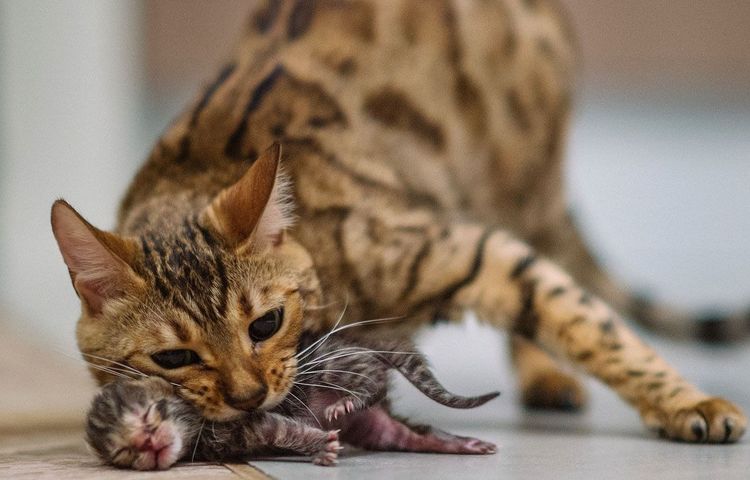
Sometimes owners report that a week after birth, all was well, the mother was caring for her kittens, and then one day, some of the kittens are missing or found dead. One cause of inappropriate behavior is a lack of milk. In this case, the mother decides which kittens to keep and which to kill, as she can't waste milk, so valuable for healthy kittens, on a weak and sick sibling. Scientists still don't understand how a mother determines the viability of her kittens.
When there is a person nearby
No matter how much an owner cares for their cat and her kittens, a human will always be a surplus in a cat family. Some animals are extremely sensitive to human contact with their newborns. A foreign scent can completely destroy their maternal instinct. A kitten that has been handled by a human may be perceived as a stranger and attempted to be discarded. This also explains why cats eat their own kittens born by cesarean section. Instincts play a major role here: without a natural birth, there's no activation of the maternal instincts. For the same reason, cats often refuse to nurse other cats' offspring, although dogs do so without issue.
First-time cats
Studies have shown that first-time mothers are the most aggressive toward their offspring. This is due to hormonal changes, which cause selfishness to overwhelm maternal instinct. This happens most often with pets. A pet's love is its purpose in life, so sharing it with another person is not something anyone wants to do, even if that someone is your own child. To prevent this, owners should observe their pet. during childbirthIf the cat licked the first kitten after it was born, then everything will be fine with the rest, but if it growls and attacks, then it is better to take the baby away from such a bad mother.
The fate of fate
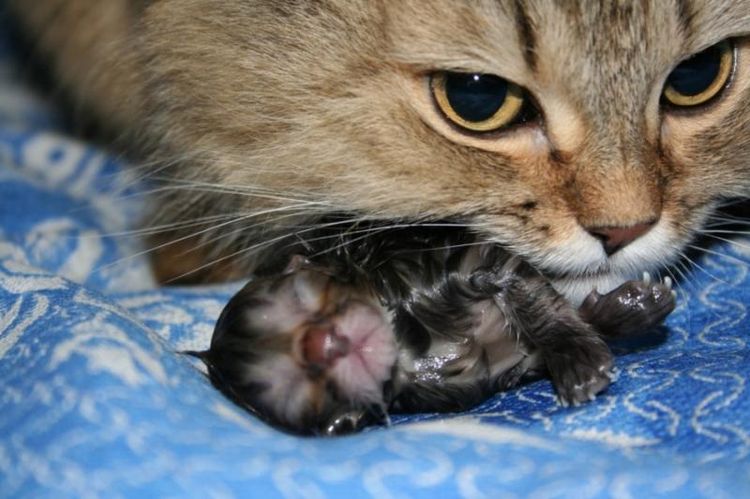
After birth, animals always eat the afterbirth and the dead kittens. Sometimes, due to shock, the animal's system malfunctions, and the new mother confuses the dead kitten with a living one or gets carried away with the afterbirth and consumes the kitten along with it. To prevent this, the owner should be nearby. There are cases of a mother mother injuring her kittens by chewing the umbilical cord.
Cat dads
Fathers sometimes behave even more strangely than mothers. Experts are trying to understand the root of the problem.
- Competing for a female cat's attention. Male cats understand that the "female" will be completely absorbed by her offspring after giving birth, so they do everything they can to get rid of rivals. After the pups die, the mother quickly returns to heat and is ready to mate again.
- All the best for your children. This is clearly demonstrated by cats in catteries, who eat other cats' cubs and make room in the sun for their own.
- The struggle for dominance. Just as female cats determine the viability of their kittens, male cats clearly distinguish between kittens of the same sex. Eliminating the leader—the alpha male—is the male cat's goal. This is especially evident in the case of domestic animals.
Cannibalism is not unique to cats, but to many other animals as well. Some use it to regulate their population, while others demonstrate natural selection. In domestic animals, it seems unnatural, so the only way to prevent inappropriate behavior is by caring for your pet before and during labor.
Read also:
- How many kittens does a cat give birth to for the first time?
- Bleeding in a pregnant cat: what to do
- How does a cat behave after mating?


2 comments
Marina
My cat tore her last kitten to pieces today. I'm in shock; all that's left are her paws and part of her head. She was already big, ate on her own, and used the litter box at one month old. And two days ago, she strangled three of them. We thought it was the male cat. But the female cat was the only one with the last kitten. The kids named her Lucky, and then this happened. She caused a complete slaughter. The kids and I are in shock. I don't know what to do with her now.
Maria
My cat is pregnant for the third time.
When she gives birth, prepare a box or bed for the kitten somewhere secluded, like under a bed, and place her there often. This will help her get used to it and encourage her to give birth there. Stay close to her when labor begins. Stroke her belly and watch if the bladder hasn't burst; break it yourself. Otherwise, the kitten will suffocate. After the bladder has burst, gently shake the kitten's head downwards until her belly begins to swell and she stops trying to meow, and only then give her to her mother. This will reduce the chances of her eating her. I nursed one beautiful kitten this way, and she grew up beautiful. I've experienced all of this firsthand.
Add a comment