
Manx (Manx cat)
About the origin of the tailless cat breed Manx (Manx cat) There are several theories. One theory holds that they appeared on the Isle of Man after the Phoenicians landed, while another claims they were brought by the Spanish in the late Middle Ages.
Content
History of the breed's origin
It's hard to say which of these versions is correct, but the important thing is that once you adopt this friendly breed, you won't trade it for any other. Legend has it that tailless cats have been around since the time of Noah. It was the cat that boarded the ship at the very last row when the door was already closing.
Unfortunately, or fortunately, this door pinched her tail, resulting in the emergence of tailless cats. But, in fact, the taillessness of this breed is due to a mutation that occurs when cats of the same species mate over several generations.
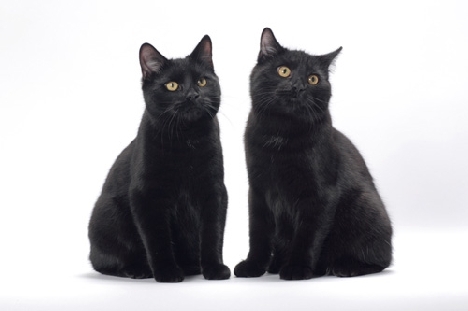
The persistent genetic change affected more than just the animal's appearance. The Manx cat breed has a high litter mortality rate. And if only one breed is crossed, the resulting offspring are not viable. For this reason, Manx cats are crossed with European shorthaired cats.
In their homeland, the breed's popularity was aided by a belief. Locals considered the cats to be harbingers of good fortune. For this reason, Manx cats were protected and adored. The breed emerged from its native habitat in the 1930s and has since successfully conquered America and Europe.
General characteristics of the breed
By depriving Manx cats of a tail, nature compensated for the deficiency with added charm. Therefore, Manx cats are characterized by a mischievous glint in their eyes, beautiful short fur, and a gentle purr.
Cats have been recognized as a breed for a long time. The main controversy centered on the standards. The body and head shape were specified, but only the coat color remained undisputed. Initially, all color combinations except Burmese and Siamese were accepted.
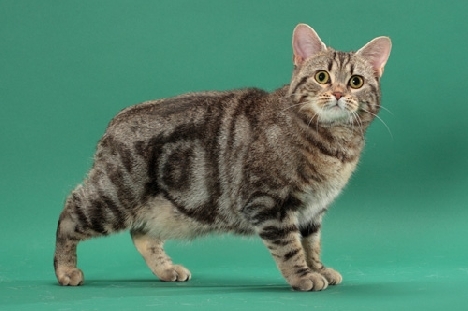
Manx cats are a medium-sized breed. They are characterized by a short, slightly raised back. Another distinctive feature is their gait. The difference in the length of their front and hind legs gives the breed a distinctive rabbit-like gait.
What does a Manx kitten look like?
In appearance, it's like a big balloon, only fluffy. The Manx is rounded throughout: paws, eyes, head, body. While roundness should remain within certain limits, it's still better than an elongated body, which is unacceptable for the breed.
Adult males can weigh up to 5 kg, while females weigh no more than 4 kg. They have a sturdy body and rounded paws. A fairly large head sits on a relatively short neck. The nose is medium-length, the chin is slightly defined, and the cheeks are well-developed. The ears are set high and slightly pointed.
The Manx breed has large, oval-shaped eyes, the color of which depends on the coat color. The Manx breed has a soft, dense, medium-length coat with a dense undercoat.
The Manx cat feels like a teddy bear to the touch. This sensation is achieved by its double coat. The outer coat of these cats is designed in such a way that the outer hair is slightly longer than the undercoat and does not lie flat against the body.
Various colors are permitted except chocolate, acromelanic, and lilac. The Manx cat may have no tail at all, a tail rudiment, a short tail, or a full tail.
If you don't plan to take your pet to shows, then having a tail isn't really important. But if you want to make your Manx famous, the absence of a tail will be a major advantage.
Based on the presence or absence of a tail, cats are divided into four classes:
- Rumpy – the tail vertebrae are completely absent.
- Riser – there are barely visible or hidden coccygeal vertebrae.
- Stumpy – the tail is slightly visible, it’s literally a couple of three vertebrae bent into a hook.
- Tailed – a regular tail, can be curled into a hook.
Character
By character of the cat breed Manx They are very friendly, sociable, gentle, and charming. They are characterized by a slight playfulness. They are very affectionate, get along well with families, and quickly find common ground with other pets. At least if people behave friendly towards them.
Using their strong hind legs, Manx cats indulge their curiosity by exploring the highest places in the house.
Besides this, cats love affection very much, they like it when their fur is gently stroked, when they pay attention to them. Tailless The pets are obedient and calm.
Even the lack of a tail doesn't stop the Manx cat from expressing emotion. It compensates for this deficiency with other means at its disposal. For this purpose, the cat has paws, the ability to purr, and whiskers.
Manx cats are very fond of children, which is not surprising. After all, cats don't experience such dubious pleasure as tail pulling.
Their favorite pastime is watching water. Even though Manx cats don't like to bathe, they can spend hours watching running water. They enjoy watching water running in the toilet, and to prolong their enjoyment, they can even learn to flush the tank themselves.
Another characteristic of Manx is that they are excellent rodent hunters and agile fishermen.
It's not for nothing that they say tailless cats worked as rat catchers on pirate ships. The little robber retained some of his seamanship, but he also lost a few. This cat can easily catch a mouse, but he's completely forgotten how to climb trees. Despite their rather heavy build, they are quite playful and agile.
Care
Grooming a Manx cat is easy. Their amazing charm always encourages owners to brush their fur periodically. Once a week, clean their eyes with a swab lightly dipped in herbal tea.
Use cotton swabs to periodically clean their ears of wax. Remember, this breed doesn't like bathing, so if you decide to bathe them (which should be done once a week), be careful—they may extend their claws. Most importantly, Manx cats need a balanced diet.
Feature Manx The kittens grow rapidly. In just a few months, they already look like adults.
So remember that they need vitamins and calcium. Tailless Manx cats reach adulthood around three years of age, but this doesn't affect their sex life.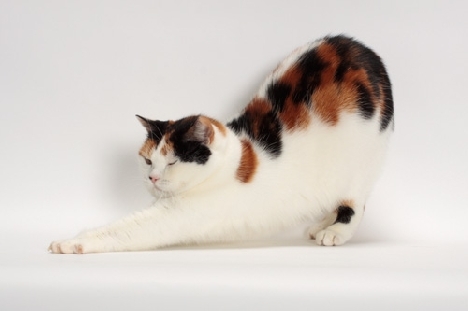
Representatives of this breed can become "mother" or "father" as early as seven months of age. If you need to spay or neuter, the best age for female cats is six months, and for male cats, nine months. It's not recommended to spay or neuter male cats before this age, as it can have detrimental effects on them.
Feeding
You wouldn't call a Manx a spoiled aristocrat who ate whatever he was given. But you understand that good health depends largely on proper nutrition.
When it comes to store-bought food, it's best to feed your Manx premium products. If you decide to feed your pet homemade food, avoid the following:
- whole sea fish;
- river fish, legumes;
- raw eggs.
On the contrary, try to feed your animal fermented milk products, offal, cereals, and lean meat.
Health
The main health problem in Manx cats is a gene that, while it gives them a beautiful appearance, also puts them at risk for spinal problems. Furthermore, the gene responsible for a short tail can even be fatal. Kittens that inherit this gene from both parents often die in the womb. But even those that inherit this gene from only one parent are susceptible to spinal problems.
These can include fused vertebrae, spina bifida, or colon damage. Typically, the syndrome manifests itself in the first month of life, but in some cases, it manifests later in life.
When buying a Manx cat, look for weakness in the hind limbs or obvious difficulty walking. Manx This is the genetic nature of this breed and is not necessarily the result of poor breeding. It should be noted that this description of the predisposition to the disease is characteristic of the breed as a whole, but each individual cat is unique.
Video review of the Manx cat breed
Read also:


Add a comment