
Mekong Bobtail: male and female cats
Mekong Bobtail – a relatively young cat breed, developed primarily by Russian breeders. The breed is related in appearance and history to the better-known Siamese cats, but has a number of differences. Their most striking individual trait is their taillessness. Or rather, they do have a tail, but it's very short and always kinked, creating a distinctive curl. These Siamese cats have a brightly colored coat. with blue eyes and friendly nature will be an excellent choice for any family.
Content
History of origin
The Mekong Bobtail is both a new and very ancient oriental cat breed. A manuscript depicting a Siamese-type cat dates back to the 14th century and is housed in a Bangkok museum. However, the breed was only officially recognized in 2004. But first things first.
Many legends are associated with Siamese cats in their historical homeland. One tells that for centuries, these blue-eyed, dark-faced animals lived in palaces, guarding treasures and accompanying princesses on walks. Cats with curled tails were especially important. When bathing, young women would remove jewelry and hang it on their tails; the special structure of their tails prevented rings and earrings from falling to the floor or getting lost.
The history of the Mekong Bobtail breed is closely linked to the origins of the Siamese and Thai cats. Native cats from Siam first arrived in Europe in the late 19th century. In 1884, they were brought to England by Suan Good, an official at the British consulate in Bangkok. The ambassador claimed that the pair had been given to him by the king of the overseas kingdom himself. Around the same time, the first cats arrived in America, having traveled from present-day Thailand across the ocean to the New World. Many of these animals had kinks and hooks in their tails, a hallmark of royal cats, but breeding efforts focused on culling those with "flaws." This distinctive trait and the distinct breed might have been lost if not for enthusiasts (particularly from Russia) who spent many years supporting the population.
Besides those first Siamese, many more bobtails were exported from Southeast Asian countries. Short-tailed pets are common there. Indeed, their modern name reflects their origin: the Mekong, a long river on the Indochina Peninsula that flows through several countries:
- Burma;
- Laos;
- Vietnam;
- Cambodia;
- part of China and Thailand.
The ancestors of many modern lines were brought from these countries.
While developing the breed, breeders had to include animals with short tails of unknown origin, but they first underwent rigorous selection. Some believe that Thai cats with kinked tails were involved in the Mekong's development, but major clubs maintain that such matings were not performed because they were unjustified. The resulting kittens were completely unsuitable for the breed's type. Today, any crossbreeding of Mekong Bobtails is prohibited.
The first standard for the Thai Bobtail breed (as the Mekong was previously known) was developed by Olga Sergeevna Mironova, a breeder from St. Petersburg. Thanks to her many years of work, it was approved at a seminar of felinologist experts on aboriginal cat breeds in December 1994 and was only slightly adjusted at a meeting of the board of felinologist experts in Moscow in 1998.
The breed was presented in 2003 at an international exhibition organized by Royal Canin. Thirty animals from various breeding lines were on display. A year later, the name was changed to the Mekong Bobtail to avoid confusion with the Thai.
Today, over 300 Mekong are registered with clubs in Russia, Latvia, Belarus, Germany, and Poland. The majority of the population is in Russia, particularly the Korgorushi club. Other well-known clubs for this breed include:
- Bast (Kursk);
- Kotofey (Saint Petersburg);
- Triumph (Tver);
- Aurinko (Petrozavodsk).
Appearance and standards
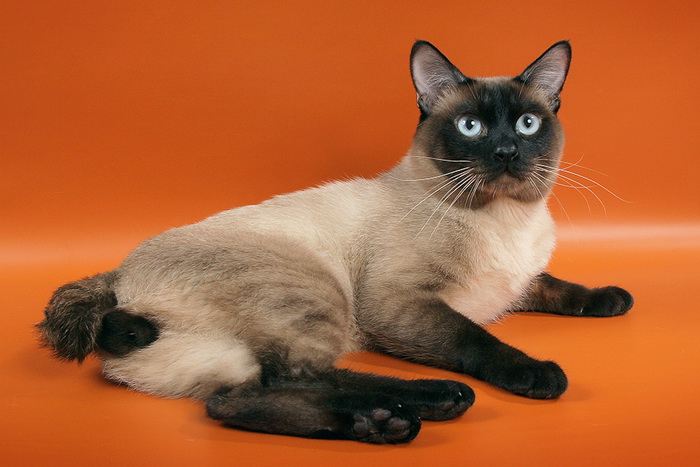
Mekongs are unique, medium-sized, shorthaired, pointed cats with an elegant build and a short, tufted, or pompom-shaped tail. Males are much larger and more powerful than females, weighing an average of 3.5-4 kg, while females weigh no more than 2.5-3 kg.
Head and muzzle
The cats' heads are smoothly contoured, almost flat on top. The oval shape of the muzzle is accentuated by the heavy lower jaw and chin. The ears are set slightly back, high, and wide at the base with slightly rounded tips. The eyes are large and expressive. A characteristic feature is the more rounded lower eyelid, indicating a close relationship with other Thai cats. Overall, the cut can be described as slightly slanted. Only one color is permitted: intense blue.
Body
The Mekong has a strong, muscular, yet graceful body of medium size. Its back is straight, with a slight arch toward the croup. Its legs are long and have soft, oval-shaped pads. A notable feature of its appearance, besides its tail, is that the claws on its hind legs do not fully retract, so when the cat walks on a hard surface, such as laminate flooring, it makes a distinctive clicking sound that is uncommon in other cat breeds.
Tail
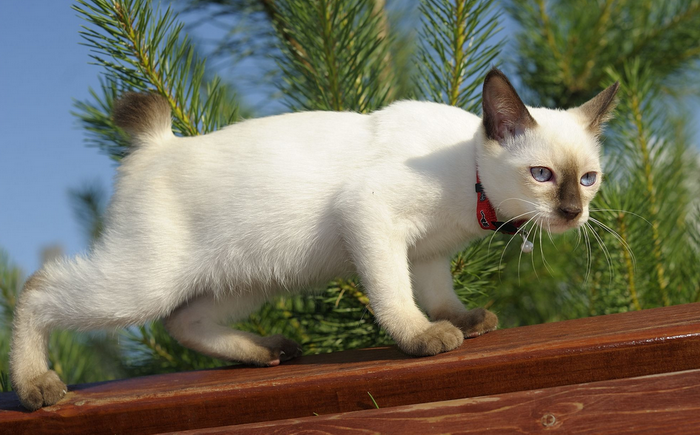
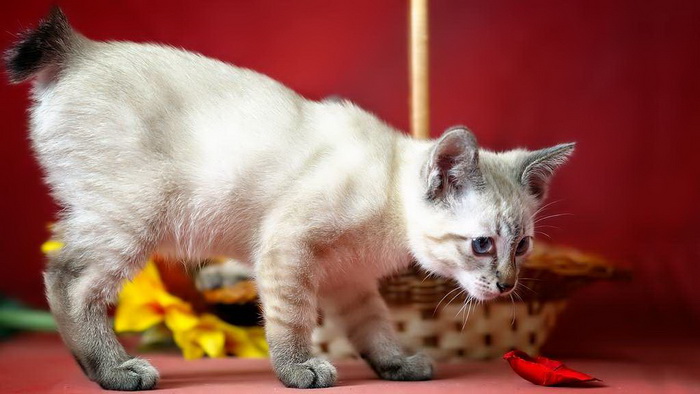
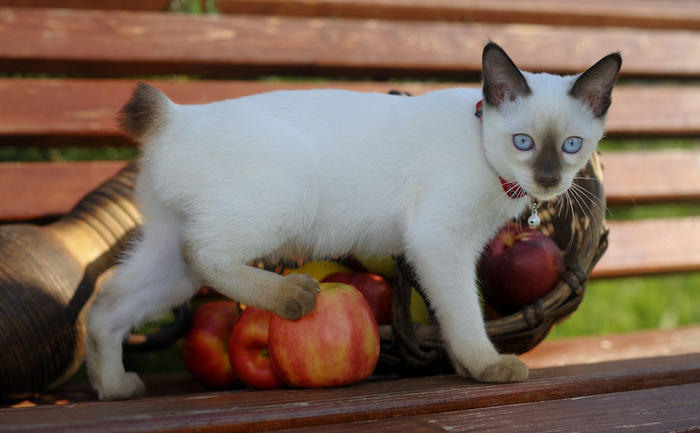
The tail is short and kinked, measuring at least three vertebrae but not exceeding ¼ of the body length. The first break should be at the base of the tail. The kinks may not be visible, but they should be palpable through the skin. The bobtail's tail is not only a distinctive feature of the breed but also a unique "passport" for each animal, as no two tails are alike. Each is unique in its own way, with unique curves, kinks, and lengths. Incidentally, long-tailed Mekongs are unheard of.
Coat and colors
The Mekong's soft, short fur lies close to the body. It is beautiful and shiny, pleasant to the touch, and has minimal undercoat. This fur is often compared to mink. Another unique characteristic of the Mekong is that its skin is not tightly attached to the muscles and is much more stretchy than that of other cats, not just on the withers, but over virtually its entire body.
Mekong Bobtails are allowed to have any pointed (Siamese) coloring without white spots or markings. The most common are:
- blue point;
- tabby point;
- red point;
- tabby point.
Character
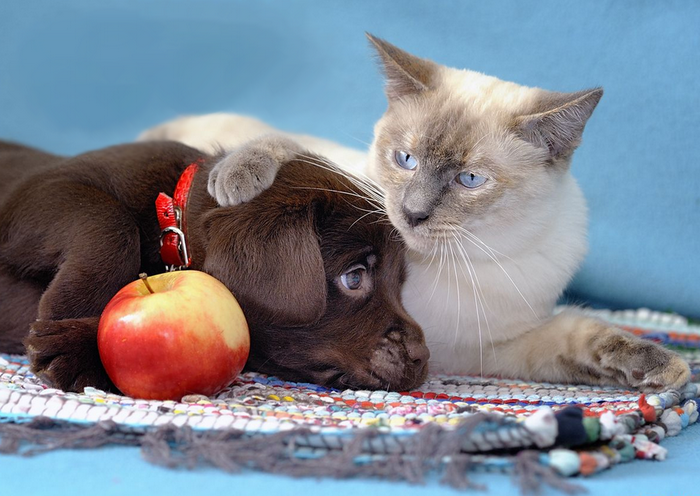
Mekong Bobtail cats are distinguished by their even temperament and exceptional intelligence; they are friendly and sociable. They are often compared to dogs. And indeed, these two animals have many similarities in behavior. Mekongs walk calmly on a leash, are intelligent enough to remember house rules and simple commands, love to carry things in their mouths and fetch, constantly accompany their owners, use their teeth rather than claws in fights, and express their range of emotions with their tails.
Like many other members of the eastern group, they are quite talkative but unobtrusive. Their entire appearance and behavior demonstrate their belonging to the upper crust of blue-blooded cats—they are proud, majestic, and independent.
The Mekong Bobtail is equally well suited for large and small families, as well as single people.
These cats can be safely taken along on trips or walks without worrying about getting lost. They prefer to be close to their owners. They also get along well with small children and tolerate many displays of affection with angelic patience. Mekongs usually get along well with other pets in the house and never create conflict.
Content
Mekong Bobtails are ideal for apartment living. They tolerate solitude well, shed virtually nothing, are clean and tidy, and have no distinctive odor. Adult cats rarely mark corners. Kittens may be a bit of a nuisance with their boundless energy and activity as young cats, but as they mature, they become more serious and even-tempered, but never lazy.
Mekong cats reach sexual maturity very early, many as early as 4-5 months. It's important for owners of multiple cats to take this opportunity to prevent accidental matings between young and immature animals.
Mekong Bobtail cats remain sexually active until old age. Interestingly, after the kittens are born, the female cats take over the mother's duties, grooming the kittens, training them to use the litter box, and providing solid food. So, if you have a pair of Mekong Bobtails, you'll have a matriarchal household. The female, in turn, has only one responsibility: feeding them and meticulously ensuring that the male cat fulfills all his nurturing responsibilities. Furthermore, female cats tend to be more independent, much like an oriental princess in their behavior.
Care
This breed doesn't require any special grooming. Brushing them 3-4 times a month to remove dead hair is sufficient. Brushing is done slightly more frequently during shedding season and only to reduce the amount of hair shed on objects or furniture. Frequent bathing is not recommended for Mekongs. Many owners only bathe them before shows.
Their ears are inspected periodically and cleaned with a special lotion as needed. Their eyes generally don't need cleaning. Cats groom themselves regularly and aren't prone to excessive tear production, so their tear ducts remain clear without owner intervention.
Diet
Every cat is an individual, and this should be taken into account when deciding on feeding. Unfussy cats can be fed natural food, providing them with a complete diet consisting of 15-20% cereal and vegetables in addition to meat and organ meats. Fish and a quail egg can be given once a week. Feeding cats "table scraps" is not recommended.
Remember that milk is only beneficial for kittens up to 2-3 months old. As kittens age, their ability to digest lactose significantly decreases, and sometimes disappears completely.
If for some reason it's impossible to provide a balanced natural diet, it's best to opt for commercially prepared foods. It's important to remember that these should be complete foods of at least premium quality. It's also important to consider your pet's physiological needs when choosing food:
- age;
- pregnancy period;
- lactation and so on.
Health and life expectancy
The Mekong Bobtail is an indigenous breed, so they enjoy excellent health. However, this doesn't mean they don't need regular checkups, vaccinations, and periodic parasite treatments.
Mekongs can develop a variety of feline ailments at any time. Monitor their behavior, and if you notice your pet acting strange, becoming sad, or refusing to eat, be sure to take them to a specialist. Remember, it's best to treat any illness in its early stages.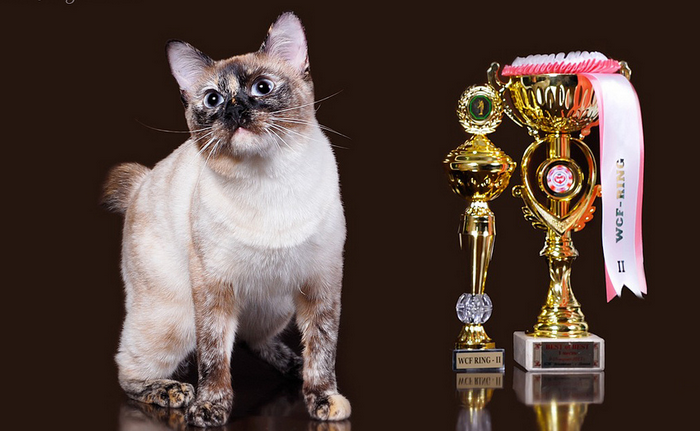
Mekong bobtails are rightfully considered long-lived, with 20 years being their maximum. Interestingly, they remain sexually active and capable of producing children well into old age. For example, Mars, a male cat from the Korgorushi cattery, is a true sex symbol in the feline world; he last fathered a litter at 23! And a female cat from the same cattery, Conchita, gave birth to a litter at 22!
Choosing a kitten and price
If you're thinking about buying a kitten of this breed, the first thing you need to do is choose a cattery and read reviews of various breeders. This breed isn't very common, so you may have to wait a bit and reserve kittens in advance.
Mekong kittens are ready to move to a new home only at three months of age. It's important to note that they are born almost white. Characteristic darkening on certain areas of the body begins to appear only at two or three months and is fully formed by one year of age, and sometimes even later. Kittens should be healthy and well-groomed, with shiny fur, clear eyes, and an excellent appetite.
The average cost of a Mekong bobtail kitten is 15-20 thousand rubles.
The final cost is influenced by the following factors:
- kitten's appearance;
- place of purchase;
- availability of documentation.
If you are not sure that you can choose a good puppy on your own, it is better to seek help from a breed specialist.
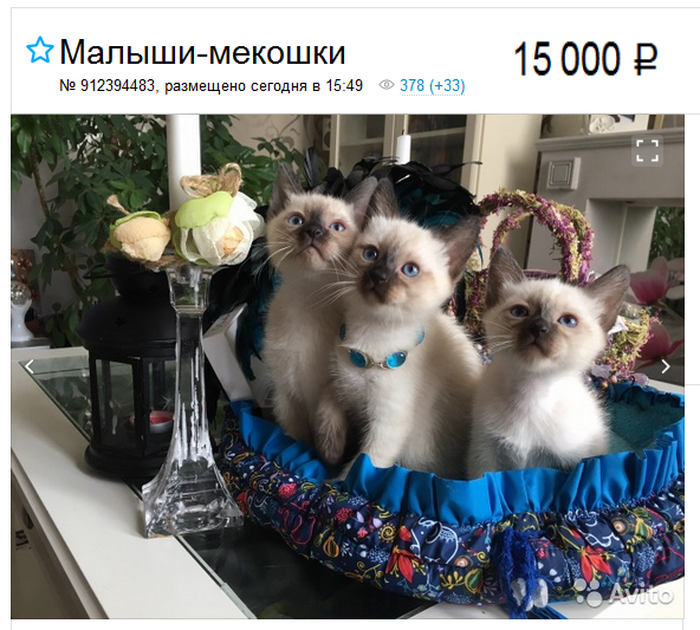
More affordable options are often found online. Kittens found secondhand without papers are typically much cheaper, around 5,000 rubles.
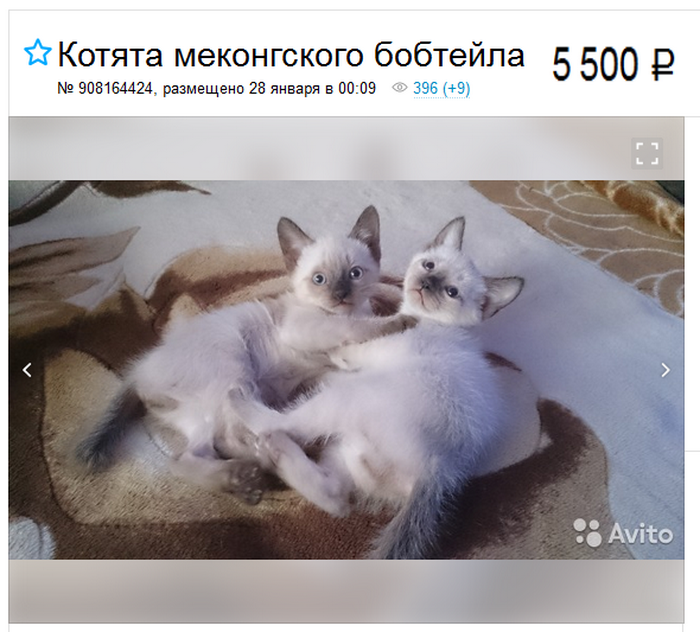
Where is the best place to buy a bobtail?
The Mekong Bobtail is a common breed, so you have plenty of options. You can visit a breeder, a pet store, or search online classifieds. It all depends on your budget and preferences.
Mekong Bobtail mating
Like any oriental cat, the Mekong is characterized by early sexual maturity and a particularly sexually active nature. Therefore, don't be surprised when a six-month-old female bobtail suddenly goes into heat.
Of course, at this age, a cat isn't yet ready to become a mother. Technically, it's possible, but the offspring of a young mother are unlikely to be viable. After all, physically, the pet is still a kitten herself, and physical maturity and sexual maturity are two different things.
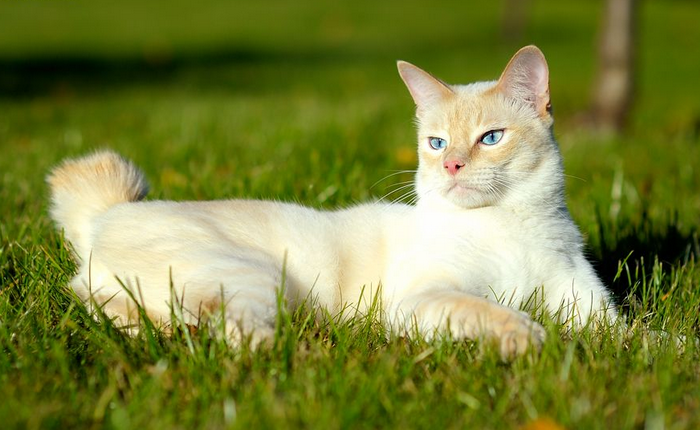
Feline experts recommend waiting until 10 months to mate. By this time, the animal's body will be fully developed, and the mother cat will be ready to give birth to a healthy litter without any risk or complications to her health or the kittens' lives.
Cases vary, and sometimes Mekong Bobtails can be bred at a younger age—7-8 months. This is necessary if the cat has experienced repeated early heat cycles. In such cases, pregnancy is essential to ensure the cat's health. However, in any case, a preliminary consultation with a veterinarian and approval from the breeding club are required.
Typically, one or two heat cycles are missed, but no more than three, as a prolonged delay poses another threat to the pet's health. Avoid overusing medications that stop or suppress heat cycles. Frequent use reduces their effectiveness. Furthermore, hormonal imbalances can occur, which can lead to serious illness.
Mekong Bobtail Owner Reviews
Who better to trust than Mekong Bobtail owners and enthusiasts to judge the breed? For many people considering choosing a pet, reviews of male and female cats are crucial in making their final purchase decision.
Personally, I think the Mekong is an excellent breed, and I found positive reviews (there weren’t any really negative ones).
- Olga. Korolev.
We've known bobtails for a long time. My son was 10 when we got our first cat. We loved her so much, and she loved us too. She followed us around, slept next to us. Now my son is 25, and he recently bought a replica of our first cat, Sonya. It feels like Sonya has returned, just as affectionate, purring at your side, lying next to you. And you know how she senses when things are bad, she understands everything, we adore her. She recently gave birth to four kittens, and she's so caring, everything revolves around them now.
- Marina. Saint Petersburg.
I bought the bobtail purely for myself, not for breeding. In fact, I even saved money on it. What can I say – he's smart, sociable, and intelligent. I adore him, but his loud voice can be a bit inappropriate at times, but otherwise, he's fine.
These are reviews of the Mekong Bobtail breed. Perhaps they will help you decide whether to buy a pet of this breed or, conversely, make you reconsider your future choice. The point of publishing reviews is not to lay out the pros and cons of bobtails. The main thing is that people are interested in these cats and are willing to share their opinions, which means the breed definitely has a future.
Photos
Photos of Mekong Bobtail cats
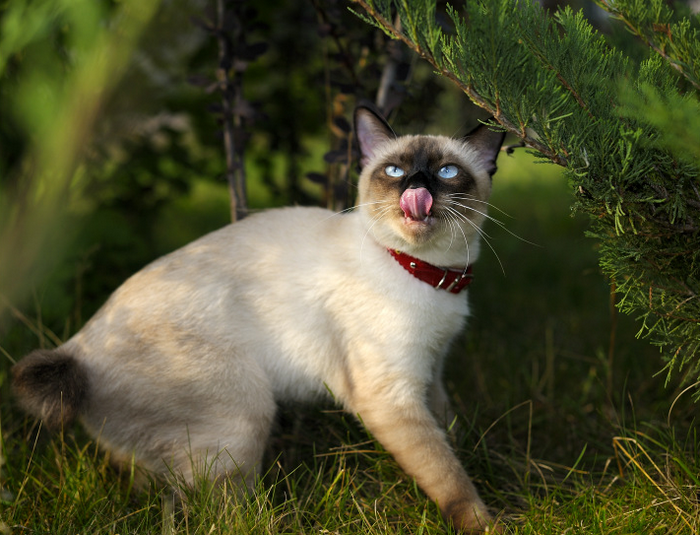
Video review of the Mekong Bobtail cat breed:
Read also:
- Kurilian Bobtail: male and female cats
- American Bobtail: Males and Females
- Japanese Bobtail is a cat breed


1 comment
AsesAll
WHY DOES ONE ARTICLE CONTAIN EXTREMELY DIFFERENT MEANING INFORMATION ABOUT THE SAME CHARACTERISTIC?!
Add a comment