
Mastitis in dogs
Mastitis in dogs is dangerous not only for the mother's health but also for her puppies. Inflammation of the mammary glands is a very dangerous condition that can be fatal for the animal. Today, we'll discuss the symptoms and treatments for mastitis in dogs, what the owner should do, and how to help their pet.
Content
Causes of mastitis in dogs
The cause of mastitis in dogs is almost always pathogenic microorganisms (stepto- or staphylococci, as well as anaerobes, such as clostridia and E. coli). These microbes can enter the dog through an open teat canal (after the puppies have fed) or through damaged skin (abrasions, scratches, wounds, scratches, and bites). If pyogenic microorganisms enter their ideal habitat, the dog will develop purulent mastitis.
But don't forget about the predisposing factors that increase the risk of mastitis in dogs. These include:
Lactostasis
When there's too much milk, or the babies don't consume all of it, it stagnates in the mammary gland. The alveoli enlarge so much that the milk ducts become compressed. Milk can no longer flow normally, and the gland enlarges and hardens. This creates an ideal environment for bacteria: warm and nutritious. The bacteria then multiply, causing inflammation of the mammary gland in the dog.
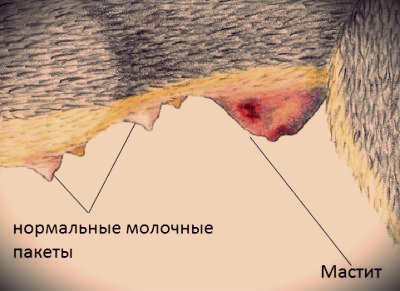
Injuries, scratches, abrasions
They are a gateway for infection, allowing pathogens to enter the mammary tissue. If you notice your dog's nipples or adjacent delicate tissues have been scratched, be vigilant. If the wounds are fresh, wash them and be sure to sanitize them (disinfect with iodine or hydrogen peroxide). Make sure your nursing dog has no pustules or lesions on her glands, and that her body temperature remains normal. If anything raises your concerns, do not attempt to treat your pet at home, even if you think you can handle it yourself. Remember, you are responsible not only for the health and well-being of the mother dog but also her puppies. It is unknown how your chosen treatment plan will affect the health of the puppies.
Other reasons
In addition, there are other possible causes of mastitis in dogs:
- HypothermiaIt weakens the immune system, making it more difficult to fight bacteria. Furthermore, if a nursing mother lies on a cold floor or in a draft, the risk of developing mastitis is extremely high.
- False pregnancySometimes a dog develops a false pregnancy, which leads to mastitis. Because no one is actually eating the milk, it continues to be produced. As a result, the dog develops lactostasis (milk stasis). This, in turn, leads to mastitis.
- HeredityYes, sometimes a predisposition to mammary gland inflammation is genetic. As a result, females suffer from mastitis for generations. If such a predisposition has been established, it's best to spay your pet rather than torment her. There's a risk that the microorganisms will "spread" to other organs, leading to severe purulent inflammation of the internal organs, which is difficult to diagnose. And purulent inflammation always carries a risk of developing sepsis (blood poisoning).
- The puppies were weaned too early or incorrectly.If the puppies are weaned prematurely, a huge amount of milk will remain in the mammary glands. Again, the first point comes into play. Furthermore, puppies must be weaned carefully. The transition to a new diet should be gradual. Avoid abruptly separating the puppies from the nursing mother, as this can lead to mastitis due to disrupted milk flow.
- Infectious diseasesBacteria easily travel through blood and lymphatic vessels to any cell in the body. Therefore, mastitis in a nursing dog may develop as a result of a general infectious disease.
- Poisoning. And also the influence of toxic substances.
- OverheatingLike hypothermia, overheating is dangerous for a nursing bitch.
- Blocked milk ductIf milk can't be released, it accumulates in the gland. This leads to stagnation, and hence inflammation. Everything is connected.
Here is a huge list of causes of this disease!
Types of mastitis in dogs
Inflammation of the mammary gland is classified by its course (acute or chronic). However, there are other types of mastitis in dogs: catarrhal, purulent, serous, fibrinous, phlegmonous, abscessing, and gangrenous. A photo of mastitis in a dog won't help you accurately determine the type of inflammation your pet has. Simply looking at the picture isn't enough; you need to examine the contents and assess the extent of the mammary gland damage.
- With catarrhal mastitis, it's extremely difficult for an inexperienced person to notice any symptoms in a dog. This type of inflammation is characterized by mucus-containing secretions. If mastitis is not treated promptly, catarrhal mastitis can progress to a more serious form—serous or catarrhal-purulent.
- Serous mastitis produces exudate along with the milk. With this type of inflammation, the nature of the discharge alone will not be able to establish a diagnosis without further testing, but the clinical presentation will be characteristic of mastitis.
- In case of fibrinous inflammation, fibrin threads (white, dense strands) will be released from the milk duct.
- With purulent mastitis, bitches of pus are secreted in the milk. These may form strings or separate into small clumps (white or yellow). The milk itself may change color and odor. With this type of mastitis, feeding puppies from the affected lobe is strictly prohibited!
- Phlegmonous mastitis is characterized by the fact that pus is located in the subcutaneous tissue, pouring out “inside the skin”, while pieces of pus are not observed in the milk itself (but they will soon appear, since bacteria will reach the contents of the lobes).
- In abscessing mastitis, an abscess develops on the affected gland. Fortunately, this type of mammary gland inflammation is extremely rare.
- The gangrenous form of mastitis is very scary, in which the breast tissue “dies” and begins to decompose.
Symptoms of Mastitis in Dogs
The symptoms of mastitis in dogs can sometimes be confused with duct obstruction. But if you understand some of the subtleties you'll learn about, making a diagnosis won't be that difficult. A correct, and most importantly, timely, diagnosis will help quickly and effectively prescribe effective treatment. So, what are the most common signs and symptoms of mastitis in dogs?
Common clinical signs of mastitis in dogs
The animal is no longer as active, even a little apathetic, whether it's a Yorkie, a Pomeranian, or a Labrador. It tends to lie down and sleep more. Appetite noticeably decreases, and in severe cases, disappears completely. Body temperature begins to rise.
Local clinical signs of mastitis in dogs
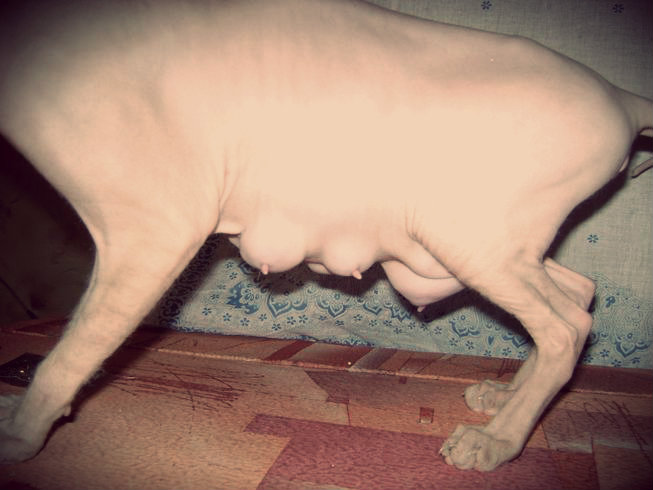
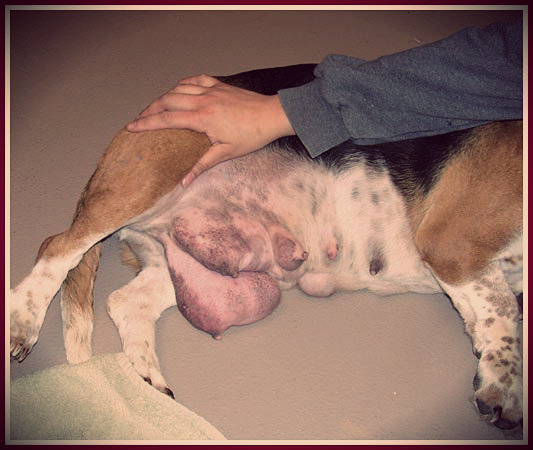
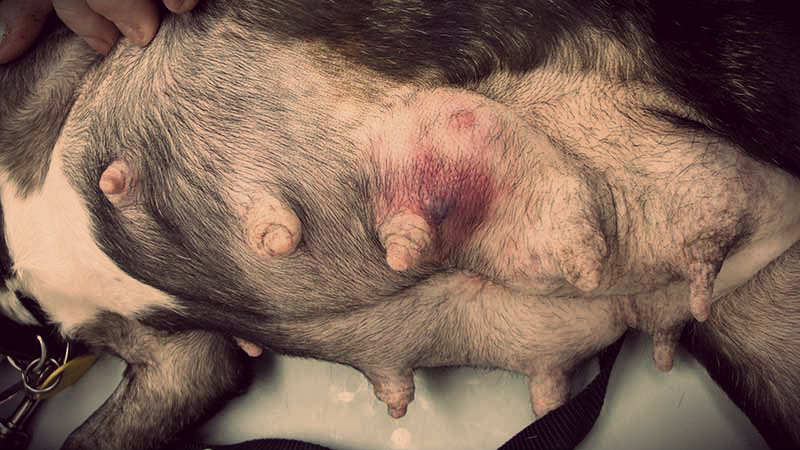
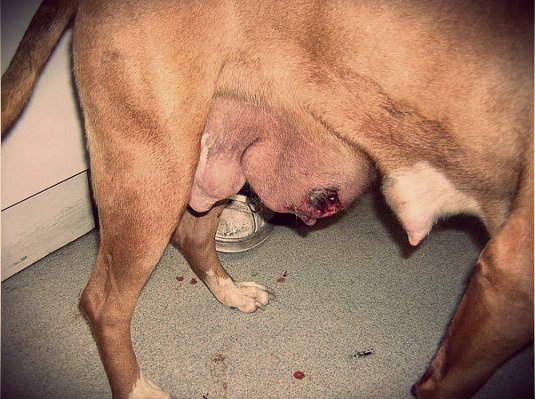
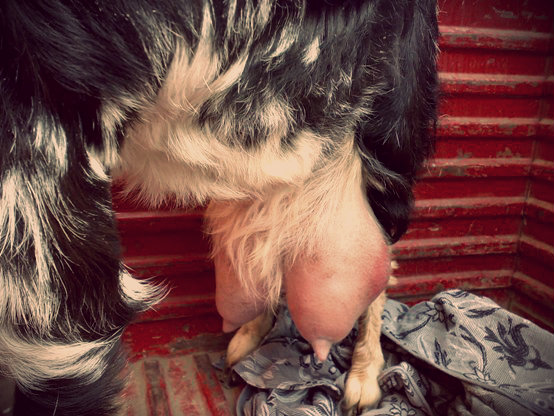
It's not difficult to determine which lobe is affected by mastitis. It's larger than the healthy lobe, asymmetry is visible, and the nipple is swollen and red. If you touch the inflamed lobe, it feels much hotter than the surrounding healthy tissue. Redness is also noticeable. The affected tissue swells, hardens, and is extremely painful. If you touch the inflamed lobe, the dog will twitch, may yelp in pain, whine, and lick the sore spot. When gently pressed, milk mixed with various impurities, such as blood or pus, flows from the nipple. Flakes (gray, yellow-green, or white) and "strings" may also be present.
Photo
What does mastitis look like in a dog? See the symptoms of this disease in several photos:
Treatment
How to treat mastitis in a dog? Treatment must be carried out in consultation with a veterinarian; no folk remedies are recommended, as microorganisms are almost 100% to blame! And without antibiotics, it's impossible to treat a dog with mastitis at home! Only a veterinarian can determine what injections are necessary for an animal with inflamed mammary glands.
First aid at home
If mastitis in a dog is just beginning, then you can begin treatment at home: you can lightly warm the gland (camphor oil is excellent for warming the gland during mastitis in dogs), express milk from the affected gland (not completely!) and tightly bandage the affected lobe.
But remember that warming up is only permitted in case of catarrhal or serous mastitis! In cases of purulent, phlegmonous, abscessing, and gangrenous abscesses, heating the inflamed tissue is strictly prohibited! Heat will only accelerate the spread of inflammation and provoke a "breakthrough" of the abscess.
Medicines
Before use antibiotics for treating a dog with mastitis, It is necessary to determine which specific drug the microorganisms are sensitive to. Unfortunately, titration requires more than one day, so broad-spectrum antibiotics are prescribed initially.
If no improvement is observed within three days, the test results will be helpful (the most effective antibiotic will be found to kill the pathogens). You won't be able to manage the problem by trial and error; you'll simply let the disease progress (even leading to sepsis and death).
It would be nice to strengthen your immune system. For this purpose, immunostimulants and modulators are prescribed. It would be a good idea to take a sample of the affected lobe to a lab (good clinics have such departments) for a culture. This way, the veterinarian will know which bacteria are causing the inflammation. If it's staphylococci, the doctor will prescribe antistaphylococcal gamma globulin. And your pet will begin to recover quickly.
Antipyretics, antihistamines, vitamins, and painkillers will help. But without antibiotics it is impossible to achieve a full recovery.
If the situation has progressed too far, or treatment for mastitis has been started too late or hasn't yielded positive results, surgical intervention will be necessary. By removing the affected gland, you'll eliminate the source of infection, and the chances of recovery will be much greater.
If a female dog with a false pregnancy has an inflamed gland, antibiotics and lactation-suppressing medications will be required. The glands must be bandaged.
Preventing mastitis in dogs
How can you prevent mastitis in dogs? We've prepared some simple recommendations for you:
- Be sure to take your pet to the veterinarian for a gland examination (both for the one actually nursing the offspring and for the one with a false pregnancy).
- If you have a non-pedigree dog that you do not plan to breed from, or do not want puppies from a purebred dog, then have it spayed.
- Make sure your dog doesn't catch a cold, doesn't lie in a cold or drafty area, and isn't exposed to dirt. A nursing bitch should always be kept clean. Disinfect all wounds and scratches immediately.
- Trim your babies' claws (starting at two weeks of age). Otherwise, they may injure their mother while sucking.
- If the puppies died or there were no puppies at all, then bandage the glands immediately, before a lot of milk arrives.
If you have any questions about mastitis in dogs, ask them in the comments, and we'll do our best to answer them!
Read also:


58 comments
Julia
Good morning. I'm a young spaniel, about a year old. She gave birth and nursed seven puppies. A month later, we decided to take the babies home. We separated from the last one when he was two months old. A month after that, I noticed my mother's mammary glands were swollen. Now, there are some lumps in some places. When I touch them, she doesn't react negatively. She's active and playful. Her appetite has changed (her eyes are less alert), but she doesn't refuse food at all. A slightly cloudy liquid comes out of one nipple when I press on it.
Love
A female spaniel, 8 years old, has given birth twice. There is a lump on her nipple, but it is soft and painless. What could it be? She is allergic.
Marina
Good day! My pet had her first heat. It's over now, but there's still swelling around her nipples. Hematomas have formed recently. There are some lumps, which are related to the hematomas. I can't say it bothers her in any way. It hasn't affected her appetite or activity. There's no discharge. But the bruises aren't going away either... We'll see the vet in a week—it's time for vaccinations. We're deworming now. Should I apply something to her breasts? Traumeel or anti-inflammatory ointment? Or should I avoid applying anything until the vet appointment?
Daria is a veterinarian
Hello! Do not apply any ointments or administer any medications before an in-person veterinary visit, as this obscures the clinical picture of the disease and obscures some symptoms, complicating and delaying the process of establishing a correct diagnosis. Even the use of painkillers will rule out several differential diagnoses (one of which may be correct). Often, medications used at home will also alter the blood count. Subsequently, complete blood counts and biochemical tests will no longer be informative.
Victoria
Hello, if milk has already started flowing and lumps have formed, can I re-benthen the puppies? The puppies died.
LENA
HELLO, I have a 1.5 month old toy terrier. I gave away the puppies. At first, the lower nipples were large, but now the upper ones are also large and they are starting to get hard. What should I do?
Daria is a veterinarian
Hello! Was it a month and a half since she started producing milk? It's strange that she hasn't had puppies for a month and a half, and the suspicion of mastitis only just surfaced. Are the milk bags hot? Is there any discharge from the nipples? What's her body temperature like? Is it elevated? How's her appetite? Have you taken her for a checkup? I'd also recommend an ultrasound of her abdominal and pelvic organs. Has she had any false pregnancies?
Irina
My Yorkshire Terrier will be seven on September 13th. She's had two babies, the last time four years ago. Her heat ended on April 8th. One nipple is swollen, specifically the nipple. The mammary gland itself isn't swollen, but there's redness around the nipple. The nipple has even darkened, but it doesn't bother her. I've tried pressing on it, but she doesn't respond at all. What could this be?
Daria is a veterinarian
Hello! Your pet needs to be examined. The dog is no longer young and is not spayed. There is a risk of tumors. Do not apply pressure to the area or irritate the inflamed tissue (if there is redness, there is most likely inflammation). Do not administer any medications yourself!
Was the animal infested with fleas? Could an insect bite or injury be ruled out (are there any bite marks, scratches, bruises, etc.) on the skin? Is there darkening of the skin itself (pigmentation) or blood (like a bruise)?
Anna
Hello! A year ago, I found a heavily pregnant dog on the street; she looked like a toy terrier. I took her straight to the vet. She was spayed that same day because labor was already underway. The surgery was successful, but milk or something similar continued to appear when I pressed on her nipples for several days. By the 10th day after the surgery, the doctors said it had "burned off." Over the course of a year, she gained weight from 3,200 to 4,500, mostly in the chest and neck area—7 cm. An "udder" has also appeared in her abdomen at the level of her last nipples; she actually weighs a lot when she's standing. There's no discharge. The tissue is firm to the touch. She doesn't feel any pain. She's active. I wouldn't have paid any attention to it, thinking it was just extra weight, if a friend hadn't said it looked like mastitis. She's scheduled for vaccinations at the end of June, and we'll be seeing the vet anyway. But maybe we should go now instead?
Daria is a veterinarian
Hello! Mastitis in a dog that gave birth a year ago? This is extremely rare (only in cases of constant exposure to cold, unsanitary conditions, poor immunity, and severe hormonal imbalances). With mastitis, the mammary tissue would be hot, any touch would be extremely painful, and the nipples would be secreting fluid (clear, pus, blood, etc.). The overall body temperature would rise. Within a few days, the inflammation would spread from one lobe to the next. The animal would be lethargic. So, there are several possibilities. It could be fat (the mammary glands are among the first to react to weight gain), or it could be a tumor (in which case an X-ray and biopsy will be ordered).
Alya
Hello! My German Shepherd has developed lumps near her nipples. She hasn't given birth or been spayed. She's 8 years old. The lumps were small, but now they've gotten bigger and more have appeared. What should I do?
Daria is a veterinarian
Hello! Your pet needs to be examined in person. It could be a lipoma (fatty tumor), swollen lymph nodes, or even tumors/growths (she's advanced age, after all). Please don't delay your visit to the veterinarian to avoid wasting precious time.
Bogdan
Hello, the dog gave birth 2 days ago.
Today the posterior glands are swollen and hanging down.
They turned red like in picture 2. What should I do?
Daria is a veterinarian
Hello! Call a veterinarian immediately or take her to the clinic. It's important to differentiate mastitis from duct obstruction as quickly as possible. In the former case, the puppies should be weaned (never allowed to suckle from the affected milk sacs), and a course of antibiotics and novocaine injections should be given to speed up the inflammation. If it's duct obstruction (too much milk is being produced in the hind mammary glands, and the puppies aren't eating it all), then the largest and hungriest puppies should be placed under these lobes to help them suckle the stagnant milk.
Svetlana
My dog (a miniature toy), she is 4 years old, has not given birth, and suddenly the lowest nipples became swollen. There was swelling. We went to the vet, I pressed on the nipples, nothing happened, she said that maybe she was too cold. She did not prescribe anything. We went to another doctor. The same thing happened there. They found nothing. The dog is capricious, withdraws from interaction, lies down and stays. Appetite and stool are normal. No abnormalities. She should be in heat in December. Maybe this has something to do with it, or maybe it’s because she was not bred until this age. A year ago, we went to a spring, she jumped into the water, she had cystitis. We treated her with sirdalud and cystokur. The doctor examined her after the course of treatment, everything was fine. I don’t know what to think anymore. Her temperature is 37.8. She goes outside in a warm jumpsuit. Not for long, only to relieve herself.
Daria is a veterinarian
Hello! Why aren't you breeding? If you don't plan to breed, don't torment the animal and have it spayed. These hormonal surges won't do any good. It's possible that the mammary glands have swollen due to an approaching heat (especially if it occurs in early December). Hormones in the blood begin to increase, causing the mammary glands to "grow," like a woman's at the end of her cycle. Her temperature is within normal limits; if she was overcooled or had inflammation, her temperature would rise. Feel the enlarged milk sacs: are they hot? What is their consistency (are they firm, soft, tender, or not)?
Olga
Hello. My dog (Chihuahua, age 1.7) was recently mated for the first time (her third heat). It's now 15 days since the mating. I felt a lump near the nipple (closer to the left ribs). It's not a ball (like a nut), as described here. More flat. It's mobile. It's in different positions relative to the nipple depending on the dog's position. I don't feel any pain when I touch it. There's no redness or discharge. The dog is playing and eating as usual (we haven't changed her diet (she ate first choice before the mating and now she eats).
Can you tell me what this could be?
Dasha is a veterinarian
Hello! Go to your appointment so your doctor can feel it for him. It could be a lymph node, or something else entirely (the topography isn't clear, but it could be closer to the head or closer to the middle of the abdomen, as the ribs cover the chest organs). Don't squeeze the breasts too much, otherwise you'll stimulate uterine contractions (the hormone oxytocin will start to be produced).
Irina
My pregnant dog (50 days) has developed mastitis. The doctor says this treatment is impossible and unsafe for the puppies. How can I alleviate her condition? And will she be able to nurse the puppies?
Dasha is a veterinarian
Hello! No, you can't feed them. Buy some milk replacer from a veterinarian right away. If you feed the puppies this milk, they will become toxic, resulting in diarrhea. Some may even die (after all, pathogenic bacteria, dangerous to health and life, will begin to multiply in this mastitis milk). What kind of mastitis is it? Is it clearly purulent, or is it still just serous or catarrhal, when there are no visible changes in the mammary secretions?
Anna
Hello! My dog (a pug) has nipples on her front paws that turn inward, and today I noticed a lump on one nipple. She's nursing. There are no external signs, and she seems fine. What can I do to help?
Dasha is a veterinarian
Hello! Place the puppies on these nipples, or contact your vet to have them tightly bandaged. Otherwise, you'll cause duct stasis (milk stagnation), which will progress to mastitis. The puppies will then "resolve" the stagnation. Just be sure to place the largest one first; they'll start sucking vigorously due to hunger, and then you can move them to the rear nipples, where there's more milk.
Mila
Hello! We have a large, 1.7-year-old dog weighing 21-23 kg, a shepherd-mongrel mix. She hasn't had a litter, hasn't whelped, and has mastitis on two lobes near the tail. When pressed, it discharges a pus-like, bloody discharge. Please advise what to do. Before this, she wasn't eating anything and was lethargic. Now she's eating little. She hides in a hole in the ground when it's hot, or I move her to the shade, wet her fur with water, and we've gone to the river. We've given up bathing her now, of course, to prevent it from getting worse. We live outside the city, so the vet is far away. Please advise what to do.
Dasha is a veterinarian
Hello! You can't avoid a veterinary visit! It's not even a matter of antibiotic therapy, but rather constant monitoring by a veterinarian. Surgery to remove the inflamed mammary sacs may be necessary. Mastitis is extremely dangerous, especially with pus. Self-medication can kill the animal. Do not massage or apply heat under any circumstances, otherwise the encapsulated areas may rupture and lead to sepsis. Novocaine blocks may be necessary. Get to the vet immediately!
Natalia
Is there a tablet equivalent to Mastometrin? My dog is terrified of injections. She weighs 60 kg and it's impossible to cope. She eats pills. I took a course of Mastometrin and it helped, but mastitis has returned. Our dog is a 6-year-old, unspayed, and has never given birth.
Dasha is a veterinarian
Hello! Have you looked into the cause of mastitis? Why does it keep appearing in your female dog, especially if it's not pregnant? Could there be something wrong with her living conditions? Is she lying on concrete, cold, or wet? Has she had her dog examined? How often does she get mastitis, and how long after treatment do recurrences occur? Injections are the most effective treatment for mastitis! However, physical therapy and ointments, along with antibiotic injections, are also possible.
Combine. The only requirement is that the mastitis isn't purulent. Are you old enough to sterilize? Don't give any hormonal medications (like contraceptives, sex barrier, etc.). Hormonal fluctuations may be causing inflammation. Have you had a uterine ultrasound (endometritis and mastitis are often closely related). If your local clinic has a lab, ideally have your mammary gland fluid titrated for antibiotic sensitivity (this will allow you to choose the ideal medication).
Elizabeth
Hello, we adopted a young dog (approximately 7-8 months old) from a kennel. She was spayed and hadn't given birth before. A day later, I felt one of her nipples was enlarged, about the size of a hazelnut. The enlargement was soft and apparently not painful when pressed. We went to see one vet, who recommended streptomycin injections. Knowing this medication is dangerous, I took her to another vet, who only said to keep an eye on her; there's nothing serious going on yet. I'm still administering Levomekol, and it's been 24 hours now.
Dasha is a veterinarian
Hello! Why are you applying Levomekol? Are there any wounds? The vet said not to apply anything during the examination, just to observe. But you still decided to apply something. Your pet may be going through hormonal changes (she's entering puberty and her ovaries were removed, or maybe the surgery was performed during her first heat or you didn't wait long enough afterward). How long has it been since spaying? What's her body temperature? Is the temperature of the enlarged area the same as the surrounding tissue? Is there any redness?
Sveta
Hello, my dog gave birth three days ago. She's not a purebred Yorkshire Terrier, and there's a large lump near the top nipple. The nipple itself is small. I don't understand if it's mastitis or not. Nothing is leaking from it.
Dasha is a veterinarian
Hello! Please see a veterinarian. It's important to rule out lactostasis and mastitis. Even if it's just lactostasis, without veterinary care and monitoring, mastitis will quickly develop. Antibiotics and physical therapy may be required.
Tatiana
Hello!
The puppies are already 1.5 months old
I'm transitioning my dog to independent feeding; she still has a lot of milk on one side. I bought Dostinex tablets, diluted 10 ml with water for injection, and am giving 0.8 ml to my dog (weighing 8 kg). This is the first day I've given them; I'm very worried about mastitis; she had it last year. I just expressed some milk to make things easier for her. Can anyone tell me what else I should do? Maybe rub some camphor oil on her and bandage her; I read about it somewhere online.
Dasha is a veterinarian
Hello! Can you bandage the wound tightly yourself? Or is it better to take her to a vet who can do it properly? Be careful with expressing the wound, as it stimulates milk production. The problem is that oxytocin (the hormone responsible for milk production) can be produced not only by direct contact with the mammary gland but also by indirect exposure (the squeaks of hungry puppies, their fussing around it), so it's advisable to limit the mother's time with them (though it's not possible to completely isolate them; after all, the mother is still "training" them). You can apply camphor, but it's more often used for mastitis (it warms the glandular tissue). Review your diet, eliminate milk-producing foods, and reduce fluids.
Irina
Hello, our American Bulldog was diagnosed with fibroid disease of the lower mammary glands. She is 9 years old and not bred. An ultrasound showed a diseased heart. Surgery is not an option. Could you please tell me how to help her? Perhaps some injections? She has been eating poorly and is constantly sleeping. Thank you in advance.
Dasha is a veterinarian
Hello! There's a type of chemotherapy that slows tumor growth. I can prescribe medications, but you won't be able to buy them over the counter; you'll need a prescription from a veterinarian. Therefore, contact your veterinary clinic; they'll write a prescription and suggest a pharmacy where you can buy or order the medication (they might not be available, as they're not often purchased in small towns). They'll prescribe a dosage tailored to your pet, taking into account the specifics of the disease, weight, and age. They'll also prescribe the frequency of administration. You'll still need to be monitored to rule out any worsening of the condition.
Irina
The cancer tests didn't confirm it, but chemotherapy is still needed?
Natalia Uryvai
Hello, we have a nursing Labrador. Could you please tell me why she has developed lumps around her nipples? Also, why are the puppies itchy? I would be very grateful for any advice.
Dasha is a veterinarian
Hello! It's best to examine the mother to rule out laxatives and the onset of mastitis. It's also possible that the babies aren't sucking everything out, or they're injuring the mother while sucking (check the surrounding skin). Regarding the puppies: what do you feed the nursing mother? Puppies are like our own children. The mother eats the slightest thing, and the allergen gets into the milk, causing the baby to develop diathesis. The same may happen with puppies. Review the nursing mother's diet. Eliminate a lot of liquid and lactogenic foods for now to reduce milk flow. Feel the swelling: are the lumps hot, red, or painful? Try applying gentle pressure to the nipples and assess the quality of the milk (maybe it's changed in appearance, becoming clear or yellow, or clots have appeared). Ideally, have a veterinarian come to your home or visit one. If mastitis develops, you'll have to switch to antibiotics or even surgery.
Christina
Hello! My dog has started leaking milk and blood from her last nipples (the ones closest to the tail). The veins around both nipples are swollen. I have one puppy. What should I do in this situation?
Dasha is a veterinarian
Hello! See a vet immediately! I have only one puppy and it's not drinking all the milk it's producing, so the nursing dog has likely developed duct obstruction, which can lead to mastitis. This is especially true if the ducts are hard, swollen, hot, red, and painful to the touch. Less commonly, blood in the milk is caused by weak capillaries. Therefore, you should contact your veterinarian for an examination and treatment before the situation worsens.
Oksana
Hello, my female dog has a swollen chest and a hard, nut-like lump. Could you please advise me on what's going on and how to treat it before taking her to the vet? She's 14 years old.
Dasha is a veterinarian
Hello! Don't treat or do anything at home before visiting the veterinarian! You could only make the situation worse. Your dog is already advanced in age, so it could be a tumor. An in-person consultation and examination by a veterinarian is essential. If the clinic has a laboratory, they can also perform a biopsy. X-rays are also recommended to rule out metastases (if a tumor is confirmed). Your veterinarian will prescribe all treatments after the examination and a FINAL DIAGNOSIS based on additional tests. Do not apply any ointments, heat, or compresses before your appointment.
George
With purulent pontitis, is it necessary to express the contents during treatment?????Please tell me
Dasha is a veterinarian
Hello! Yes, with purulent mastitis, it is necessary to remove the contents of the milk sac to eliminate the ideal breeding ground for pathogenic microorganisms, which cause pus formation. However, this must be done extremely carefully to avoid damaging the already inflamed tissue. Heat should never be applied! Breast massage is prohibited with purulent mastitis! Antibiotics are essential! It is best to have the milk microorganisms tested in a laboratory to determine the most effective antibiotic.
Galina
Hello, my dog has a red spot between her back nipples that's spreading from the scar to her right breast. After a C-section, I have a growing red spot that looks like a hemotoma. I've already seen four doctors and they all say it's nothing serious, just apply iodine. One of the doctors suggested it might be an abscess. The breast with the spot is longer than the opposite breast and there's no milk in it. I don't know what to do.
Dasha is a veterinarian
Hello! Applying iodine and brilliant green is pointless. Firstly, it won't do any good (therapeutically). Secondly, you could burn the dog's tissue. Monitor the condition of the suture. If there's no redness, no suppuration, and the suture isn't oozing, there's no need to worry. There shouldn't be any large lumps either. An abscess won't just be a spot, but a thickening, an increase in volume (you might feel like there's something foreign underneath, different from the healthy tissue around it). This spot will also be painful to the touch (the same applies to a hematoma). A puncture will give an idea of the contents (pus, exudate, edematous fluid). I can't advise you on what to do, as I can't see the animal. Perhaps Levomekol ointment or a compress (warm compresses and massage are contraindicated for an abscess! Otherwise, they can provoke a rupture of the purulent cavity, which will lead to phlegmon).
Elena
My female Labrador has a small, red, insignificant, soft tumor near her nipple. I think she is pregnant, but I am not sure what it is. It is a long way to the hospital; we live in the suburbs.
Dasha is a veterinarian
Hello! How can I help you? It's impossible to diagnose a dog without physically examining it. You don't know whether it's pregnant or not. And without seeing the animal, it's even impossible to say what's wrong or how to help. It could be mastitis (a cold sore), a growth, an insect bite, a pinched or accidentally injured uterus, an allergy, or something else entirely. In some cases, the temperature (both general and local) will be elevated, in others, the swelling will be dense, and in others, it will look almost like normal tissue but will increase in size. Treatment will also vary, ranging from antibiotics, antihistamines, and even surgery. Therefore, no veterinarian can tell you exactly what your Labrador has without an examination (and they're unlikely to risk making a diagnosis through a screen).
Elena
Hello, my dog (an 11-year-old female Pekingese) had an inguinal hernia removed four years ago, and her uterus prolapsed. She bites, won't let anyone near her, and won't let anyone do anything. Last summer, we had her hair shaved under mild anesthesia. When we were shaping her, we noticed a small cap near her nipple. The GP said it was either mastitis or another hernia. This year, she started to get bigger and larger, and the doctor said she wouldn't be able to withstand the anesthesia. She's old and she's a Pekingese. She's become thin, eats little, but goes for walks on her own, and sometimes pees where she lies. What do you recommend?
pees where he lies
Dasha is a veterinarian
Hello! If the vet suspected mastitis, why didn't they treat it? If it was a hernia, why didn't they perform surgery? A diagnosis was necessary. Another possibility (judging by the dog's advanced age) is that it could be a mammary tumor. Unfortunately, surgery is rarely performed at this age. Firstly, the dog may not survive the anesthesia. Secondly, after surgery, metastases or new tumors may develop. As a result, the dog will die even faster than before the surgery. It would be a good idea to get an x-ray to make sure there are no metastases yet. Perhaps the most humane option would be to euthanize the pet (if the veterinarian is unable to help the animal in pain). Sorry, but sometimes euthanasia is the only way to end a dog's suffering.
Alex
My dog is left without puppies. What should I do? How can I stop lactation? How can I avoid mastitis?
Dasha is a veterinarian
Hello! First, you need to see a veterinarian to rule out postpartum complications. Second, the veterinarian will tightly bandage the dog's mammary glands to prevent milk flow. They will prescribe a medication to stop or reduce lactation. Avoid giving milk-promoting products, water, and liquid (especially warm) food. Do not express milk under any circumstances! Otherwise, this will trigger further milk flow, which will only worsen the situation.
Dasha
What does it mean—they did a blockade on a dog. How does that work? What is this procedure? And why is it needed specifically for mastitis and false pregnancy in dogs? Thank you!
Dasha is a veterinarian
A blockade is an injection of novocaine into specific "points" to target nerves in a specific area (the needle is inserted deeply, and as the needle is withdrawn, novocaine is slowly injected). This numbs a specific area. The benefit of a blockade is that it not only relieves pain but also helps the inflammatory process subside more quickly. However, this isn't done just once. A full course is required (including medications, which cannot be stopped). Without experience, you won't be able to perform a novocaine blockade at home.
Khristya
My dog's nipples are swollen and there is milk-like fluid visible from them.
She's not a vodka and hasn't chewed anything yet.
Ale tіchka was already 2 times. I don’t know whether it’s going to pass or not, but it’s going to require some kind of treatment.
Dasha is a veterinarian
Hello! Please consult a veterinarian for an in-person examination. They should rule out pregnancy (or, if there was no actual mating, a false pregnancy). If you are certain your dog could not have mated with a stud dog outside, be sure to rule out a false pregnancy. This is a dangerous condition that requires mandatory veterinary observation and treatment. Do not attempt to express milk, as this will only stimulate further milk production, and since there will be no puppies, edema and mastitis may develop. During the in-person examination, the veterinarian may notice other changes or symptoms you haven't described, or make a different diagnosis. Do not attempt to prescribe or administer any medications on your own.
Lena
My pregnant bitch's rear nipples are hardening...what should I do?
Dasha
Consult a veterinarian for help. Only after an in-person examination can anything be determined for sure. What is the pregnancy's due date, how is it progressing? Is it a false pregnancy? What's the number of pregnancies? How long until delivery? Could it be milk coming in? Or could it be lactostasis? What other symptoms are there? Is there redness, tenderness, suspicious nipple discharge, or fever (both local and general)?
Add a comment