
Giardiasis in dogs: symptoms and treatment
Giardiasis (giardiasis), a zoonotic infectious disease affecting humans and animals, is caused by a single-celled protozoan organism of the genus Lamblia. It parasitizes the intestines, causing gastrointestinal disturbances, intoxication, and malnutrition, and without proper treatment, can cause significant harm. Giardiasis is very common in dogs; according to statistics, one in ten domestic dogs and almost all strays are carriers of the infection.

Content
Mechanism and routes of infection
Giardia exist in two forms. In the external environment, under unfavorable conditions, they remain dormant, forming cysts surrounded by a tough protective shell. When a cyst enters the body of a warm-blooded animal, the shell dissolves, and two trophozoites emerge. active form of giardiaHaving attached themselves to the intestinal mucosa, they begin to feed and reproduce. During their life cycle, the trophozoites damage the intestinal wall and release metabolic products that are toxic to the animal's body.
Giardia can remain viable in the environment for a long time: in stagnant water for up to several months, and in feces for about 3 weeks. Giardiasis is transmitted through the alimentary (fecal-oral) route. Dogs can ingest the cysts of the pathogen:
- by consuming contaminated food or water,
- when sniffing grass or soil,
- through direct contact with an infected relative or visiting a litter tray used by a sick animal.

Forms and symptoms of giardiasis
The incubation period of the disease is from 1 to 3 weeks; giardiasis can occur in acute or chronic form.
Acute form
The disease's symptoms are associated with damage to the intestinal mucosa by Giardia trophozoites. Actively reproducing, Giardia destroy the epithelium that ensures nutrient absorption and also leads to inflammation. As a result, dogs develop:
- Diarrhea, which may alternate with constipation. Stool may be pasty or watery, mixed with mucus or fat.
- Bloating, flatulence.
- Belching.
- The animal becomes apathetic and reluctant to make contact even with the owner.
Chronic form
This form of the disease is characterized by alternating exacerbations and remissions. After a period of acute clinical manifestations, the dog's condition improves, and virtually all symptoms disappear. During this remission, the Giardia trophozoites do not die but continue to multiply and are actively released into the environment.
Then, after 2-3 weeks, an exacerbation occurs, and new symptoms are added to those described above:
- a foul odor from the mouth, reminiscent of rotten eggs (giardia emit hydrogen sulfide during their life cycle);
- blood in the stool;
- visible, seemingly unexplained, weight loss;
- allergic manifestations - skin rash, rhinitis or conjunctivitis;
- brittle, dull, unkempt-looking fur.

Diagnostic methods
If a dog exhibits symptoms of giardiasis, a series of laboratory tests are prescribed to differentiate the protozoan infection from other diseases with similar clinical features. These include:
- stool tests (general and test for lamblia antigens);
- analysis of a smear from the rectum for pathogen DNA (a method based on the polymerase chain reaction);
- an enzyme-linked immunosorbent assay that allows the detection of the pathogen's antigen in the blood serum.
Important! Giardiasis in dogs often occurs in a latent or mild form, with symptoms being very mild or even absent. Therefore, the disease is sometimes discovered accidentally during a stool test during a routine examination. However, since protozoan infections are also dangerous to humans, veterinarians strongly advise dog owners to regularly bring their pets in for preventive checkups.
Treatment of giardiasis in dogs
Antiprotozoal medications that suppress or destroy Giardia are selected by a doctor. The most commonly used medications are:
- Aldazole (active ingredient – albendazole).
- Metrogyl (a drug of the 5-nitroimidazole group).
- Macmiror (active ingredient – nifuratel).
- Panacur (active ingredient: fenbendazole).
- Tiberal (active ingredient – ornidazole).
These medications inhibit the DNA of Giardia cells, causing the death of the organisms. A course of treatment typically lasts 5-7 days.
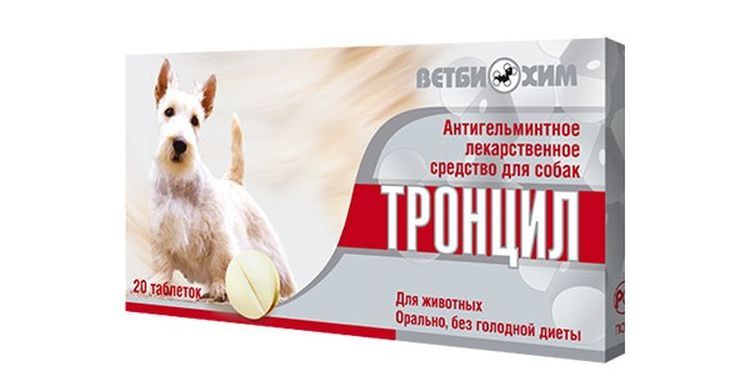
A new complex also gives a good effect in the treatment of giardiasis in dogs the drug TroncilIts active ingredients—pyrantel embonate, praziquantel, and febantel—are safe even for puppies as young as six months. A three-day course of treatment is sufficient for the full course of treatment.
To relieve toxins, restore the natural intestinal microflora, and strengthen the immune system, the dog is also prescribed enterosorbents, probiotics, and immunomodulators. Until complete recovery, it is recommended to feed the dog special therapeutic foods such as Hill's PD Canine, PVD Canine EN, and Royal Canin GASTRO-INTESTINAL.
Completely eliminating Giardia from a dog is rare, as the cyst membrane is impermeable to most chemicals. Only the active form of the parasite, the trophozoans, can be eradicated with antiprotozoal medications. These inhibit the production of nucleic acids in the Lamblia DNA, which kills the organism. A dog is considered cured if stool testing reveals no Giardia antigens.
How to protect your dog from giardiasis
To reduce the risk of your dog becoming infected with giardiasis, you should follow these rules:
- keep the room in which it is kept clean;
- do not bathe your pet in ponds or lakes with stagnant water;
- do not allow the animal to take food from the ground, train the pet to eat and drink only from its “personal” dish;
- To avoid the possibility of contact with stray animals, do not let your dog out for a walk unattended;
- Provide your dog with a complete diet and include foods that help strengthen the immune system;
- deworm the animal in a timely manner.
Previously, there were no vaccines against giardiasis, but recently the American company Fort Dodge released a vaccine against giardiasis, "Giardia Vax," based on inactivated trophozoites. This vaccine has not yet been licensed in Russia and is therefore not yet available in veterinary pharmacies.
Read also:
- Herpes in dogs: symptoms and treatment
- Anthelmintic medications for dogs: reviews, prices
- Chlamydia in dogs: symptoms and treatment


Add a comment