
European wildcat
When we hear about a wildcat, or a forest cat, many people think it's an ordinary cat that somehow ended up in the forest and went feral. In fact, this is completely untrue. European wildcat — is a separate species that lives in deciduous and mixed forests at an altitude of up to 3000 m.
It can be found in European forests, Asia Minor, and Russia, all the way to the Caucasus Mountains. Wildcats nest in rock crevices, abandoned fox and badger dens, tree hollows (not high ones), and in bushes and reeds. How does the European wildcat differ from the common domestic cat?
Content
Physical differences of the European wildcat
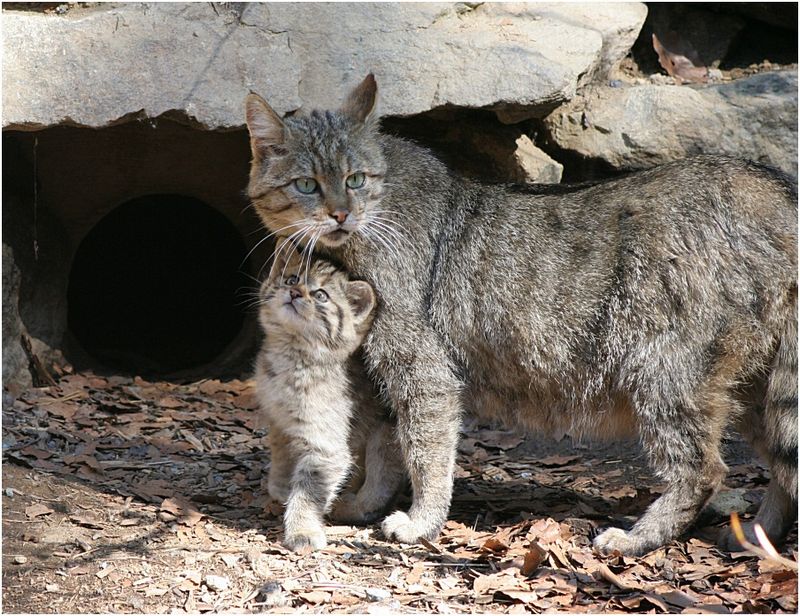
Wildcats have many distinctive features. Size, for example, is a wildcat's height. Wildcats reach approximately 43-45 cm, and their length ranges from 80 to 90 cm. They weigh 7-11 kg. Wildcats are, of course, somewhat smaller than male cats, but, believe me, they are larger than domestic cats.
The wildcat also has beautiful whiskers, but almost no eyelashes. The wildcat's coat color, however, isn't much different from that of its domestic cat relatives.
Typically, the European wildcat is gray with black stripes and ochre highlights. In summer, the wildcat's ochre shades become more vibrant, allowing it to blend into the forest landscape.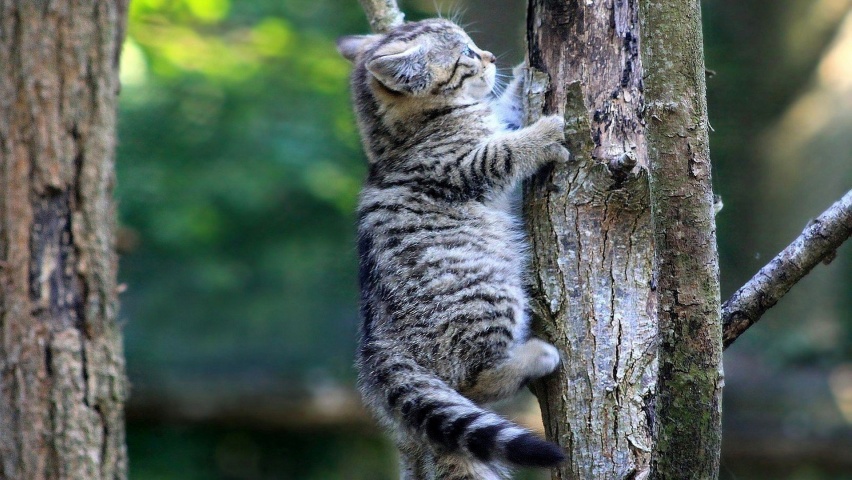
Cats of this breed shed their fur several times a year, and in winter, the European wildcat develops a luxurious coat. This allows them to feel quite comfortable even in the mountains and southern Siberia.
Behavioral features
So, does the European wildcat's behavior differ from that of a domestic cat? The answer to this question is a resounding yes. Although it's a cat, like a tiger, you can't play with it. Many attempts to domesticate the European wildcat have ended in failure. There have been attempts to tame kittens from birth, but... As the saying goes, no matter how much you feed a wolf (in our case, a cat), it still looks to the forest.
Wildcats fight desperately for their privacy. Close proximity to humans makes them nervous, so they settle in remote areas. If their privacy is disturbed by humans, they retreat to even more secluded areas.
The mating season for wildcats begins in cold January and lasts for three months. During these months, the forest wilderness resounds with heartbreaking cries, screams, growls, and hisses. Only the forest dwellers witness the cats' wild battles—their decisive victories, and sometimes defeats, and the fur torn out in the fight.
Incidentally, wildcats are truly excellent fighters and hunters. They hunt a lot and with passion. They catch small and large rodents, birds, frogs and hares, and even fish in shallow streams. Sometimes, the cats' prey includes young deer and roe deer.
It's worth mentioning that the wildcat is an excellent mother. When her kittens are born, they are completely helpless, tiny bundles of flesh. They are blind and, for the first few days, deaf. The mother cat is very attentive to her kittens, trying not to leave them alone for long.
She tries to teach them all the useful skills that will help them survive in the harsh conditions of the dense forest. To achieve this, the wildcat organizes hunting training for the kittens, sometimes bringing live animals as training aids. And by four to five months, the kittens are ready for independent life.
There is also a rather interesting breed of cat that is particularly reminiscent of our hero - Norwegian Forest Cat.
Photos of cats, even exotic ones like the European Wildcat, can be found in every section of our website.
Video about European wildcats
Read also:


Add a comment