
Who is smarter: cats or dogs?
Who is smarter – a cat or a dog? Whose intelligence is more developed, whose mental abilities are more diverse? Numerous studies have been conducted on this question over the past few years. What conclusions have scientists reached?
Content
- 1 Differences in the cerebral cortex
- 2 What Science Says About Comparing the Intelligence of Cats and Dogs
- 3 Intelligence traits of cats
- 4 Differences in social intelligence
- 5 Who has a better memory?
- 6 What is the secret of dogs' genius?
- 7 Why the debate about "who is smarter" remains open
- 8 Practical conclusions for owners
Differences in the cerebral cortex
Most feline enthusiasts believe that cats are smarter than dogs. This is evidenced by differences in their cerebral cortex: cats have twice as many neurons as dogs. Dogs are constantly forced to follow their owners, faithfully carrying out their orders, while cats are self-sufficient.

Felids have much more developed sensorimotor intelligence. This means they are more sensitive and precise in their movements, and if necessary, they can hunt larger individuals relative to their own size.
Successful hunting is the life goal of these pets. That's why even pets living within four walls constantly train: chasing toys, playfully attacking people—all of this demonstrates the instinctive honing of their hunting skills.
Rational intelligence is another characteristic trait of furry pets. Cats can be quick-witted in areas that are truly useful to them, but completely clueless in matters that don't interest them. This selectivity speaks of creative intelligence (dogs possess so-called reproductive intelligence, which simply mechanically reproduces previously learned information).
What Science Says About Comparing the Intelligence of Cats and Dogs
One of the key metrics used to compare animal intelligence is the number of neurons in the cerebral cortex. A golden retriever has approximately 623 million neurons, while the average-sized cat has about 250 million. This is almost half as many as a dog. Clearly, dogs have the advantage in terms of brainpower. Their EQ (encephalization quotient) is approximately 1.2, compared to 1.0 for cats.
However, intelligence isn't just about raw neural data; it's also about how an animal uses its abilities. Dogs have a well-developed social intelligence. They can understand gestures and vocal commands, read human emotions, and participate in goal-oriented teamwork. Interestingly, some dogs can remember over 1,000 words and distinguish objects on command, like the famous border collie Chaser.
Cats, on the other hand, exhibit a more independent, autonomous intelligence. They have well-developed spatial memory and problem-solving skills. In experiments, cats not only mastered tasks but also continued to attempt them until successful completion, even of complex ones—suggesting high resilience and persistence.
Table: Comparison of Key Cognitive Abilities
| Indicator | Dogs | Cats |
|---|---|---|
| Number of neurons | ~530–623 million | ~250 million |
| Encephalization Quotient (EQ) | ~1.17–1.2 | ~1.0 |
| Problem solving | They learn quickly and seek help from humans. | They decide on their own, are persistent and inventive |
| Social intelligence | High: reading signs, sequencing | Moderate - focused on "self-sufficiency" |
| Memory | Work and long-term, related to education | Spatial stability in tasks |
Intelligence traits of cats
A cat's powers of observation and attentiveness are virtually unrivaled. This can be demonstrated simply by observing how a furry friend behaves in an unfamiliar environment: the animal will first thoroughly explore the new space and inspect every nook and cranny. It's impossible to distract it from this activity. It will quickly find safe areas and a warm place to rest and sleep. In this situation, a dog will be less observant and cautious.
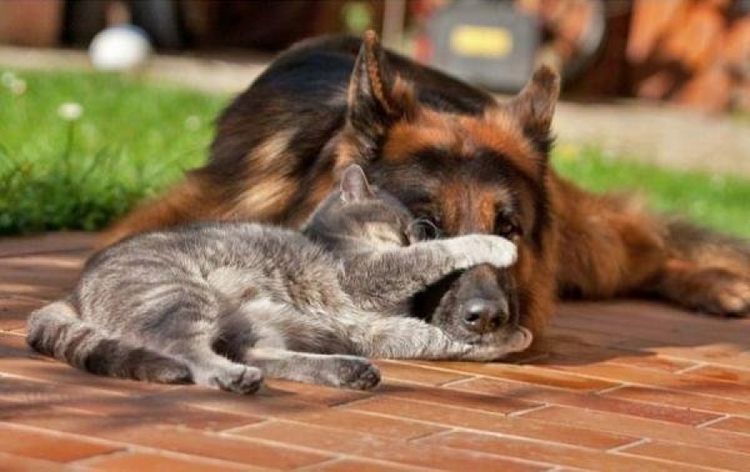
How does curiosity manifest itself? Upon seeing an unfamiliar object for the first time, a cat will quietly approach it, sniff it, and only then touch it with its paw, claws extended. Once assured of the object's safety, the pet will turn away and is unlikely to show any interest in it again. This cautious curiosity is precisely what dogs lack, yet this quality doesn't prove detrimental to the animal; rather, it contributes to its full survival in unfamiliar conditions.
Both cats and dogs can easily remember their names, and male cats can follow a few simple, carefully learned commands (for example, going to the bathroom in the same place). Are felines capable of using this information to their advantage? Just a few years ago, it was believed that only monkeys, whose intelligence is most similar to humans, possessed such abilities. It was soon discovered that cats also possess these abilities. They can find food in places inaccessible to humans and, if necessary, demonstrate creativity in finding their way out of a maze.
Read also about on our website Top 10 smartest dogs in the world.
Differences in social intelligence
However, social intelligence is much more developed in dogs. These animals prefer to hunt in packs, as communication is essential for successfully catching prey. During the hunt, roles are clearly assigned among pack members.
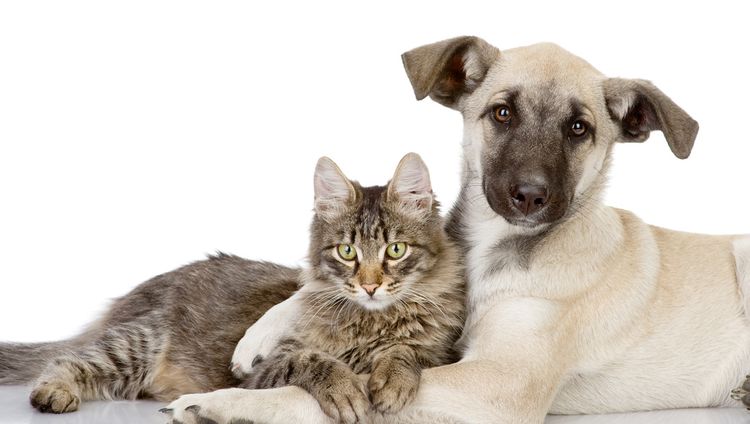
Dogs understand people much better, because humans are also social creatures. That's why these animals, especially if they're specially trained, can obey up to a hundred different commands.
Who has a better memory?
Who is smarter – cats or dogs, and why? Some believe that cats have a much better memory, as they are capable of holding a grudge against humans for a long time and expressing their displeasure and resentment in various ways. However, here again, cat lovers are making a mistake.
Canadian scientists conducted an interesting study: in front of two animals, they hid a tasty treat in one of four boxes. A dog remembered the location of the treat and was able to easily find it even after several minutes, while the other animals forgot almost immediately. The conclusion is obvious.

However, these pets' excellent memory doesn't extend to all situations. Other researchers conducted an equally intriguing experiment in which animals were asked to find a treat in a fairly large maze. It turned out that rats and wolves had significantly better spatial orientation, suggesting that dogs' abilities are not limitless. One caveat: once a four-legged friend has seen its owner solve a particular problem in one way or another, it can memorize the algorithm and solve the problem independently.
Tips for Co-Housing
-
Gradual acquaintanceAllow the animals to get used to each other's smells and presence before direct contact.
-
Sharing of resourcesProvide separate bowls, beds and toys for each pet.
-
Positive reinforcement: Reward calm and friendly behavior with treats and praise.
-
Observation and intervention: Monitor animal interactions and intervene when necessary to prevent conflicts.
What is the secret of dogs' genius?
The secret to dogs' intelligence lies in their ability to fully interact with people. Unlike other animals, they can accurately read and recognize human gestures. Every dog owner has helped them find their favorite toy at least once, simply by pointing in its direction.

So whose intelligence is more developed? Based solely on the research findings above, one might conclude that dogs are superior to cats in intelligence. However, this conclusion is not entirely accurate, as each pet species is considered superior in one area or another. What one species lacks, other animals can easily achieve.
Based on the above, the following conclusions can be drawn:
- dogs have a well-developed memory;
- dogs are better at interacting with people;
- Cats are distinguished by greater precision in their movements and better abilities for hunting alone and for survival in general.
Why the debate about "who is smarter" remains open
Firstly, the method of measuring intelligence plays a huge role. Obedience tests are more suitable for dogs, as they are motivated by human interaction and rewards. However, when analyzing the cognitive abilities of cats, research faces a problem: these animals are less sociable and not motivated by social recognition, so their abilities are underestimated.
Secondly, intelligence cannot be measured by a single metric. Dogs have stronger social intelligence, while cats have stronger autonomous decision-making and survival skills. Standard IQ tests favor dogs, but they don't capture the full spectrum of feline intelligence. Many studies, labeled "the debate settled," actually emphasize the uniqueness of both species, rather than the superiority of one over the other.
Practical conclusions for owners
It's important for dog owners to understand: your pets excel at social adaptation, training, and teamwork. Their brains are optimized for human communication. They eagerly accept feedback and learn from rewards.
Cat lovers should know: cats are remarkably intelligent, but in their own way. They exhibit patience, determination, and independence. They analyze situations, don't ask for help, and use observation to solve problems. This makes them cognitively complex and engaging companions, even if their abilities sometimes remain "behind the scenes."
Read also:


6 comments
Reptiloid
Dogs are smarter because they have more neurons.
klava
I'm neither a cat nor a dog person, but I have a friend who's obsessed with them, but I've had both cats and dogs. Dogs have a very strong sense of smell and appetite, which is why when small dogs need to be limited in their food, they overeat and burp, and they obey commands for the bowl. Cats don't have this; of course, they don't obey commands like sit and lie down, but I think cats are more intelligent; firstly, they're curious. My cat meets me after work and demands that I pet him when I come home, even though there's food there and he's well-fed. He is also picky in games, if the toy is lying down, he is not interested only when I play with it. Then I bought a flashlight, not a laser, but it looks like it. At first he played, but then he seemed to understand that he was being fooled. He can’t touch it and the beam moves quickly. I saw this in his gestures, how he cooled off towards this flashlight, but he plays with other toys perfectly. He is also lazy, like a person. He once got out of the potty and you can see something left under his tail, then it fell on the floor. I told him to wash his butt at first I thought he didn’t understand me, but then I pestered him with these words and he began to wash it and when I went to the kitchen, he looked at me like he thought he made me do it. There are cats that even go to the toilet and they can also protect from a rabid dog and other animals. Even bears are afraid of them, although they are much smaller than dogs, but no less courageous.
Boris
I'll say that dogs are incredibly clumsy creatures :). Large and medium-sized cats, unlike small ones, are very intelligent and quite social. It's like a completely different animal. Their motor skills are surprisingly fast and precise in critical situations, and this is coupled with their powerful intellect. Why are you comparing a small cat like Vaska to a German Shepherd?
Queen
In the wild, cats live in families—prides—so all this nonsense about solitary cats is a lie.
Even when she's alone at home, she misses her family. When you come home, she jumps on your chest and licks your face, purrs... As soon as you leave the door, she screams pitifully and tries to get away.
Don't insult cats with unflattering conclusions; they are man's best friend!!! Kind and sweet. And they will never bite or kill a person, unlike dogs!
Queen
I disagree. Cats are often more communicative and attached to their owners than some dogs. And they're much easier to understand. I, for example, understand my cat with a half-meow, half-movement. And she knows every emotion on my face!
I have observed more than once how cats are faithful until their last day, while dogs betray and leave good owners forever for a piece of food.
Anna
Don't hurt them! I'm a dog lover and I know that, unlike
Cats and dogs help people! They don't just lie on the couch and eat.
Add a comment