
Red spots on a dog's belly
Red spots on a dog's belly are very easy to spot, as this is the part of the body that isn't covered in hair. This symptom can indicate both a serious illness and a non-life-threatening condition. It's crucial to understand the causes of these spots, correlate them with other signs of possible illness, and clearly understand when you can treat the problem yourself and when you need to see a vet.
Content
Causes that do not require veterinary attention
The appearance of minor redness is not a reason to urgently visit a veterinarian. Sometimes, a red spot can appear as a result of chafing from a new leash or harness, and simple Vaseline is enough to eliminate the problem.
Other common causes of red spots on a dog's belly include:
- Allergic reaction.
Allergies are fairly easy to recognize by the accompanying symptoms. If a food allergen enters the animal's system, vomiting and polydipsia will be observed. Also, if the bare skin of the abdomen has been in prolonged contact with chemicals or synthetic medications, a contact allergy will develop. In this case, in addition to flat, reddened patches of skin, including on the face, you may notice constant itching.
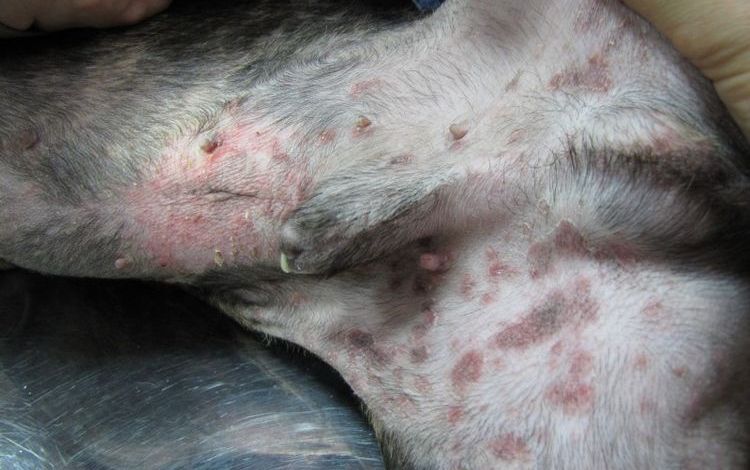
To rid your pet of allergic spots, it's important to eliminate further contact with the allergen. To achieve this, it's recommended to feed your pet only food labeled "Hypo-allergenic." If you suspect your dog's red belly spots are the result of exposure to chemicals, thoroughly bathe your pet in clean water (using all-natural products).
- Prickly heat.
If your pet is too hot, heat rash may develop. The red rash is usually localized not only on the belly but also on the ears and in skin folds. The dog itself may not react to the rash, but may suffer from polydipsia and lethargy. If left untreated, wet scabs will eventually develop, which may fester and emit an unpleasant odor. At this stage, the animal will often lick the affected areas vigorously.
To prevent heat rash, ensure your pet is adequately cooled in hot weather. Furry breeds are particularly susceptible to this problem. It's best to move walks to early morning and late evening. If your pet is constantly outdoors, ensure constant access to a water bowl and bathe them periodically with cool water. Heat rash can be treated with hydrocortisone ointment or calamine lotion.
- Tick and flea bites.
Bright red spots on a dog's body may appear at the site of parasite bites. Flea infestations are easy to spot: part the fur at the withers or behind the ears. If black eggs or fleas are visible, immediate action is necessary. Ticks are much more difficult to detect. In most cases, the parasite attaches to the animal, but sometimes the tick can bite and fall off, leaving its head embedded in the skin.
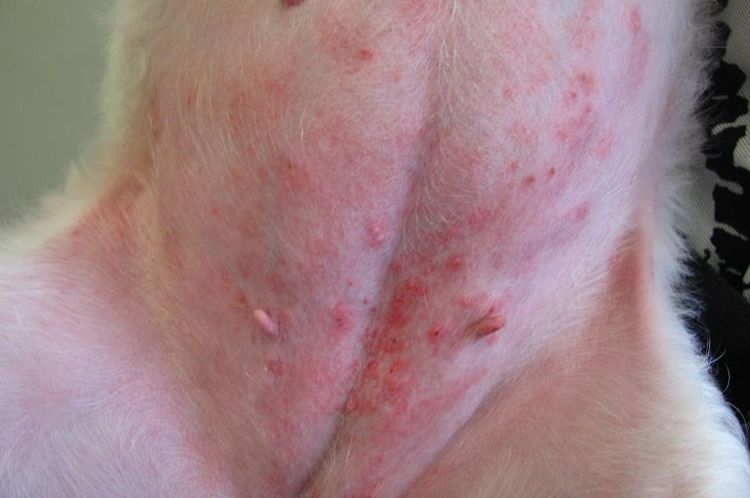
It is necessary to conduct a comprehensive treatment of the dog with antiparasitic drugs. For daily protection, you can purchase a special collar.
If a persistent spot remains on your pet's skin after treatment, consult a veterinarian. The remaining tick will likely need to be removed.
Reasons requiring specialist assistance
When examining your pet and making your own diagnosis, it's crucial to be extremely careful not to miss signs of dangerous diseases. After all, if the skin redness is due to an infection or immune system failure, veterinary assistance will be essential.
Fungal infections
When infected with a fungus, red spots appear on the dog's groin and lower abdomen. The animal may whine when going to the bathroom and scratch frequently. If left untreated, the spots quickly develop into small ulcers that spread to the paw pads, ears, nose, and even the mouth.
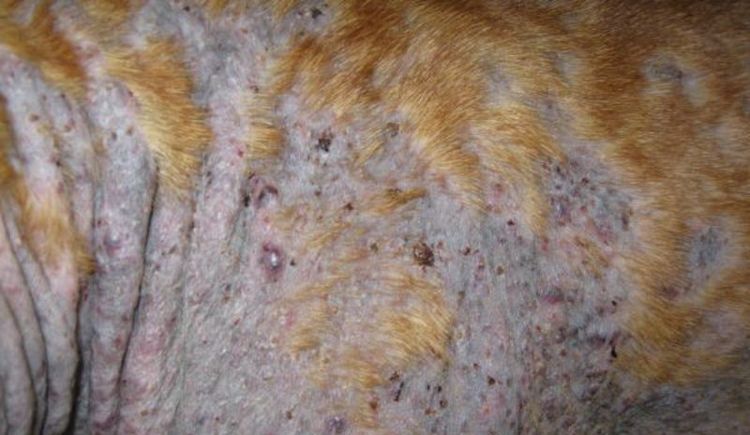
- Therapy program.
Do not administer any medications to your pet on your own. A veterinarian will prescribe medications after reviewing the blood test results and a swab. Until you consult a specialist, you can only apply a weak chlorhexidine solution to the sores to alleviate your dog's discomfort.
Ringworm
Almost perfectly smooth, round red spots on a dog's belly may indicate the presence of ringwormIf the reddened areas are covered in hair loss, and the animal is constantly scratching and acting restless, then the diagnosis is certain.
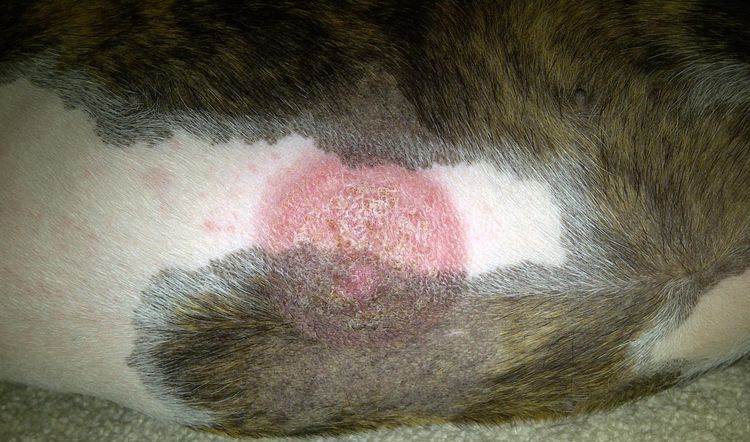
- Treatment program.
All that can be done at home is to isolate the dog (as there is a risk of infection). The veterinarian will prescribe antifungal and immunomodulatory medications.
Folliculitis
The disease develops as a result of infection of the hair follicles. Reddish papules may be seen in the lower abdomen and groin area. Folliculitis most often develops after Staphylococcus intermedius enters the body (sometimes a granuloma develops concurrently). Hypothyroidism can also trigger the disease.
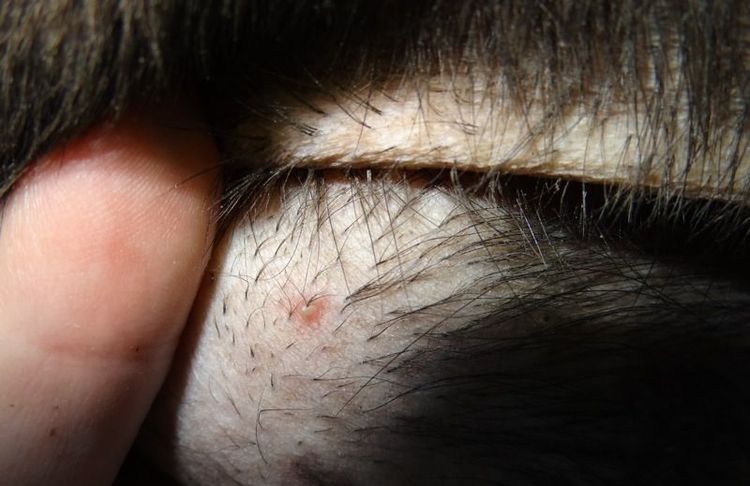
- Treatment program.
Affected areas are shaved and treated with an antibacterial solution. Depending on the underlying cause of the condition, antibiotic therapy or topical antiseptics are prescribed.
Tumors
If you can clearly feel the hardening of the reddened areas of skin when pressing on them, then it is likely that the problem is caused by benign or malignant tumors.
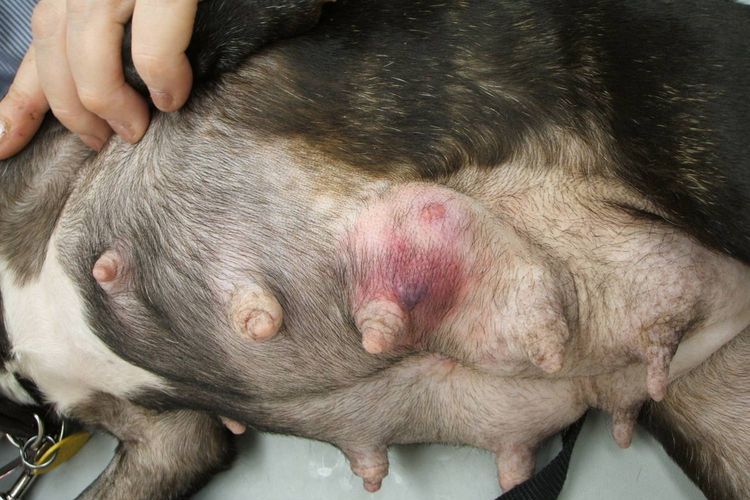
- Treatment program.
First, the veterinarian will determine the nature of the tumor by performing a biopsy. Benign tumors may resolve without intervention. However, if the tumor is malignant, the animal will need radiation or chemotherapy.
How to diagnose yourself
To help non-medical professionals make a basic diagnosis, veterinarians have developed a specific algorithm. So, if you notice reddened areas on your dog's belly, follow these steps:
- examine the entire body of the animal to understand the extent of the lesions (sometimes a tick can be found during such an examination);
- monitor for any changes in your pet's behavior (sudden fatigue, unexplained thirst, constant itching, etc.);
- compare the symptoms with the location of the rash;
- If the diagnostic picture matches the description of one of the above diseases, provide the dog with all possible assistance;
- If you cannot determine the cause of the rash, or the treatment has not helped the animal, then contact a veterinarian.

Sometimes, the use of corticosteroid ointments or creams only alleviates the external manifestations of the disease, such as spots and itching. However, in the long term, such treatment can be harmful to the animal. It is imperative to identify and address the root cause of the problem to prevent complications and possible relapses.
It's important to remember that in most cases, red spots on a dog don't indicate any serious health issues. The skin condition will quickly resolve with simple topical treatments. However, it's crucial to monitor any accompanying symptoms and consult a veterinarian if any negative changes occur.
You can also ask our website's staff veterinarian a question, who will answer them as quickly as possible in the comments box below.
Read also:
- The dog drinks a lot of water: the reason
- Allergies in dogs: symptoms and treatment
- Dermatitis in dogs


74 comments
Elena
Hello Dasha! I have an 8-month-old beagle. He's up to date on all his vaccinations and has been dewormed. He has some red spots on his belly; they're nervous, but his fur doesn't itch. He's on a natural diet: grains, organ meats, chicken, and various vegetables. He eats fruit, mostly apples. He loves cucumbers and tomatoes. He's been eating all of these since he was about 3 months old. During the New Year's holidays, we gave him boiled trout, and he's been stealing tangerines from the other kids. We haven't given him anything else.
Daria is a veterinarian
Hello!
It's possible your puppy is having an allergic reaction. The first signs often appear on the belly, where the skin is quite delicate, thin, and hairless. In this case, we recommend consulting a dermatologist. Allergies can develop at any age, even if your pet has been eating certain foods since infancy.
At this time, do not administer any allergy medications on your own, as not all medications are approved for use in animals. It's also possible that mild cases may only require dietary adjustments or adjustments, as well as topical medications.
Wishing the little tail a speedy recovery.
Denis
Hello, my dog has red spots on his belly that won't go away, and his belly is red. What should I do? He's on hypoallergenic food.
Daria is a veterinarian
Hello!
I really hope that you have already visited a veterinary dermatologist and resolved your problem.
Hypoallergenic food does not eliminate the possibility of allergies to external factors. It also does not eliminate food allergies.
Let's figure it out.
Depending on the region, red spots on the abdomen may appear due to the external environment (grass, snow with reagents, insect bites)
Diet violation. Giving treats containing an allergen, and the dog managed to pick up some food (and other things) during a walk.
These may be symptoms of endocrine diseases.
In any case, an in-person examination and analysis of all factors that could affect the health of the skin is necessary.
Health and soft skin on your little tail's belly!
Evgeniya
Good day! I need your help. We've been to many vets, but no one can help us (our Spitz is now 1 year and 8 months old, male, not neutered). I'll start from the beginning... We got him when he was 1.5 months old. We immediately noticed he was scratching his tummy. He had all the age-appropriate vaccinations, was treated for fleas and worms, and given Bravecto! I tried my food, different brands and flavors, premium class, but he continued to scratch. At 6 months, he managed to swallow a screw. We noticed right away and took him to another city for surgery! Thank God, everything went well; the screw was in his stomach! After that, he had a catheter taped with adhesive tape on his leg. On the last day of the IVs, I left the house for a short time, and he was wearing a collar and in his kennel! When I returned, I discovered the collar was missing, and part of the catheter had been eaten...
Two days later, he started vomiting. He couldn't sleep all night, but thank God, everything was fine the next morning! The itching didn't seem to bother him much! After the surgery, I noticed a dark spot on his thigh, but I didn't think much of it! His fur, even before the surgery, was becoming cottony and lifeless! We took him to the groomer, she combed it out and said she hadn't cut it, but when I got him home, he was half-bald! And then, or maybe it was a coincidence, it all started... Little by little, the fur started falling out, now we look like a lion (with a bare bottom and a fluffy face! The tummy is itchy, there is a red spot right near the scar, 2-3 cm, and this is the main thing that worries us (((What we did: we took thyroid tests, it turned out that the cortisol level was 22, they prescribed Kotef 1/4 1 time per day, a week later we took the test again, the level showed 66, and in March we took the test now 132, the rest of the indicators are normal, and in the urine too!
What have we tried so far for the spot and itching on his tummy? We've tried Clodax, Dexafort injections, Stop-Itch sprays, Simparic, and Milbemax. We've also taken Apoquel 5.4, 1/2 twice a day for a week, and then 1/2 once a day for another week! I've also applied Levomekol, Yam-BK ointment, panthenol, olive oil, coconut oil, and Gamabiol to his tummy. I bathe him with Climbazole shampoo and tar soap, apply 20-minute masks, and dry him with cold air from a hairdryer. We've been eating a natural diet for a year (beef, horse meat, peppers, zucchini, and carrots). He sleeps soundly, is in a good mood, and doesn't vomit or feel sick, with excellent stool. Please tell me what I can do to stop the itching, even though he's bald. We've been diagnosed with both atopy and alopecia X! They're recommending neutering, but I feel sorry for him, and I've read that it's bad for him! Thank you in advance for your reply.
Victoria
Hello, my dog has red spots just above his belly, like a rash. What could it be?
Daria is a veterinarian
Hello! This could be anything. It could be an allergic reaction to food/medications/household irritants, flea dermatitis, ticks, or other causes of dermatitis. A thorough dermatological examination with a detailed history is needed: age, sex, feeding, vaccinations, deworming, treatments, walking, housing, other symptoms, contact with other animals, frequency, duration, any cyclical occurrence, seasonality, have any new supplements/vitamins/treats been given, is there itching, restlessness, what shape and size (same or different), and are the spots increasing in size or number? So many questions!
Evgeniya
Good evening! I have a 5-month-old Corgi puppy. Every time I wash him, red spots appear on his tummy, which looks like an allergy.
What could it be?
Daria is a veterinarian
Hello! Why do you wash your hair often? And what do you wash it with? If you use shampoos or soaps, I'd first check their ingredients. How long does it take for the allergy to clear up?
Yana
Hello! My two-year-old Pomeranian has developed irregular, blood-red spots that are growing in size and number every day. His skin is slightly flaky, looking like an old woman's, and is not elastic. These spots don't bother him. They are mostly on his stomach near the genitals, chest, and neck. I can send you a photo.
Daria is a veterinarian
Hello! No one can make a diagnosis based on just a photo. A physical examination, a scraping, and a complete blood count and biochemistry panel are required. We're ruling out allergies (not just food), cutaneous parasites, endocrine disorders, and hormonal issues (if your pet isn't neutered). I hope your pet has been treated for fleas.
Tatiana
Hello. Could you please tell me? My puppy has two round, pink spots with a red border on his belly, with a red dot in the middle. Could this be a tick bite? Thanks in advance.
Daria is a veterinarian
Hello! We need to take a look. What kind of spots are these? It could be a mosquito. A flea. Or any other insect. Or it could have been pricked by grass or a branch. Or dermatitis, or something else. Without a diagnosis, it's impossible to say IN ABSENTIA what exactly the animal's spots are and where they came from.
Stanislav
Hello. After a walk, we discovered four red spots on my dog's belly, each about 5 mm in diameter. What could they be? It's a Yorkie.
Daria is a veterinarian
Hello! These could be insect bites or injuries from hard plant stems (like punctures). Monitor these spots closely to see if they get larger or bother your pet.
Valya
My dog has a red spot on his side. It's firm, but on top, and oozes when pressed, but it doesn't itch or hurt. It's in the same spot where the dandruff used to be. It hasn't gotten any bigger in three days. I'm applying fucorcin, as the veteran recommended, but it's not going away. What should I do?
Daria is a veterinarian
Hello! Dogs don't have dandruff; it's just flaking, dry skin. However, it's important to understand the underlying cause. The appearance of a oozing spot is a clear reason to first consult a veterinary dermatologist, who will then refer you to a veterinary oncologist if necessary. It's crucial to rule out any neoplasms first to avoid delays in treatment (thankfully, veterinary medicine is advancing rapidly). Don't attempt anything on your own without a thorough examination and testing. Do not apply any topical ointments or treatments to the area before your appointment, as this can complicate the diagnosis.
Tatiana
Hello, my dog has a severe rash. She is a female Staffy. There are many red spots on her belly. There are also some spots on her fur. What could it be?
Daria is a veterinarian
Hello! What kind of feeding? What kind of feeding? Is there itching? What shape are the spots? Rough or smooth, scaly or not? Are there any rashes or suspicious growths under the elbows, on the chest, or between the fingers? Have you given any medications? Has this happened before? I would probably suspect, first and foremost, a food allergy (especially to chicken or other poultry), similar to a human diathesis (for example, to sweets, citrus, strawberries, and other things). But infectious and parasitic skin diseases are also important to consider. We need to determine how long the spots have been there, how quickly they appeared, and whether they are causing any discomfort.
Elena
Hello, my dog has clear discharge from her vagina and her belly is red. She is 9 years old and not spayed.
Daria is a veterinarian
Hello! I need an ultrasound and a complete blood count urgently! It's absolutely urgent! Gynecological problems can't be delayed. Pyometra (a purulent inflammation of the uterus) can develop very quickly and just as quickly take your pet "over the rainbow." Have you noticed increased urination or thirst? Is there any lethargy? What's your pet's general body temperature like?
Christina
Good afternoon. I discovered a round spot with a red border and scaly skin in my dog's groin area. We went to the vet, he checked it out, and he said it was an allergy. He prescribed prednisolone ointment right away, without any tests. My heart is still unsettled. I can send a photo of the spot. What should I do?
Daria is a veterinarian
Hello! How many spots are there? Are they growing in size? Are they itchy? Are the borders clear (circular, with different edges, or a shapeless spot)? Have you used a Wood's lamp? Have you had a scraping done, and is it possible to go to another clinic? What are you feeding (chicken or other allergens)? Have you tried giving suprastin for 1-2 days? Is the spot dry or wet? Is it only on the stomach? Are there any areas in the groin or armpits (typical areas for atopic dermatitis)? Are there any small bald patches similar to this spot on the face, front paws, or ears?
Tatiana
Hello, I have a 5 year old female Spitz, spayed, and a month ago a brown spot with a dry crust appeared on her stomach. I started wiping it with chlorhexidine every other day, but now the sore has gotten bigger and a small one has appeared nearby. They are brown in color and when I wipe them, the crusts come off. What could this be?
Daria is a veterinarian
Hello! Your pet needed to be examined by a veterinarian. A skin scraping should be performed at the border between the affected and healthy tissue. Rule out tick infestation and fungal infections (every veterinary clinic, even the most basic one, has a microscope). It's important to understand the animal's diet (natural or commercial) and any treatments (for worms, fleas, and ticks). Rule out an allergic reaction. Is your pet itchy or restless? Are the spots only on the belly? Inspect the groin, armpits, and face for similar spots.
Alexander
Hello! My mother died at the end of May, living only three days after giving birth. Five puppies were left behind. We started feeding her formula from birth, after which the puppies began to die. One puppy remained, so we continued feeding her Nistogen. She started gaining weight poorly. She is now two weeks old and weighs 115 grams. She is a small yard breed. We recently fed her goat's milk for two days (1 yolk and 10 ml glucose). Red spots appeared on her chest and two spots on the folds of her hind legs. Can you recommend anything?
Daria is a veterinarian
Hello! You should have looked at the milk replacer from the start. Infant formula isn't very suitable and can cause digestive upset. The puppy is too young to be given medication. The stained areas can only be treated with chamomile tea. The puppy itself should be switched to dog formula. The skin stains are most likely an allergic reaction (to goat's milk protein or the yolk). Remove the allergen, and the stains should clear up on their own without any medication.
Alesya
Hello, I'm very concerned about my three-year-old Yorkshire Terrier. Recently, she's been acting extremely restless, can't find a place to stay, and is constantly scratching herself. I also noticed a red spot where her collar used to be, but after researching, I've concluded that she's probably just rubbing it with the collar. Please help, I don't understand why she's so restless.
Daria is a veterinarian
Hello! Do you have a flea/tick collar nearby? Sometimes, the tight fit of such collars, impregnated with chemicals, can cause burns, irritation, and allergic reactions. This could also be due to the application of anti-parasite drops to the withers (if similar treatments have been recently used). It's also important to understand what your Yorkie's collar is made of. Loosen it or remove it altogether. If the collar hasn't been treated, inspect the skin. It could be parasites (fleas, lice, a tick bite, or even a mosquito bite during a walk).
Lydia
Good afternoon! We have a problem. Our mixed-breed mongrel (she has all the vaccinations required for her age) eats natural food. She started scratching. We gave her Nexgard Spectra for fleas, ticks, and worms a week ago. She continues to scratch her belly and seem to bite fleas all over her body, although we don't see any parasites. Today, pink leopard-print spots appeared on her belly. I gave her Suprastin. I understand this is a difficult matter. Please help, at least with advice! Also, she now only eats treats with gusto, ignoring regular cereals. Her behavior is normal, she is active and playful, but she scratches.
Daria is a veterinarian
Hello! Please describe the diet properly, including what exactly it consists of. Giving treats to an animal you suspect may have an allergy is only doing harm. You should have washed the animal and combed it thoroughly beforehand. If the fur is thick or the animal is large, parasites could have survived. Suprastin should be administered with caution, and for no more than 3 days. It is given to relieve an acute allergy attack. You should completely revise the diet. Eliminate all potential allergens. Commercial pet foods include special lines for allergy sufferers. You might want to consider them as well.
Irina
My Chihuahua has red, flaky spots on his belly and some areas of his skin. He doesn't itch and acts normal. They look like sores, and it's clear he doesn't touch them or scratch them. What could it be? They're especially noticeable in his groin area, belly, and paws. Thanks in advance.
Daria is a veterinarian
Hello! There are many possible causes. The first things to rule out are fungal infections (tinea, microsporia), then dermatitis of various etiologies (bacterial, allergic, drug-induced, due to hormonal imbalance, or internal organ damage, such as hepatocutaneous syndrome), zinc-dependent dermatosis, pyoderma, demodicosis (although the first lesions are more often on the face), furunculosis, and much, much more.
Dermatology is a broad field, with numerous conditions characterized by the appearance of spots. An examination, additional tests (scrapings, microscopy, blood tests for biochemistry), and more detailed history are needed (age, sex, neutering, vaccination, deworming history; living conditions and feeding; treatments, whether the pet has been treated recently; are there other animals present; how long ago the skin parasites were eliminated; what the pet eats, etc.). I would suspect atopic dermatitis, but unfortunately, you haven't mentioned anything about your pet's lifestyle.
Galina
Hello. My German Shepherd has red spots on her belly, neck, and nose. She has long fur, scratches her neck occasionally, sleeps peacefully, and hasn't lost her appetite. I'm treating the spots with hydrogen peroxide. Can you recommend any pills or other advice? The vet is 60 km away.
Daria is a veterinarian
Hello! How can you recommend pills without a diagnosis? It could be an allergy, dermatitis, a reaction to skin parasites, mites, or something else entirely. You haven't mentioned the animal's gender (neutered/unneutered), what you feed it, when the last deworming/flea treatments were, when the vaccinations were (or were there any) or whether you give any supplements or medications, where the animal is kept, etc. You've listed one symptom that matches almost every condition covered in the "Dermatology" course.
Elizabeth
Hello! I have a 6-month-old dachshund. This is my first dog. We were feeding her Proplan small breed puppy food with chicken, and a red spot appeared on her belly that she's been scratching. She also has red inflammation in the corners of her ears and under her arms. We went to the vet, and they said they suspected chicken was in the food. I've been using 2% chlorhexidine on all her wounds for two days now. We bought hypoallergenic food, and nothing's happening. I know it's only been two days, but is this definitely an allergy, or is there anything else that could be causing it? Thank you very much.
Dasha is a veterinarian
Hello! The allergy isn't going away that quickly. Did you give him charcoal to bind any residue in his intestines? Did you give him an antihistamine (likely Suprastin in the dosage appropriate for your dog)? What hypoallergenic food did you choose (brand and flavor)? Did you have any tests done? At least a basic blood test. Did you have a scraping done?
Anna
Hello! My German Shepherd puppy has developed a bump on her leg, near her belly. She's three months old. What could it be? I've also noticed loose stools. We're not feeding her food; I'm preparing my own meals (meat, cereal, and dairy). I'm worried it could be ringworm, as we have a cat in the yard who was sick, but the vet said it's not contagious. She's already had two shots, and her tail is starting to heal.
Dasha is a veterinarian
Hello! What do you mean a cat isn't contagious with ringworm? That's something new in veterinary medicine. Fungal infections take a long time to treat, and the spores persist even AFTER recovery and the disappearance of all clinical signs. So claiming a cat isn't contagious is, at the very least, foolish. Either the diagnosis is incorrect, or the vet is a magician. And what kind of injections are these? Do they vaccinate? Almost all veterinarians are abandoning that. At every veterinary conference, they say that with proper treatment, small pets recover in the same amount of time, whether they receive a vaccine or not.
Regarding the German Shepherd: what kind of cereals and meat? What kind of dairy products? Vaccinations? Deworming? Is there itching? Please describe the dog's behavior and symptoms in more detail.
Olesya
Hello, my dog (a female Labrador) has developed several dry (I would even say loose) round sores with a red border, about 1 cm in diameter. What could these be?
Dasha is a veterinarian
Hello! Pet appointment! Urgent! Rule out ringworm if you don't want the whole family to be covered in the same spots. If a fungal infection is confirmed, then a complete blood count and biochemical analysis should be performed. Rule out dermatitis, allergies, and other conditions. During the in-person examination, explain when the spots appeared, how quickly they are spreading, what treatments you've already had (surely they have already been treated with something; few pet owners would resist applying something to the spots), and what you're feeding. And before the appointment, DO NOT TREAT the spots with ANYTHING! No brilliant green, iodine, cream, spray, or anything else. This will complicate the diagnosis.
Galina
Galina: Hello, Dasha. My 8-year-old dog has developed yellow bumps about 4 cm in size on his back. They then burst. He licks them, but new ones pop out. Please tell me what they are and what to do. He's generally afraid of any kind of treatment, snaps, and won't let strangers near him.
Dasha is a veterinarian
Hello! Whether it's approaching or not, the clinic will figure out what to do. But the animal definitely needs to be seen by a vet! A diagnosis is needed! It could be an abscess, or cancer, or something else entirely. "Back"—that's written rather vaguely. Where exactly is the "lump"? The contents need to be examined. And the areas where it burst need to be treated. How can I recommend treatment if the diagnosis hasn't been established and the animal hasn't been examined? Take the animal to the clinic—they'll find a way to treat the animal.
Alexandra
Hello. My dog has a smooth, non-scaly red spot on her belly (near the fold of her hind leg). There's a tiny, barely noticeable red dot in the center of the spot. She constantly whines loudly and chews on the spot. Could you please tell me what this could be? She's 2 years old.
Dasha is a veterinarian
Hello! Take him in for an in-person examination. Rule out an insect bite, an allergic reaction, or dermatitis. It could be a tick, or something else entirely. A diagnosis can't be made without an examination or just a verbal description. But if the animal is bothering you, we need to figure out the cause. Have you had your pet flea-treated? Are there any skin parasites?
Svetlana
Hello! We have a 2.5-year-old East European Shepherd. Every summer, red spots appear on her belly. She feels fine, doesn't scratch, eats, and is energetic. We apply Flucinar. It helps, but when we come in from outside, new bright red spots appear. We've treated her for ticks with a collar and Brovecta. This isn't our first dog, and we've all had this problem in the summer. We walk on mown and tall grass, but also on asphalt. We washed her belly with tar soap—it improved. But as soon as we come in from outside, the problem starts all over again. What should we do?
Dasha is a veterinarian
Hello! Put a blanket on your pet when you take them for a walk. There's likely grass along your walking route that, when in contact with skin, can cause an allergic reaction (may even cause burns; get them examined). This is especially true if all your dogs are showing the same symptoms at the same time.
Elena
Hello! My dog has small red spots under his front and back paws in his groin area. I bought him a flea collar, but he's constantly scratching himself. Can you tell me what it could be?
Dasha is a veterinarian
Hello! Did the spots appear a couple of days after you put the collar on? What brand of collar is it? Or was he itching before you decided to treat the fleas? What are you feeding him? It sounds very much like an allergic reaction, but we need more details about your pet's life: what started, when, and what you were using.
Maria
Hello! My puppy has a single, oval-shaped red spot in his groin area, approximately 5 mm in diameter on the long side. He doesn't scratch or lick himself, and his behavior is calm and within normal limits.
A 5-month-old pug puppy is allergic. I just finished giving him a course of children's Diazolin (50 mg). On Saturday (June 23), we stopped giving him turkey meat because it made his face red and caused pimples around his eyes. He is currently eating Acana monoprotein fish food.
The puppy was treated with Prac-tic drops for ticks on June 19. We were at the dacha over the weekend, where he ran around in the grass and swam in the pond. I didn't find any ticks on him. I wash him after every walk.
Could you please tell me what could be causing this red spot? Is it necessary to rush to the vet right now?
Dasha is a veterinarian
Hello! Keep an eye on your puppy. If more spots appear or it becomes bothersome, take him to the vet. It's possible he's allergic to something again, or it's a residual reaction from the previous one...
Evgeniya
Hello, we have a German Shepherd puppy. Today he stopped eating and is lethargic, and I also discovered one large red spot and several smaller ones on his belly. The spots are smooth and have clear borders. What could this be? Thanks in advance.
Dasha is a veterinarian
Hello! Has your pet been treated for ticks? Has it been in the woods or in an area with bushes and tall grass? What is its body temperature? Are the mucous membranes and conjunctiva of the eyes yellow? Is its urine normal? What are you feeding it? Is there any itching? It's difficult to diagnose your pet without examining it. It could be an allergy, an insect bite, dermatitis, or even ringworm, just the way you described it. Without seeing your pet, it's impossible to tell. Monitor its well-being. If you notice the symptoms described above, rush to the clinic! It's extremely important not to miss the symptoms characteristic of piroplasmosis.
Tatiana
Good evening! My 15-year-old Pinscher has developed folliculitis, along with irregularly shaped bumps on her belly. They're flat, hard, and superficial, and in some places they're ulcer-like, but dry and not oozing. A year ago, when there were no ulcers, just bumps, the vet said it wasn't worth operating on her because of her age. Should I treat them with something? She's active, runs and jumps, but she periodically licks her bumps, even though they're dry.
Dasha is a veterinarian
Hello! If he's licking, it means he's bothered (maybe itchy). He's quite old. Have you ruled out cancer? Was the veterinarian diagnosing folliculitis, or did you just guess? The most you can do without a vet's examination is treat the sores with chlorhexidine to prevent infection. Ideally, you should see a veterinary oncologist or get an x-ray.
Victoria
Good evening, Dasha! I hope you can help, as our vet isn't answering the phone at 8:00 PM. We came back from a walk (through the woods and hills), and as usual, I was wiping her paws and whole body with water (it's hot now, so I'm soaking her fur and head with water). I noticed a bright red, even crimson, scarlet spot on her lower abdomen, on either side of the middle, where there's almost no fur. It's the following: 2 spots—a little larger than a pea, 3 spots—smaller than a pea. Two of them had black "grains" in the center. I gently touched them with a wooden toothpick and they fell off, like dirt. Our female Labrador, 2 years and 3 months old, was spayed at 1 year (during spaying, they tested for anesthesia medications—she had an allergic reaction to intravenous sodium thiopental, so they used a different anesthesia medication). We vaccinate and deworm her on time. She has never been sick.
Last year, at the end of May, she had an allergic reaction to some vegetation. The grass in the park had been mown, and she had been rolling around in it while playing with another dog. The symptoms were as follows: lumps the size of 3 kopecks appeared on her forehead, then all over her head. I called the vet, they gave her a single intramuscular injection of diphenhydramine—it cleared up within a couple of days. They didn't apply any ointment or give her any more pills or injections. While I was writing to you, I stopped to look at her tummy—the spots had gotten bigger: big ones, up to the size of a kopeck, had spread out. I touched one spot again with a toothpick (it seemed like a dark spot in the center), but the spot was gone, and the tip of the toothpick was stained the same color as the spots (crimson). I'm really worried, what should I do?
Dasha is a veterinarian
Hello! Give antihistamines immediately. If the blisters are growing so quickly, it's most likely an allergic reaction. Don't pick at anything else with a toothpick or needle; don't do that at all. Give diphenhydramine or suprastin (the injection works faster than tablets). See your vet tomorrow morning. If your pet's condition changes, let me know.
Victoria
Thank you, Dasha, for your quick response. I didn't pick at anything, though. Another new spot appeared in the crease of my thigh not far from the others, and the original ones have spread in size. The center of the spots has lightened significantly compared to their original color, but the 1mm edge of the spot remains bright crimson, and there's a red dot in the center of the larger spots.
Anastasia
Good afternoon. We switched our dog from a natural diet to a dry one. A month later, hair started falling out on his butt, and a small patch of hair was bald. We went to the vet and they said it was an allergy. They prescribed Polysorb, Zodak, birch tar shampoo, flea and tick treatment, and Purina HA food. We've been giving everything as prescribed for a week now, but we haven't seen any improvement. Red spots have appeared in his groin area and ear, but there's no itching. Could you please tell me how long it usually takes to treat allergies? And is it possible to switch my dog to a natural diet, or is it too late?
Dasha is a veterinarian
Hello! What flavor additives does the dog's food have? Allergies take a long time to resolve. It's necessary to not only cleanse the intestines of accumulated waste and allergens, but also the blood. This process is lengthy. Get a blood test (even a general analysis will show whether there's an allergic reaction). If possible (at a clinic with a good lab), you can test for the specific allergen. Does the dog steal? Does the owner or family member give the dog natural food out of pity? Try another food for allergy sufferers (but make sure it doesn't contain chicken or turkey! Industrial poultry is a strong allergen for pets).
Elizabeth
Hello, we have a cute little dog, she is about seven or eight years old, she started pulling out her fur and a red spot appeared on her tummy that she constantly licks and it bleeds, what could it be and how can I help?
Dasha is a veterinarian
Hello! The first thing you need to do is get your dog examined by a vet. There are many reasons for this behavior. I suspect eczema. What are you feeding him? Throw away budget food without mercy. Only high-quality food is required, even if he's a mutt. What should you do? Start by putting on a special collar to prevent licking. Trim the hair from both the affected area and the surrounding healthy tissue.
Do you have laundry soap at home (ideally 72%)? Wash the affected area with soapy water 1-2 times a day for 7-14 days. Then, thoroughly wash with hydrogen peroxide until completely clean (soaking off any crusts and removing any ichor) 2-3 times a day for up to 10 days. Then rinse with chlorhexidine with the same frequency (2-3 times for 10 days). A novocaine block under all lesions shows excellent results (it's unlikely you can inject it subcutaneously).
Then treat the skin with Fukortsin/Chemispray/Alupharm spray of your choice 2-3 times a day for up to 10 days. Alternatively, lincomycin can be given intramuscularly or oflaxacin tablets for up to 10 days (the veterinarian will determine the dosage after an examination). One tablet of Carsil and one tablet of Serrata twice a day for 12 days. Suprastin or other antihistamines can be given twice daily.
This diagram is for informational purposes only! Remember that self-medication can cause much greater harm to your pet. Be sure to see a veterinarian for an examination and diagnosis. Only after eliminating the cause can you expect a positive result from the treatment.
Marina
Dasha, hello! Can I call you? Do I have any questions?
Dasha is a veterinarian
Marina, giving out your number online is like signing your own death warrant. Early in my practice, I made the mistake of giving out my cell phone number to clinic visitors. As a result, the number spread throughout the area, calling on weekends and at night. It's not very pleasant.
I see comments every day and try to respond as quickly as possible. But even my advice and suggestions will never replace an in-person examination by a veterinarian, additional tests (ultrasound, x-ray), and blood/urine/stool analysis. I cannot challenge my colleagues' treatment plans (we also have professional ethics). Moreover, unlike me, they see the animal, examine it, and can make several preliminary diagnoses, and then one final one.
My only advice to you is to never hide anything during a veterinary appointment and to provide as much information as possible. What seems insignificant to you may actually be an important link in the animal's medical history and help us understand what's wrong with your pet.
Marina
Dasha, hello! We went to the vet today. First of all, it's incredibly stressful for the dog. He's terrified, his teeth are chattering, and he's shedding so much fur out of fear. This happened when we took him to surgery—out of 20 dogs, not one was so scared. My question is, could stress be making the redness worse? Fireworks are starting now, and we're also terrified of them, so we've been using Adaptil and Stopstress drops for four years now. Two vets are leaning toward dermatitis. They didn't draw blood, stopped him from taking Suprastin, applied scruff drops—I forgot the name—they smell like essential oils, and prescribed Sinaflan ointment. Dasha, I can't ask us everything because... The dog is struggling. I forgot to tell you that the stains were only on one side, but on Saturday they suddenly appeared on the other side as well. I've already washed the area, changed the bedding, and washed the toys. What is this?
Dasha is a veterinarian
Unfortunately, if the veterinarians couldn't tell you the exact diagnosis during an in-person examination, I can't confirm what your pet has (without seeing it, only based on your description). Dermatitis is possible, but there are a huge variety: contact, allergic, bacterial (infectious), fungal, and so on. Insecticides and acaricides (for fleas, ticks, and other skin-sucking insects) were most likely applied to the withers. However, it would be a good idea to find out what treatments your pet is currently receiving (first, if they help, take note; second, if they're ineffective or cause allergies, know what not to use). Follow the prescribed treatment, observe, and try switching to hypoallergenic food. Unfortunately, working with animals is more difficult than working with people. Animals don't tell you what, how, or how long they've been hurting. Treatment is often chosen through trial and error (differential diagnosis, gradually ruling out certain conditions).
Marina
My dog's belly is reddish, with reddish pimples on one side. Her behavior is normal: she's not scratching or licking the area. The vet applied flea drops to her withers and prescribed Akriderm and Suprastin ointments. There have been no changes. Could you please tell me what this could be?
Dasha is a veterinarian
Hello! It could be an allergy. However, using Suprastin (or other antihistamines) without identifying the allergen won't help. First, you need to identify what's causing the sensitivity. Start with the diet. Switch to a hypoallergenic one, continue treatment, and observe for a week or two (remember, not all pimples and redness will disappear overnight; miracles won't happen in a day or two). Deworm (sometimes this reaction can occur even with worms). Has the dog been lying on its stomach on a chemically washed floor, or on a cold floor (maybe in the snow)? Is the dog female or male, age, neutered or spayed, diet, when was the last vaccination and deworming, any recent illnesses, or have any medications, vitamins, or new supplements been given? Without a full medical history, even a physical examination is impossible to say what's wrong with the animal.
Marina
Hello! We have an 8-year-old male Karelian-Finnish Laika, neutered. He was vaccinated in the spring, and at the end of November we gave him a Prazitel tablet (we give him every three months; the last one was Milprazone). We also started him on 8-in-1 Adult multivitamins for about five days, but we stopped because he wasn't eating. He's a hunter; he was hunting about a month ago, and it was about -20°C (-4°F). That's when we noticed the first three seemingly red spots, but we thought he'd gotten them on the crust. They went away, but his belly remained pinker than usual.
Then a pimple appeared, which is when we went to the veterinary clinic. Currently, there are multiple red spots on one side of her body that initially looked like pimples. Her belly is reddish, and she doesn't scratch or lick, but we noticed it gets redder after a walk. Exactly a year ago, Dasha was also out hunting. He spent about 20-25 minutes in icy water and fell through the ice. By the time we rescued her, we were running to the car. She was wrapped in a wool sweater. We called the vet, and by the time we got home, they gave her a course of ceftriaxone, and everything seemed fine. Could this be a reaction to the cold and cool weather? The vet is leaning toward bite symptoms, so they treated her, but she's worse now than before.
Dasha is a veterinarian
Another possibility is a reaction to cold. That's why I asked if the animal had been exposed to frost or had any cold skin contact. The animal's medical history reveals that it had frostbite in the past. The body is an unpredictable mechanism. Perhaps it's now reacting this way to low temperatures. There's a term for cold allergy (even at 0 degrees Celsius, I get red spots on my hands within an hour or two, and the next morning it feels like I've been out in the cold for three days; I can't go out without gloves). Have you had a blood test? If the animal has allergies or parasites, a blood test will reveal it. Flea bites will not only cause red spots on the skin, but you'll also notice dark spots (like dirt) on delicate areas.
In fact, these are bloodsucker droppings (they look more like small pieces of dried blood). Try placing your dog on something light-colored (maybe white or light-colored tiles in the house, sheets of paper, a blanket, or an old sheet). Start combing, using your fingers to "trebuchet" the roots, and also "rustle" the belly and chest so that they start to fall onto the floor. Then, look for spots on the floor. If there were skin parasites, the animal would scratch, become restless, lick itself, and chew itself, and its appetite would decrease.
In the future, your dog is a hunting dog, so get a stronger anthelmintic (Prazitel doesn't always work fully). For fleas, try Strongold, Advocate, and Inspector drops—they're effective against many types of bloodsuckers, ticks, and intestinal helminths.
Marina
Thank you very much!
Dasha is a veterinarian
You're welcome =) Once your pet gets better, you can thank the vet who got her back on her feet. Try putting a warm blanket on her outside, at least for walks. See if the situation improves. It might turn out that the skin on her tummy really was cold and that's why she reacted this way. Or maybe she really does have an allergy. Maybe there's something wrong with her diet? My cat developed an allergy to the food she'd been eating for years. It turned out the manufacturer had changed something in the recipe, the ingredients had changed, and she reacted this way. We had to change the manufacturer, but it took her a long time to find the right food (she wasn't happy with the taste, and then she kept developing an allergy even to hypoallergenic foods). I kept her on oatmeal for a week to relieve all this sensitivity. Then I gave her a new food to try. Maybe they changed the food abruptly? That happens too. You need to discuss all this with your vet during an appointment. Didn't they ask such questions when they were collecting the anamnesis?
Marina
Dasha, I have another question. Of course, we're going to the vet tomorrow. I'll ask about blood work, if possible, but since we live in a small town, they're sending her to another city, so it'll take a while. Should I give her suprastin? Should I use ointment? And since the internet is popular these days, I read that spots can also be caused by tumors? How can I rule this out? The dog is very dear to me because he had a difficult life; his first owner abandoned him. And our vet isn't as modern as we'd like, so many things are inaccessible.
Dasha is a veterinarian
Don't take anything before the tests! Ideally, stop taking medications a few days beforehand (they ruin the picture). Our town isn't very big, but we do biochemistry in our own lab (we specialize not only in small pets but also in large livestock: cows, horses, sheep, and pigs). We absolutely can't do without a biochemistry test on site; transporting blood to the capital every time would be too expensive =) But you should also have a general blood test done, including a leukogram.
Regarding tumors, don't panic. The animal is still young, and the picture isn't that bad for a tumor (appetite hasn't changed, there's no exhaustion, the fur isn't falling out, and the general condition hasn't changed much). Again, a vet might suspect a tumor based on a blood test, but then an X-ray is needed to determine the location. We brought our cat in, and we also thought it might be cancer (she'd lost 4 kg in six months, stopped eating, started sleeping poorly, and we found some spots). It turned out to be, you know what? Just fleas! They had plagued the old cat so much that she was constantly scratching herself and stopped eating, which is why she lost weight =)) Everything will be fine!
Add a comment