
Cat chewing wires: why and what to do
Many owners face a common problem: their cat, kitten, or cat will chew on cables and wires in the house, putting their own lives at risk and damaging household appliances. We'll explore why cats exhibit this behavior at different ages and provide recommendations from experienced breeders to help break your kitten or adult cat of this dangerous and unwanted habit.
Content
A dangerous habit
Cats and cords are perhaps the most popular meme on the internet, but every adult understands that if a cat chews on wires, it's important to correct the unwanted behavior as quickly as possible, as the consequences can be truly serious:
- If an animal bites a cable under 220 volts, it may die from an electric shock;
- fragments of the braid that get into the stomach can cause a variety of gastrointestinal problems, from a banal upset stomach to intestinal obstruction;
- Damaged cords can short-circuit, melt, and ignite, which in turn can cause a devastating fire in an apartment or house;
- Damaged laptop charging cables or additional computer equipment (printer, keyboard, mouse, speakers, etc.) caused by pets are quite expensive and, in some cases, can lead to the failure of the most expensive device.
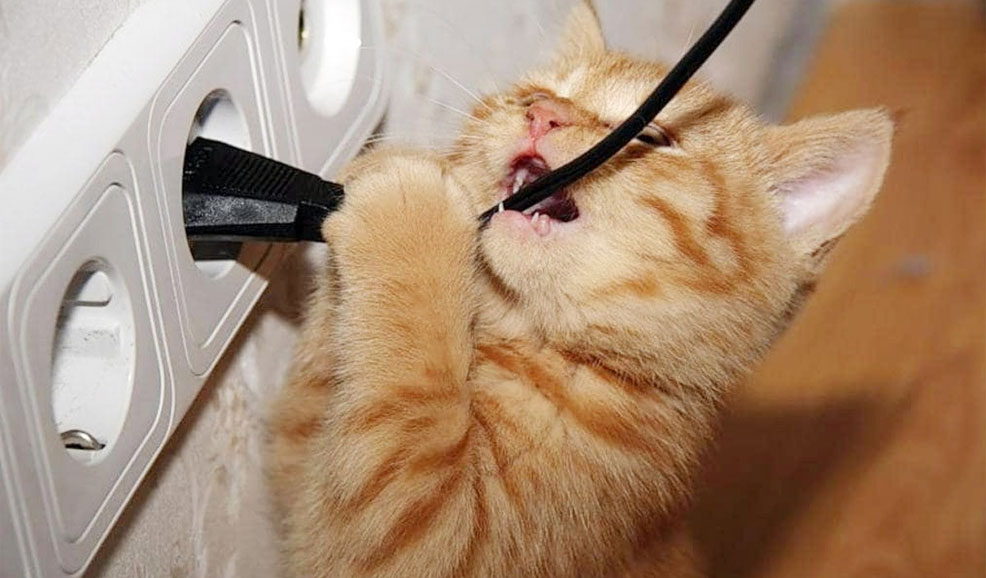
Naturally, neither a kitten nor an adult cat understands this, so as soon as you notice that a kitten or an adult cat is chewing wires, you need to:
- Find out the reason for the unwanted behavior.
- Organize a set of measures aimed at eliminating the problem (preferably before it becomes a habit for the animal).
Why does a cat chew wires?
The reasons why cats are attracted to wires and cables can vary widely, from medical to behavioral. Let's try to understand the most common ones.
Reason #1 – changing teeth
Kittens begin to lose their baby teeth to permanent ones at approximately 3-4 months of age. At this age, they'll be ready to chew on almost anything within their sight.
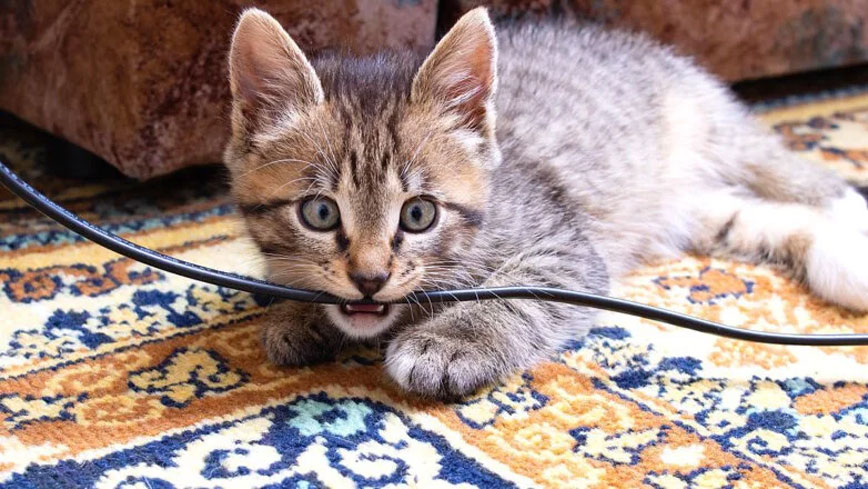
It's actually quite easy to understand why a kitten does this. When the little one bites the cord, it massages its gums and feels a pleasant sensation. The thin cable's shape makes it easy for a kitten to chew and gnaw on.
Reason #2 – Curiosity
Cats are naturally inquisitive and eagerly explore any new object. Licking and testing objects with their teeth are ways for young animals to learn about the world.
That's why the main advice for those looking to stop their cat from chewing wires and chargers is to make them inaccessible!
Reason #3 – the desire to play
In some cases, the owner is to blame for the cat's particular interest in wires, as cats are often offered various objects on textile cords as toys.
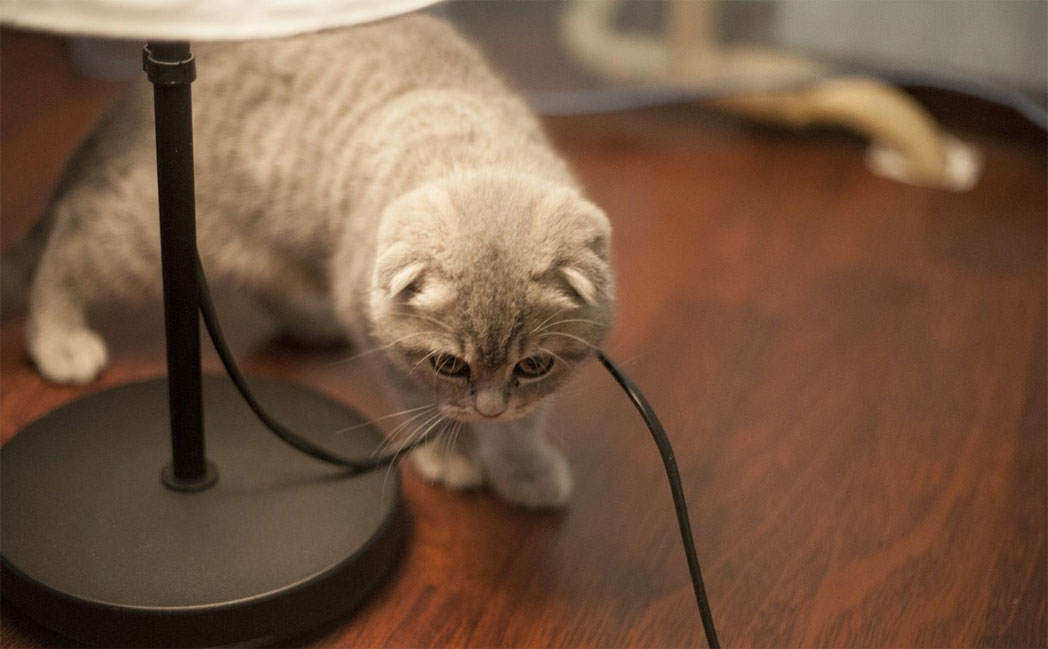
A temptingly swinging cable is an interesting and engaging toy for a cat, and play involves attacking and biting the prey. When a kitten starts playing with a new object, it quickly becomes engrossed, developing the idea that it's fun and enjoyable. That's why it's important to quickly teach the cat that the cable is not a toy.
If it has already happened that your pet has chewed through more than one cable, we can talk about the formation of a persistent habit of entertaining itself with dangerous games in the absence of the owner.
Reason #4 – Eating Disorder
Before deciding what to do and choosing an effective approach, pay attention to how your cat chews the wires—whether it's simply biting through them, or trying to remove the wires and, if successful, eating them. If your cat has an eating disorder, you'll often notice that, in an attempt to satisfy their hunger, they've chewed not only wires but also other inedible objects made of plastic, rubber, leather, or synthetic materials.
In this case, it would be helpful to consult a veterinarian and select a balanced diet, since most often, a craving for inedible items is a symptom of the animal's body not receiving the necessary vitamins and microelements.
Reason #5 – Behavioral Problems
If a pet belongs to an active, people-oriented breed, but does not receive enough attention from its owner on a daily basis, a variety of behavioral problems may develop.
It's worth talking about a behavioral problem if it's clear that the cat understands that it shouldn't do something (it tries to chew wires in hard-to-reach places or when people aren't around, and immediately runs away when its owners appear on the horizon).
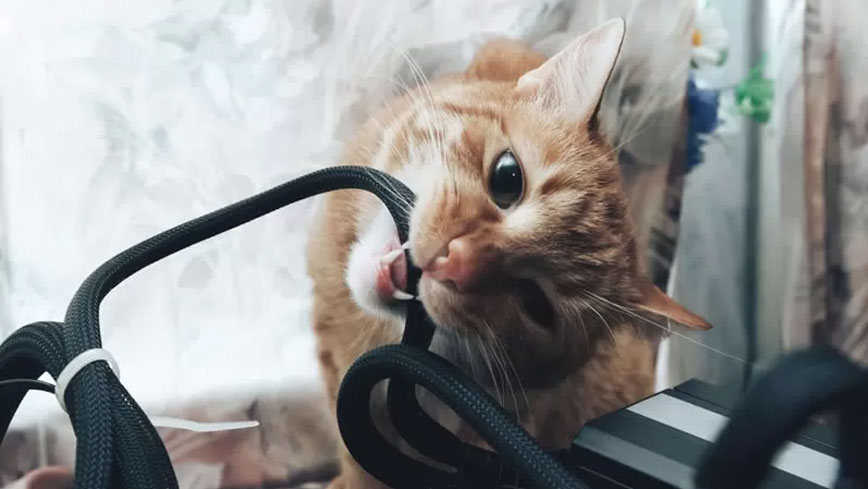
Important! Never scold or punish your pet if you discover another destroyed cable! An aggressive reaction from the owner will only make the situation worse if the pet has behavioral issues.
Effective ways to combat the problem
Most breeders have likely encountered the problem of their cat chewing wires, as forums offer plenty of advice, some of which is truly effective.
- The simplest thing you can do (and should do even before your pet arrives in the house) is to remove all 220-volt wiring from the accessible area (put it in boxes, hide it under the baseboard, or run it in thick plastic pipes).
- It's also worth considering how to make cables that are physically impossible to hide in a conduit as invisible as possible. You can cover them with corrugated plastic tubes, which will prevent biting and make the cable thicker and simply harder to bite.
- Provide your kitten with plenty of chewable toys and treats to satisfy this need during the teething stage.
- Let the animal know that this behavior is undesirable. This method works for the first few attempts to taste the wire. As soon as the cat shows interest in the forbidden object, make a loud noise (slamming a newspaper or a plastic bottle). However, trying to scare the animal away from the wire with a spray bottle of water is not a good idea.
- If your cat has developed a fondness for a particular cable, wrap it in double-sided tape or foil. Chewing on such materials is definitely not something your pet will enjoy.
- Distracting and engaging your pet with play is one of the most enjoyable and effective methods, but it's best suited for owners who are often home. You can build or purchase a play structure for your pet and provide it with plenty of toys to divert its attention from wires to safe activities.
- You can coat the wire with something strong-smelling and unpleasant-tasting (mustard, pepper, garlic, lemon or orange juice, or aloe vera). However, it's important to monitor your cat's reaction, as this method won't always work. Sometimes, habit is stronger, and the cat will chew and cry when exposed to the irritant. Therefore, avoid using overly harsh solutions, which can burn the mucous membranes. It's best to buy a special repellent spray from a pet store.
How did you overcome this problem? Please share your ideas in the comments on how to stop a kitten or adult cat from chewing wires.
Read also:
- Peppermint Balls for Cats: How to Use, Benefits, and Harms
- Eye color in cats: what colors are they?
- The Smartest Cat Breeds in the World: Top 10



Add a comment