
Cats and other animals at home: war or peace?
Before bringing a pet into your home, it's important to understand its psychology. Of course, every animal (like people) is unique. Everyone has their own personality, even those born in the same litter. Things get even more complicated when you're planning to add more beloved four-legged friends to your family (perhaps even want to get a feathered one). Today, we'll talk about cat psychology.
Content
Psychology of domestic cats
Although cats in the wild live in packs or prides, they don't always get along with other animals. A domestic cat spends much more time in splendid isolation, observing the world around it. Only in rare cases do these purring creatures "team up" with their fellows.

Based on this, we can conclude that a cat can get along with other pets. However, this usually takes a long time. Territorial struggles can ensue (especially between males, and if they're not neutered, bloodbaths are guaranteed). Cats can also fight for their owner's attention, a spot on the couch, or anything else. Some breeds can be aggressive toward anyone who tries to interact with them.
However, we mustn't forget about the very sweet cats who are willing to live with anyone, as long as they have a roof over their heads, food, and affection. There are also completely indifferent cats, who seem to withdraw from the world around them. They don't care who else lives in the house with them. Even if someone runs all over them, they won't even bat an eyelash. But such indifferent animals are extremely rare.
Before getting a second pet (or bringing a new cat to your existing one), it's important to study its personality. Observe how it reacts to you, how it behaves in the house, whether it displays any "royal" attitudes (everything is mine and mine alone), and whether it's prone to conflict. If your whiskered meow is aggressive, then cohabitation with another animal is out of the question. Everyone will suffer, including you and your apartment (they'll tear it to pieces during the massacre, and they'll also start marking every inch of the space).
Cat and dog relationship: how can they get along?
Cats and other animals can coexist. Despite the well-known proverb about cats and dogs living together, there are many instances throughout history where these two creatures lived so harmoniously that it's enviable. They eat from the same bowl, sleep together, and play together. But to maintain such a relationship, patience is required. Initially, there may be fights or mutual fear.

If you really want to get both a cat and a dog, it's best to get them at the same time and when they're young. That way, they'll grow up together and see each other as members of a pack, with you as the leader. When trying to get two adult animals to be friends, conflicts are rarely avoided.
Much depends on the cat's personality, and the temperament of other pets should be taken into account. If even one of your pets is overly temperamental, problems are inevitable.
Introduce the animals gradually, from a distance. It's best to have one person hold the dog (it's even better to muzzle it to prevent the dog from making "ooh-ooh" noises to the cat), and another hold the cat (it's a good idea to wrap it in a thick towel or blanket to prevent scratches). At first, you'll need to observe the animals, place them in different rooms, and feed them separately. Over time, the pets will get to know each other and perhaps even become friends. However, there's no guarantee. After all, even if the cat and the other animal are the kindest, the four-legged friends might dislike each other, and vice versa, two vicious ones might form a gang and terrorize the entire house.
Cats and rodents
That's a whole other story. In the wild, what do cats catch? That's right, small rodents.

Even if your cat and its relatives have no experience hunting mice or rats, their hunting instinct will still kick in. They may or may not eat the hamster, but they may sit near the cage for a long time. They often even try to touch the unfortunate rodent with their paws.
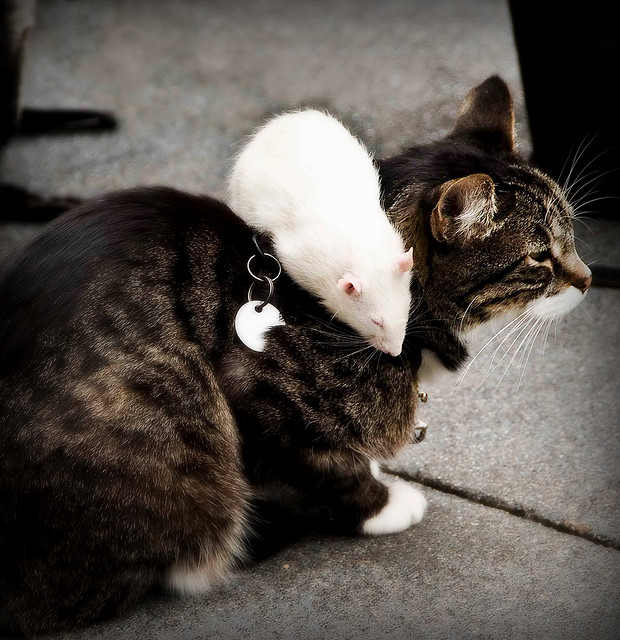
It might be fun for a cat, but for a small animal, it's incredibly stressful. And if the rodent doesn't die of fear (what about its heart? How long can it keep beating like that in its chest?), it won't live long. If you want your cat to have a happy life, and other animals to live long and peaceful lives, keep the rodent's cage away from the cat's eyes and paws. And don't let your purr-loving pet approach the small "victim."
Cats and feathered pets
Now let's discuss the "cat and bird" tandem. That's a whole other story, especially if the bird has the ability to fly around the house. Here, cats and other animals (in this case, birds) put on a real show with chases and jumps, the results of which can be disastrous, requiring us to treat the birds or, in the worst case, nothing at all.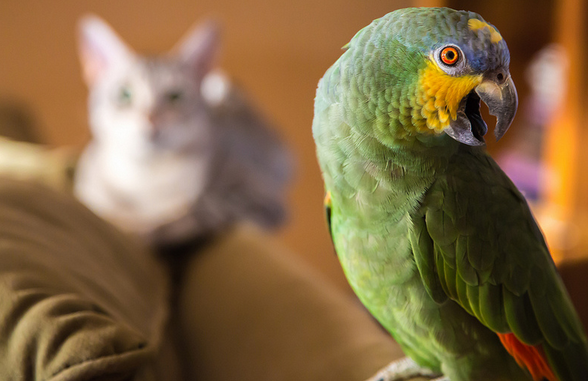
Although it happens that a cat is completely indifferent to a chirping pet. Somehow, they manage to be friends, or at least ignore each other: they eat from the same bowl, and a bird might groom the whiskered meow. This indifference usually occurs in cats accustomed to having other animals in the house besides the cat. Perhaps the owners frequently bring in new pets, so the "roommates" don't evoke any emotions.
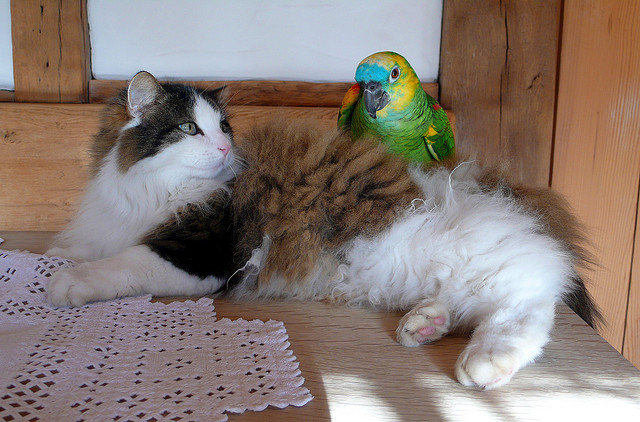
Or older cats no longer show interest in what's going on around them. Often, neutered/spayed cats "admire" no one but themselves, and new singing pets are completely unimportant to them. At first, they might sit near the cage, lick their lips, and maybe even try to paw their way between the bars to make a little snip. But over time, their interest fades, and the frightened parrot or canary is left alone.
But be careful. Cats are very sneaky. They often pretend they don't care what's going on, even closing their eyes.
But let your guard down, relax, or turn away, and that's it—your cat has tasted real meat, its tail is sticking out of its mouth, feathers are flying around, and silence reigns in the house. A predator, he is a predator.
Cats and other animals

I'm tempted to talk about how cats and other animals get along. But these days, practically any animal or bird can become a pet, so the psychology of relationships could be discussed endlessly.
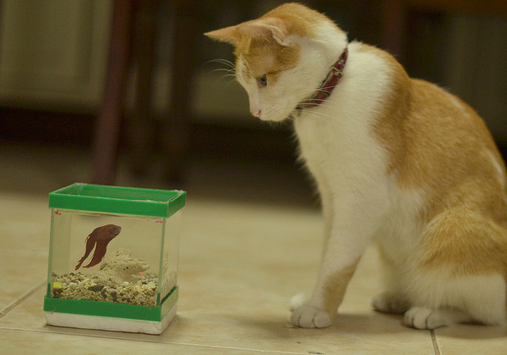
Cats and fish are the most common pets to share an apartment (or house). It's believed that they have a calming effect. In fact, sitting next to an aquarium and simply observing the silent aquatic creatures can be truly calming. Therefore, cats often find a spot where they can clearly see all the aquarium's inhabitants. And they can spend hours staring at them.
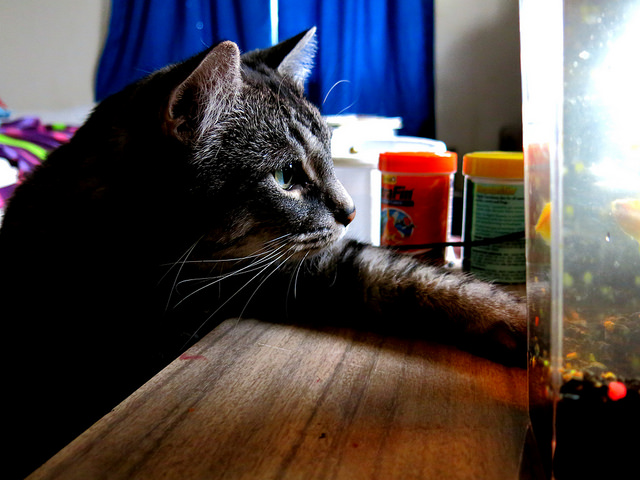
And if it also has a pump that creates large bubbles and beautiful LED lighting, your pet will be ready to sleep next to the fish house. Important: be sure to close the aquarium lid tightly to prevent your pet from getting into the water and trying to catch and eat the fish.
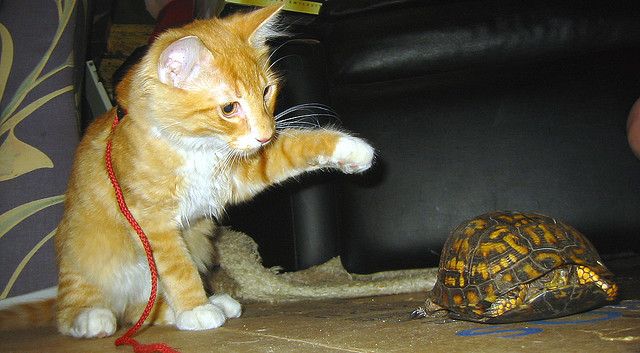
Turtles are also common pets. They come in aquatic (red-eared or yellow-eared) and terrestrial varieties. You can't put aquatic turtles with fish: they'll eat them without choking, and they'll live alone in an aquaterrarium. So, a cat can also watch the reptile swim. But here's the thing: turtles spend most of their time on dry land, basking under special lamps. And that's when a cat might seize the opportunity to attack.
There are two possible scenarios. First, your pet will damage the turtle with its claws, try to chew it up, or play with the reptile on the floor with its paw (young turtles are no bigger than a matchbox and very light, plus their survival rate is low even under ideal conditions). Second, the turtle will "retaliate" by biting your cat with its beak (it has no teeth). An adult reptile can easily fend for itself, but you still shouldn't try to introduce such exotic pets to your cat.
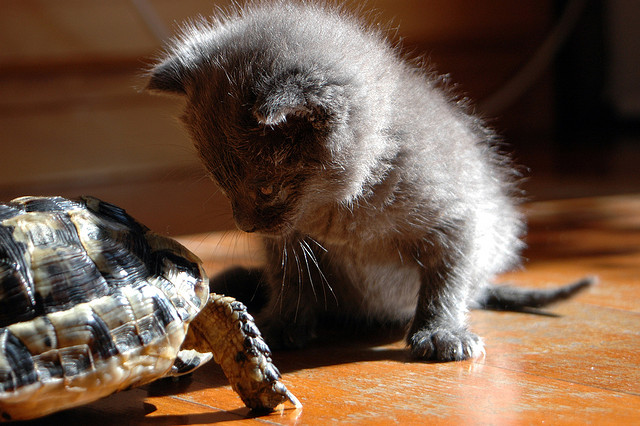
Chinchillas, rats, snakes, spiders, hedgehogs, rabbits—you name it, people are keeping pets these days. And no one can predict how a cat will interact with other animals. This can only be determined through experience, once they've been introduced. However, in 99% of cases, if a pet is aggressive toward people or is overly stubborn, it's best not to have other pets (that would walk on the floor with them or fly around the room). For such a pet owner, it's ideal to have only one that will live in an aquarium/aquaterrarium/terrarium and will be protected from all sides.
If you already have someone at home and you bring a cat home, it's unclear how the cat will behave in the new territory. Some will remain quiet, while others will start to "claim" their territory and try to "reclaim" it from the "old-timers."
In any case, be patient and resourceful. And try to ensure that all pets are comfortable and safe. After all, you are responsible for the ones you've adopted.
Read also:
- How to make friends between a cat and a dog in an apartment
- Animal riddles with answers
- How to Cope with the Death of a Cat


Add a comment