
What to do if a cat doesn't eat anything?
Sometimes it happens that a cat won't eat or drink anything, and it's hard to immediately figure out the reason. Today, we'll discuss the possible causes of this behavior and share recommendations on what to do in this situation. Of course, everyone has those days when their appetite decreases and they don't feel like eating anything at all. But when this state persists, especially for several days, it's time to sound the alarm. There's likely something wrong with your cat's body.
Content
Reasons why a cat is starving
There are many reasons why a cat won't eat or drink. Diseases can be infectious or non-infectious. Some diseases can be caused by:
- viruses;
- fungi;
- bacteria.
Helminthiasis
Regardless of whether your cat goes outside or not, preventative anthelmintic treatment is mandatory for all animals every 3-4 months.
Helminth eggs can enter the home on the soles of shoes, household items (from a store or market), and even on your hands (after all, we all touch handrails on public transport and numerous door handles).
Important! Don't underestimate the danger of helminthiasis, as there are many different types of feline parasites, many of which can be dangerous to their owners.
Gastritis
Gastric inflammation in cats is quite difficult to diagnose, as it often shows no symptoms in the early stages. The causes of these problems in veterinary medicine are not yet fully understood. Helicobacter pylori has been detected in samples from sick animals, but a link between its presence and the onset of inflammation has not been scientifically established. It is also unknown whether animals can contract the bacteria from humans.
Veterinarians list the following as provoking factors: improper nutrition (in particular, the use of cheap, low-quality food), the use of aggressive medications, helminthiasis, and stress.
Among the main symptoms of gastritis:
- loss of appetite;
- digestive system disorder (diarrhea, vomiting);
- lethargy;
- anxiety.
In most cases, gastritis responds well to treatment with specialized medications. However, self-medication is not recommended. It's important to establish a correct diagnosis, which is only possible after a complete examination of the animal. Without medical treatment, acute gastritis can become chronic, leading to gastric ulcers, which can even be fatal.
Enteritis
Enteritis is a serious infectious disease that progresses rapidly and is characterized by a strong inflammatory process in the small intestine.
Depending on the cause of the inflammation, the following types of enteritis are distinguished:
- viral;
- bacterial;
- post-traumatic;
- helminthic.
In common parlance, viral enteritis (panleukopenia) is often called "plague".
The severity of symptoms varies with different types of the disease. Typically, these include refusal to eat, vomiting, severe diarrhea (containing undigested food particles), and general weakness.
Important! Enteritis progresses quite quickly, and the animal's condition worsens with each passing hour, so it's crucial to seek medical attention as soon as possible.
Toothache
During the teething period, a young cat may temporarily refuse food if a baby tooth, firmly attached to the gum, becomes loose but does not fall out. Eating causes pain, which causes the cat to refuse food. This isn't a sign of a lack of appetite. The cat simply spits out solid food after taking it into its mouth. It's as if it was hungry but suddenly changed its mind.
In older animals, similar symptoms can occur with dental caries. Toothache can be as severe for animals as it is for humans. A swelling on the face (a gumboil) may also be present. The cat will protest violently when you try to look into its mouth, even if it previously didn't resist such manipulations.
Inflammatory processes and injuries in the oral cavity
It is difficult for an animal to eat when there is inflammation or injury in the oral cavity:
- ulcers;
- swollen gums;
- periodontitis;
- stomatitis.
Any of the listed problems can cause the animal pain during feeding, which can lead to a complete refusal to eat.
Be sure to examine your pet for symptoms of stomatitis!
Foreign body in the throat
A common reason a cat can't eat or drink is because a foreign object is stuck in its throat. This could be a fishbone or something similar. It's important to monitor what your pet eats. Don't let them grab anything from the floor or ground. Don't even try to remove anything yourself, as this could damage the mucous membrane of the throat or push the object further down, making the situation worse.
Important! Foreign bodies can become lodged not only in the throat but also in the stomach or intestines. This can lead to gastrointestinal obstruction. Food rots in the intestines, causing severe toxicity, which can lead to death.
But sometimes the foreign body is hard, and when moving through the intestines, it can lead to perforation (tearing all layers, resulting in the contents of the digestive tract entering the abdominal cavity), which in turn provokes peritonitis - an extremely dangerous condition.
Poisoning
Poisoning can also cause cats to refuse to eat or drink. Poisoning can occur from poor-quality food, medications, and even houseplants. Often, pets suffer from cleaning their food bowls with chemicals, which are then poorly rinsed. The animal eats from the bowl and is poisoned. Poisoning can occur not only through oral ingestion but also from inhaling fumes from cleaning chemicals, paint, acetone, or ammonia. These substances are full of irritants that negatively impact a pet's health. Therefore, if you're planning a renovation or a deep cleaning, take care of your pet's safety.
Sexual desire
A cat's heat cycle (especially the first) is characterized by a dramatic change in behavior. During this period, it's common to see a refusal to eat in the first few days. A cat may even lose interest in a favorite treat if another female is nearby. If there are no other alarming symptoms, and the cat's behavior suggests a typical hormonal surge, there's no need to worry. However, a visit to the veterinarian is still recommended.
As a rule, the first such period in cats occurs at 6-10 months (but in some breeds, maturation can occur earlier, as early as 4-5 months, or later, closer to a year).
Other reasons
Fasting is most often recorded in cases of inflammatory processes in the digestive organs. This is not only gastritis in cats (inflammation of the stomach) and enteritis (acute inflammation of the intestines). But hepatitis, pancreatitis, enterocolitis and cholangitis. poor health of the animal can also be caused by liver diseases, among which the most common are: amyloidosis, lipidosis or cirrhosis.
Of course, the list of possible reasons for refusal to eat is much broader and can include factors that seem harmless at first glance (disliking a new food or stress when changing residence or having a new pet in the house), as well as serious illnesses, including cancer.
Found the cause - what to do?
Even if you've identified the reason why your cat isn't eating, it's not always clear what to do next. Of course, the first step is to confirm your suspicions, and a visit to the veterinarian is essential. You might suspect stress, but your pet may actually have a serious illness. You might determine that something has been overdone, there are visual signs of injury, or a digestive upset, but the cause can only be determined after a full examination. Therefore, if your cat isn't eating or drinking, don't waste time self-treating; take your pet to the veterinarian as soon as possible.
Important! Never force-feed your cat.
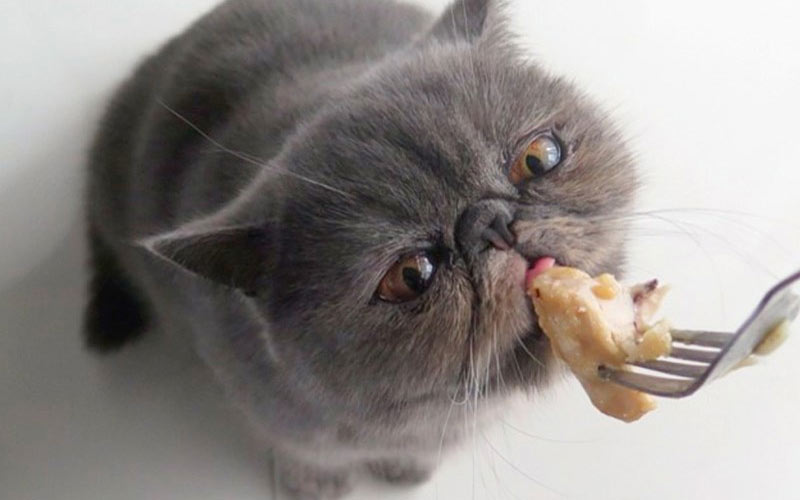
If a cat refuses even its favorite treat, there's a good reason. Animals won't starve themselves, overcoming hunger, unless they're driven to it by pain.
Simply leave some food and water freely available. Your pet may not eat for a while due to illness, but drinking is vital during this period. Be sure to check whether your pet is using the litter box (both for bowel and bowel movements). If there is no feces, the cause may be... intestinal obstruction (foreign body, clumps of licked hair). This can only be removed surgically. If you delay a visit to the vet, the cat may die.
When you urgently need to see a doctor
Even if an apparently healthy cat isn't eating or drinking, has become passive, or is anxious, it's still important to take it to the vet, even as a preventative measure. However, there are a number of symptoms that warrant an immediate visit to the vet.
The first thing to notice is a dry nose. Any temperature changes are also a warning sign. You should also see a doctor if you experience the following symptoms:
- sharp pain when touched;
- plaintive cries;
- severe depression of the animal;
- fever;
- vomit;
- severe diarrhea.
Any of these signs in themselves are cause for concern, and if the cat is not eating anything, then it is better not to delay a trip to the veterinary clinic.
How to help a cat that won't eat at home
You can treat your pet at home after visiting a specialist. Once the veterinarian determines the cause of the animal's illness, they can provide a series of recommendations for caring for the animal at home. In this case, the owner should act as a caregiver and monitor the animal's condition.
If your cat hasn't eaten or drunk anything and their appetite begins to improve after treatment, you should consider feeding them. You can warm the food slightly to enhance the scent. It's also important to monitor the amount of food they consume. Even if they're starving, you should initially limit their access to food, otherwise they'll overeat, and their weak bodies have a harder time processing large amounts.
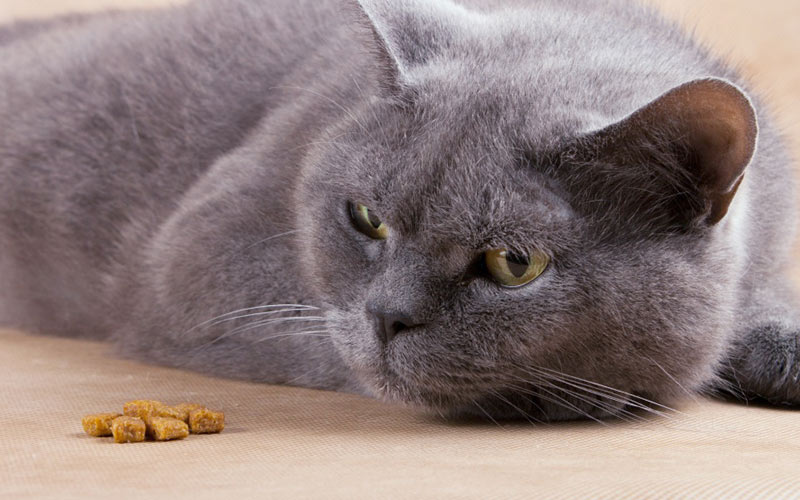
If the cat does not eat or drink, then with the doctor's permission You can encourage her to feed. Water can be poured into her mouth through a straw, and the same can be done with liquid food. Feed little by little, but pay attention to her stool; if there's none, you can increase the portion.
Prevention
It's much better to prevent problems rather than trying to figure out why your cat isn't eating. This requires:
- quality nutrition and proper regimen;
- timely vaccination;
- stress minimization.
Regular checkups are essential for a cat's long and healthy life. The same can be said for its living conditions. Beatings, yelling, and intimidation cause stress and, consequently, illness. The benefits of a healthy diet are well known. The only thing that can be added is that abrupt changes in food are not advisable. If you do decide to switch your pet to a different brand of food, do so gradually, observing its reaction to the dietary changes.
For more information on this issue, please see your veterinarian's recommendations:
Any questions? You can ask our website's staff veterinarian in the comments below, who will answer them as quickly as possible.
Read also:
- What to do if your cat stops eating dry food?
- How to tell if a cat is sick
- My cat is vomiting blood: causes and what to do


17 comments
Alexey
The cat hasn't eaten or drunk for 3 days. He's hiding in the attic.
It started about a week ago, he would go out to eat once a day and then leave again almost immediately.
What happened to him and what to do?
Daria is a veterinarian
Hello!
If your pet hasn't eaten or drunk for several days, it's time to see a veterinarian. There could be many reasons for this behavior. Unfortunately, it's impossible to prescribe treatment or make a diagnosis online.
Maria
Hello. My 15-year-old cat has been eating poorly and vomiting occasionally. She's been going to the bathroom less often and less frequently. She's urinating wherever she wants. What should I do? How can I treat her?
Daria is a veterinarian
Hello! The first thing you need to do is figure out the diet, feeding and watering schedule, and housing rules. Are there other pets in the house or does it go outside? Is the animal stressed? How long has it been since the parasites were eliminated? The second thing you need to do is have your pet examined at a veterinary clinic: a physical examination, ultrasound, and blood and urine tests. I won't say that the animal is old and that's why it has these problems, because 15 years, while old, is far from the limit for an animal. And it's impossible to prescribe treatment without a diagnosis.
Sergey
Hello, can you tell me what to do? My 14 year old Persian cat has stopped eating and drinking completely. We took him to the vet, where they did an ultrasound and said he has a kidney cyst and needs to be put to sleep because he will only live for 2-3 days. His stomach was bloated, but now the bloating has gone away. He has lost a lot of weight. He asks for food but doesn't eat it. He doesn't hide, he sleeps a lot, we feed him through a tube. He goes to the toilet to pee and poop, but he turns away from any food.
Daria is a veterinarian
Hello! Kidney cysts are difficult for even humans to live with; they require lifelong treatment. And here's a cat who will require minimal IV fluids to maintain his strength (since he's starving), but he also shouldn't be given a lot of fluids, otherwise his kidneys won't be able to cope. Hemodialysis is the worst option, as the kidneys are unable to cleanse the blood. The cysts will cause kidney failure. I suspect that, in addition to the sudden weight loss, he's also started vomiting. Another option is to try metoclopramide as an antiemetic (it relieves nausea) at a dose of 1 ml twice daily. It's possible that the animal isn't eating due to nausea caused by blood intoxication.
Mila
Hello, my cat has been sick for over a week. I took him to the vet, who said he has double pneumonia. He received antibiotics for three days, and the vet said that if he eats normally on the fourth day, there's no need to bring him back. I did just that, and he started eating that day, and I thought he was recovering. But a day later, he developed a severe runny nose, a runny nose, and watery eyes, but he rarely coughed anymore. The problem is that he still has a runny nose, mostly clear, but sometimes yellowish. Sometimes his eyes run, and he's not eating at all. It's obvious he wants to eat, but he's not eating. I've tried everything I could think of.
Daria is a veterinarian
Hello! What three days of antibiotics for double pneumonia? Here, you need a week of injections. They stop giving antibiotics 2-3 days after all symptoms have disappeared. X-rays are needed to assess the animal's condition. Was the diagnosis made at least after the x-ray? Or just by auscultation? Has asthma been ruled out? Heart failure too? Was emphysema also ruled out in the differential diagnosis?
Natalia
Hello! My cat is 18 years old. She eats, but very little and only at night (this hasn't happened before). She drinks a lot. She cries often, but not pitifully, as if calling for a male cat. She is spayed and has had her mammary glands removed (it was a benign tumor). I'm concerned about her weight loss. I've been feeding her various dietary foods, including Pro Plan and Royal Canin. She eats, but not much. I often have very noisy little grandchildren. Could my cat be nervous? How can I help her?
Daria is a veterinarian
Hello! He drinks a lot, but how does he pee? Don't have a glucometer at home? It would be a good idea to check your cat's blood on an empty stomach in the morning (prick the ear, put a drop of blood on a special strip, and check the results on the glucometer). Older cats often develop diabetes, especially if they're very stressed. However, their endocrine glands can also fail with age. Is it a lot or significantly less? For a calming effect, give Bayun, Fospasim, or Stop-stress.
Alena
My 17-year-old cat died. He had lost a lot of weight over the past year. In March, he started vomiting frequently at home. We had tests and an ultrasound. He was diagnosed with chronic hepatitis and given IVs and injections. He recovered. At the end of March, we took him to our dacha. He was wormed. Everything was fine, but he continued to lose weight. He developed a hoarse cough. One day, I noticed he was bumping into things. I was lucky to go to the local vet in Shatura. They said it was most likely worms and that he needed to be dewormed. They took an ear swab, but decided against further testing, saying the worms would blur the picture. The ear swab showed cocci. We gave him a Sofradex IV and Amoxiclav.
I gave him Drantal, but as the vet said, give him a second pill after 14 days. After the second one, he vomited. After that, we went back to the vet, who didn't do any tests again, but did a brain test again, and some cocci remained. They noticed a tumor under his upper eyelid. They told him to put him on Tobrodex drops, and if it didn't go down, they'd remove it. The third eyelid wasn't affected. The tumor seemed to be shrinking, but the cat would paw at it sometimes until it bled. But he kept getting worse and lost 500 grams.
He eats meat, chicken, and fish well, and he peed and drank, but four days before he died, he suddenly pooped. They gave him an enema and he passed a very hard, medium-dark poop. The next day, he started feeling ill and could barely go outside. I gave him painkillers, but he kept going into the dark, and at 6 p.m., he went out onto the terrace and died. I can't figure out what I did wrong; maybe I shouldn't have given him so much Drantal. I wrote to the doctor, but he didn't even respond. He's in a terrible state, like I've lost a child. I'm beside myself. It's hard. Please tell me what illness my cat might have, or is it just old age?
Dasha is a veterinarian
Hello! My condolences. Losing a pet is always difficult. But it's impossible to say for sure what happened to the animal without seeing it, its test results, or performing a postmortem examination (as crazy as that may sound). It could be age (17 years is quite a long time), or perhaps its health has deteriorated due to old age. If you'd overdosed the Drontal, the kidneys and liver would have been affected. You would have noticed symptoms: vomiting (bile or after eating), discoloration of the mucous membranes (pale, bluish, or even yellowish), a smell of acetone from the mouth, and others. Don't beat yourself up. The animal has lived a very long time already. And the loss of coordination could already be related to age-related changes (vision has worsened). Regarding the tumors, it's unclear. Is it a tumor or swelling and edema?
Ira
The cat asks for food but won't eat. He drinks water. He also has a runny nose and sometimes coughs. Please tell me what to do. Thanks in advance.
Dasha is a veterinarian
Hello! First, take your cat's temperature. Is your cat vaccinated? How old is he? Does he have access to the outdoors? How is he kept at home? What do you feed him? When was the last time he was dewormed, and with what? What other symptoms are there? Ideally, take him to the vet for a blood test (general and biochemical analysis, to rule out inflammatory processes and infectious diseases—a viral infection may be suspected based on the white blood cell count). What condition are his eyes? What kind of runny nose is he: clear or purulent? How often and what type of cough is he? Have you ruled out a cold or allergies (allergies can cause a sore throat, which leads to a "mild" cough, a shallow one, but there will also be sneezing, watery eyes, itching, or restlessness). Again, based on the symptoms you described, we can suspect at least 10 diseases. We need a more detailed description of the animal's condition, an in-person examination, and tests.
Darina
Of course, you need to take the animal to the vet. Our cat turned out to have worms. Oh well, we treated him with Helmimax and he's fine now. The main thing is not to let things get worse. What I really liked was that the tablet can be divided into four parts and administered depending on the cat's weight.
Inna
The cat hasn't eaten or drunk for 3 days, doesn't even sleep, and has trouble walking. What should I do?
Dasha is a veterinarian
Don't you feel any pity for your pet? He's slowly dying without food, water, or sleep. It's clear he has health issues that need to be identified and addressed URGENTLY. He needs IV fluids to nourish his exhausted brain and muscles and address the symptoms of dehydration. Take him to the vet immediately for an in-person examination so they can not only diagnose him but also begin emergency supportive care.
Add a comment