
My cat broke its tail: what to do
A pet's tail isn't just a decoration; it's a vital part of the body, performing specific functions. Specifically, it allows the animal to coordinate movements and balance, land smoothly after a jump, and even communicate. Unfortunately, injuries to this organ are common in veterinary practice. This is why caring owners are concerned about what to do if a cat breaks its tail.
Content
Why is a broken tail dangerous for cats?
The tail is an extension of the spine and consists of vertebrae connected by cartilage, nerve endings, and blood vessels. In newborn kittens, it is very soft and fragile. Because the skeletal system is not yet fully formed, fractures (usually vertebral fractures) of this vital organ are much more common in kittens than in adults.
If a cat's tail is broken in the middle or at the tip, the fracture is closed, and the nerve endings are intact, the injured area may heal on its own. Many stray cats have broken their tails dozens of times, and each time, it heals without any serious consequences. These animals continue to lead normal lives; in fact, some breeds even have their tails docked.

However, every owner should be aware that the consequences of a fracture can have a detrimental effect on a cat's health, both overall and in certain physiological processes. The organ is located near the urethra and anus and shares nerve endings with them, so an injury at the base can lead to problems with urine and feces. Lameness and tail paralysis are also possible.
Causes of tail fractures
External factors cause vertebral injuries, which is why stray cats are more likely to suffer fractures, particularly when they get hit by cars.
Pets, if handled with care by their owners, while not immune to this problem, suffer fractures of this part of the body much less frequently. For example, pulling a cat's tail is a favorite pastime for most children. Meanwhile, cats react nervously and even aggressively when people touch this organ, needless to say, causing them immense discomfort and pain. This is why it's so important to explain to children that simply petting their pet's fur won't harm them, but pulling their tail is absolutely forbidden.
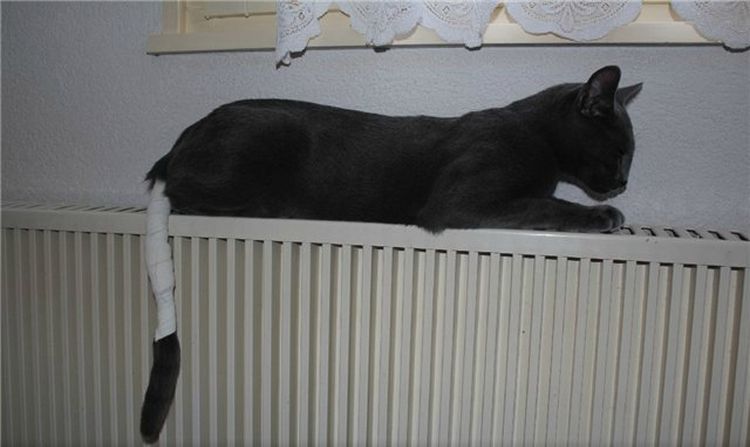
Sometimes, owners, trying to reason with a mischievous pet, slap them on the "soft spot," but miscalculate the force of the blow, damaging their vertebrae. Or, as happens very often, an inquisitive and playful animal simply gets stepped on, with a broken tail being the inevitable result of such mischief. But the most common source of injury is doors. A cat leaves its prized possession in the doorway, and the owner, unnoticing, closes the door tightly.
A fracture can also occur as a result of a fight with another animal, or less commonly, an insect bite. Read also about What is a cat's tail for?.
Symptoms of a broken tail
The changes to the organ are easy to notice visually: the previously straight tail becomes curved and enlarged. The cat has difficulty moving its tail, even if only the upper part is damaged. The pet's behavior also changes: it becomes irritable, screams, and hides from its owner.
The following signs may also indicate a fracture:
- kink in the tail;
- severe pain;
- a gap through which bone fragments are visible (in the case of an open fracture);
- signs of a bite and damage to the skin;
- the organ is hot to the touch;
- redness, swelling, excessive softness of the tail (with an abscess and suppuration);
- the tail, not supported by muscles, hangs down, the cat is unable to lift it up;
- easily palpable thickening;
- lameness, numbness of the hind limbs;
- urinary and fecal incontinence;
- blood in urine;
- bleeding (in severe cases);
- tail paralysis.
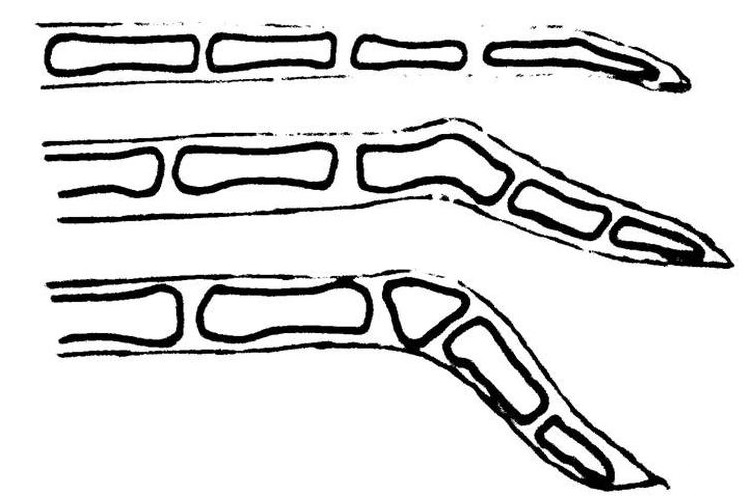
As we can see, symptoms may vary depending on the severity of the injury.
Owners should pay attention to the following fact: if a bend is clearly visible on the tail, but the fracture site is hard, and the cat does not feel pain when palpated, this means that this defect is congenital, or the fracture has healed on its own.
The first thing inexperienced cat owners try to do when a cat breaks its tail is straighten it. This will only worsen the situation, as it can damage not only the tail itself but also the hind legs, intestines, and bladder. Furthermore, this action can cause uncontrolled arterial bleeding and, ultimately, death.
Diagnosis and treatment of a broken tail in a cat
If a fracture is suspected, the animal should be taken to the veterinarian immediately. The veterinarian will first determine the specific organ involved. Radiographs and physical examination will help determine the extent of the injury. If paralysis is present, the specialist will require an ultrasound, blood and urine tests, and electromyography (to determine the conductivity of nerve impulses through the anal sphincter and muscles).
For shallow wounds, antibiotics are prescribed to prevent infection. Prompt treatment of the wound with a weak solution of betadine or chlorhexidine is essential, as the cat's inability to lift a broken tail can cause the wound to become contaminated with feces and urine.
What should you do if your cat breaks its tail at the tip? If it doesn't affect its ability to move, the injury will heal on its own without consequences. However, if it breaks at the base or mid-tail, surgery will be required to correct the alignment of the vertebrae or amputate the organ below the fracture.
Other measures used include applying a plaster cast or a sling for two weeks. To prevent the cat from reaching the cast and licking its tail, an Elizabethan collar is placed around its neck.
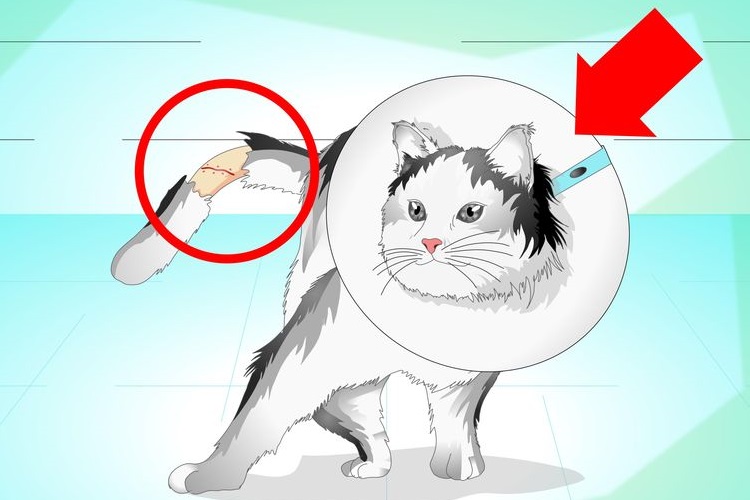
The owner is required to provide the cat with the most comfortable conditions and silence so that it can calmly recover from the injury.
If the cat's limbs are paralyzed and it is unable to relieve itself, euthanasia is considered the only humane option.
You can also ask our website's staff veterinarian a question, who will answer them as quickly as possible in the comments box below.
Read also:


40 comments
Anna
I brought a kitten home from the street. The corner of her tail is bent exactly like in the second picture. It's hard when I touch it. I didn't touch it too much because I was afraid it would hurt her or that something worse might happen. She's calm, but only became active when she saw a dog. I read that it could be congenital or the injury has already healed. Should I see a vet right away? What are the symptoms?
Ahmad
Hello. We adopted a one-month-old kitten and later discovered a curvature at the tip of its tail. It's a slight Z-shaped curvature, not very pronounced, about 1 centimeter from the tip. It doesn't seem to be causing any discomfort; perhaps it was injured and has healed. My question is: can I leave it like this without taking it to the vet?
Daria is a veterinarian
Hello! Don't go anywhere with this. No one will break his tail again. It's possible it was pinched somewhere before, stepped on, or otherwise damaged. Just make sure the cat doesn't jump out of nowhere. A tail is like a rudder for these whiskered cats. Therefore, cats with a damaged tail are not always able to roll over from any position and land on all fours. However, this change won't otherwise affect their quality of life.
Ahmad
Hello. I've already found out that this is a congenital genetic defect. Thanks for the prompt response. I'd already forgotten I'd written this here.
Oleg
A month ago, my cat crawled home in the morning and immediately you could see a lump on his back leg and a badly broken tail at the base. Luckily, it got warmer and the cat was sleeping outside for most of the time! My question is, my cat goes to the toilet on his own, but about a week ago his tail became stiff and then completely stone-like and dried out to the very base. What should I do if the nearest clinic here costs more than a car, and the military vet was transferred to Donbass?
Daria is a veterinarian
Hello! Your pet needs its tail amputated. You can't do it yourself. There's hope that it will fall off on its own, but it's slim. The most important thing is to prevent the animal from developing blood poisoning (sepsis) or other inflammatory processes. It's important not to cause further harm; don't try to tear it off, cut it off, or anything else yourself.
Oleg
My cat's tail is broken in the middle and won't lift. What should I do to treat it?
Daria is a veterinarian
Hello! You need to take your pet for an x-ray! They'll then decide whether to straighten it, cast it, or amputate part of the tail. If the animal doesn't receive professional help, the tail will most likely become necrotic (wither away) and fall off.
Irene
Hello! Kitty, 1 year old. Fell from a balcony, 7th floor. We immediately took her to the vet! Ultrasound, x-ray, examination, treatment! They said only a bruise and stress. Now, almost 2 months have passed since the fall. The cat has recovered, everything seems to be fine, but her tail is hanging from the middle ... (it doesn’t work. But it doesn’t bother her ... but I really want it to recover! Is it possible to do anything now? Is it possible to put a tail on?!?! (((
Daria is a veterinarian
Hello! To determine whether tail motor function can be restored, an X-ray is necessary. However, be prepared that after two months, it's virtually impossible to restore the tail (too much time has passed). If the blood supply was disrupted and the nerves were damaged, recovery is unlikely. Most likely, there was a fracture. However, the good news is that necrosis hasn't occurred and amputation isn't required (it's very common for the tail to begin to die/necrotize after such an injury, drying out, and a piece of the dead tail either falls off on its own or requires surgery). Overall, the X-ray will help determine whether the problem is serious or whether there's still a chance for recovery.
Irina
Hello. My cat's tail is broken, I think, in the middle. But I see the tip of the tail is sensitive. His tail is covered in wounds all around, like it's caught in a noose. There's pus oozing out of the wounds in places. What antibiotic should I give him, where, and what dose? Thank you.
Daria is a veterinarian
Hello! Well, actually, it's best to take your pet to the vet. Amputation of the tail may be necessary (otherwise, it will begin to die off, dry out, and cause tissue necrosis). But if you want to take responsibility for your pet's life and health, administer the antibiotic yourself and hope there are no complications such as sepsis and tissue necrosis. Amoxicillin + clavulanic acid (sinulox, clavaseptin, amoxiclav, flemoklav solutab, augmentin, etc.) – intramuscularly or subcutaneously 8.75 mg of active ingredient per 1 kg of body weight once a day (depending on the percentage you choose); if tablets are given with food, then 12.5-25 mg of active ingredient per 1 kg of body weight 2-3 times a day. This is the drug of first choice. Then they can switch to fluoroquinolones, penicillins, or new-generation cephalosporins. I don't know how bad it is, how your pet tolerates the medications, or how much money you're willing to spend on the animal's treatment.
Catherine
Hello. Our cat came home from outside with a drooping tail (we assume he was bitten by a dog), as he has a small wound on his back. The hair is falling out at the end of his tail. He doesn't lift it and won't let anyone touch it. This happened about a week ago. A couple of days ago, the hairless end of his tail turned black. He constantly asks to go outside. He walks well and doesn't limp. We can't afford to see a vet. What should we do?
Daria is a veterinarian
Hello! What should I do? Seek immediate medical attention! The tail needs to be amputated, and the animal needs to be put on a course of antibiotics to prevent complications. If this continues, necrosis will cause the tail to fall off, and the animal will be at high risk of dying from sepsis or intoxication due to the decay of dead tissue. The tail will never be restored.
Zarema
The end of my cat's tail was torn off and we got it caught in the door! The cat crawled under the bathtub and we can't help it! What should we do?
Daria is a veterinarian
Hello! Get her out and take her to the vet! You can stop the bleeding and bandage her at home. At the vet, they'll stitch the wound and administer antibiotics and painkillers. Get an X-ray beforehand to rule out further damage to the tail vertebrae from the door strike. You probably didn't expect any other advice. I'm not going to tell you how to get your cat out.
Maria
Hello! I accidentally pulled my cat's tail when he was running away. The next day, I noticed his tail was dangling unnaturally from the middle, and when pulled from the middle, it hung to the floor. But he doesn't feel any pain when touched. His tail isn't swollen, and he's as playful as ever. What could this be, and should I take him to the vet?
Daria is a veterinarian
Hello! Of course, you should see a veterinarian! An x-ray is essential to rule out serious damage to the tail. If qualified assistance isn't provided promptly, tissue death may occur, and the tail will have to be amputated. I can't even imagine accidentally tugging a fleeing cat by the tail to show signs of a fractured caudal vertebrae...
Maria
Thanks for the reply. It's true, not much, probably just bad luck, I don't know. But he wasn't in any pain, and he still is. He moves the tip of his tail occasionally, twitching. Could that happen with a fracture?
Today we're going to the vet... I'm really worried (
Daria is a veterinarian
If there's a fracture, the tail wouldn't move, just like with a torn ligament. An X-ray is needed for a diagnosis. It could be a sprain or some other injury. You can't make a diagnosis without an examination. After the examination, they'll tell you what to do if there's a chance of restoring tail mobility. But if the tail moves, there's a chance of saving it.
Anna
Hello, my cat's tail is broken at the base, as if it were torn from the spine (...you can see it from the pictures), he can't go to the toilet on his own, his tail hangs without moving, I would like to hear the prognosis after the surgery, will he be able to start defecating on his own, have there been any real cases like this in practice? I hope for an answer, thank you.
Daria is a veterinarian
Hello! Many miracles happen in practice. Each case is unique in its own way.
What's the prognosis after surgery? Forgive me, but even the operating surgeon won't tell you anything BEFORE the procedure, as it's unknown how the surgery itself will go, whether there will be any complications, or whether everything will go smoothly. Is there any damage to the spine itself (particularly the lumbosacral region)? Did the X-ray reveal any spinal cord damage? If you go to a good clinic, your pet will be rehabilitated there (assuming there are no serious spinal or spinal cord injuries). After all, how many cats survive without a tail?
Alsou
I have a cat, when I touch her tail, she screams and bites and doesn't move her tail. She can't even sit. Please help.
Daria is a veterinarian
Hello! Your pet needs an X-ray urgently! Rule out a fracture (since the tail isn't moving and there's severe pain). There's nothing you can do at home. Delaying the procedure could cause nerve endings and tissue death in the tail (if a fracture or other injury is confirmed).
Patrick
Hello, I have a homeless, elderly cat wandering the street. He doesn't limp and has good coordination. However, his tail is hanging down and he only moves it near his butt. He seems to be doing well, is affectionate, eats, jumps on cars, warms himself, and sleeps on a rug outside a store. My question is: should I take him to have his tail amputated? Is it dangerous to leave it as is?
Dasha is a veterinarian
Hello! It's all individual. In some cases, amputation is necessary to prevent blood poisoning. In other cases, the tail dries up and falls off on its own. Therefore, it's still necessary to take your cat to an appointment, and they'll tell you whether surgery is necessary during the examination.
Victoria
Hello, my cat was hit by a car two days ago. Her tail is broken at the base. She can't get up and isn't going to the bathroom. An X-ray showed a fracture, and an ultrasound showed an atonic bladder. We manually expressed urine twice. The doctor prescribed injections of prozerin, dexamethasone, and synulox. Immediately after the injury, she was also given Dicynone and papaverine. They said the swelling and pain need to be reduced, and maybe she'll start going to the bathroom on her own. Then they'll remove her tail. If not, there's nothing we can do. She started eating and licking herself yesterday. But she barely drinks water and still hasn't gone to the bathroom. Are there any options for saving my cat?
Dasha is a veterinarian
Hello! The veterinarian has seen the images and the ultrasound display, and he can see the situation more clearly. The lumbosacral spine may be damaged. The spinal cord may also be damaged, so the prognosis in these cases is guarded. Dexamethasone helps speed recovery (although discontinuing this hormone can lead to even more serious health problems). Dicynone has powerful antiseptic properties. Papaverine is an antispasmodic. All of this is aimed specifically at reducing inflammation and bladder spasms. But what's important is what's happening to the spine itself. Sometimes the tail falls off on its own without surgery (it withers due to damaged blood supply and innervation).
If the animal cannot empty its bladder on its own due to spinal cord injury, then you will only prolong its suffering (catheterization is very unpleasant, and it is impossible to keep a catheter in place for more than 5 days).
Maria
Hello. My cat has a fracture just below the base. We took her to the vet today and they put a splint on her. When we got home, she took it off a while later. So, we took her back.
Dasha is a veterinarian
Hello! Yes, of course. You won't be able to apply the tape so tightly and correctly at home. You don't want the tail to shift and grow back together properly, do you? You can put a special collar on your cat to prevent her from pulling on anything with her teeth.
ILYA
MY CAT'S TAIL WAS PULLED. HE IS NOW LYING DOWN. WHEN I TOUCH HIS TAIL, HE MEOWS LOUDLY. IT APPARENTLY LOOKS LIKE HE HAS EITHER A STRAIN OR A DISLOCATION AT THE BEGINNING OF THE TAIL. CAN IT HEAL AT HOME?
Dasha is a veterinarian
Hello! It might heal, but how? What if the vertebrae are damaged? If the sacral-vertebral region is damaged, involuntary bowel and bladder movements may occur. If it doesn't heal properly, the tail may not lift. A cat's tail is like a rudder, and if it's broken, the animal has difficulty steering and maneuvering. Therefore, it's crucial that everything heals and heals properly. Take it to the vet for a checkup.
Dima
My cat's tail is broken at the base, there is a wound under the fracture and it is spreading along the tail. What should I do?
Dasha is a veterinarian
Hello! Take your pet to the vet. It may be possible to immobilize the tail to speed healing. The wound may need stitches, but in any case, it needs to be treated. After an in-person examination, the veterinarian will assess the condition of the wound and fracture, provide a prognosis, and prescribe treatment (if the wound is deep, antibiotics will be required).
Oksana
Our cat's tail is broken just below the base, and it won't lift! What should we do? He's a British Shorthair, about 7 months old!
Dasha is a veterinarian
Hello! Take your pet to the vet. It's important to do this immediately so the vet can apply a splint while the wound is still fresh, which will help the tail heal faster and more smoothly. A fracture impairs function (it doesn't move past the fracture site), so it's understandable that the tail won't lift.
Advice: Take your pet to a veterinarian for an assessment and prognosis: will the bone heal smoothly or crookedly, and will it fully recover. They will also provide feeding and care recommendations to speed up the recovery.
Arina
Hello. My 1.5-year-old cat has a broken tail. He got it caught in a door. The wound was bleeding, but we treated it and it seems to have stopped. Is this serious or should I just go for a checkup and not be too worried?
Dasha is a veterinarian
Hello! If there is no suppuration, swelling, or other signs of inflammation, there's nothing a veterinarian can do. Please note: a cat with a broken tail (even just one broken vertebra at the tip) cannot land normally (if the cat falls on its back, it will almost always flip in mid-air and land on its feet). It may be slightly more difficult to maneuver when running (with turns, as these whiskered cats love to dart from room to room). Therefore, for your cat's safety, prevent it from going outside, sitting in open windows, or on cabinets. It's best not to use brilliant green or iodine, as this can cause tissue burns, and be careful with ointments (the cat will lick it). Just watch the wound heal.
Julia
Good day, my kitten is almost 4 months old, we discovered a fracture at the tip of his tail, what should we do?
Dasha is a veterinarian
Hello! Did you or the veterinarian discover it? If you did, take it to the vet. If it's not too late, they'll carefully "reattach" it and secure it firmly. The cat's body is young and will heal quickly (give more calcium and phosphorus, and vitamin D for better calcium absorption). Fractures of the caudal vertebrae are not uncommon in cats. If everything heals neatly, there won't even be a trace left. Sometimes a curvature remains, but this won't stop the pet from being loved. The only thing is that with a broken tail (and one that hasn't healed correctly), the animal will have a harder time standing up after a fall. For cats, a tail is like a rudder, a steering wheel. They can flip over in mid-flight and land on their feet. With a damaged tail, they're more likely to "make mistakes," so you'll have to be careful when handling the pet.
Add a comment