
Walking your cat safely and correctly
When asked, "Does your cat go outside?" many people will answer, "No." And that's understandable. But some owners would still love for their kitty to be able to frolic outside, run through the grass, play with rustling fallen leaves, or simply explore the world around her. After all, these experiences bring a wealth of positive emotions to a cat. So what should you do? How should you walk your cat? After all, you don't want to lose your cat by sending her outside, and you don't want to isolate your pet from the world.
A cat outside exposes itself to numerous dangers. These include infectious diseases, ticks, fleas, and parasites, all of which a cat can bring into the house. Add to this the risk of fights with other animals, getting hit by cars, or getting lost, and the refusal to take them for walks becomes a categorical decision.
Content
Is it possible to walk a cat?
There's no direct answer to this question. Inexperienced owners can only be advised to compare the life of a domestic cat with their own. Both humans and cats can, theoretically, spend their entire lives within the four walls of an apartment and feel quite comfortable. But you wouldn't want to be stuck in a stuffy room all the time, would you?
Only by walking and playing outdoors can a cat experience true freedom and the joy of life, which will immediately take on new colors. The pet will delight itself and its owner with its desire to chase insects and lie in the grass, basking in the rays of the warm sun. Regular walks will strengthen the cat's respiratory and nervous systems, making it more resilient.
Many people wonder if it's safe to take their cat outside in winter. It's clear that winter is very cold outside, so you need to proceed with caution, gradually acclimating your cat to lower temperatures. Again, everything will depend on your pet's wishes and well-being. For some who prefer the warmth of home, a short stay on the balcony will be enough.
When you can't walk your cat
Not all cats can always be taken outside, even under the supervision of their owner.
Veterinarians recommend not to walk:
- small kittens until the vaccination schedule is completed;
- cats over five years of age who have not previously been accustomed to living outdoors;
- pregnant cats (they can easily catch “contagious” diseases);
- sick or recovering pets;
- "inadequate" cats during estrus;
- unsterilized cats and cats without owner supervision.
How to walk a cat for the first time
When planning to walk your cat on a leash, be prepared for a variety of reactions from your pet: your pet may become very frightened, or they may become so engrossed in the walk that they want to run away from you. Therefore, check the leash's strength in advance, then attach it to harness and set off on your journey, taking Murka in your arms, or placing it in carrier.
Don't put your cat down on the ground right away; let it look around, sniff, and get used to the environment. If your pet is very frightened, it's best to gradually acclimate it to walking on the ground, taking it outside for a few minutes each morning. Don't put off outdoor walks for too long: your cat will experience stress as if it were their first time, forgetting previous experiences.
Using a cat harness
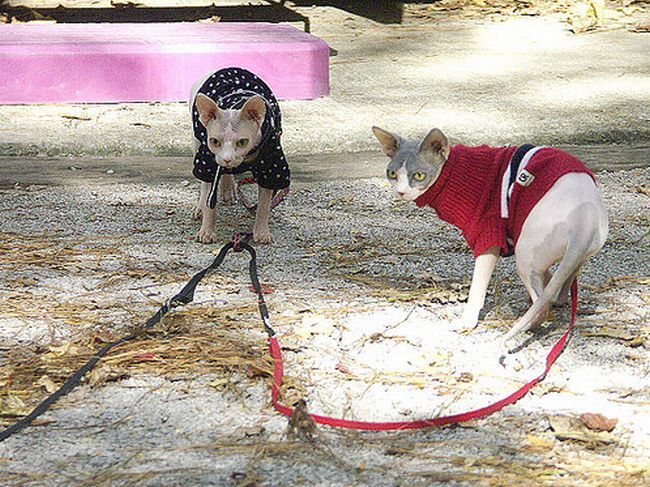
A harness can be helpful here. While walking with a harness will certainly limit your cat's playtime, it will also protect her from a lot of dangers. Therefore, we can discuss the steps to get your cat used to walking outside.
First, buy a comfortable cat harness (a dog leash won't work) and begin training your cat to wear it. At first, simply leave the harness somewhere visible and accessible to your cat, allowing her to get used to it. Then, use only the harness, without the leash, and try to distract her with something pleasant, such as a treat or a game. If your cat tries to rip the collar off, don't give in to it; keep engaging her, and remove the collar when she's calm and distracted. This way, she won't associate the harness with something unpleasant.
Repeat this procedure over the following days, remembering to reward your cat. Then, begin attaching the leash itself. Once attached, follow your cat, and never tug on the leash.
You're simply a safety net, not its controller. If you try to tell the cat where to go by tugging on its leash, it will simply lie down on the floor and stay there.
How to put on a harness
Harnesses come in different types, but cats prefer the "H" and "8" models.
The "H" design consists of a pair of rings fastened with a strap (sometimes two straps for greater security, with the second strap attached underneath, parallel to the first). The latch of the larger ring is located just behind the front legs, while the smaller ring is secured around the neck. A strap connects the rings along the back, preventing them from coming apart.
The main difference between the second model, which has the shape of an infinity or figure eight, and the first is the way the rings are fixed - the rings are connected directly to each other without the use of a strap.
This model only has one lock, and many owners find it difficult to put the harness on their cat. But the process is straightforward:
- open the lock;
- hang the first ring around the pet's neck;
- wrap a hanging strap around the chest behind the front legs;
- close the "latch".
Both models have proven themselves to be effective, but dogs respond more calmly to the "H" version of the harness. This is likely because the cross strap prevents the ring from constricting the neck too much.
Precautionary measures
If you decide to take your cat outside, be sure she's up to date on all her vaccinations and is healthy. In addition to a harness, attach a collar with a tag with your address on it. Never let her outside without it. Then, put the harness on, place her in the carrier, and take her outside. It's best to choose a quiet spot, away from traffic, people, and animals. Open the carrier, and allow Murka to get comfortable and climb out on her own. Don't force her out, even if the first few times are just sitting in the open carrier and sniffing the new scents. After all, this is a walk for fun.
Once your cat starts leaving the pouch, simply follow her wherever she likes. Again, don't try to direct her unnecessarily. Initial trips outside can be limited to 10-15 minutes, and then the time outside can be increased to an hour. After walking your cat outside, wash her paws and regularly treat her for parasites (worms, fleas, etc.).

How to properly walk your pet
If you've decided to introduce your pet to the outdoors, you'll need to learn the basic rules for walking cats, as recommended by experienced breeders:
- It is better to take walks away from the highway (the noise of cars can cause stress for the pet);
- the cat should be kept at a distance from stray cats and dogs;
- It is necessary to ensure that your pet does not catch or eat mice or birds in any form, and you should also prevent it from eating unfamiliar food.
Read also:


1 comment
taia7
Cats are my favorite animals. Once I got a kitten, I became so attached to it that I couldn't live without it. Basically, wherever I go, I always take my cat with me. And once, while we were camping, the cat got lost. True, she was soon found. I'll never forget that fear: leaving a defenseless creature, not being able to find my beloved. So, it turns out that only a harness can save you from being lost. Are there other ways to keep your cat safe?
Add a comment