
Scientists have bred a cat that glows in the dark.
American scientists from the University of Orleans, in the course of scientific experiments on gene replacement, have bred a cat that glows in the dark.
Reports of luminescent animals ceased to be a novelty in scientific circles after a group of scientists won the Nobel Prize in Chemistry for the discovery of the green fluorescent protein. It was discovered during experiments with jellyfish. Using this gene, humans were able to observe the development of diseases and tissues at the cellular level for the first time.
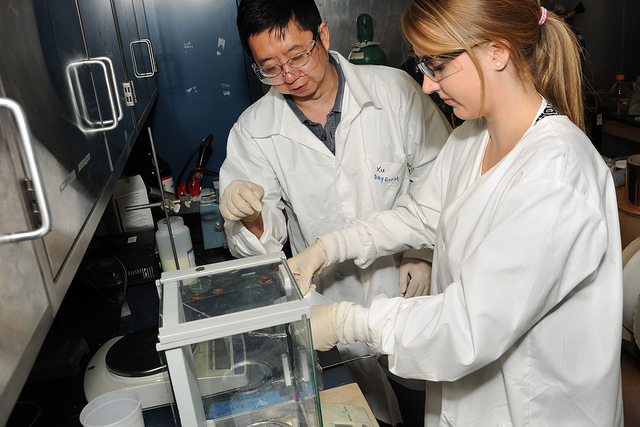
The American scientists' research wasn't aimed at creating a new breed, let alone a glowing one. They were studying genetic diseases and inserting a fluorescent protein into a specific gene to monitor the disease's progression. The geneticists began conducting similar experiments back in 2001, and seven years later, a cat was born whose eyes, tongue, and nose glow bright green under ultraviolet light. The scientists explained their use of cats for their purposes by saying their genetic structure is very similar to that of humans.
Throughout the experiments, they are kept in special cages, vaguely reminiscent of quail cages. As is well known, the distinctive features of such cages are good ventilation and a stable internal temperature of around 22-25 degrees Celsius. Quail cages are most often made of plywood and fiberboard, less commonly plastic, and all necessarily have a wide mesh designed for ventilation and relative freedom of movement of the "occupants."
The glowing kitten was born in a nearly normal way. Scientists took cellular material from a donor cat, added a new protein, and implanted it into a female cat, who acted as a surrogate mother. She was able to carry and give birth to a seemingly ordinary ginger kitten. After examining the animal, the scientists discovered its unusual qualities and named it Mr. Green Gene. The laboratory cat grew and developed normally and is still doing well, which also confirmed the safety of introducing the fluorescent protein into a living organism.
A group of Korean scientists had previously produced several fluorescent kittens through cloning, but unlike the American green cats, the Korean cats appeared reddish under ultraviolet light. A red fluorescent protein had been implanted into their cells. In 2006, scientists at the National Taiwan Research University began breeding fluorescent piglets. Their goal, however, was not to develop a new breed, but to use pigs as donors for human organ transplants.
Read also:


Add a comment