
Purina One dog food
Every dog breeder has seen Purina One dog food on store shelves. Thanks to its popularity and well-developed distribution network, this brand's food can be found in almost every supermarket and pet store. So what exactly is this food, and what accounts for its popularity?
The owner of this brand is the Nestlé conglomerate, which produces a vast range of products. Going back further, the history of the Purina company dates back to 1894, when Ralston Purina began mass-producing horse feed. Products for farm animals followed, as well as pet food lines. After more than 100 years of existence, the company succumbed to the pressure of lucrative offers, and all assets were acquired for a tidy sum by the Swiss company Nestlé. Today, we have several lines of dog and cat food bearing the same name – Purina.
Content
Purina dog food range
Currently, according to publicly available information from the manufacturer, its product range includes four types of dry food and six types of wet food. Altogether, that's only a dozen items, which, frankly, is not enough.
The company's dry food is presented as a mixture of small, crunchy kibble and soft pieces of food. This is designed to improve digestibility and make the food more appealing to pets. This type of food is marketed under the following names: "My Dog...":
- …already an adult – food with beef and rice;
- ...fidget - chicken food with rice;
- ...a food lover - a diet based on turkey meat and rice cereal;
- …sensitive – diet with salmon, and the same rice.
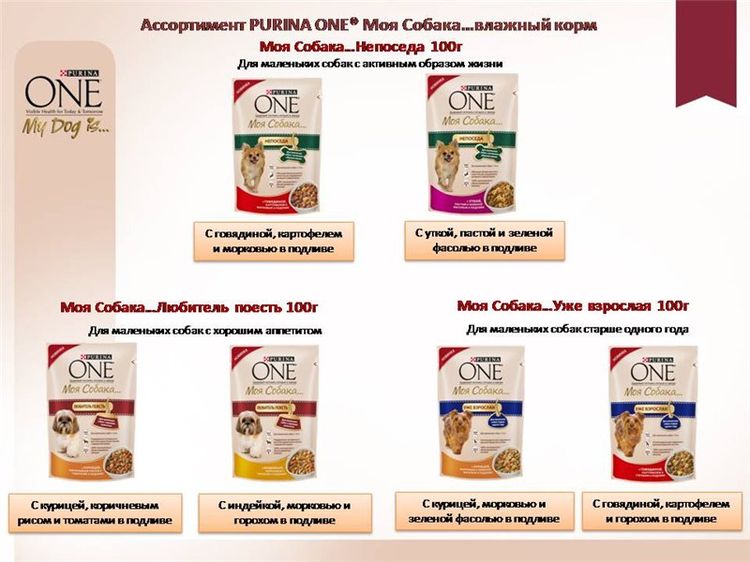
Wet food is categorized according to the same principle, but there is no food for dogs with sensitive digestion. However, the remaining types of food are now available in two different flavors:
- Chicken with green beans and carrots + Beef with potatoes and peas - this is for adult dogs;
- Beef with added potatoes and carrots + duck with pasta and beans – diets for fidgets;
- Turkey meat with added peas and carrots + chicken with tomatoes and brown rice – for dogs who love to eat.
The manufacturer also emphasizes that all Purina One dog food (both dry and wet) is designed for small breed dogs—the fine grain size and small packaging confirm this. The manufacturer does not specify what owners of large dogs should do if they want to feed their pet Purina One.
As we can see, the selection isn't extensive. But perhaps this is offset by the excellent composition and balanced content of all essential nutrients? Let's take a closer look at the ingredients in Purina food.
Composition of Purina dog food
To understand what this brand's dog food consists of, we decided to conduct a detailed analysis of one of the most popular (based on online reviews) diets from the "Neposeda" class – dry food containing chicken and rice.
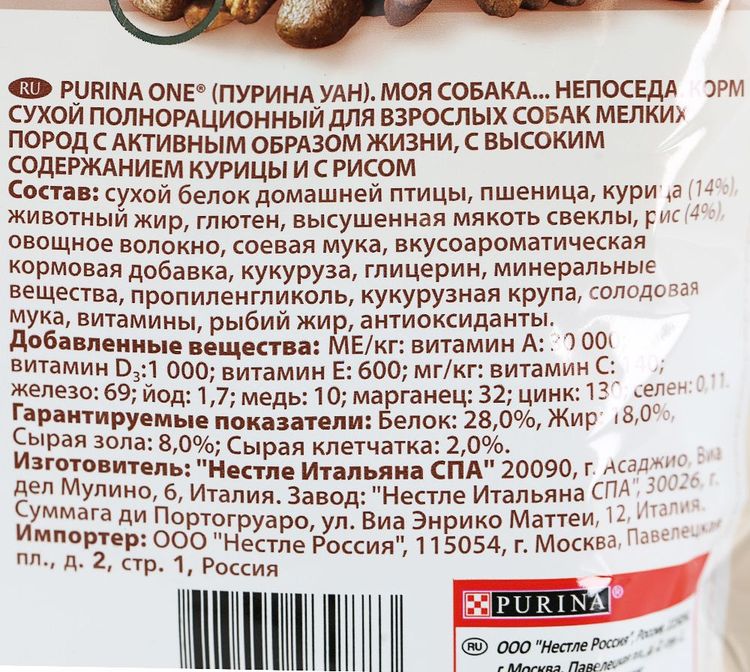
After examining the package, one can conclude that the food is produced in Italy (at least, that’s what our sample was) and has the following ingredients:
- Dry proteins obtained from poultry;
- Wheat;
- Corn;
- Chicken (14%);
- Animal fat
The first five or six components can be used to judge the quality of the food, as they make up the bulk of the nutrition. Everything below the list is merely impurities that don't significantly affect the composition.
Next comes the gluten content and beet pulp (dried before use). Then comes rice (4%), vegetable fiber, and soy flour. Then come the truly unpleasant ingredients: flavoring additive, glycerin, minerals, and propylene glycol. Finally, the list ends with the content of corn grits and malt flour. Vitamins, fish oil, and antioxidants round out the nutrient list.
That's basically it. The ingredients are meager, but let's take a closer look at the nutritional value of this diet.
Guaranteed Content
The Purina One dog food package also contains information about the guaranteed nutritional content:
- Proteins – 28% (normal value);
- Fats – 18% (within normal limits);
- Ash content – 8% (sufficient value);
- Fiber – 2% (below normal).
By and large, if you believe the description, this food is capable of maintaining a dog's strength at the proper level, but let's find out exactly what each ingredient on the list means.
Protein
Dogs need meat for proper and complete nutrition—it's their primary source of protein. However, poultry protein, a less-than-healthy component obtained through extensive processing of poultry carcasses, is the primary ingredient in dog food. Essentially, this substance contains nothing but protein and offers no additional nutritional benefits. It's often used as a way to boost protein levels.
Chicken is listed as another source of animal protein. It's not a bad thing that it's included in the food at all. However, it's important to remember that this description can refer not only to meat but also to other parts of the animal—after all, all the bones, skin, legs, and entrails were once "chicken." This ingredient designation usually indicates low-quality raw materials.
Fats
Purina One dog food lists animal and fish oils as lipid sources. Animal fat, derived from cattle and pigs, is essentially lard that was not used in higher-quality production. Its low quality and limited nutritional value make this nutrient an unwelcome addition to any pet food.
Fish oil is a very beneficial substance for dogs, providing polyunsaturated acids, which are natural antioxidants. However, the fact that it's the second-to-last ingredient on the list negates all its beneficial properties—it's simply not enough to meet a dog's needs.
Carbohydrates
The guaranteed analysis doesn't list carbohydrate content. A simple mathematical calculation shows that the food contains approximately 30-35% carbohydrates. This is a lot, especially considering the sources of this nutrient—there are seven of them! And these are all grains in one form or another (cereals, flour, etc.). Wheat, corn, malt, and soy—all of these are not digested by dogs and are excreted virtually unchanged. It's safe to say that these are simply fillers that make the product cheaper.
Additional components
Beet pulp is added to Purina dog food to provide plant fiber. This is beneficial, as it improves digestive tract function, especially intestinal function. Vegetable fiber is apparently added for the same purpose.
Glycerin and propylene glycol are substances that prevent food from caking and drying out. Essentially, they are preservatives in a sense. The main danger of propylene glycol is that it can lead to diabetes with regular use. Neither of these ingredients are good additives to dog food.
Flavoring additive is a not-so-healthy ingredient in Purina One dog food, designed to enhance the taste and smell of the food. This promotes more active eating, but there are a few questions. What does this additive consist of, and most importantly, why is it needed? Pets won't eat the food without it.
Vitamins and minerals are undoubtedly beneficial substances, but here we're talking about some pre-made set, added for the sake of appearance. There are no fruits, vegetables, or herbs intended to provide the dog with natural vitamins and microelements.
Antioxidants are beneficial substances that prevent aging. They're a good component in any form. However, in small quantities, their benefits are negated.
In summary, we can say that this food is not complete and nutritious. It is simply physically incapable of maintaining a healthy body if fed to a dog over a long period of time.
Pros and cons
Among the obvious advantages of this diet, we can note:
- Wide availability (your nearest store will probably have it on sale);
- Low cost compared to analogues.
But there are also some downsides that you shouldn't forget:
- Poor composition;
- Presence of chemical ingredients;
- Lack of indication of the percentage content of each component (except chicken and rice);
- A huge amount of cereals.
Reviews of food
Due to the widespread availability of Purina dog food, reviews can be found on any pet forum. Most of them say it's a decent diet, without any strong negative or overly enthusiastic opinions. There are also reviews in which breeders complain about the quality of the food, which has led to deterioration in the health of their dogs.
Let's look at some of the most compelling reviews of Purina food:
Stas, the dachshund owner:
"I've been buying Purina for my dog for a while now. I like that it's available at any pet store, and I can pick it up on the way home. My dog eats it happily, and he's healthy—knock on wood, everything seems fine."
Oksana Pavlovna, spaniel breeder:
"My dog eats natural food, but when I'm really too lazy to cook, I buy her Purina in pouches. She devours it voraciously and always licks her bowl clean. The only downside is that the food has a very strong odor—she smells like it herself after eating. Otherwise, it's just food."
Evgeniy, the pug's owner:
"There was a time when I decided to save money and bought my Bona Purina One at the local supermarket. I won't do that again, and I don't recommend it either: the dog was throwing up everywhere, and on top of that, she developed terrible diarrhea. The vet told us not to reinvent the wheel and returned her to her previous food. Since then, I've had a very negative attitude toward Purina."
Speaking from experts, veterinarians' reviews of Purina dog food are all consistent: it's a low-quality food that's only popular due to its price. Doctors don't recommend these diets for daily feeding, as they can impact your pet's health.
Price for Purina Van food
The entire range of foods is sold at roughly the same price across all retail chains. Dry foods are available in 0.6 and 1 kg packages, while wet foods are available in 0.1 kg pouches, designed for one meal. Prices for Purina One dry foods range from 200 rubles for a 600-gram pack to around 330 rubles for a 1.5 kg pack. All pouches are priced the same, regardless of flavor, and range from 25-30 rubles.
As you can see, the prices are quite reasonable. However, our website considers this food to be an economy-class food and recommends owners improve the quality of their pet's diet at the earliest opportunity!
Read also:


Add a comment