
Mealfeel cat food
One of the newest additions to the Russian pet food market that is increasingly attracting interest from cat owners is the Mealfeel brand. This brand's products are manufactured for and sold exclusively by the Four Paws chain of stores. This review examines Mealfeel's diets to determine their strengths and weaknesses, and whether it's worth offering to your pet.
Content
Manufacturer
This brand is owned by PetExpert (Russia), but the production facilities where the food is made are located abroad. It's quite common in the pet industry these days for companies to offer turnkey private label development and manufacturing services. Milfil wet food is produced in France at the La Normandise facility. The Mealfeel line of dry cat food is manufactured at the facilities of the Belgian company United Petfood.

Each of these companies has over 20 years of experience in industrial animal nutrition production. Furthermore, their state-of-the-art equipment allows them to create products of the highest quality, as confirmed by a wide range of certifications (FCA, ACS, IFS).
Assortment
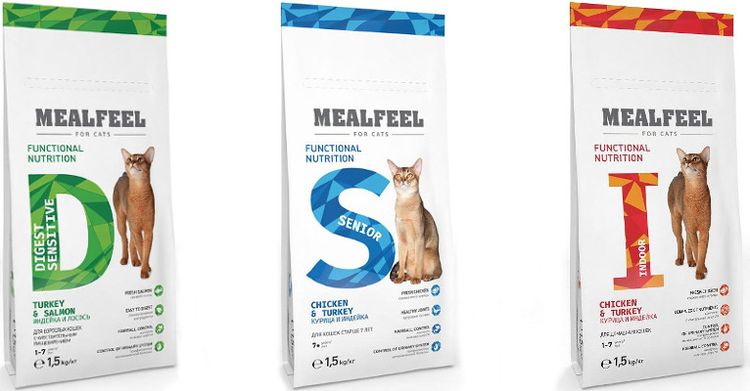
Currently, the Milfil product range consists of six dry menus and 14 canned diets. The dry food line is easy to navigate – each package is marked with a capital letter (in a different color) denoting the key formula feature:
- S (purple) — Sterilized — is a formula for neutered and spayed cats. Its main ingredients are chicken, 15% fresh salmon or lamb (depending on flavor), corn gluten, rice, and peas. It has an increased content of L-carnitine, a fat-burning substance, to help prevent excess weight gain in pets. Protein/fat balance: 37%/12%.
- I – Indoor – is a recipe for adult pets kept indoors. This menu is based on chicken, turkey, peas, and rice. Protein/fat ratio: 32%/16%.
- K – Kitten is a food for kittens over one month old and for growing kittens up to one year old. The diet is based on chicken and turkey, combined with legumes and rice. Protein content is 34%, lipids – 23%.
- S (blue) – Senior – is a food for cats over seven years old. It includes poultry (chicken and turkey), white rice, peas, and dried potatoes. It also contains chondroitin, glucosamine, and an MSM complex to support joint health. It has reduced protein and fat content: 29% and 13%, respectively.
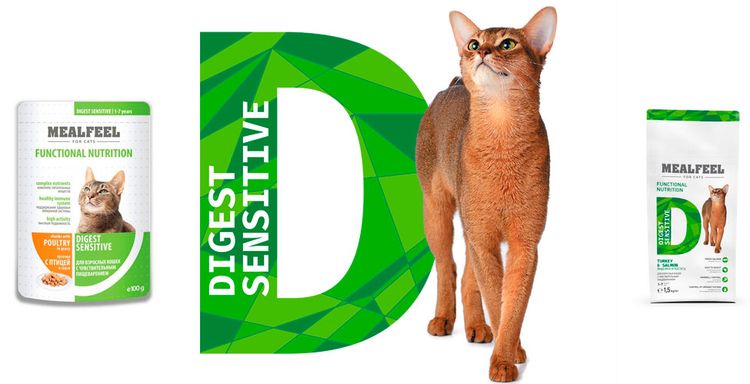
- D – Digest Sensitive – a diet for pets with digestive issues. This formula consists of turkey and salmon combined with peas and rice. Protein levels are 32% and fat levels are 23%.
The canned diet line is positioned as a complete and fully balanced diet. It is divided into wet food pouches (chunks in sauce) and canned food in lamisters (pâtés).
Wet diets differ from each other in terms of the basic physiological needs of the pet (age, castration, sensitive stomach), plus there's a formula to support healthy skin and coat. The flavor selection is fairly standard:
- poultry,
- lamb,
- salmon and shrimp,
- chicken with pieces of fillet,
- beef,
- lamb and chicken fillet,
- turkey.
There are only four varieties of canned food in Lamister:
- turkey with carrots (turkey 14%, carrots 4%);
- white fish (fish 14%);
- beef with liver (beef 14%, liver 4%);
- poultry (its content is also 14%).
According to information provided on the official website, the total amount of meat and meat by-products in these diets does not exceed 50-55%.
Price
The price range of Mealfeel brand food is above average, comparable to many super premium diets today.
The price of Mealfeel food does not depend on the type or taste of food and is:
- per pouch 100 gr. – 60 rub.,
- per lamister 100 gr. – 60 rub.,
- for dry croquettes in a pack of 0.4 kg - 290 rubles, 1.5 kg - 950 rubles, 8 kg - 3800 rubles.
Evaluation and analysis of the composition
The manufacturer eloquently states that dry diets contain 40 to 50% meat components, depending on the recipe. Additionally, almost every formula (except for the kitten menu) includes special additives for the prevention of urinary stones and the elimination of hairballs. At least, the manufacturer promises these properties in its diets with the labels "Control of the urinary system" and "Hairball control."
Let's take a closer look at the composition of Mealfeel food, using as an example the Digest Sensitive diet, designed for cats with sensitive digestion over 1 year old.
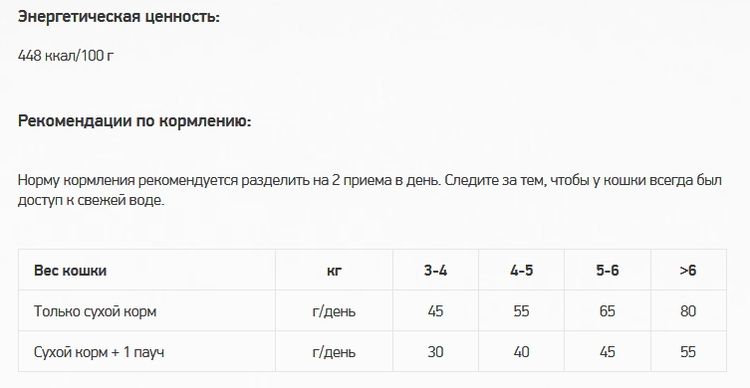
The nutritional values (data taken from the official website) are as follows:
- proteins – 32%;
- fat – 23%;
- fiber – 3.5%;
- moisture – 6%;
- ash content – 7.5%;
- carbohydrates – 28%.
Analyzing these figures, it's clear that the fat percentage is higher than average compared to typical dry cat food. This, coupled with the low carbohydrate content, means your pet will get more calories from lipids, which is crucial for cat nutrition.
Main ingredients
The quality of the ingredients plays a key role in determining how balanced, nutritious, and healthy a food is. Therefore, let's examine the list of components that form the basis of this recipe:
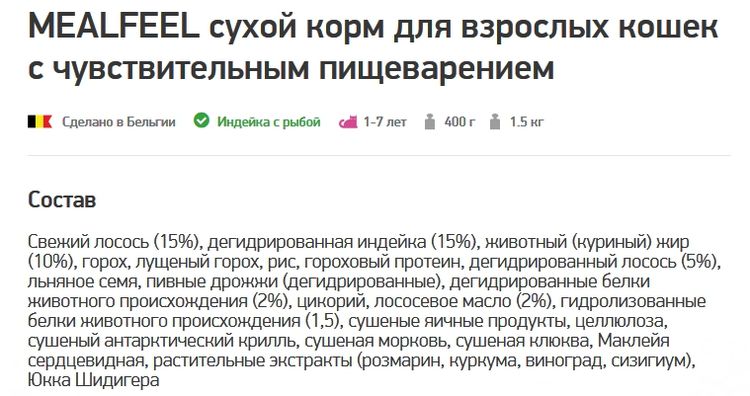
- fresh salmon – 15%;
- dehydrated turkey – 15%;
- chicken fat – 10%;
- peas;
- split peas;
- rice;
- pea protein;
- dehydrated salmon – 5%.
The remaining ingredients are additives that don't significantly impact the overall nutritional formula, as they're present in insignificant quantities. So, let's move on to the analysis:
- Fresh salmon is listed first. This means that whole fish or fish parts, previously unprocessed, were used. It is a good source of protein, as well as beneficial omega fatty acids and a wide range of minerals and vitamins. Although it is a high-quality ingredient, raw salmon contains up to 70% water. During processing during the cooking process, most of the moisture is lost, reducing the meat content in dry food to approximately 9%.
- The second component is dehydrated turkey. This term refers to the use of meat with skin and possibly bones. Dehydrated turkey meat is considered a kind of meat concentrate, as it contains more than four times more protein than fresh turkey. Furthermore, dehydrated turkey (unlike flour) is never exposed to high temperatures during processing, so it retains more nutrients and is more easily digestible.
- The third ingredient is chicken fat. It's obtained from chicken through rendering—a process similar to making soup, where the fat is skimmed from the surface of the liquid. Chicken fat is high in linoleic acid, a vital omega fatty acid. It's a truly high-quality ingredient.
- Peas are the fourth ingredient listed. They are increasingly found in prepared pet food as an alternative to grains such as wheat or corn. Pets are almost never allergic to this product, and it has a much lower glycemic index, which can be considered an advantage. However, this legume contains approximately 25% plant protein, a nuance that must be taken into account when assessing the nutritional value of the diet.
- Split peas are the fifth most important food item in the diet. There's no significant difference in the nutritional properties of regular and split peas. Other than being a good source of carbohydrates and natural fiber, they offer no significant nutritional benefits.
- The sixth ingredient is rice. It's a complex carbohydrate that (after cooking) is fairly easily digestible. However, aside from its calorie content, rice offers modest nutritional value for cats.
- Pea protein ranks seventh. This is what remains after the starchy part of the pea is removed. Although it contains over 80% protein, plant protein is much less digestible for cats than animal protein.
- Number eight is dehydrated salmon. Essentially, it's dried whole salmon or salmon parts, with protein concentrations several times higher than fresh salmon. An excellent, high-quality ingredient.
It's important to note that several ingredients in this diet are, in one way or another, peas or pea derivatives—items 4, 5, and 7. Although these are high-quality plant-based ingredients, this division of a single product into several separate ingredients is often used by manufacturers and is called a "split."
If all these individual elements were combined and presented as a single product, this "aggregate" product would rank higher on the list. Perhaps legumes (not meat) are the predominant ingredient in the food.
Additional components
The Mealfeel diet's ingredients don't end there, and the list could be extended to include a number of other elements. However, a realistic assessment of the actual contribution of ingredients located so far down the list to the recipe reveals that they are far too insignificant. However, there are some notable exceptions that require special attention:
- Flaxseed is one of the best plant sources of Omega-3. When ground into flour, flaxseed is also rich in soluble fiber.
- Salmon oil is a valuable natural source of EPA and DHA, essential fatty acids that form part of Omega-3. These two substances boast the highest bioavailability for cats. Depending on its type and purity, salmon oil can be considered a highly valuable supplement.
- Chicory, or more precisely its root, is rich in inulin, a starch-like compound composed of repeating carbohydrate units. Inulin is not only a natural source of soluble dietary fiber but also a natural prebiotic, promoting the growth of beneficial bacteria in the digestive tract.
- Furthermore, this menu contains cellulose—an indigestible plant fiber. It is typically made from vegetable byproducts. Its sole purpose is to enrich the diet with fiber. However, without a specific source for the cellulose, it seems rather controversial.
Brief conclusions
Judging by the quality of its ingredients, Mealfeel Digest Sensitive deserves a place in the super-premium cat food category. However, the amount of legumes in the formula, along with the added rice, indicate that it contains too much plant protein, which doesn't meet the needs of cats. This formula can't claim to be a leader, but thanks to its high-quality sources of animal protein and fat, Mealfeel is a confident "good" performer in its class.
Owner reviews
Since Mealfeel cat food hasn't yet reached widespread popularity, online reviews aren't common. Here are some of the owner reviews we've found:
Zlata, owner of a Cornish Rex cat, Voronezh:
"I got a growing Cornish cat as a gift. Previously, he ate all sorts of porridge and soups, mixed with cottage cheese and chicken. I decided it was best to feed him dry food, as it had vitamins and was perfectly balanced. After browsing the shelves at the pet store for a long time, I couldn't decide on a purchase and asked a salesperson for help. Then I heard how great Milfil was: the taste and ingredients were superb—everything was truly high quality. I bought it on sale and took it to feed it. I transitioned gradually, over the course of about a week. At first, everything was great: his appetite was good, his activity was off the charts, and he went to the bathroom regularly and without complaints. About a month later, I noticed a change in his coat, and instead of gaining weight, my Duchess even lost a little weight. I think this food isn't right for him, and I've already decided to look for a different option and a different brand."
Igor, owner of a mongrel cat:
"I found this little one on the street and she's been with me for almost six months now. I don't feed her dry food, but she happily eats kitten pouches. According to a breeder I know, Mealfeel for cats isn't much better than cheap brands, but my Alisa can't get enough of it—she won't calm down until she licks her bowl clean. I don't see the point in experimenting with her and constantly feeding her different foods when she's doing just fine on this one."
Veterinarian Reviews
Unfortunately, neither thematic forums nor other websites contain information about the opinions of veterinarians regarding dry or wet cat food of the Mealfeel brand.
Read also:


Add a comment