
Leonardo cat food
Pet stores today offer dozens of different commercial cat food options. It's quite difficult for someone unfamiliar with the intricacies of their cat's nutrition to make the right choice, so many rely on advertising. As a result, their pet ends up eating low-quality, but over-hyped, food, while better options gather dust on the store shelf, awaiting purchase.
One such product is Leonardo cat food – a super-premium formula designed for all breeds and ages. It's produced by the same company that makes Belcando dog food. Let's learn more about this food and decide together whether these diets are worth considering.
Content
Company history
All Leonardo brand pet food is produced exclusively in Germany by the German company Bewital Petfood. It all began in 1963, when the company's founder, Mr. Bernhart Wigger, set out to create the best pet food. He grew up on a farm and saw countless animals around him, treated with love and care. It's no surprise that as he grew older, Bernhart decided to do something specifically for animals—to develop high-quality nutrition designed to provide animals with the full nutritional value they need.
This is how Bewital was founded, a company that has been developing and producing high-quality pet food recipes for over half a century. The company's strong point is the most advanced technology and state-of-the-art equipment in its factories. The manufacturer itself cites the quality of its products as another distinguishing feature – all of them undergo strict certification and quality control. All ingredients used in the production of cat food are fit for human consumption, as stated on the company's website.
Another point: according to company representatives, all meat and fish are processed within 24 hours of slaughter or catch. This is an excellent indicator, guaranteeing the freshness and quality of the raw materials.
Leonardo's range of food
Leonardo's product line includes cat food, both in the familiar dry kibble form and in canned and pouched forms. There are 11 dry food varieties in total:
- Start – small granules with a special composition for the smallest kittens;
- Kitten – for animals up to one year old;
- Adult – a series for adult cats. It comes in 8 different flavors, as well as diets for overweight cats, allergy sufferers, and sterilized cats. The allergy-friendly food is grain-free;
- Senior – for pets over 10 years old. This food is stated to be gentle on the cat's kidneys.
All of these foods are based on meat and fish, as well as meat ingredients, along with small amounts of grains, herbs, and vitamin and mineral supplements. Diets with duck, lamb, salmon, and chicken are available. All dry diets are available in 0.4, 2, 7.5, and 15 kg packages.
Leonardo canned food is available in 5 varieties, sold in 200 and 400 gram cans:
- For kittens (containing beef and chicken eggs);
- With chicken;
- With liver;
- With ocean fish;
- With rabbit meat.
We also offer 85-gram pouches for single feeding. There are also several varieties available:
- Duck with cheese;
- Ocean fish with shrimp;
- Kangaroo meat with catnip;
- With chicken for kittens;
- Assorted meats;
- Chicken meat + chicken eggs;
- Beef;
- Chicken;
- Rabbit meat with added cranberries;
- Trout with catnip.
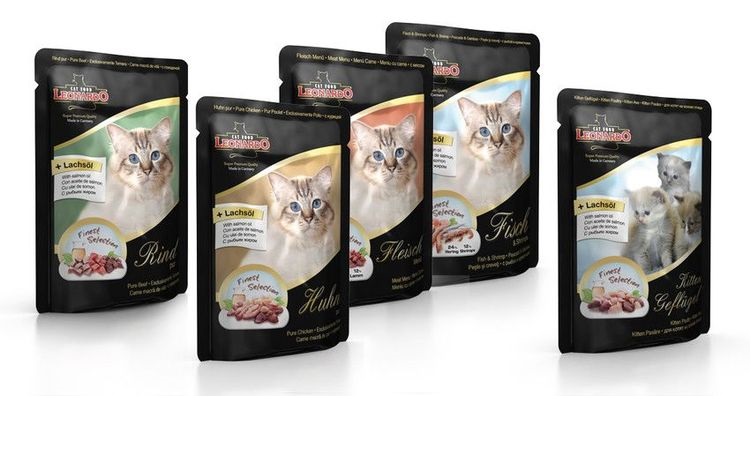
In general, based on our experience, the selection is quite good, totaling 26 varieties of cat food. This means any breeder can choose a customized diet for their pet, taking into account all its needs.
It all looks very, very promising, but is the composition of Leonardo cat food as good as the manufacturer claims? Let's take a closer look at one of these foods, atom by atom, and find out what it actually consists of. This will allow us to determine whether this food qualifies for the super-premium segment of cat food.
Analysis of Leonardo's feed composition
For a detailed examination, we chose Leonardo adult cat food with lamb and rice. First, let's clarify the manufacturer's ingredients:
- Fresh lamb meat, lungs and liver (30% content);
- Dried lamb protein (14%);
- Dry poultry protein with reduced ash content (14%);
- Rice;
- Corn;
- Poultry fat.
Typically, the first 5-6 ingredients make up the lion's share of the food's mass, meaning that these are essentially all the ingredients in the food. The remaining ingredients are merely beneficial (or not so beneficial) additives. Let's take a look at them. Next on the list are hydrolyzed poultry liver, rye, and malt. Next come dried egg, marine zooplankton (specifically, 2.5% crushed krill), 2.5% dried brewer's yeast, herring meal, and grape seed flour. Next come chia seeds (1.3%), dried cilantro, and table salt. The list also includes potassium chloride, inulin, and dried herbs (0.05%), including chamomile, mistletoe, fennel, caraway, and gentian. After the main composition, the vitamin and mineral content is listed with a detailed breakdown, but we will not provide it - it is enough to note that the vitamin-mineral complex is present in the composition.
At first glance, Leonardo cat food seems quite good, as it contains a lot of meat and fish ingredients, which are essential for cats to obtain animal protein.
Guaranteed content of substances
- Protein: 32% (it is emphasized that 85% of this amount is of animal origin);
- Fats: 20%;
- Ash content: 8.5%;
- Fiber: 2.3%;
- Water: 10%.
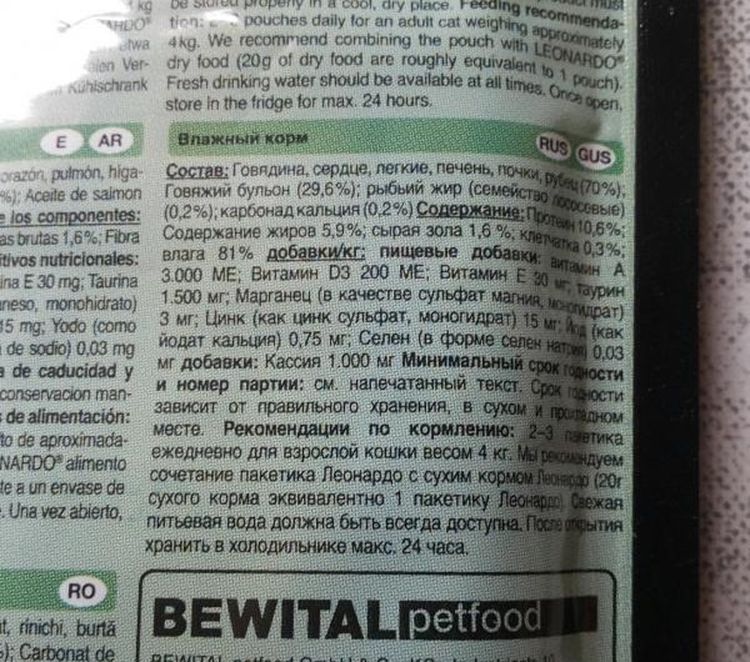
As we can see, the carbohydrate content is not listed at all, and the manufacturer has every right to do so. After doing some calculations, we can say that the carbohydrate content in the food is approximately 25-27%, which is quite good for a cat's diet. Furthermore, the protein is mostly animal-based, meaning it is almost 100% digestible for cats.
Let's clarify what is hidden behind each of the names of the feed components.
Squirrels
Fresh lamb, along with 30% of the animal's liver and lungs, are key protein sources. These are excellent ingredients that are fully digested and deliver all the nutrients they contain to your cat. However, it's important to note that 30% of fresh meat and by-products will lose up to 60% of their mass during processing due to the removal of water, and therefore their percentage in the final product will be lower.
Lamb protein is listed next—it's a highly processed product, consisting of almost 100% protein. The source of the protein isn't specified. Processing also removes all the beneficial nutrients, even if they were present initially. It's a good source of protein, but it's often added to feed solely to boost protein levels.
Poultry protein is most likely chicken protein. The source of the protein is also not specified (it could actually be whole carcasses, not just pure meat), so this component also serves only to raise the protein levels to the recommended level.
Poultry liver hydrolysate serves both as a protein source and as a natural attractant—a flavor additive that stimulates food consumption. It's a good ingredient in Leonardo cat food. Reviews from experts are generally positive.
Dried egg is a good source of protein that is fully digestible by cats. However, it's worth noting that the source of this nutrient is not specified: whether it's whole fresh eggs or egg processing waste is, unfortunately, unknown.
Zooplankton (krill) is an ideal source of protein. It also contains a lot of Omega-3 and Omega-6 polyunsaturated fatty acids, which are very beneficial for animal health. It's definitely a high-quality and healthy ingredient.
Herring meal is a good nutrient, containing not only protein but also fatty acids. It's very beneficial for cats, especially those living in apartments. However, the whole herring is often used to make the meal, which somewhat reduces the quality of the final product. Despite this, herring meal is a healthy ingredient in cat food.
To sum it up, it can be noted that 7 sources of animal protein is a very good indicator even for more expensive foods.
Fats
Poultry fat is listed as the only source of lipids in the ingredients. Its quality and the source of the bird are unknown. However, to be fair, chicken fat (which is likely what was used) and duck fat are excellent sources of fat for cats. They are high-quality products containing all the necessary nutrients. They promote healthy skin and coat and provide the body with linoleic acid.
Carbohydrates
The source of carbohydrates, according to the ingredients on the package, unfortunately, is grains: rice, corn, rye, and malt. Unfortunately, cats' bodies are not adapted to processing grains, so all these components can be considered "ballast"—they pass through almost in their original form and provide absolutely no benefit to the cat. This is a drawback of Leonardo cat food.
Other components
Dry brewer's yeast is a good source of plant-based protein and contains numerous vitamins and minerals that help strengthen the nervous system, help manage stress, and improve digestion. This ingredient also helps prevent dysbiosis by supporting intestinal health. Yeast is also beneficial for your pet's skin.
Grape seed flour is a natural antioxidant that helps prevent heart disease and strengthens blood vessels and the retina. It's a good ingredient, but its small amount negates its beneficial effects on cats.
Chia seeds are a healthy supplement, sometimes called Spanish sage. They have antioxidant properties and contain a huge dose of calcium and unsaturated fatty acids. They're a good ingredient, but they're added more for the enjoyment of the host than for any real benefit.
The Constantinople pod, also known as carob, is a high-quality supplement containing plant protein, vitamins, fiber, and a host of other beneficial elements. This nutrient content is an undeniable advantage of this food.
Potassium chloride is an emulsifier designed to ensure the homogeneity of products made from components of varying densities. It is safe and used in the food industry worldwide.
Table salt is essentially useless for cats. Its sole purpose is to encourage them to drink more, which is beneficial when feeding dry food.
Inulin is a prebiotic that promotes normal digestion. A high-quality ingredient derived exclusively from natural plant sources.
The ingredients also list dried herbs, but their amount (0.05%) provides absolutely nothing for the animal—all benefits are negligible. Essentially, 1 kg of food contains half a gram of the entire herbal composition—a negligible amount.
Vitamins and minerals are most likely added in the form of a ready-made premix, with some average value.
Ultimately, the food is quite good, though it's a stretch to call it a super-premium diet. It's recommended as a daily diet for an indoor cat.
Leonardo food reviews
We've reviewed the experiences of owners and compiled a summary of the many reviews of Leonardo cat food. Here are the most compelling opinions about this cat food:
Tatyana Pavlova, the cat's owner:
"My pet is a mixed-breed, but she's quite a picky eater. At first, I fed her raw food, but then I wanted to switch her to dry food. We chose Leonardo on the advice of the pet store salespeople and bought 400 grams to try. What can I say—it's just food. She eats it, doesn't seem to be losing weight, and her stomach is fine. It's a good, high-quality food!"
Anton, Sphynx breeder:
"Kuzya had skin issues—it was constantly flaking and dry. The vet recommended trying Leonardo for allergy sufferers (it even seemed grain-free), so we bought a small pack. Everything went perfectly—the cat started eating the new food, and literally within a month, his condition improved dramatically. He started gaining weight, so we had to cut back on the portions a bit, but otherwise, everything was great!"
Anatoly, owner of a British cat:
"This isn't food, it's a CAT-trobe! We bought it to replace Royal, which ran out at the store. The cat was completely stricken with diarrhea; the poor thing didn't leave the litter box for two days. I returned the old food, and everything gradually returned to normal. Now I can't trust Leonard at all!"
If we look at the opinions of professionals, veterinarians' reviews of Leonardo cat food are typical: it's a fairly good food, a good alternative to budget and premium foods. Holistic products are certainly better, but they are also significantly more expensive.
Leonardo's food price
We looked at store prices and compiled a summary of the average prices for cat food from this manufacturer:
Leonardo Kitten:
- 4 kg – from 420 rubles,
- 2 kg – from 1400 rub.,
- 5 kg – from 4120 rub.
Leonardo for adults with lamb and rice:
- 4 kg – from 380 rubles,
- 2 kg – from 1360 rub.,
- 5 kg – from 4150 rub.,
- 15 kg – from 7300 rub.
We see that the price of Leonardo cat food is quite high compared to similar products, but this is fully justified by its excellent composition and high content of animal nutrients, providing these carnivores with ample protein. Feed your pet properly, and they will delight you with their purring for years to come!
Read also:
- GMOs and organic foods in pet food
- How to feed a cat correctly?
- How to switch a cat to a different food?



Add a comment