
Happy Cat cat food
Today, we offer our readers a review of another, lesser-known cat food: Happy Cat. Many may have seen it on pet store shelves, but they preferred more established brands whose names are familiar and therefore more trustworthy. Should you avoid unheralded brands when feeding cats, or should you take a closer look at the "dark horses"? We'll find out by taking a closer look at Happy Cat.
Content
Brief history of the company
All Happy Cat brand pet food is produced by the German company Interquell, based in Wehringen, Bavaria. This family-owned business traces its roots back to 1776, when the family acquired a mill and commercially milled and sold grain.
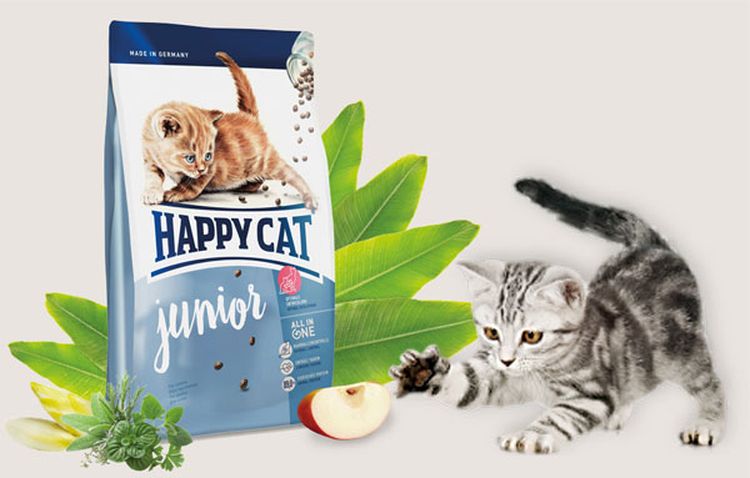
In the 1950s, equipment was developed to produce cereal flakes, which, when mixed with dried meat, became the first dog food. In 1965, the first commercial dog food, Müller's Hundenahrung, was released and became quite popular among consumers. By introducing new recipes and state-of-the-art equipment, the company expanded its product range. In 2002, the company began producing Happy Cat cat food—a new line of diets for these whiskered predators.
The company's credo is "only high-quality ingredients and a balanced formula." Advertising slogans claim that all Happy Cat products contain only fresh meat, fish, and other ingredients designed to provide the animal with everything it needs. Particular attention is paid to the addition of fruits, vegetables, and herbs—natural sources of vitamins and essential nutrients. Whether this is true or not will be revealed later when we take a closer look at one of the brand's foods.
Happy Cat food assortment
A responsible pet owner looking to choose the right diet for their pet has plenty to choose from: the manufacturer offers 42 types of food and 7 types of treats that aren't actually food. This number is impressive, but it's worth delving into the details: of the 42 types, 17 are dry foods, 21 are wet foods, and 4 are in a separate category called Minkas.
All Happy Cat wet cat food is divided into:
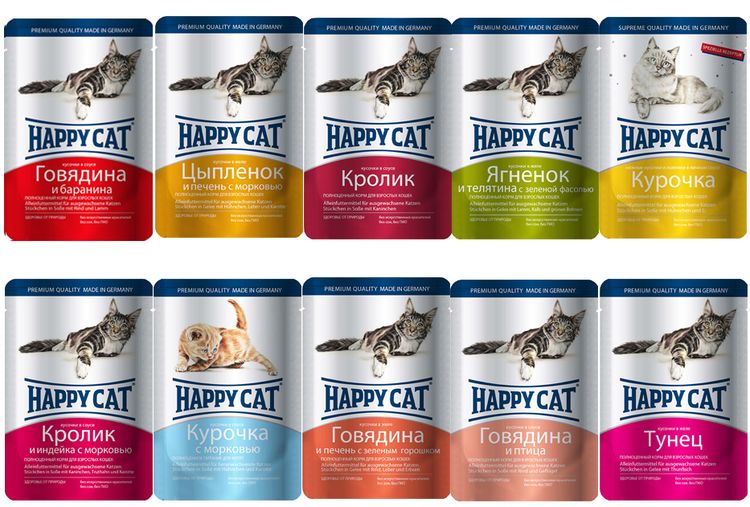
- Pouches (12 flavors);
- Canned food in tins (4 flavors);
- Individually packaged pates for one meal (5 flavors).
Based on our impressions from a cursory examination of the ingredients in all these foods, this wide selection differs from one another only in flavor—that is, the type of meat or meat components added as a source of animal protein. This includes chicken, rabbit, beef, salmon, and many other meats. However, otherwise, all these foods are similar and have no significant differences.
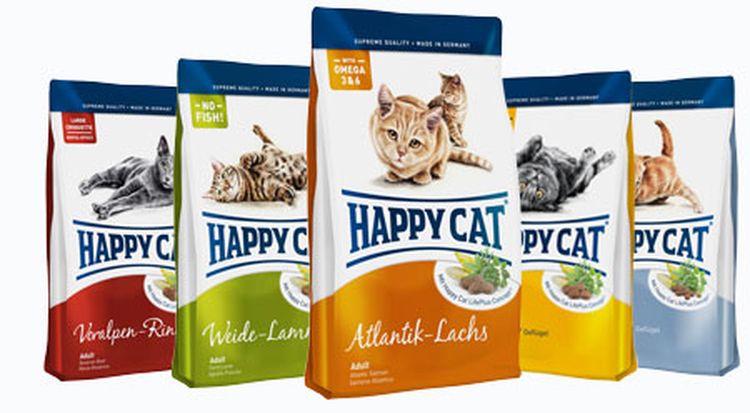
Happy Cat dry cat food is more comprehensively categorized based on the pet's age and activity level. All recipes can be divided into the following groups:
- For kittens and young animals (2 items);
- For adult animals (14 items) – divided into diets for active animals, pets, cats with sensitive stomachs, and for cats prone to obesity.
- For older cats and cats over 10 years old (only 1 type of food).
It is worth noting that these types of nutrition are in turn divided into Sensitive and Supreme lines.
The Minkas line holds a special place among the diverse Happy Cat foods. It's the most affordable, offering four different options: poultry, a mix of four types of meat and fish, kitten food, and food for sterilized cats. Although the ingredients are advertised as being of the same quality as those in the Supreme or Sensitive lines, Minkas raises many questions regarding its composition. Adhering to the old adage "cheap can't be good," we expect these foods to be high in grains and low in meat, which is critical for a cat's nutrition. However, the price will be significantly lower than foods with a high meat content.
Another highlight of this brand is its line of veterinary diets. Its existence is mentioned on the company's official website in Russia, but unfortunately, neither the exact product range nor any information about these foods is available. We believe this is because these foods are possibly not exported to our country, and therefore there is no information about these diets on the website.
So, there's quite a wide selection, allowing you to tailor a diet to each individual cat's needs. That's a plus. Now let's take a look at what this food actually consists of by analyzing the ingredients in Happy Cat cat food.
Composition analysis
For a thorough study, we selected the most optimal food—HAPPY CAT SUPREME ADULT with lamb. According to the manufacturer, this high-quality food has an improved energy balance and contains only easily digestible meats that are gentle on the pet's digestive system.
Let's take a look at what it consists of. The first five components are:
- Bird (21%);
- Rice flour;
- Corn flour;
- Poultry fat;
- Meat products.
The first five ingredients constitute, so to speak, the base of the food. That is, it consists primarily of these components, and everything below them is merely additives.
The ingredients list then lists corn, 8% lamb, potato flakes, and fiber. Next come beet pulp, dried whole egg, sodium chloride, and yeast. Then comes apple pulp (0.4%), potassium chloride, 0.2% seaweed, 0.2% flaxseed, and 0.04% New Zealand mussel. The food also contains 0.04% chicory root, extracted yeast, milk thistle, artichoke, dandelion, ginger, birch leaf, nettle, chamomile, coriander, rosemary, and sage. Licorice root and thyme round out the list. There's also a footnote informing us that the total dry herb content does not exceed 0.17%. The vitamin and mineral content is listed separately.
That's the entire composition of the food. Frankly, it's not great. Despite the manufacturer's flattering words, the food isn't as good as it seems.
Let's take a look at the guaranteed analysis:
- Protein – 32%;
- Fats – 18%;
- Fiber – 3%;
- Ash content – 7%;
- Omega 6 and Omega 3 fatty acids – 2.88%;
Overall, the fat and protein levels are within the norm for this class of food. The only drawback we find is the lack of carbohydrate content, which, according to our rough estimates, is around 30%, which is a bit high. This is because carnivores like cats cannot digest grains (the source of those carbohydrates). Essentially, they're a cost-cutting filler added to increase the bulk of the food.
Now let's move on to a detailed study of the components.
Squirrels
The only protein sources listed are poultry (21%), lamb (8%), and "meat products." Vegetable protein is also definitely present, but its exact content is not specified.
BirdThe ingredient is generally good, as poultry is a valuable source of protein. However, "poultry" in the ingredients list isn't pure meat. It often refers to the entire carcass or the scraps left after deboning. Hoping that this ingredient contains pure meat is a waste of time. Another point: 21% is before processing. After removing moisture, the percentage of this raw material will decrease almost threefold.
Lamb – same thing. Firstly, it's only 8%, and secondly, they're referring to either carcass cuttings or other by-products. And the moisture issue is also at play here – the actual moisture content in the finished feed will be significantly lower than 8%.
Meat products – is a generally suspect nutrient that doesn't inspire confidence. There's no clear understanding of the animal species used, what parts were used, and the original state of the raw material—it's all a mystery. This term typically conceals low-quality animal by-products that have no other use.
It's worth noting that, despite the low quality of the meat, reviews of Happy Cat cat food are mostly positive and don't carry any overtly negative connotations.
Another, perhaps the most worthy source of protein in the food, is dried whole eggs – an excellent ingredient containing a wealth of beneficial substances. A truly beneficial and high-quality nutrient.
Fats
Only one substance is mentioned as a lipid source in the ingredients—poultry fat. In principle, it's better than animal fat, but it also has its own peculiarities: because the specific source of the raw material isn't specified, it's impossible to determine whether it's high-quality poultry subcutaneous tissue or low-grade waste from which the fat was rendered. Most likely, it's the latter. We can't call this a high-quality lipid source—that's a disadvantage for the feed.
The formula also contains flaxseed, which can also be considered a partial source of fat, and very healthy fat at that (flaxseed oil). However, considering the ingredient's quantity—only 0.2%—it's clear that its contribution to the food's fat content is negligible.
Carbohydrates
What this food has in abundance are carbohydrate sources. Rice flour, corn flour, corn, potato flakes—all these fillers are, to one degree or another, designed to make the food cheaper. They offer no benefit to the cat, except perhaps a small amount of plant protein. This is a significant drawback for the food.
Additional ingredients
Beet pulp – a waste product of sugar production. It is considered a valuable source of plant fiber, which aids digestion.
Sodium chloride – Regular salt. It's added as a flavor enhancer and to encourage drinking. This is important when feeding dry food, but salt has no other beneficial properties.
Yeast and extracted yeast – A beneficial component that promotes healthy intestinal microflora. It can sometimes cause food allergies in particularly sensitive animals.
Apple pulp - A waste product from juice production. It has a high pectin (apple fiber) content.
Potassium chloride – a common emulsifier that poses no danger and is widely used in the food industry.
Seaweed – In addition to vitamins and minerals, they contain iodine – this is almost the only natural source of this important element.
Flax seed - A plant-based source of Omega-3 polyunsaturated fatty acid. It's also a storehouse of vitamins, but the small amount of the ingredient minimizes the benefits.
New Zealand mollusks – A valuable source of GAGs, a building block for joints. While definitely beneficial, it's added in a tiny amount—just 0.4 percent.
Chicory root – A source of inulin. However, the problem is the quantity of the ingredient—0.04%.
We won't list all the herbs listed in the ingredients—they're all beneficial. However, their total content is listed as 0.17%. To put that into perspective, that's 1.7 grams per kilogram of food. This amount of herbs won't have any impact on your pet's health, so they're simply included for show.
Vitamins and minerals are listed separately and are most likely added as a ready-made mixture that provides the animal's basic needs.
To sum it up, we have to admit that the food's composition is quite poor, and therefore we would classify Happy Cat cat food as belonging to the economy segment.
Happy Cat reviews
Although this brand isn't as popular as Whiskas or Kitekat, we still found a fair number of reviews from breeders regarding this food. In short, all reviews of Happy Cat dry cat food describe it as a good diet for cats, capable of meeting their pet's basic energy needs. However, many pet owners agree that, in addition to Happy Cat food, a complete nutritional package of supplements and premixes is essential for a complete diet.
As for the opinions of doctors, the situation is clear: due to the poor quality of its ingredients, veterinarians' reviews of Happy Cat cat food do not recommend using it as a primary diet for long periods. As soon as possible, it's worth considering higher-quality diets with a higher meat content and meat-based ingredients. However, veterinarians note that this food can be a good replacement for budget brands, which are downright "inedible" for cats.
The price of Happy Cat food
When choosing cat food, every owner, without exception, is concerned about cost. We analyzed numerous online platforms selling these foods and found that the price of Happy Cat cat food ranges roughly within the following ranges:
Happy Cat Junior – for kittens and young cats:
- 3 kg. – from 260 rub.;
- 4 kg. – from 930 rub.;
- 4 kg. – from 2080 rub.;
- 10 kg – from 3900 rub.
The rest of the brand's dry food is sold at the same prices, regardless of its intended use and nutritional composition, which is quite strange.
Happy Cat canned food, 0.4 kg tin – from 115 rubles, regardless of flavor.
100 gram pouches for a single meal – from 65 rubles per pouch (any flavor).
Thus, we can conclude that the prices for Happy Cat food are at the level of other foods in this class.
We hope this article helps you choose the right and healthy food for your furry friend!
Read also:


1 comment
Rimma
The food may be good, but of my two cats, only one accepts it; the other turns up her nose. And I need food that both will eat.
Add a comment