
Grandin dog food
Grandin dog food has long been a favorite among breeders. A product from Czech and German manufacturers, it meets all the needs of pets, according to the company itself. Today, we'll explore the ingredients of this food, learn what raw materials it's made from, and draw conclusions about its quality, as well as whether it can claim to be a complete diet for dogs.
Content
Manufacturer
As for the trademark owner, everything is shrouded in mystery. Even the official website for this food offers no information about the Grandin brand's owners, listing only the manufacturers—the companies that directly manufacture the finished products. All Grandin dry foods are produced in the Czech Republic, at the Dibaq AS plant. This reputable plant meets all European standards and requirements regarding quality and sanitary production.
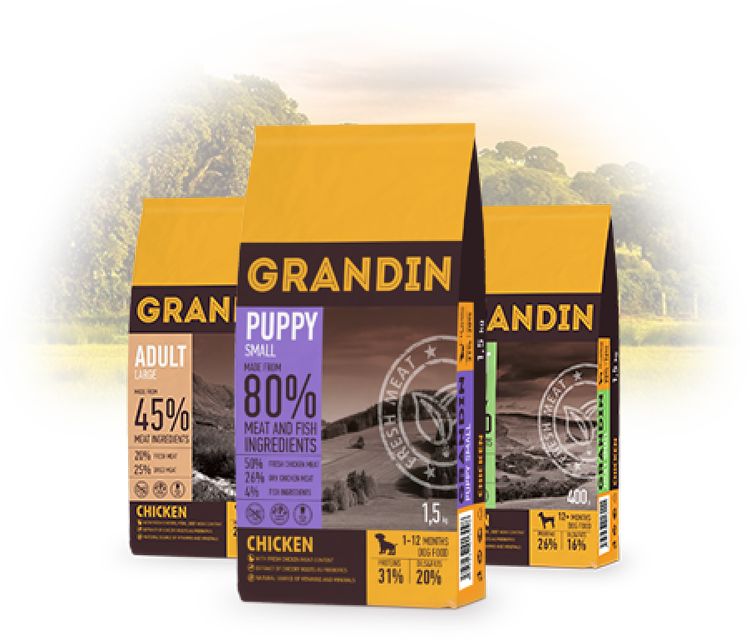
As for canned pet food, it is produced by the Landguth plant in Germany. Both facilities are modern and hold numerous certificates confirming the high quality of their products.
As far as we understand, Grandin dog food is manufactured to order at third-party factories, and the brand owner doesn't own the production itself, but merely provides the recipe. This is a common practice, and even many well-known brands of dog food outsource their production, so to speak.
According to information on the official Grandin dog food website, all recipes are developed with the participation of breeders and veterinarians, and only exceptionally high-quality ingredients are used. The manufacturer also states that it owns its own kennel, allowing it to monitor how its brand's food helps puppies and adult dogs grow and develop.
Assortment of feed
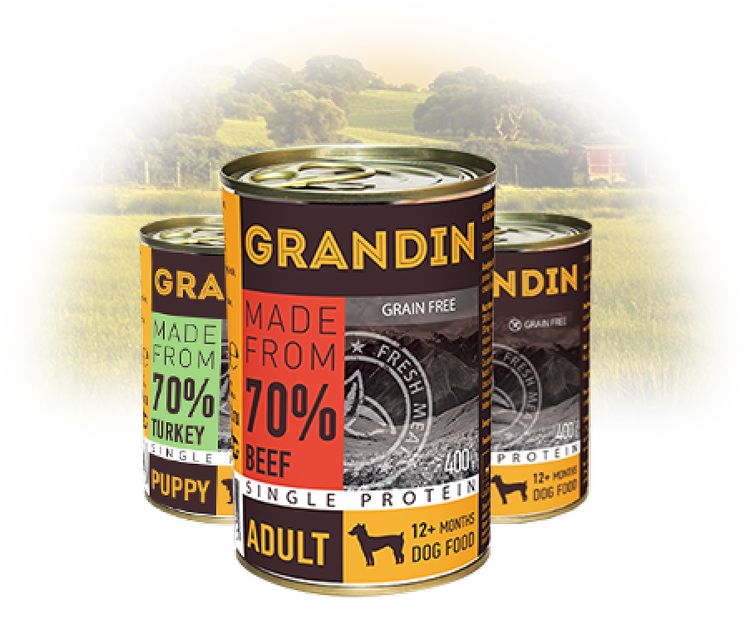
The Grandin brand's range of pet food includes 11 different types: 7 dry foods and 4 canned foods. The canned foods are available in the following flavors:
- For adults - with chicken, lamb and beef.
- For puppies - with turkey.
All canned goods are available in two packaging types: tin cans with a ring for opening without a knife, 200 and 400 grams.
There are more dry foods:
- For puppies of small breeds - with chicken;
- For adult dogs of small breeds – with lamb;
- Diet for small dogs based on chicken meat (55% meat);
- Wheat-free food with 70% chicken content - also for small breeds;
All these foods are sold in two packaging options: 400g and 1.5kg bags.
The dry food line also includes food for medium and large breed dogs:
- For large breed puppies – chicken-based;
- For adult individuals of large breeds - also with chicken;
- For adult dogs of all breeds – containing lamb meat.
That's the entire list of Grandin dog foods available to breeders. Frankly, there's not much to choose from: there are no veterinary lines, no breed-specific food, or special nutrition for dogs with special dietary needs.
Let's find out what these diets are made of. For our analysis, we chose the most universal type of diet with fairly good reviews – for adult dogs of medium and large breeds, based on lamb.
Analysis of the composition of Grandin feed
According to information available to the consumer, this food consists of the following components:
- Lamb (15% fresh meat + 5% dried);
- Poultry meat (19.5% dried chicken);
- 3% lamb liver (hydrolyzed);
- Whole grain rice;
- Ground rice;
- Poultry fat.
These ingredients, listed first, make up the bulk of the feed (based on previous feed analysis). The remaining ingredients are substances present in small amounts in the feed, providing only indirect benefits and not significantly affecting the nutrient content.
Next on the list are dried beet pulp, dried apple pomace, salmon oil, and brewer's yeast. The list of nutrients ends with sodium dihydrogen phosphate, chicory root (0.01%), and yucca (0.005%). That's all there is to it.
In our opinion, this food has a rather modest composition, typical of premium foods and some super-premium brands. However, reviews of Grandin dry dog food claim that it is indeed super-premium. We'll draw a conclusion on this later, when we examine each ingredient in detail.
It would also be useful to know the guaranteed content of substances:
- Proteins: 24%;
- Oils and fats: 14%;
- Fiber: 2.3%;
- Ash content: 7.9%;
- Calcium: 1.5%;
- Phosphorus: 1%.
All indicators look good and are quite sufficient to meet the needs of an apartment dog. However, if the dog leads an active lifestyle and gets significant exercise, its diet should include more protein to provide energy.
Squirrels
The feed contains lamb and chicken as protein sources. The lamb content is 15% fresh + 5% dried. This seems like a good balance, but it's important to remember that during production, the water content of fresh meat is removed, leaving, at best, a third (about 5%) of the fresh meat.
19.5% dried chicken is a very good value. It's a high-quality source of protein that's almost completely digestible by dogs.
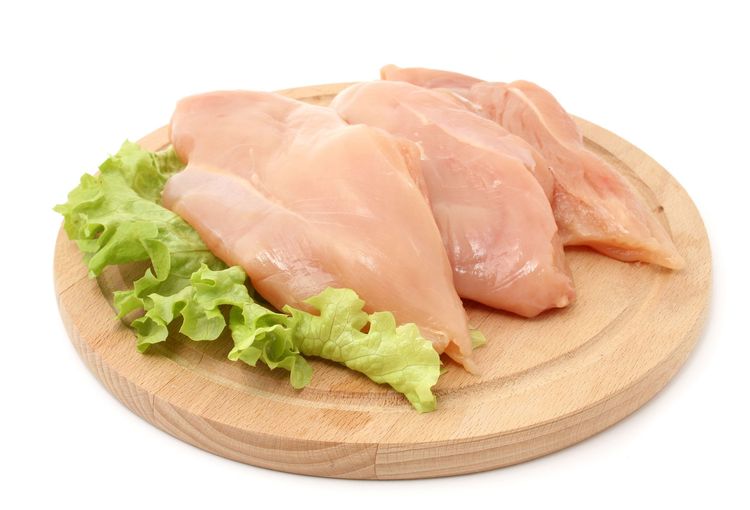
Lamb liver is also listed as containing 3%. Liver also contains animal protein, but due to its small amount, it is most likely added as a natural flavoring to improve the feed's palatability.
Fats
Poultry fat and salmon oil are indicated as lipid components.
Poultry fat is a product obtained after processing the carcasses of any type of poultry. It contains approximately 90% fatty acids and is attractive to animals due to its aroma. However, this component is not of particularly high quality—its source material and its degree of purity are unknown.
Salmon oil is a good source of polyunsaturated fatty acids. However, the method of extraction is important—melting it at high temperatures virtually destroys the beneficial properties of this component. Furthermore, it's worth noting that the oil is listed below the middle of the ingredients, meaning its content is low.
Carbohydrates
The carbohydrate content is not listed, but it's safe to say it's quite high. Whole and cracked rice are essentially the same product: they contain a high amount of carbohydrates, which are practically indigestible by dogs. This means that rice in dog food serves as a filler and is added to reduce the cost of the product.
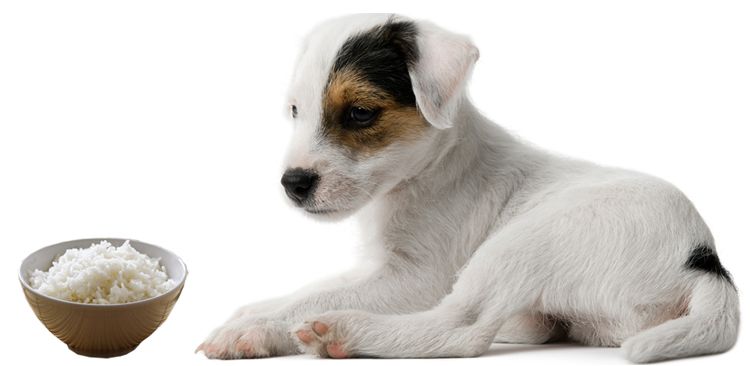
Reviews of Grandin dog food often claim it's grain-free. This isn't entirely true. While it's true that there's no wheat, it's successfully substituted with rice.
Additional components
Beetroot and apple pulp are sources of fiber but have no other beneficial properties. Apple pulp may contain vitamins, provided it is dried without high temperatures.
Brewer's yeast is a nutrient beneficial for skin and coat. It also aids digestion, helping prevent intestinal dysbiosis. It also contains beneficial protein (up to 50% of the total protein content), which is very easily digestible.
Chicory root is a beneficial supplement containing inulin. However, its 0.01% content negates any benefits—a kilogram of feed contains 0.1 grams of the supplement.
The same goes for yucca—this plant, when added to feed, offers a number of beneficial properties. However, the yucca content is also negligible—1 kg of prepared feed contains 0.05 grams of the plant. Comments, as they say, are unnecessary.
I'd like to mention sodium dihydrogen phosphate separately. It's a food additive that helps preserve the color of the food. Apparently, without this chemical, the food doesn't look appealing enough.
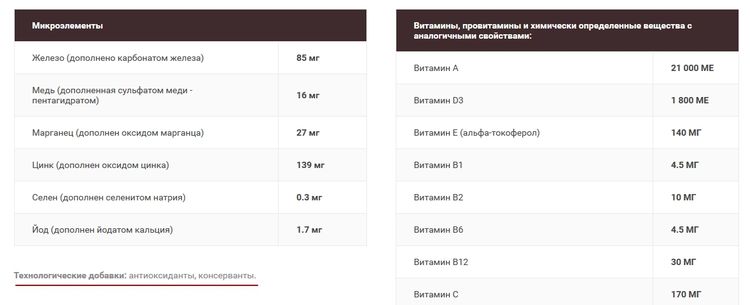
And another very important point. The ingredients don't list the preservative content, but the manufacturer's website does list the antioxidant and preservative content in small print. We consider this a blatant disrespect for our customers: they say, "We're not hiding it, preservatives exist, and we're reporting it." But we do it in a way that no one notices. This is a huge disadvantage for any food.
That's what Grandin food is like. After analyzing the ingredients and taking all the nuances into account, we're inclined to classify this food as premium, as it still has a long way to go to reach super-premium status. Unfortunately, that's the way it is.
Grandin dog food reviews
You can find quite a few opinions about Grandin online. People generally like this food because of its meat and meat-based ingredients. However, many complain about its low availability and accessibility. Here are some of the most positive reviews:
Andrey, the beagle's owner:
"I was feeding my dog Royal, but I wanted to cut down on food costs. On the advice of some dog-owning friends, I tried Grandin—the ingredients were appealing, and the price was reasonable. As for the food, he eats it happily, and hasn't had any significant digestive or health issues. For now, we're sticking with Grandin!"
Svetlana, Yorkshire Terrier breeder:
"My little Beads had a hard time choosing a food—one gave them diarrhea, another made their fur dull. The vet recommended trying Grandin wheat-free small breed food—we're happy with it. The price is reasonable, the ingredients are good, and so far so good."
Alina, owner of a Pekingese:
"I bought Grandin on a whim and gave it to my dog. He started having diarrhea, so I rushed to return him to his old food. Later, the doctor said it was likely an intolerance to something specific about Baksik. We're not experimenting anymore for now."
As you can see, the reviews are mostly positive. The low price and easy palatability make this food a worthy competitor to cheaper budget foods. However, in our opinion, if you can afford it, it's still worth buying a higher-quality food for your dog.
Veterinarians have similar opinions about Grandin—we didn't find any glowing reviews, but there were no outright negative ones either. It's a solid, premium-grade product, no more, no less.
Price of Grandin dog food
As for the cost of food, having studied online displays, we came up with the following average prices:
A 0.4 kg package of dry food, depending on the flavor, costs approximately 220 to 320 rubles;
- 1.5 kg – from 545 to 780 rubles;
- 3 kg – from 1050 to 1200 rubles;
- 12 kg – from 4000 to 4300 rubles.
Canned food, regardless of flavor, costs 120 rubles for a 200-gram jar, and about 160 rubles for a 400-gram jar.
This food isn't the most expensive, and almost any loving dog owner can afford it. We wish your pets good health, and we hope this article helped you choose the right food for your furry friend!
Read also:



1 comment
Dory
I was feeding my dog Brit, and on the advice of the salespeople at the 4 Paws store, I switched to Grandin. After two months of feeding her, she started having bloody diarrhea and vomiting. We switched her back to Brit, and everything went back to normal! The food didn't work for us; she's a Jack Russell.
Add a comment