
Royal Canin dog food
This article will discuss Royal Canin dog food, a familiar brand to almost every pet owner. Over its 20-year presence on the Russian pet market, Royal Canin dog food has received numerous reviews from both dog owners and veterinarians. Today, we'll explore just how good this food is—we'll examine all its pros and cons, from its ingredients, product range, and pricing to reviews from actual customers.
Almost half a century has passed since the first Royal Canin dog food was created. Since then, the French company has grown rapidly and was acquired by the global giant Mars Inc. in 2002. Currently, Royal Canin products are manufactured at 12 factories located in France, the United States, Canada, China, Poland, and other countries. Since 2004, Royal Canin food has been produced in Russia, and many negative reviews use this fact as a primary reason.
The manufacturer claims that all its factories are equipped with the latest equipment, and that identical ingredients and production processes are used, regardless of the country of origin. All raw materials are tested for toxins and compliance with quality standards, and the finished product is also tested. Despite this, reviews of Royal Canin pet food among dog owners are mixed. So, let's take a closer look at this brand and discover what lies behind the attractive packaging of one of the most well-known pet food brands in our country.
Content
Assortment
Royal Canin dry dog food alone offers over a hundred different menu items. Reviews of most of them can be found on every dog feeding forum. To simplify the process of choosing a menu for your pet, they are divided into several main lines.
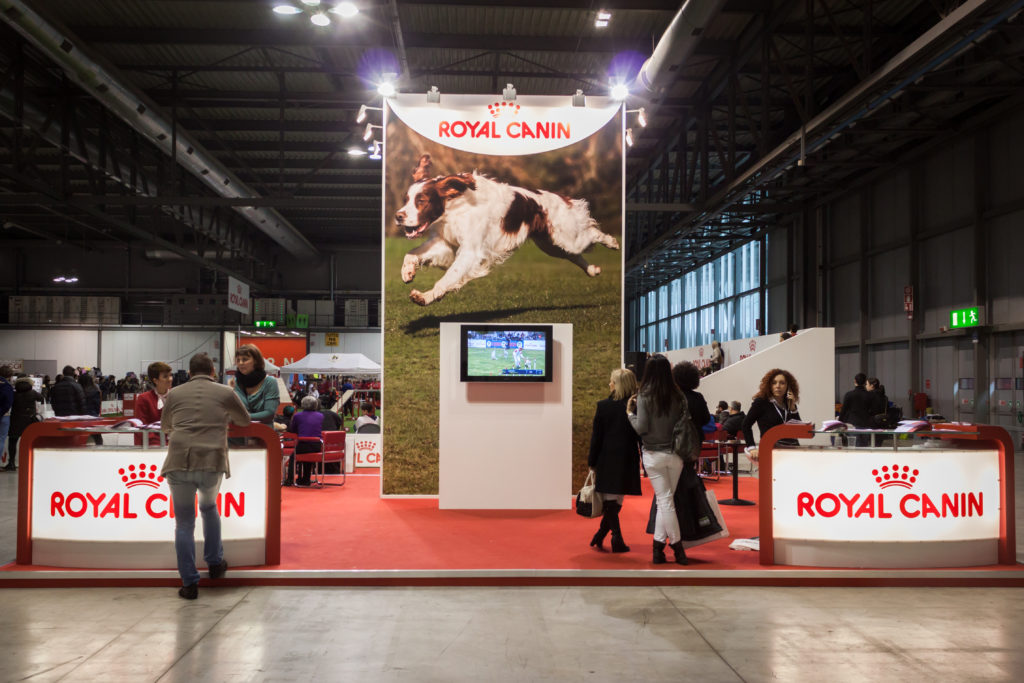
Veterinary Diets These can be classified as a separate category, intended to support the health of pets during treatment, as adjunctive therapy, during recovery, or as daily diets for various chronic ailments. Among other things, these diets are for dogs with kidney and heart failure, diabetes, liver disease, and gastrointestinal diseases. Royal Canin therapeutic dog food has received numerous positive reviews from veterinarians and is recommended for use only as prescribed by a veterinarian.
Breed Health Nutrition They offer specialized diets for over 20 different breeds of puppies and adult dogs. You can find food for everything from a giant Rottweiler to a miniature Chihuahua.
Lifestyle Health Nutrition — a series of recipes developed specifically for your pet's environment and lifestyle. For example, for a pet with intense and regular exercise, there's the Endurance diet, while for those who spend most of their time indoors, there's the Indoor diet.
Size Health Nutrition line is the main and largest segment of Royal Canin dog food, and, judging by customer reviews, also the most popular. It is divided into five subcategories based on dog size. Each subcategory offers a menu appropriate for the pet's age, as well as options for animals with special needs, such as Dermacomfort for sensitive skin or Digestive Care for digestive issues.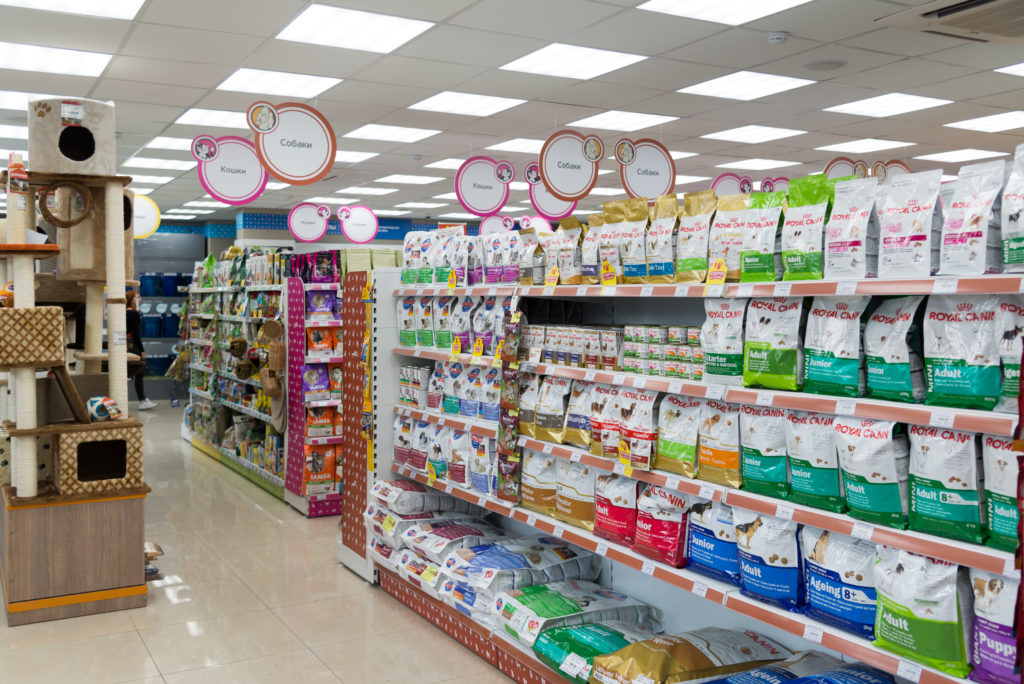
Every Royal Canin line of diets includes wet dog food. It particularly represents a significant portion of the veterinary diet portfolio. Seven types of canned and wet food are available for daily feeding, and rave reviews are primarily from those who prefer mixed feeding or have fussy pets.
Analysis and evaluation of feed composition
The company's website claims that Royal Canin dog food is super-premium. Numerous reviews on various websites claim otherwise. We won't jump to conclusions until we analyze the ingredients. For this purpose, we used food from the leading line for dogs over one year old, medium-sized (Medium Adult).
Guaranteed nutritional values of the diet:
| Squirrels | 25% | within normal limits; |
| Fats | 14% | average indicator; |
| Fiber | 1.2% | below acceptable; |
| Humidity | 9.5% | norm; |
| Ash | 5.9% | below average. |
The ingredients in Royal Canin dog food have raised concerns about its very low fiber content. Fiber plays an important role in maintaining digestive health, and such levels are typical of low-quality foods. This issue cannot be ignored—we consider it a drawback of this product. Let's look at the ingredients listed in descending order of their quantity:
-
-
- Dehydrated animal protein (poultry);
- Corn flour;
- Corn;
- Wheat flour;
- Animal fats.
-
These are the main components of the diet, followed by dehydrated pork proteins and wheat. Animal protein hydrolysate ranks eighth, with beet pulp and fish oil in ninth and tenth. However, their contribution to the overall composition of Royal Canin food is insignificant, as their content in the overall formula is very low.
In addition, the percentage content of the components is not indicated, which calls into question the balance of such a diet.
Squirrels
The first ingredient listed is a source of animal protein, but its origin is difficult to determine, as the vague designation "poultry" may conceal low-quality raw materials. Therefore, this component is questionable, as is the listed hydrolysate "of animal origin." The second protein source after fat is dehydrated animal proteins (pork), which are highly concentrated proteins in the form of flour.
It's also worth noting that ingredients #2 and #3—corn flour and corn—are essentially the same product: corn. The manufacturer intentionally separates them into different ingredients to list the meat product higher than the grain product. The same can be said for wheat flour and wheat, which are listed separately.
Based on this, we can safely assume that the composition of Royal Canin dry dog food is based on grain components, and there is an insufficient amount of meat ingredients in it.
Fats
The primary fat source is labeled as "animal." This makes it impossible to determine its origin, and this label often conceals ingredients of questionable quality. An undesirable component in food.
Fish oil and soybean oil are listed last on the nutrient list. Fish oil is very beneficial and essential for animals, which cannot be said about soybean oil, which is much less digestible. However, their percentages in this formula are too small and practically irrelevant.
Carbohydrates
Royal Canin dog food, whose ingredients we analyzed, contains approximately 44% carbohydrates. These carbohydrates come from corn and wheat—cheap grains that are virtually indigestible by animals. Not only will they not provide any nutritional benefit to your pet, but in some cases, they can even have adverse effects. According to veterinarians and dog owner experience, wheat is the most common cause of allergic reactions in pets. This controversial ingredient is not recommended by us.
It's worth noting that the composition of Royal Canin puppy food (from the same series) is almost identical to this formula. Surprisingly, it also contains rice, even though growing dogs obviously need more meat than grains.
Additional components
In addition to the above ingredients, Royal Canin dry dog food contains beet pulp, yeast, mineral supplements and MOS (prebiotics).
It's a common belief that beet pulp's benefits as a source of fiber make it an important and necessary ingredient. On the other hand, it's considered a cheap filler, and higher-quality products are available as a source of fiber. Yeast is also a controversial ingredient; it's rich in vitamins B, A, E, and D and improves metabolism. However, it can trigger allergic reactions in some pets.
It's worth noting that Royal Canin dry dog food has a modest composition and doesn't boast any fruits, vegetables, or medicinal herbs or berries. However, it provides all the nutrients, vitamins, and minerals a dog needs.
Pros and cons
The advantages of these feeds include:
- A wide selection of recipes, functional lines;
- Availability of wet rations;
- Mineral and vitamin supplements included.
Flaws:
- Ingredients of plant origin predominate;
- The presence of components that are potential allergens for dogs;
- Ingredients of dubious origin;
- Low fiber content.
To summarize, it can be stated that Royal Canin dog food cannot be classified as super-premium. This brand's recipes are predominantly plant-based and contain few sources of animal protein—meat and meat-based ingredients. In our opinion, Royal Canin dog food is significantly inferior to many super-premium products and is nothing more than a hyped-up brand. Its characteristics correspond to premium nutrition and, moreover, cannot be considered a balanced and complete pet food.
In conclusion, we would like to answer the question that owners often ask in reviews: “Which food is better, Royal Canin or Hills"In our opinion, this dilemma can only be resolved based on the individual pet's well-being. The individual needs of different dogs vary so much that there is essentially no single correct answer in this situation.
The key to solving the problem (which diet is better) may be a simple piece of advice: take Royal Canin dry dog food and compare its composition with another food you have chosen.
Royal Canin dog food reviews
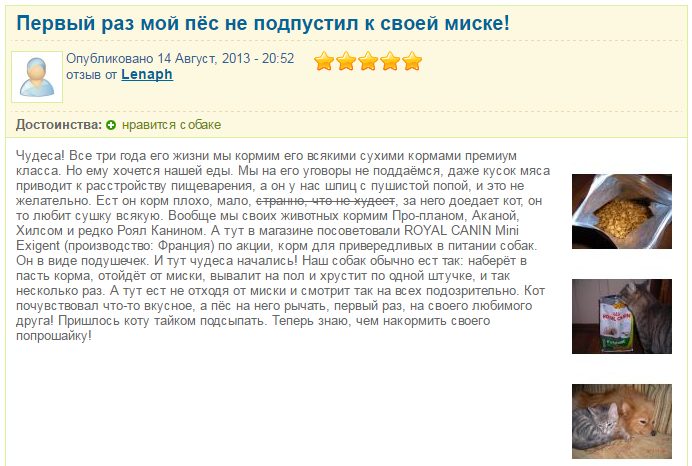
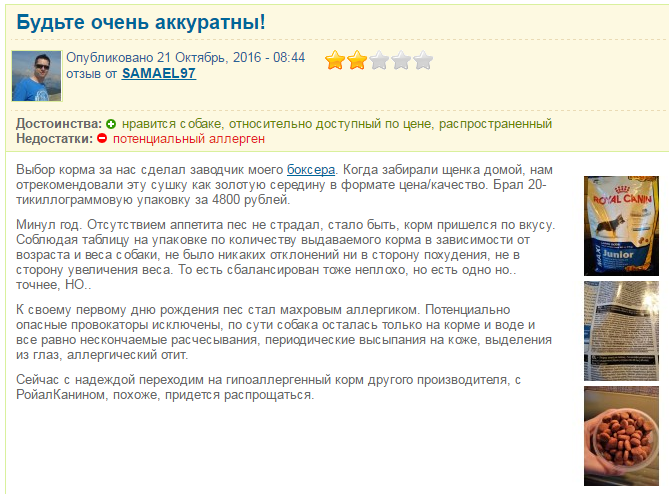
Armed with the opinions of experienced people, it becomes easier to decide on dry food for your pet. There are many reviews of Royal Canin food online, both positive and negative. After reviewing them, we decided to highlight the following:
Katerina, 7-year-old dachshund:
"I've been buying this food for several years, and I've never had a single complaint. Our Monika eats it with relish, and I was especially pleased that she was in excellent condition and not overweight. Then I read reviews about how bad Royal Canin was for dogs, that it had spoiled, and I started to have doubts, but I decided not to change the food for now—it's kind of stressful for a dog. However, something went wrong when I bought a new bag of food, and it made her vomit. Now I'm giving her the therapeutic Gastro Intestinal, and we'll see what happens."
Zhenya, German Shepherd:
"We ate Maxi food, first for puppies (on the breeder's recommendation), then switched to adult food. Sometimes I switch to Pro Plan. I can't say which is better, Royal or Pro Plan; my dog eats both well. It's clear that Royal isn't the highest quality food, but overall, I'm happy with the price-quality ratio, especially since my dog looks great, healthy, and energetic."
Reviews from veterinarians
Experts generally describe Royal Canin diets as premium nutrition and recommend them as a replacement for budget brands such as Chappie, Darling, and Pedigree. Veterinarians emphasize that the wheat content and low fiber content may cause health problems in dog breeds prone to allergies or with sensitive digestion.
Royal Canin dog food prices
To understand the cost of Royal Canin dog food, we used the average prices of the most popular online stores. Royal Canin Medium Adult dog food:
- 4 kg – 1450 rub.;
- 15 kg – 4730 rub.;
For Yorkshire Terrier:
- 0.5 kg – 285 RUR;
- 1.5 kg — 830 RUR;
- 3 kg – 1250 rub.;
- 7.5 kg – 2900 RUR
Therapeutic diets will cost the owner significantly more; for example, the average cost of Royal Canin food for dogs with food allergies or intolerances (Hypoallergenic) is as follows:
- 2 kg – 1150 rub.;
- 7 kg – 3400 rub.;
- 14 kg – 6100 RUR
Looking at the price of Royal Canin dog food compared to other super-premium formulas, it's slightly cheaper than most. However, this brand doesn't have a high enough composition to compete with them. This suggests that this price level is largely due to the company's marketing strategy.
Read also:




4 comments
Marina
We have a cocker spaniel, which hasn't been the most popular breed lately. But that doesn't make us love him any less, because we got him for the love of it, not for the pretty picture. We feed him exclusively Royal Canin for cocker spaniels over 12 months old. We weren't on this food right away, which is probably why we had some health issues. But since we started eating this food, everything has returned to normal. He's active and feels well. He has no digestion issues, and therefore no toileting issues.
Vadim
My dog is already 10 years old. For the last two years, I've been successfully feeding him Royal Canin, a premium food. It not only makes my dog look great, but also makes him feel great. The price reflects the quality. I recommend this brand to everyone.
Zhenya
Royal Canin's reasonable price is primarily due to the lack of ubiquitous advertising! This is why people love it—it's a great value for money! Otherwise, I don't know how knowledgeable the author of this article is, but I personally have no complaints about the ingredients. My cat eats Royal Canin for British Shorthairs perfectly, as it contains poultry, meat by-products, and a wealth of vitamins and minerals. Incidentally, he passed it down to us from the breeder.
Elena
I disagree about Royal Canin. We tried more expensive brands, but our cat absolutely refused to eat them. He went hungry for two days, no matter how much I tried to persuade him. But he immediately pounced on this food. And the fact that it's a little cheaper is a big plus for us, the buyers. As long as our pet is healthy.
Add a comment