
Korat (cat)
Korat cat captivated everyone with its amazing beauty and grace. The origin of blue cats dates back to the ancient "Cat Book of Verses" (1350-1767). It is here that one can find the first mentions of the inhabitants of the high-altitude Korat plateau, which is located on the northeastern border of Thailand. Korats are representatives of a very rare breed of cats Even today, their numbers are considered small. We've prepared lots of photos for you, as well as a detailed description of the Korat cat breed.
Content
History of the breed's origin
Gray kittens were first exhibited at a Cat Club show in the UK in 1896 under the name Siamese (Siam, the early name for Thailand). However, the new arrival failed to generate any interest. Read also What to name gray cats on our website.
The next attempt to popularize the breed occurred in the 1950s. A pair of Korats were brought to America in 1959, serving as breeding stock and propagation material. The Korat was recognized as a distinct breed by virtually all feline organizations until 1965. The cats arrived in England from the United States in 1972. This time, they were viewed differently, with interest and respect. In 1982, the breed was officially recognized by FIFE, and representatives, albeit in small numbers, began to spread around the world.
The largest population is found in the United States, where strict pedigree requirements apply for this breed. Besides America, they are bred in Australia, Britain, Canada, New Zealand, and South Africa. Show cats must have documentary evidence that their direct ancestors came from Thailand. In their homeland, Korat cats are considered sacred and cannot be bartered or sold.
They are respectfully called "si-souvat", which means "the one who brings happiness" The Korat cat can only be given as a gift!
If such a cat is given to newlyweds as a wedding gift, their family will always be filled with love, happiness, and prosperity. Korat cats have always been an integral part of secular and religious ceremonies in Thailand. To this day, they are considered a national treasure. Unfortunately, even in their homeland, their numbers are very limited, and their export is restricted by law.
Video review of the Korat cat breed:
Breed description and standards
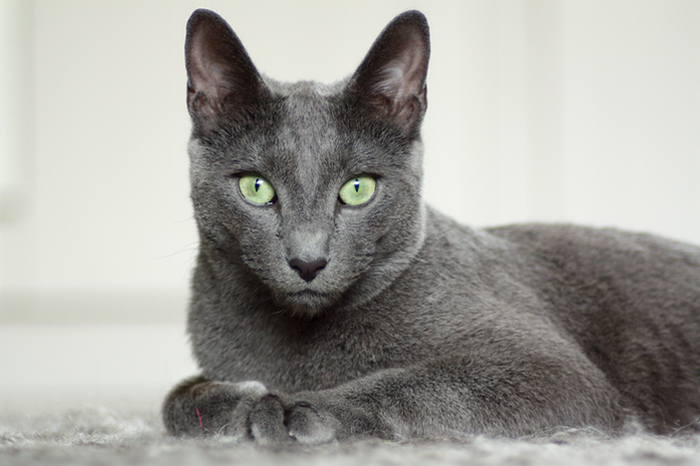
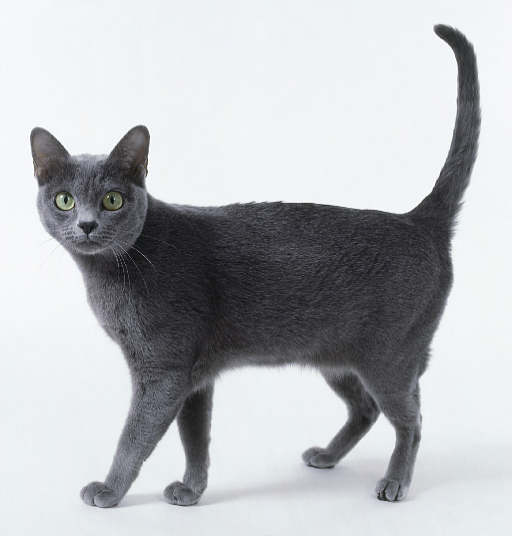
Korat cats are distinguished by their graceful, sturdy bodies, without being overly massive. Their lines are smooth and elegant, and their large, round green eyes give them an alert and expressive appearance. These cats, both in appearance and in life, are always ready for action. When picked up, they feel noticeably heavier than expected.
Head and muzzle
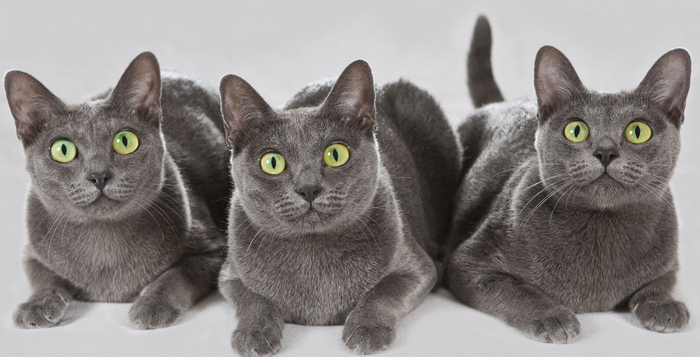
Viewed from the front and from above, the head resembles a heart, with a prominent brow ridge and soft lines on both sides of the muzzle, down to the chin. The pinch is slightly defined. The Korat's nose is "leonine," with a slight convexity in front of the noselobe. The cheeks and chin are well developed. Korats are characterized by large, high-set ears, rounded at the top and wide at the base. The outer part of the shell is covered with thick fur. The eyes are prominent, wide-set, and round. Only bright green or amber color is acceptable. The shade is fully developed by 2-4 years. When open, Korat cats' eyes are wide, and when closed, the eyes take on an "Asian slit."
Body
The body is medium-sized, refined and graceful, with well-developed muscles. The chest is broad, as is the space between the front legs. The back is gently arched, and the legs are proportionate to the body and are characterized by medium length and muscle. The paws are oval. The tail is thick at the base, medium in length, and tapers to a point. Minor kinks are permitted by the standard.
Coat and color
The coat is short, fine, and soft, lacking an undercoat. "Breaks" may form on the back when moving. The shiny coat lies close to the body. In appearance, the Korat somewhat resembles the Burmese Blue cat, and genetically— oriental Blue. The Korat cat's coat color is exclusively blue with a silvery tint, which results from slightly lighter tips. In literature, this color is called "solid ticked silver blue." The skin of the nose, lips, and paw pads is dark blue or lavender. Their offspring have exactly the same coloring as their parents.
Character and temperament
Korat cats have a wonderful personality, are gentle and charming, and are deeply attached to those who provide them with love and affection, often missing them deeply if they are absent for extended periods. This is a very devoted cat breed, capable of showering people with love and affection.
Korats are inquisitive and highly intelligent cats, they are energetic and moderately active.
Korats have a cheerful disposition; they are sociable and observant, and nothing goes unnoticed. Although Korat cats are not capricious or vocal, they have a good vocalization and always manage to communicate their needs to their owners. Owners of this breed say that their expressive faces and engaging, intelligent gazes do everything they can to clearly communicate their needs.
Maintenance and care
Korats are ideal cats for apartment living or indoor living. They are calm and clean by nature, and thanks to their lack of an undercoat, they shed virtually nothing.
Korat grooming is easy, and they're excellent at grooming themselves. Their coat is short, without an undercoat, and never mats, so brushing is only necessary once a week. Avoid bathing your pet unnecessarily. Frequent bathing can cause their hair to lose its protective coating and their skin to dry out, which can affect their appearance. Their ears should be cleaned periodically, and their eyes should be washed as needed, not on a schedule. Give your cats lots of love, sit them on your lap, and pet them—they'll be grateful.
Diet
Korat kittens are very dependent on their mother at one month of age and require only their mother's milk. Then, supplementary feeding should be gradually introduced, such as low-fat milk and cottage cheese. Feeding a cat cow's milk is not recommended, nor should it be fed low-quality commercial food.
You should begin diversifying your Korat's diet starting at 2.5-3 months of age. Their food should contain sufficient protein. Chopped raw meat, except pork, is usually used for this purpose. Pork is contraindicated for Korats even in adulthood, as it can cause stomach upset and liver and pancreatic damage. Adult cats can now be fed dry food of at least premium quality.
Health
The Korat breed is considered healthy, and currently only two hereditary diseases are recognized: atelosteogenesis imperfecta (a hereditary disorder characterized by incomplete, abnormal bone formation) types I and II. Unfortunately, both types are fatal for cats. Their manifestations are determined by a genetic mutation.
However, fatal outcomes in cats with the disease are only observed if they inherit the defective genes from both parents. If the genes are inherited from only one parent, the cat will only be a carrier of the defective genes and will be safe. Korat cats require all veterinary preventative care, just as other breeds do. They need scheduled vaccinations and regular treatment for external and internal parasites. Ensure the quality of their food and the purity of their drinking water. With proper care and upkeep, a Korat cat will delight its owner with its health and excellent spirits for a long time.
Average life expectancy is 13-14 years.
How to choose a kitten
When choosing a Korat kitten, you should start by defining the purpose of acquiring it. This is a rare breed, and Korats are mostly purchased for breeding or show purposes. Buying a pet "for yourself" is expensive, but such cases do occur.
If the purpose of purchasing a Korat is to participate in shows or breed, the first thing to look for is the kitten's papers. Research the Korat's pedigree, be sure to meet the kitten's parents, and at least look at photos of the parents' Korats. A kitten without papers is automatically considered unsuitable for such purposes by experts, although it will cost significantly less.
If you want your Korat kitten to win prizes in the future, study its pedigree. If your pet's family includes show winners, the cat's chances of winning in the future automatically increase.
Once you've verified that the documentation is in order, examine the kitten itself. Pay attention to the following details:
- Belly. A kitten's belly shouldn't feel like a ball. Bloating is the first sign of possible gastritis or other gastrointestinal problems.
- Mouth. The ideal color for a kitten's mouth is pink. A Korat kitten's mouth should also be odor-free. Any color deviation or unpleasant odor indicates a health problem.
- Anus. The area under the tail should be clean and dry. Tangled fur around the anus indicates that the baby is suffering. diarrhea.
- Body condition. The kitten's skin should be completely covered with fur, with no bald spots. Feel the kitten; any lumps or swelling are a warning sign.
- General condition. It's best not to buy a lethargic kitten. However, there's a caveat. If you see that the kitten is generally healthy and suitable for you, but is acting lethargic, wait a bit. The kitten may have recently woken up or had a large meal, and lethargy after eating and sleeping is normal.
Don't forget about the Korat's personality. You can immediately notice a Korat's personality by observing how the puppy behaves. Choose a moderately active pet, not too lethargic, but not hyperactive either.
The first mating of a Korat cat
A Korat cat can only be bred once it reaches 10 months of age, not earlier. Before the first mating, the cat should have had several heat cycles—two or three. It's not recommended to wait more than three heat cycles, and if the cat is in heat frequently, it's best to breed her a little earlier than usual.
Prepare the animal for mating:
- carry out deworming;
- undergo a medical examination;
- Vaccinate your animal against infections.
Korats are very prolific, with an average litter of 4-5 kittens, but sometimes a female cat can give birth to up to 9 kittens. All kittens are born with gray fur and yellow or pale green eyes, which become brighter with age.
Korat cattery
In Russia and the CIS countries, there are only a few cats of this breed and only a couple of catteries breeding them, one of which is registered with the Felidae club.
If you're drawn to the exotic appeal of these cats, you might want to explore other Thai cat breeders. And if you like the Korat's unique coloring, consider the similar Russian Blue.
Korat cat: kitten price
Since you can only buy a Korat kitten abroad or, if you're lucky, from a rare breeder who transports Korats, it's important to understand that the price of a Korat cat is inherently high. The price can vary depending on factors such as:
- Class;
- pedigree;
- delivery location, etc.
If you're lucky, you might be able to buy a purebred kitten for a very reasonable price. However, you'll need to have it spayed or neutered to prevent future breeding. An older Korat is also affordable, if that's an option for you. In any case, breeders are human beings, and you can always negotiate the price and other purchasing conditions. As an average, keep in mind that while kitten prices vary by country, they generally don't fall below $500.
Given the above, one should be wary of offers to buy a Korat kitten through online classifieds and especially at a bird market.
Photos
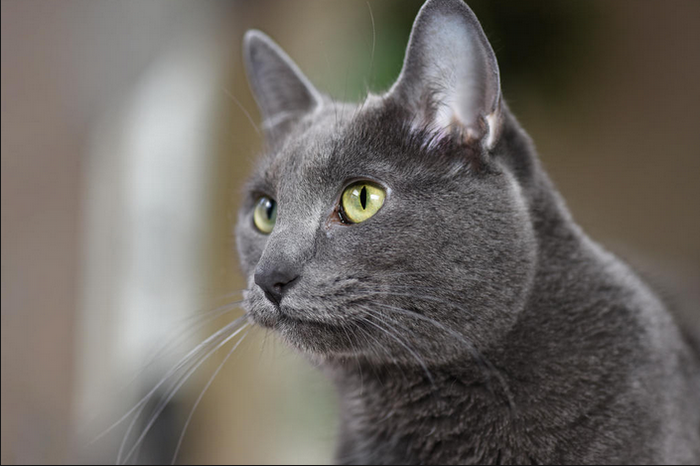
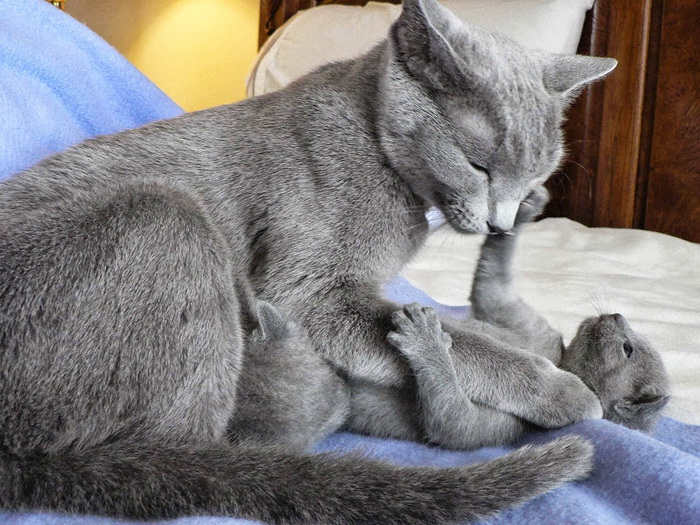
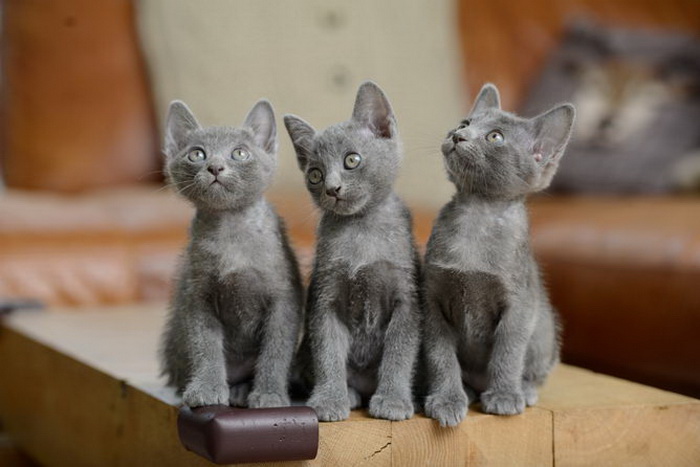
Photos of Korat cats:


Add a comment