
Coccidiosis in cats: symptoms and treatment
Continuing the topic of parasitic diseases in pets, we'll discuss coccidiosis in cats, what symptoms may indicate a coccidia infection, how the disease is diagnosed, and what treatments a veterinary clinic may offer.
Content
The causative agent of the disease
Coccidiosis is a disease caused by infection with coccidia (protozoa that parasitize various invertebrates, insects, and the gastrointestinal tract of birds and mammals, including cats, dogs, and humans).
Scientists distinguish over 400 species of single-celled parasites, grouped in the order Coccidia. Some of these parasites can be transmitted exclusively between individuals of the same species, while others are zoonotic—they can be transmitted between different species (for example, from cats to dogs or humans, and vice versa). Coccidiosis in cats is most often caused by:
- Isospora felis (parasite only in the body of cats);
- Isospora rivolta (parasite only in cats);
- Cryptosporidium parvum (can be transmitted to humans);
- Toxoplasma gondii (can be transmitted to humans).
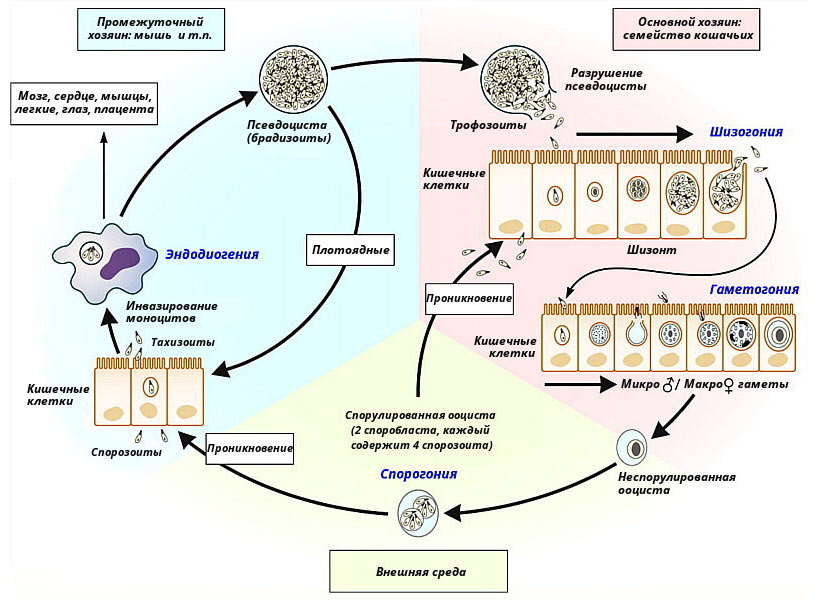
The parasite's life cycle includes three stages, the change of which most often occurs when the parasite enters the body of a new host:
- schizogony (asexual reproduction);
- gamogony (sexual reproduction process);
- sporogony (reproduction by the formation of sporozoite cells).
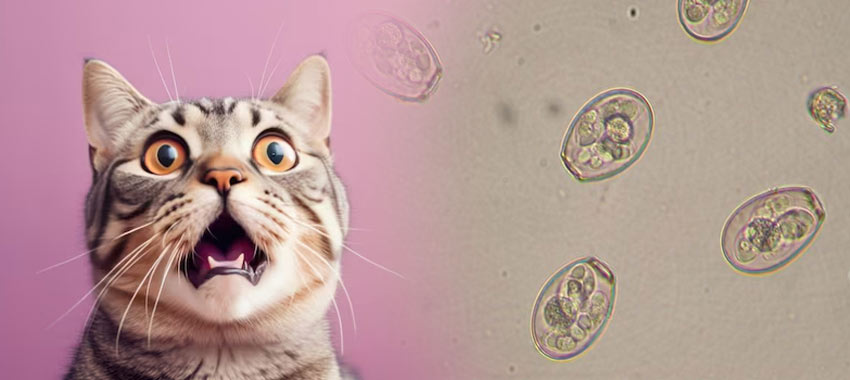
You won't find coccidia in the series of photos, because the intracellular parasite is very small, its size does not exceed 40 microns, and it can only be seen under a fairly powerful microscope.
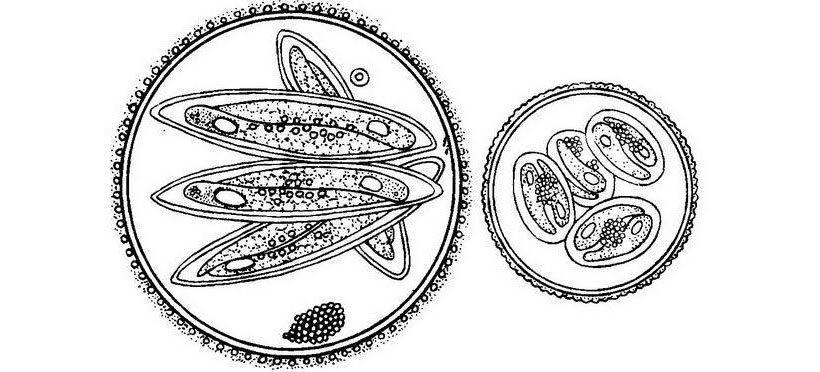
Moreover, coccidia spores are highly resistant to various external influences, high temperatures, and disinfectants, so they remain viable even after many months, causing illness if ingested by a cat or other animal. This fact makes disease control and prevention extremely difficult.
Routes of infection
In the vast majority of cases, infection with coccidia occurs through the ingestion of sporulated oocysts by animals, which can be found:
- in water;
- in raw meat;
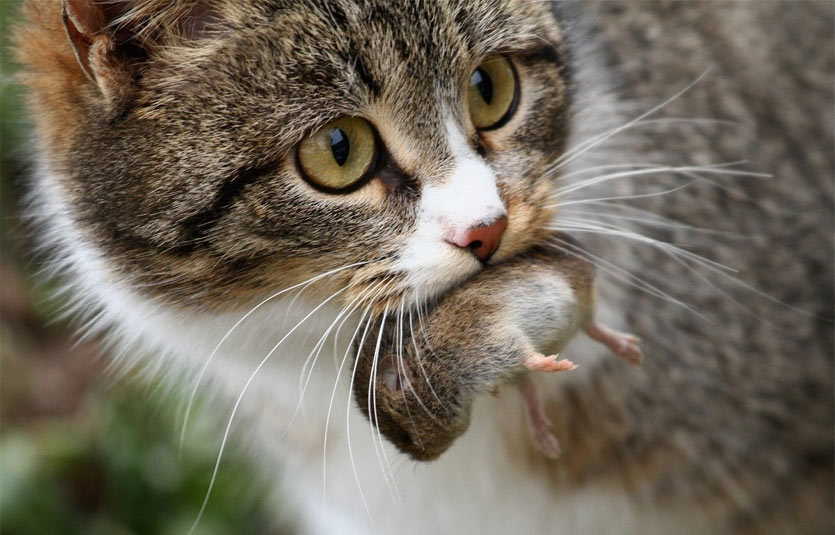
- in insects or mice;
- in the feces of infected animals;
- on the ground;
- on care items.
From one viable spore that enters a cat's body, up to 2 million coccidia can develop in a very short time.
Protozoa most often infect kittens under 6 months of age, when the animal's immune system is not yet fully developed and the parasite can easily penetrate the epithelial cells of the gastrointestinal tract. In adult cats, coccidia often do not cause clinical symptoms (signs and symptoms of infection are absent), but according to various estimates, approximately 55% of animals (cats and dogs) are latent carriers of at least one species of these dangerous parasites.
Acute disease in adult animals usually develops against the background of so-called “triggers” (provoking factors):
- weakening of the body after illness;
- helminthic invasions;
- poor nutrition;
- hypothermia;
- severe stress;
- unsanitary conditions of detention.
Symptoms of the disease
Symptoms depend largely on the type of protozoa ingested by the cat. Most coccidia penetrate the epithelial cells of the gastrointestinal tract, causing inflammation, mucosal trauma, and necrotic changes, which are subsequently complicated by secondary bacterial or viral infections. The affected areas of the intestine cannot function normally, resulting in disruption of the small intestine, impaired absorption of nutrients, and the development of severe diarrhea and dehydration.
Acute form
In its acute form, coccidiosis in cats can cause the following symptoms:
- diarrhea (with mucus and blood);
- flatulence;
- vomit;
- depressed state;
- loss of appetite and refusal to eat;
- bloating;
- enlargement of the liver and gallbladder;
- muscle tremors;
- convulsions;
- paleness of the mucous membranes.
However, the animal's temperature does not rise, which can confuse inexperienced owners and prompt them to treat their pet at home. As symptoms worsen, the body temperature will only decrease (an increase indicates a bacterial infection), but it is impossible to treat coccidiosis without identifying the pathogen.
Without timely diagnosis and proper treatment, coccidiosis can be fatal in kittens, as coccidia infect liver tissue and cause kidney failure.
Chronic form
When the disease becomes chronic, the owner may observe slightly different symptoms:
- a kitten or adult cat may appear exhausted and apathetic;
- the coat becomes dull and unkempt;
- appetite may change periodically, from eating without enthusiasm to completely refusing to eat;
- diarrhea with mucus may alternate with constipation;
- In the feces of animals fed a natural diet, particles of undigested food can often be seen.
The danger of this form is the gradually increasing intoxication of the body with parallel suppression of the animal's immune system, against which background other dangerous infectious diseases may arise.
Carriership
It is important to remember that animals carrying coccidia do not show any obvious symptoms, but are dangerous because they are a source of oocysts that can cause disease in other cats or people (depending on the type of parasite).
This is why owners are advised to have their cats tested for coccidiosis as part of their annual comprehensive examination.
Diagnostic methods
If you notice symptoms and suspect coccidiosis in cats of any age, it is important to see a veterinarian as soon as possible for diagnosis. The sooner the correct treatment is prescribed, the higher the pet's chance of recovery.
To select the right medication for coccidiosis, veterinarians conduct a comprehensive diagnosis, which includes:
- anamnesis collection;
- physical examination of the animal;
- blood test (general, biochemistry, antibody test);
- stool analysis.
Because the symptoms of the disease are similar to those of many other dangerous diseases, your veterinarian may recommend additional screenings to rule out bacterial or viral infections and to assess the condition of internal organs.
Remember that each type of protozoa has its own most effective medication, so your vet will only be able to determine how to treat a cat suspected of having coccidiosis after receiving laboratory test results.
Treatment of coccidiosis
Animals that have been confirmed to be infected with any type of coccidia based on test results are prescribed:
- drug therapy with coccidiostatics and antibiotics (if there is an associated bacterial infection);
- supportive therapy for the gastrointestinal tract and other organs affected by protozoa;
- a special diet that reduces the load on the gastrointestinal tract.
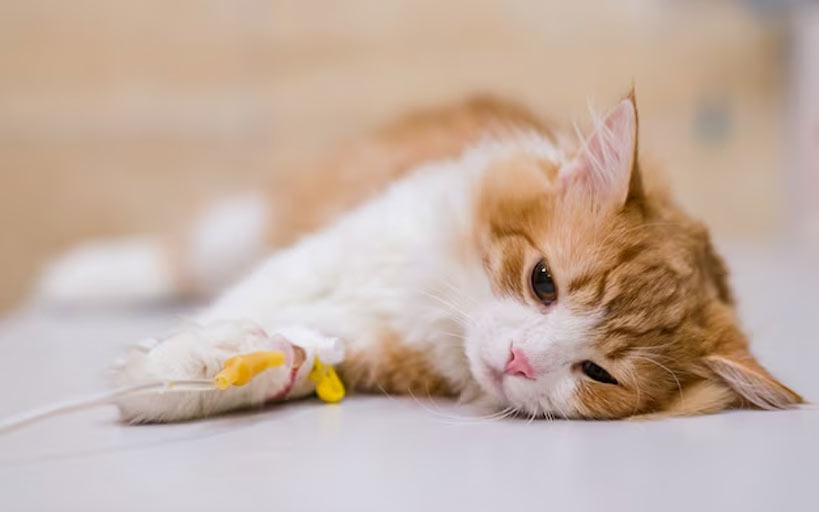
In severe cases of the disease, infusion therapy can be performed in a clinical setting.
List of the best anticoccidial drugs for animals (coccidiostats):
|
The drug |
Manufacturer |
Release form |
Volume |
Price |
|
Stop-Coccid |
Apicenna (Russia) |
suspension |
10 ml. |
526 ₽ |
|
Eymetherm |
Agrovetzashita (Russian Federation) |
2.5% solution |
100 ml. |
396 ₽ |
|
Inspector Quadro |
Ecoprom (Russian Federation) |
pills |
4 pcs. |
800-100 ₽ |
|
Procox |
Bayer (Germany) |
suspension |
7.5 ml. |
956 ₽ |
During treatment, it is also important to pay special attention to the animal's hygiene, as oocysts that come into contact with the cat's fur, grooming items, habitat, toys, and other household items can cause a relapse of the disease.
As a rule, therapy is carried out until a negative test for coccidiosis is obtained and symptoms are significantly reduced.
Unfortunately, if the mucous membrane is significantly damaged, pets that have recovered from the disease may require a special diet for a long period (sometimes for life).
Prevention
To prevent protozoan infestations, special preparations are added to the diet of broiler chickens, laying hens, turkeys, rabbits, and other farm animals.
For an indoor cat, the best prevention is:
- minimizing contact with stray animals;
- proper hygiene (timely cleaning of the litter box, cleaning of bowls and toys)
- continuous treatment against parasites;
- compliance with the vaccination and deworming schedule;
- regular periodic inspections (at least once a year).
The easiest way to kill protozoa is by exposing them to high temperatures. Oocysts die after 10 seconds of exposure to temperatures above 100°C, so it's important to take advantage of this fact when cleaning items that can be boiled, scalded, ironed, or steamed.
Veterinarian's advice
Read also:


Add a comment