
When do kittens' eyes change color?
When owners watch their kittens' eye color change, it's always interesting to predict what their permanent shade will be. Some speculate that it can be corrected with special nutrition or that it's linked to the color of their fur pigment. In reality, such assumptions have no scientific basis; future eye color is determined genetically at the moment of conception, and the process of "changing eye color" is primarily related to the development of the visual organs.
Reasons for color change
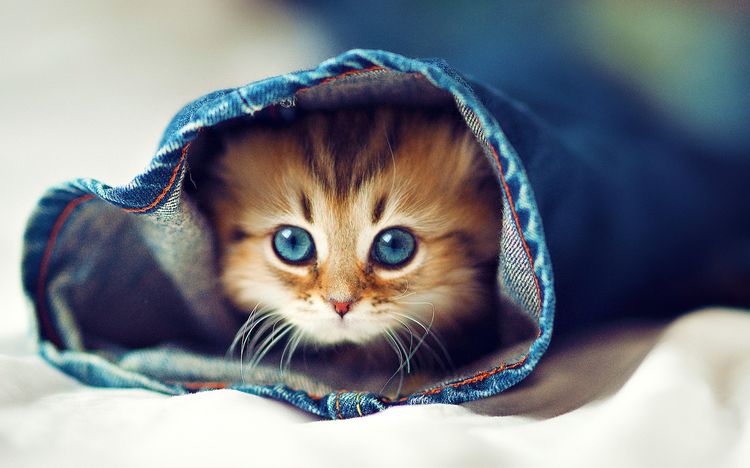
Most kittens are born with blue eyes, but that doesn't mean they'll stay that way their entire lives. The blue hue visible to the human eye isn't the true color of the iris, but rather an indicator of low levels of the pigment melanin. The lower the level, the cooler the color will be.
At birth, pigment levels in the body are at their lowest. They continue to accumulate during the first months of life as the visual organs develop, which causes the eyes to change color. This process is called coloration. Multicolored specks appear on the familiar blue iris. These specks gradually increase in size until the eyes acquire their permanent color.
When to expect changes
The process varies among breeds, with the timeframe ranging from 1 to 12 months. In mixed-breed kittens, it often begins at 1 to 1.5 months of age. In Scottish Fold and other purebred kittens, eye color The iris typically changes between 4 and 12 months. The so-called "true cat color" of the iris is fully formed towards the end of the second year of life. At 10 to 14 days, when a newborn kitten opens its eyes, they are usually covered with a cloudy film, causing them to appear cloudy. Around one month, the film disappears, causing the iris to appear brighter. Subsequently, as the kitten grows and pigment accumulates, its color changes, becoming more pronounced. Predicting the final color is quite difficult, as the color palette is very diverse: from gray to red (in albinos).
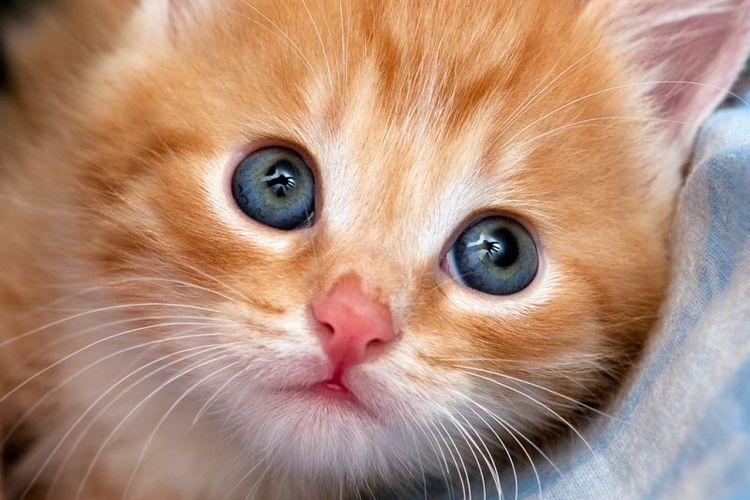
The main colors of cat eyes are:
- green;
- yellow;
- copper;
- blue.
However, blue eyes in an adult animal are essentially a sign of insufficient melanin production. Without melanin, short wavelengths of visible light (which the human eye perceives as blue) are scattered in the iris, just as they are in the atmosphere, causing the eyes to appear blue, like the sky.
According to felinologists, if a kitten is born with yellow eyes, they become brighter over time (even copper or amber), but never turn blue. However, a change from blue to yellow or even brown is entirely possible.
If you're looking to adopt a kitten with a specific eye color, it's best to bring home the pet after four months. By this time, the basic color has usually formed, and it can only become more intense and deep over time.
Breed characteristics
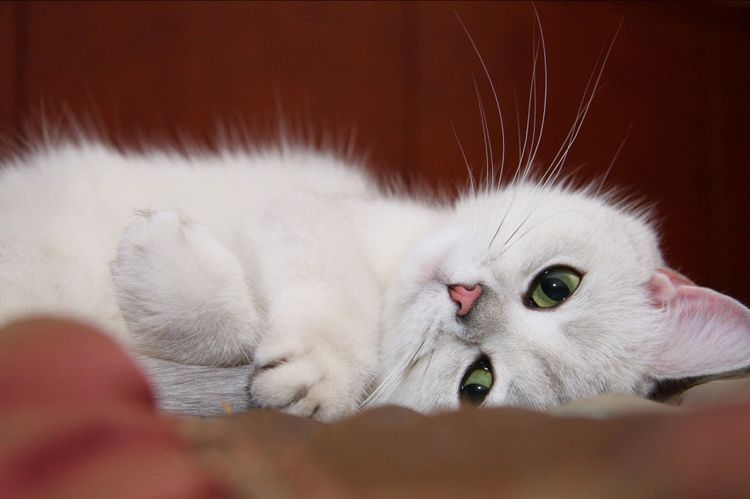
The "correct" eye color as a sign of purebred kittens was invented by humans. Through extensive selective breeding, humans were able to establish certain traits for animals of different breeds and colors:
- at Russian Blues – shades of green;
- the Scots have copper or green ones;
- at orientals - green;
- the British have bright orange and amber ones;
- Siamese, Ragdolls, Thai cats, and Balinese cats have blue eyes;
- Abyssinians have green or yellow ones;
- at Burmese cats - light gold.
But exceptions are possible in every case, as the iris can be virtually any color, regardless of breed. Another issue is that such animals are often culled by breeders in the fight for breed purity and future profits.
Read also:


Add a comment