
Keratitis in dogs
How wonderful it is to look into your dog's loving and devoted eyes. It's a shame the pleasure of such a wonderful sight can be spoiled. Yes, it's keratitis in dogs, which causes cloudy spots on the eye, and sometimes even a film that completely covers the eyeball, and can even ooze pus. What is this disease, how is it treated, and what causes it? Let's find out!
Keratitis in dogs is a rather unpleasant condition. A healthy eye is essential for normal vision. Even the slightest inflammation can impair eye function. It's not difficult to spot an eye condition in your pet. Only a veterinarian can differentiate between the two, determine the cause, and prescribe effective treatment. However, you can also notice if something is wrong with your pet's health.
Keratitis is an inflammation of the cornea. Continuing the topic of eye diseases in dogs, I'd like to explain in more detail what this condition is, how to correctly identify the symptoms of keratitis in dogs, and how to prescribe the correct treatment at home.
Content
Causes of keratitis
Let's look at the main reasons that can lead to the development of keratitis in a dog.
| Mechanical damage | A foreign object (sand or hair) can get into the eye and cause irritation to both the cornea and conjunctiva. This also includes eye injuries, scratches from fighting, or scratching. |
| Viruses |
The most common viruses that affect the cornea are herpes and adenoviruses. However, other pathogens can also cause viral keratitis in dogs. Often, this type of corneal inflammation is simply a sign of a serious underlying disease. For example, keratitis in dogs can develop as a result of distemper or infectious hepatitis. |
| Bacteria and fungi |
Viral keratitis in dogs isn't the only condition that affects the animal's eyes; bacterial and fungal keratitis can also affect them. Bacterial keratitis is not uncommon. This is because even if the animal initially had a small scratch on the cornea, pathogenic microorganisms (from the air) will inevitably take advantage of the opportunity to penetrate the cornea. Coccal infection, which causes purulent keratitis in dogs, is the most common. |
| Inversion of the eyelid or growth of eyelashes towards the cornea |
This is usually a congenital condition, although inverted eyelids can also occur in adult animals. This most often occurs because the pet had a crust or ulcer on the edge of the eyelid that healed and led to this condition. Such crusts form with ulcerative or purulent infections. blepharitis. |
Types of keratitis in dogs
Veterinary specialists distinguish several types of canine keratitis, differing in their symptoms, characteristics of occurrence, and mechanism of disease development:
- Suppurative superficial keratitis. The main cause is mechanical damage to the mucous membranes of the eye. This form of keratitis in dogs is characterized by the following symptoms:
- purulent discharge;
- profuse lacrimation;
- photophobia.
- Parenchymatous keratitis. This is a microbial disease. It often develops against the background of diseases such as toxoplasmosis, canine distemper. Symptoms include the following:
- characteristic spots and dots are visible on the surface of the cornea;
- eyes are watering a lot;
- the cornea swells.
Conjunctivitis often develops with parenchymatous keratitis.
- Punctate keratitis in dogs. This is the rarest subtype of the disease. Scientists haven't yet fully understood its exact cause. A characteristic feature of the disease is pearly, cloudy spots on the surface of the affected eye. Remarkably, the dog appears to be completely healthy, and its vision hasn't deteriorated at all.
- Phlyctenular keratitis. It is caused by toxic poisoning or allergic reactions. According to veterinary specialists, shepherds and collies are most susceptible to this condition. Symptoms of keratitis in dogs include large, grayish-white blisters. If left untreated, the blisters will eventually merge and burst. As a result, the cornea of a dog with phlyctenular keratitis becomes reddish-gray.
- Ulcerative keratitis. As the name suggests, this condition is caused by an ulcerative lesion of the cornea. Vision becomes cloudy or completely cloudy. If left untreated, open ulcers may develop on the cornea.
Symptoms of keratitis
The symptoms of keratitis in dogs are fairly simple. They include redness and then clouding of the cornea. Pus may appear on the cornea, and then ulcersHowever, the first symptoms of keratitis in dogs are profuse lacrimation, photophobia, and an inability to fully lift the eyelid (as if the eye is not fully open). Only after this does the cornea become dull and cloudy. It's as if a veil has covered the patient's eye. It even appears slightly rough. However, don't expect this to happen in a few days. Far from it. A couple of hours is enough for the cornea to become cloudy.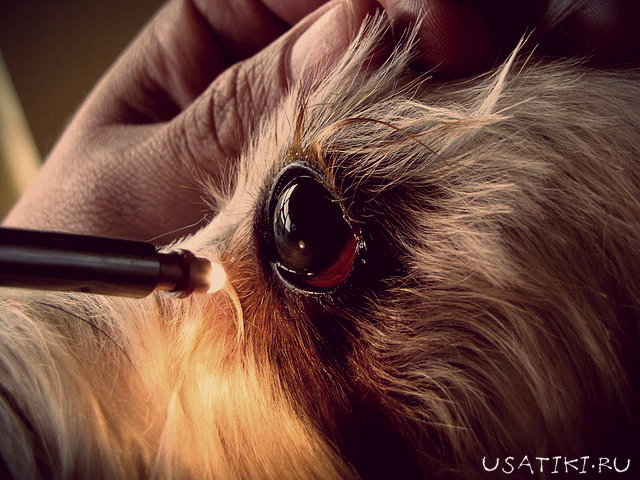
If a dog suffering from keratitis isn't treated, the condition will become increasingly severe. The clouding will become permanent, vision will be lost and never recovered, and the cornea itself will become overgrown with blood vessels. Instead of a clear, normal color, it will become gray-blue with red streaks.
If a dog has purulent keratitis, the cornea turns not just white, but a whitish-yellow color. Pus also drains from the eye. Owners may mistake it for conjunctivitis, although there's some truth to this diagnosis. Everything is interconnected, so the inflammation "jumps" from one part of the eye to another, and if a dog has purulent keratitis, it will inevitably affect the conjunctiva, iris, and sclera itself. In advanced cases, a veterinarian diagnoses panophthalmitis. The only solution is removal of the affected eye.
If you see a veterinarian promptly, the eye will become clear and shiny again. Vision will be restored. Below are photos of dogs showing symptoms of keratitis:
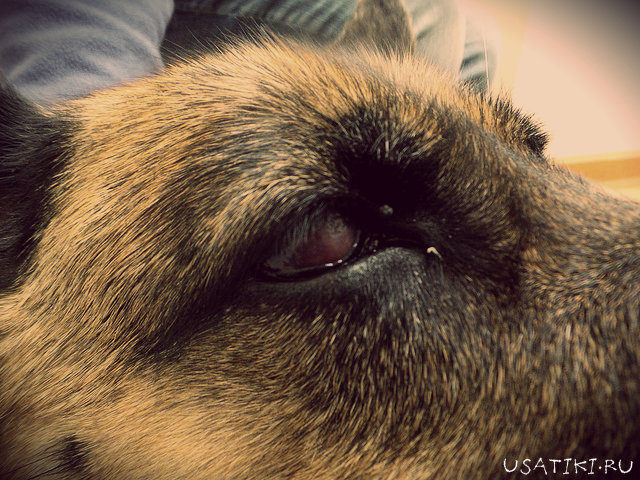
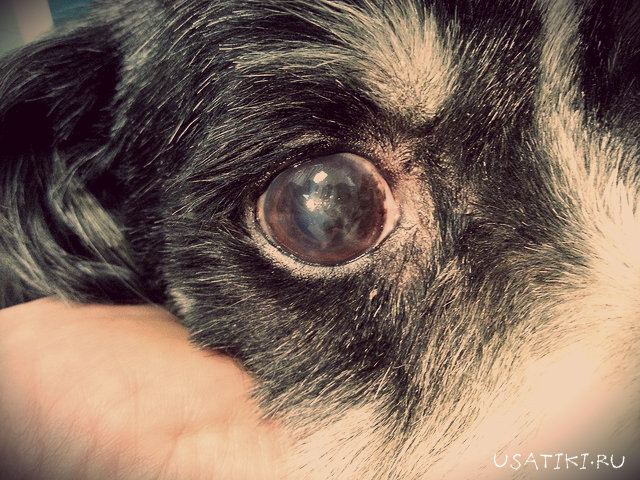
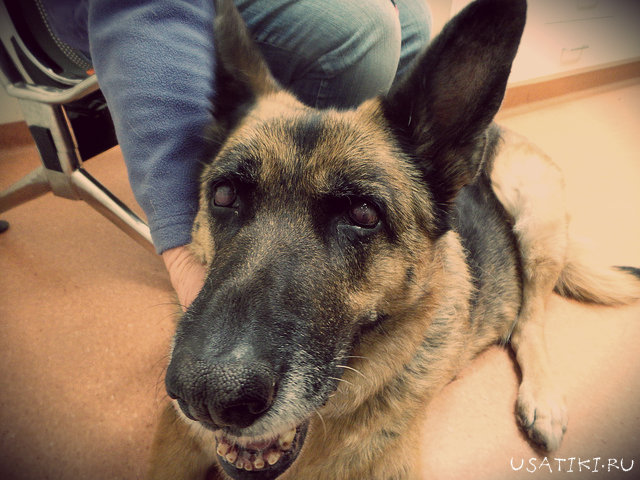
How to treat a dog's keratitis at home?
Treatment
Treatment depends on the type of condition and the factors triggering the development of keratitis in dogs. The vet first takes steps to eliminate the underlying cause of the disease; only then can positive results be expected from further treatment.
Treatment of dogs suffering from keratitis must be carried out under the supervision of a veterinarian! They must determine the exact cause before developing a treatment plan. If bacteria are the culprit, a course of antibiotics is needed. If viruses are causing keratitis, specific therapy, such as immunoglobulins, is needed. If the pet has an inverted eyelid, surgery is necessary.
For allergic keratitis, the primary goal is eliminating the trigger—the allergen. After that, the pet begins treatment with antihistamine medications. The dog is also prescribed a special hypoallergenic diet.
General recommendations for treating keratitis in dogs
-
Treatment begins with rinsing the cornea with antiseptic solutions suitable for the eyes. These include either a 1% furacilin solution or a 2% boric acid solution.
-
Then, antibiotic eye drops and novocaine blockades are necessary. You shouldn't do this yourself; only a veterinarian. This is necessary not only for pain relief but also to reduce inflammation. Hydrocortisone is often injected into the conjunctival sac.
-
If the dog has superficial keratitis, then you can use antibacterial eye ointments (tetracycline ointment will do).
-
If superficial keratitis in a dog has become complicated and the vessels have grown into the cornea, a month of complex injections will be required. First, the pet is injected subcutaneously with vitreous humor, and a placental suspension may also be used (though this is only for 5 days, not 30). However, treating a dog with keratitis is still expensive and requires a significant amount of time and veterinary visits).
-
Vitamin therapy is prescribed to treat the dog's keratitis, and a special diet is created. No salt! It's already prohibited, and adding it to a pet's food with inflammation is completely prohibited. Carbohydrates (cereals, grains) are also excluded.
If your pet is left untreated, it will develop more than just conjunctivitis. Iritis (inflammation of the iris), complicated cataracts, and glaucoma, are also common consequences of keratitis in dogs. The cornea becomes overgrown with connective tissue. It appears cataract, which will never disappear. The pet will remain permanently blind in that eye. However, the eye will be preserved. However, if keratitis in a dog (photo below) is complicated by a pyogenic infection and the animal is left untreated, panophthalmitis (inflammation of the entire eyeball) may develop.
Prevention of keratitis in dogs
Preventing keratitis in dogs isn't all that difficult. The key points are listed below:
- Vaccinate your pets, especially against herpes and adenovirus.
- Keep an eye on your whiskered friend, especially if he's a fighter. If you notice a corneal injury (or even suspect this has happened to your four-legged friend), consult a veterinarian (preferably an ophthalmologist) immediately. As mentioned above, corneal clouding can occur within a couple of hours!
- Keep away from dusty areas. Brush hair carefully to avoid getting it under the eyelid and causing irritation to the conjunctiva and cornea.
-
If your pet is prone to inverted eyelids, have their eyes examined regularly. If you have any suspicions of any problem (such as watery eyes or red eyes), don't self-medicate. Visit your veterinarian for a consultation. Let them prescribe medication.
- If your dog has conjunctivitis, don't treat it yourself. Conjunctival inflammation often leads to serious complications, such as keratitis. Some people talk about pigmented keratitis in dogs, but in reality, it's iritis—an inflammation of the iris.
If you have any questions about keratitis in dogs, please leave a comment! We'll be sure to answer them!
Any questions? You can ask our website's staff veterinarian in the comments below, who will answer them as quickly as possible.
Read also:
- Eye drops for dogs
- Keratoconjunctivitis in dogs: symptoms and treatment
- Third eyelid prolapse in dogs


24 comments
Svetlana
Hello! My dog (an 8-month-old Corso) has started watering in one eye, and there's visible redness inside. We went to the vet. They did a staining test on the eye—everything is fine. They prescribed Tobradex drops, but immediately after using them, my dog started rubbing his muzzle against furniture and walls and rubbing his muzzle on that side with his paw. She stopped using the drops. Now I'm using artificial tears, and he's stopped scratching himself against the furniture, but his eye is still inflamed. Can you advise me on how to help my dog?
Daria is a veterinarian
Hello! Have you seen the vet again? Have you called the clinic to confirm your pet's allergic reaction to the prescribed medication? Although, eye drops aren't exactly the best experience for pets (they can sting). Artificial tears don't have a therapeutic effect on inflammatory reactions; they only help with dry eye syndrome. Ointments might be better for your pet. Just don't use albucid; it stings badly, even for humans. Your dog won't let you near its eyes. Where exactly is the inflammation? Is it the conjunctiva or the white of the eye itself that's red? Or have you looked through the pupil and seen the vascular floor become inflamed? Could you please clarify the location of the redness?
Olga
The dog was scratched by a cat, we immediately went to the doctor, there was swelling of the cornea, ciprovet drops were used, the swelling went down, but a scar remained like a shell on the cornea, will it go away or will it remain?
Daria is a veterinarian
Hello! If the scratch is deep, it will remain. If only the surface layers were damaged, there's a chance there won't be a trace left. Without seeing the injury and the eye itself, it's difficult to give any prognosis. The treating doctor should have told you about the consequences.
Angela
Hello! I have a 7-month-old Japanese Chin puppy. When we adopted her, we discovered that her eyelids were inverted and her eyelashes were bothering her cornea. Her left eye was uninjured, and her eyelids closed and blinked. Her right eye had damaged her cornea due to eyelashes. We had eyelid surgery. The right eye was treated. The eyelid on her right eye began to close, and there was some improvement. However, a month later, the right eyelid stopped working, and another month later, the left eyelid also doesn't close completely. Now both eyes are inflamed. We've been to several clinics, and they all say it's corneal degeneration due to her eyelids not closing. But they don't know how to treat it or what to do. Have you encountered this problem?
Irina
Hello, my dog, a toy terrier, developed a white spot on his eye and it quickly grew. Yesterday it shrank by half and overnight it covered the entire eye again. Could you tell me what this is and how to treat it at home?
Daria is a veterinarian
Hello! I can't recommend treatment at home because first, a diagnosis is necessary. This is impossible without examining the eye itself. Lens and cornea pathologies are ruled out, and the fundus and retinal condition are examined. If necessary, intraocular pressure can be measured. Only after a complete examination can treatment be considered. Otherwise, self-medication can worsen your pet's condition, leading to partial or complete vision loss in that eye.
Christina
Hello, my dog had a chemical burn. The vet prescribed an antibiotic, injections, and nasal drops. The nose almost cleared up, but on the second day of taking the antibiotic, problems with one eye started, and the next day with the other one. Today the vet came again and said that he was allergic to the antibiotic, and that in 30 years of veterinary practice, this is the first time he has seen medothymic keratitis. Please tell me what can be done to prevent my beloved dog from losing his sight and to ease his pain. He can't see, and his eyes are sticking outward, with blood vessels visible.
Daria is a veterinarian
Hello! What kind of eye drops were prescribed? Why prescribe antibiotics for a chemical burn? The tissue is already inflamed and irritated, so why add more irritants? If you're trying to prevent bacterial infection from spreading to the wounds, then you could take them orally or at least by injection. For now, you need to apply eye gels to moisturize the eyes. No hormones like dexamethasone or prednisone if the cornea is damaged! This will trigger the development of a corneal ulcer and ultimately lead to blindness!
Svetlana
My Pekingese has pigment keratitis and glaucoma. The doctor prescribed dexamethasone, fucithalmic, cosopt, optimmune, and cornegel. I'll use the drops for four weeks. Is this the right treatment?
Daria is a veterinarian
Hello! Glaucoma treatment can be lifelong, so don't be alarmed by a four-week course. The medications are prescribed correctly. Cornegel is for dry eye syndrome. Have you looked into the cause of your glaucoma?
Tatiana
Hello! We've been treating keratitis for six months now. We have slight whitening in both eyes, more so in one, with rough patches (like calcifications, according to the doctor). We started with Tobodex, but there was no improvement. Then they ground the cornea, and now there is moisture and healing. It seems to be better, but the other eye (where the cloudiness was less and it wasn't operated on) is unchanged. There is no pus - it doesn't look like a bacterial infection. Could it be viral? (We are being diagnosed with a metabolic disorder, possibly lipid metabolism, or genetics). How can we diagnose a viral origin of the disease? I had rotavirus 3 months before the symptoms appeared, could there be a complication affecting my eyes?
Daria is a veterinarian
Hello! I need more information about my pet's condition, vaccinations, living conditions, feeding, age, and breed. Has there been any eye surgery? Have fungal pathogens been ruled out? Viral infections are the most common cause of eye problems in cats. Conjunctivitis and keratitis are most often caused by herpes infection, and chlamydia is also possible. The use of Tobradex slows corneal regeneration! The use of any glucocorticoid (steroid) medications slows corneal regeneration. If there is a risk of ulcers developing, steroids will definitely cause them. Tobradex has a "brother"—Tobrex—that doesn't contain steroids. However, long-term antibiotic drops are not prescribed. If dry eye syndrome develops, special gels should be used to moisturize the cornea.
Julia
Hello, my dog's eye started watering, it turned red, then turned white in the lower corner. I used Iris eye drops, but they didn't help, and now red blood vessels are appearing! I suspect it's keratitis. The only vet in town refused to see us, saying we need to see an ophthalmologist, but it's too far away to travel! I'm now applying Korneregel ointment! How can I help my dog?
Daria is a veterinarian
Hello! It's strange that there's only one doctor. There must be some kind of SBBZH. There's more than one veterinarian there. I can't refuse either, at least an examination and recommendations for eye care. I should try antibiotic drops (for example, Tobradex—it contains both an antibiotic and a hormone that reduces signs of inflammation). It might help. I'd also like to have the eye examined. Make sure there's no mechanical impact (dust, eyelashes might have curled and damaged the cornea). Check for any corneal damage (maybe scratched).
Olga
Hello!
Two weeks ago, we noticed our dog squinting strangely, and even when open, her eyes seemed half-open. We took her to the vet, who diagnosed conjunctivitis and prescribed Zoohealth drops twice a day for five days. We started using the drops, and everything improved. But today, a week later, the symptoms started again. We immediately went to a different vet, who diagnosed keratitis. He did a fluorescein test to check for corneal damage. No damage was found, but for the past four hours, my dog has been seeing very poorly! Her corneal edema has started (her eyes appear bulging, which is unusual for her). The vet says she has an individual reaction to fluorescein and that it will pass. He prescribed Tobrex drops (every four hours for the first two days, and three times a day for the next four days). The corneal swelling is gradually going down, but she still can't see very well. I'm absolutely panicking! I'm afraid she might lose her sight. Please give me some advice. And can you tell me if this kind of reaction to fluorescein is possible? Or is it something else?
Daria is a veterinarian
Hello! Yes, an allergic reaction is possible. Especially since the solution was applied to an inflamed cornea, which is highly porous (so the eye may react differently). Tobradex drops are good. Firstly, it's an antibiotic, and secondly, they contain a hormone that reduces swelling and inflammation. Alternatively, you can use "Pure Tear" drops between antibacterial drops. Due to the inflammation, the cornea itself may be dry, which may be a concern for the animal. You could try adding an intramuscular antibiotic to help speed up the inflammation. Keratitis may not be the underlying cause, but merely a symptom of something else (you need to assess whether there are any other symptoms). Have you tried antihistamines (at least suprastin for one day)?
Natalia
Hello, my Chihuahua is losing hair around his eyes and itching. How can I help?
Daria is a veterinarian
Hello! What are you feeding your pet? Is there chicken in their diet? Have they been dewormed on time? Has their shedding increased? Are they itchy in their ears? Check their skin for any rashes or dandruff. Have you given them any vitamins, supplements, or medications? An allergic reaction needs to be ruled out.
Julia
Hello! Our dog was diagnosed with keratitis. He's undergoing comprehensive treatment. There's some progress, but I'm not sure how. Initially, there was a translucent, light-purple film on his right eye, which, within 2 DAYS!, turned into a white, opaque film, covering the entire eye. Now it's pinkish-purple and opaque. Do you think this is a positive or negative effect of the treatment?
Daria is a veterinarian
Hello! Based on the symptoms you described, I suspect your pet has a cloudy eye. How are you treating it? Have you taken any swabs? Are you just using eye drops or are you still taking antibiotics? It sounds like the situation is getting worse. You need to adjust your treatment plan and get some tests done.
Alexandra
Good afternoon! My dog (a Chihuahua) was diagnosed with corneal melanosis and vascular keratitis (fluorescein OU test was negative). He prescribed treatment: Maxitrol, 1 drop; 3 times a day, Protopic 0.03%, 2 times a day. I am confused by Protopic ointment. What is your opinion? Thank you.
Tatiana
Will blockades help?
Dasha is a veterinarian
Blockades will relieve inflammation and pain, but they are not the primary treatment method. Treatment should always be comprehensive, aimed at eliminating the underlying cause of the disease. Furthermore, blockades should only be performed by a veterinarian, as you yourself can harm your pet (with the exception of medical professionals who also use novocaine blockades).
Add a comment