
Keratitis in cats
Keratitis (corneal clouding) in cats is another of the most common ophthalmological diseases in pets. What is this condition? Why does it occur? In this article, we'll explore the different types of keratitis in cats, as well as the main symptoms and home treatment options for keratitis in cats.
Keratitis is an inflammation of the cornea. Recognizing this condition isn't difficult, as the cornea is normally clear and shiny. However, once inflammation occurs, the eye immediately becomes cloudy. In most cases (almost 100%), keratitis in cats is acquired.
Content
Reasons
Next, we will examine the main causes of keratitis in cats, in order from most likely to least likely:
- Keratitis in cats often develops due to mechanical impact on the cornea (hard particles, sand, dust, twigs, and much more).
- Corneal inflammation often develops in conjunction with conjunctivitis (inflammation of the conjunctiva, the mucous membrane of the eyelids). When a cat blinks, the mucous membrane of the eyelids adheres tightly to the cornea, and bacteria (which inevitably appear on sensitive, inflamed tissue) are introduced to the cornea, causing inflammation.
- We should not forget about eye burns (thermal, chemical), which are difficult to treat.
- Infectious diseases. In this case, keratitis or keratoconjunctivitis will already be a symptom of an infectious disease (adenovirosis, herpes, calicivirus and others). And the pet needs comprehensive treatment, because local therapy will only alleviate the symptoms of eye diseases, while the underlying disease will continue to rage.
- AllergyIt can develop into anything. And without qualified help, it will be difficult to help your pet.
- Autoimmune.
- Blockage or inflammation of the lacrimal glands. This causes the cornea and conjunctiva to dry out.
- Avitaminosis.
- Genetic predisposition.
Most often, British, Siamese, Persian, Sphynx and American Shorthair cats are predisposed to keratitis.
Symptoms
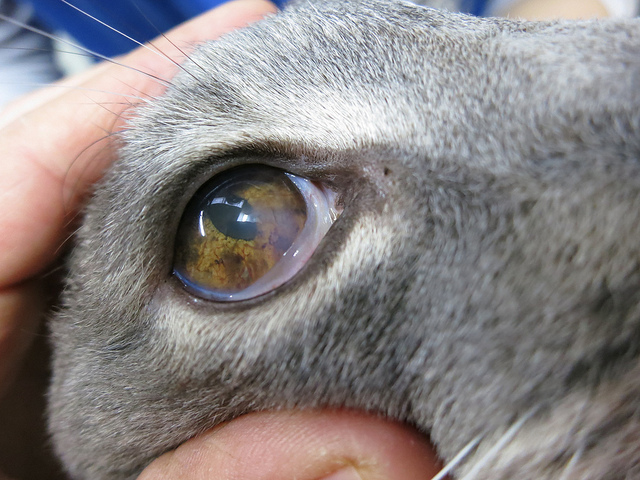
The symptoms of keratitis in cats can help owners recognize the condition early and seek veterinary help. Below, we've compiled the most prominent ones, along with photos of the condition, to help you determine if you're dealing with this condition.
- The cornea becomes cloudy and rough (matte). This condition can affect one eye or both eyes at once.
- Sometimes the cornea becomes overgrown with blood vessels.
- Infiltrate (fluid inside the cornea) accumulates, causing the upper layer of the eye to swell.
- The inflamed eye is draining. The fur underneath is wet. Pus may accumulate in the corners.
- If the disease has progressed too far, scarring may occur. Unfortunately, further treatment will not yield visible results, and the cat will go blind.
- Severe photophobia. A healthy cat will happily lie in the sun, but if its cornea is inflamed, it will hide from the bright rays of the sun or a lamp.
Treatment
Treating keratitis in cats at home always begins with eliminating the cause! Without this, it's simply impossible to restore your pet's normal vision. Relieving corneal inflammation isn't easy.
Yes, hormonal or antimicrobial medications can be effective, but if the underlying cause remains untreated, keratitis will return sooner or later. Antibiotic eye drops are most commonly used. If fungi are the culprit, antifungal agents are required. Unfortunately, antifungal medications are prescribed for a very long course of treatment, and positive results are not always achieved.
If a virus is the cause, specific serums are necessary. Without them, recovery will be virtually impossible. However, once the underlying (viral or even bacterial) disease is treated, keratitis in cats usually resolves on its own.
What to treat with?
The question of how to treat keratitis in cats can be answered after determining factors such as:
- cause of the disease;
- severity of the disease;
- depth of corneal damage.
Keratitis in cats is treated with ointments and eye drops. Sometimes, animals are given subconjunctival injections. Your veterinarian may also prescribe tablets, subcutaneous injections, or intravenous injections.
Antiviral therapy, including interferon-containing medications, is used to treat viral keratitis. Bacterial complications are treated with antibiotics and sulfa drugs.
For allergic keratitis, topical and systemic antiallergic medications are prescribed. If there is a risk of corneal perforation, corneal plastic surgery of varying degrees is performed.
Ulcerative keratitis
Neurogenic, or otherwise known as ulcerative keratitis, in cats occurs due to damage to the animal's trophic nerve tissue. The disease results in the formation of flat ulcer of the corneaThis is a long and gradual process, but the cat experiences no pain or discomfort because the cornea is numb. If the disease progresses favorably, the ulcer heals, leaving a slight cloudiness in the eye.
But if a secondary infection occurs, purulent keratitis develops in cats, which can lead to complete destruction of the cornea.
The appearance of ulcerative keratitis is associated with pathologies of the animal’s body:
- hypovitaminosis;
- diabetes mellitus;
- metabolic disorder;
- chronic renal failure.
The overall state of the immune system influences the progression of the disease. This also influences the severity of the pathological process and the course of keratitis.
Treatment of ulcerative keratitis in cats involves eliminating the causes of the inflammation and using antiseptic solutions:
- rivanol – 1%;
- furatsilin – 1:5000;
- boric acid – 3%.
Eosinophilic keratitis
A disease such as feline eosinophilic keratitis is an infiltration of the cornea by blood cells – eosinophils.
The causes of eosinophilic keratitis can vary, but doctors have noted that the herpes virus is often to blame. Stimulation of the immune system can also be a triggering factor. This disease is chronic, with frequent relapses.
Treatment involves anti-inflammatory and immunomodulatory agents such as cyclosporine and corticosteroids. Antiviral medications are sometimes prescribed. If your cat's keratitis is recurrent, it may be worthwhile to keep the animal on long-term maintenance therapy.
There's also a condition called feline bullous keratitis. This condition is characterized by the formation of fluid-filled blisters on the cornea. This condition is treated with standard medications used to treat keratitis in cats. One example is Solcoseryl.
Keratitis in a kitten
Keratitis in a cat is one thing. People research treatment methods and confidently begin treating the condition at home or take their pet to the vet. It's a different matter when the condition affects a baby, and that's when questions arise about how to treat keratitis in a kitten and which medications won't harm the baby's eyes.
Let me reassure you – treating keratitis in cats and kittens is no different. Therefore, give your kitten medications appropriate for the specific type of keratitis without hesitation. The only thing to consider is the dosage. If you are unsure whether the amount of medication is sufficient for your kitten, take them to a veterinary clinic.
Prevention
Prevention is always better than cure. Keratitis in cats is no exception.
- Don't forget about vaccinations. Timely vaccinations help build a strong immune system, which will protect your cat from infection. This significantly reduces the risk of your cat developing keratitis.
- Inspect your cat's eyes after walks outside. If you notice any tearing, carefully inspect the eyes again to rule out mechanical irritants.
- The house must be clean. Dust thoroughly and wash the floors.
- Brush your pet. Shedding hair can also get into the eye and rub the conjunctiva and cornea, leading to inflammation.
- Monitor your pet's diet, don't forget about vitamins and deworming. Strengthen your beloved four-legged friend's immune system.
- As always, no self-medication. A misdiagnosis and treatment chosen on your own or based on advice from the internet can only harm your pet. Your cat will lose his sight permanently.
If you have any questions about keratitis in cats, please leave them in the comments! We'll be sure to answer them!
Read also:


14 comments
Natalia
Hello, my cat can't open his eye fully. The fur around his eye is wet, and sometimes there's purulent discharge. Upon examination, the cornea isn't smooth, but rather rough, and the white of the eye is red with blood vessels. The vet prescribed tetracycline ointment. We've been treating him for a week, but there's been no improvement. Could you please advise me?
Tatyana Shmonina - veterinarian
Hello! Tetracycline ointment won't help in your case. You should consult a specialist (an ophthalmologist).
Maria
Hello. My eight-year-old cat has developed light-colored films on the sides of both eyes. We live in a small town. I was prescribed Balarpan, Korneregel, and Derinat. I've been taking the drops for several months now. Nothing's working. Please help. We don't do any tests here, so I'd have to transport them 300 km, and I'm old enough to take them.
Daria is a veterinarian
Hello! Derinat has no proven beneficial effects on the body in veterinary medicine. Balarpan and Kornegel are more likely to be used for dry eye syndrome (DES) than keratitis. We need to understand the cause, not treat the symptoms. In fact, in most cases, eye problems are not the primary cause, but a concomitant symptom of another disease. There is no medical history at all: age, diet, treatments, walking habits, contact with other animals, other symptoms, concomitant factors, etc.
Natalia
We picked up a kitten at work. It had red bags under its eyes. Based on the description, it could be tamed, but again, we're not doctors. Is it necessary to determine whether it's viral or bacterial at the hospital? Or can we handle it ourselves?
Daria is a veterinarian
Hello! You won't be able to determine the nature of keratitis on your own. This can only be done during an in-person examination and with the necessary tests. However, an empirical (trial) treatment aimed specifically at relieving the symptoms may be prescribed. Kittens, especially stray kittens, often suffer from a viral infection. A serum may be needed as a specific treatment, along with broad-spectrum antibiotics to suppress any secondary bacterial infections that may develop in the kitten's weakened body.
Tatiana
Is there a vaccine for keratitis? We have two cats at home, and we're looking to adopt a kitten from a shelter. He has keratitis and is being treated. Will our cats catch it later? Or do they need any vaccinations?
Daria is a veterinarian
Hello! Keratitis can be an independent condition or a clinical sign of another (infectious) illness. Before adopting new animals, especially from a shelter, all your pets should be vaccinated against viral diseases. Even after vaccination, you shouldn't immediately adopt a new pet. You need to wait 14-21 days for immunity to develop.
Xenia
Hello, my kitten first developed a small blue spot on his eye, and the next day a growth appeared. It's been growing for three days. We've been using eye drops and chamomile tea, but there's no vet nearby. Could you please tell me what it is and how to treat it? We found him on the street.
Daria is a veterinarian
Hello! It's likely keratitis. If the kitten is a stray, it could be viral. How are you treating it? If you don't start the right treatment, there's a risk of losing the eye or the infection spreading to the other eye.
Lyudmila
Good afternoon. Our cat has a slight swelling of the eyelid on his right eye and a round, dark brown spot on his cornea. His eyes also water every day. We clean them with chamomile or eye lotion, and the watering subsides for a while, then starts again. Could you tell me what drops I can buy? Thank you.
Daria is a veterinarian
Hello! It looks like iritis—an inflammation of the iris. Try Iris drops or Tobradex and clean your eyes. You can also add intramuscular injections for about 5 days to ensure not only local application of antibiotics but also a systemic effect. It's possible that your eye problems are just a symptom of a more serious condition that needs to be addressed first.
Elena
My 3-month-old kitten has a cloudy, bluish spot on the underside of his eye. The other eye is healthy. He also had conjunctivitis, which I treated with clavuxin for 5 days. I used Tobrex drops and ointment at night. There's been a slight improvement: the pupil has become reactive to light, but it's still not as good as a healthy one. What should I do? I've been treating it for 2.5 weeks now; I found it on the street.
Daria is a veterinarian
Hello! It could be keratoconjunctivitis. It's important to use not only topical drops, but also intramuscular antibiotics, antivirals, and vitamin injections. In general, infectious diseases should be ruled out (rescued animals often suffer from viral diseases, such as infectious rhinotracheitis, which manifests itself in the eyes and with a runny nose). You can't use the same medication for long periods of time, as the microflora develops resistance. The active ingredient should be changed to achieve better treatment effectiveness.
Add a comment