
Keeshond (Wolfspitz) is a dog breed
The Keeshond, or Wolfspitz, is the largest member of the German Spitz group of dog breeds. These agile, intelligent, and loyal dogs were used to guard homes and livestock, and, in rare cases, as gundogs. The breed was very popular among sailors and boatmen. The modern Keeshond is a companion dog.
Content
History of origin
The history of spitz-type dogs, including the Keeshond, spans thousands of years. They are likely descended from ancient peat dogs and later lake dogs, as evidenced by remains discovered during excavations in what is now Switzerland. As for the Keeshond itself, it originated in the Netherlands in the 16th century, but cynologists disagree on its origins. Most likely, they share some ancestry with the Samoyed, Norwegian Elkhound, Chow Chow, and Finnish Spitz.
Until the 18th century, they were known in their historical homeland as "Dutch barge dogs," as they were often kept by boatmen and sailors. It was probably during these "barge" days that Keeshonds acquired their amusing habit of hiding in a secluded place (such as a crate) to stay out of the way until called. They were also kept to guard yards, outbuildings, and livestock.
Confusion with names
Some sources claim that the Keeshond (Dutch Spitz) and the Wolfspitz are two different breeds, but this is not entirely accurate. Barge dogs, which originated in Holland many centuries ago, were renamed "Keeshond" in the 18th century, from the words "hond" meaning "dog" and "kees" a diminutive of "Cornelius."
Cornelius de Giselaer led the Dutch Patriot Party, and his energetic companion always accompanied him. The dog soon became the party's mascot and brought fame to the breed throughout the country. After the Revolution and the fall of Giselaer and his party, the breed was on the brink of extinction, but it was not forgotten. It continued to be bred in England, the United States, and Germany.
In 1933, Dutch Keeshond fanciers created a club and developed a standard, but they were not destined to become the official founders of the breed. In 1899, standards were developed in Germany for several Spitz breeds of different sizes and colors, initiated by the "German Spitz" association, and the German line of Keeshonds (Dutch Barge Dogs) was named "Wolfspitz." The International Cynological Federation supported Germany, but in many other European countries, particularly England, by this time the breed was already known as the Keeshond, and it continues to be called so.
According to the FCI classification, the breed belongs to the group of German Spitz called Wolfspitz/Keeshond, that is, it is one officially recognized breed, which is usually called differently in different countries and, in addition, the German and English lines do have some minor differences in appearance.
Appearance and standards
The Volspitz is a square-shaped dog with a dry, strong constitution. Sexual differences are clearly defined. Males have thicker and longer fur, and their build is somewhat heavier than that of females. Height at the withers ranges from 45 to 55 cm, and weight reaches up to 30 kg. The coat is long and straight, with a very dense, long, soft undercoat. The fur forms a mane and feathers on the legs and tail. Color: zonate gray.
The head is wedge-shaped, proportionate to the body. The stop is moderately pronounced. The muzzle is thin, tapering toward the tip of the nose. The nose, lips, eyelids, and nails are black. The ears are small, triangular, erect, set high and close together, tilted slightly forward. The teeth are strong and complete, with a scissor bite. The neck is of medium length and strong.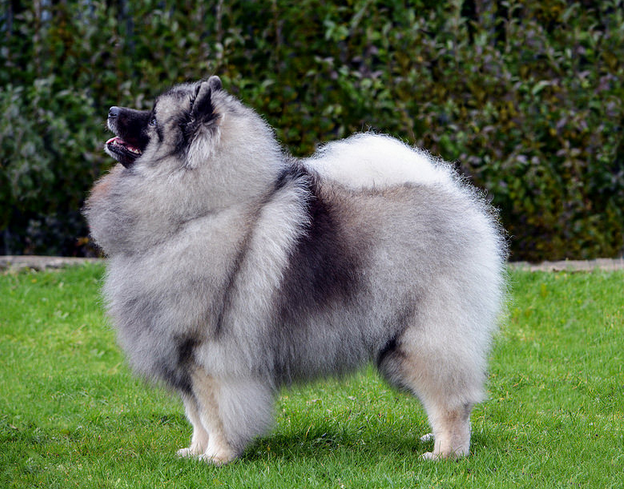
The back is straight. The loin is slightly arched and moderately wide. The croup is slightly sloping. The tail is set high and curled over the back. The chest is deep. The belly is tucked up. The fore and hind legs are straight and parallel. The movement is free, easy, and slightly springy.
Education and training
Keeshonds are highly intelligent, eager to interact, and eager to please their beloved owners, making them easy to train. Some training difficulties may arise due to their excessive activity and curiosity as puppies. After six months, as they mature, they become calmer and more serious. When training, it's best not to yell at or physically punish Wolfspitz; they are intelligent enough to understand the meaning of a stern look or a change in their owner's tone.
Training is often limited to a standard set of commands. If the dog is going to participate in a show, training in proper stance, public parading, and showing teeth is added. In most cases, owners of this breed train their dog themselves, but if even the slightest behavioral correction is needed, it's best to immediately seek professional help, as correcting an adult dog's habits will be much more difficult.
.png)
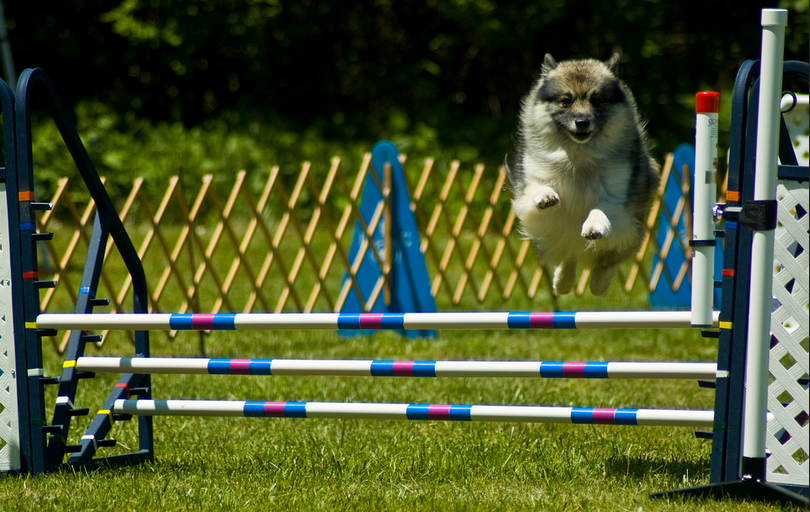
Wolfspitz are energetic and playful, so to stay in shape, they need active walks and active games. Leashing these dogs off-leash in urban areas is not recommended, primarily because their fearlessness and enthusiasm often lead them to dubious adventures. Life with a Wolfspitz can be enriched by participating in agility.
Character and psychological portrait
Balanced, docile, sociable, friendly, non-aggressive, and unobtrusive—all these qualities are inherent in this breed. Wolfspitz are true companions, attentive, active, and very attached to their family. They strive to please their owner, are sensitive to their moods, and empathize.
They are wary of strangers and will always warn of intruders with a loud bark. The saying, "Barks loud, but doesn't bite," somewhat describes this breed, with the difference that if a family member is in danger, a Keeshond will bite without hesitation. They get along well with other pets. They are very affectionate with children and tolerant of any pranks they may have. All these qualities make the Keeshond a true family dog.
Maintenance and care
This breed can be kept in both apartments and private homes. They are hardy and adapt easily to different environments, but this doesn't mean they should be turned out into the yard in extreme cold or left in the blazing sun.
Grooming a Wolfspitz is quite labor-intensive. Brush the dog at least twice a week. Bathing is possible once a month. After bathing, the coat must be blow-dried; leaving the undercoat damp increases the risk of fungal skin infections. Grooming involves using combs with different tooth lengths for specific areas of the body, anti-static shampoos and conditioners, and a special spray to prevent matting behind the ears, in the groin, and between the toes. The dog's ears are cleaned as needed using special lotions, and its nails are trimmed.
The breed does not require grooming, but preparation for shows sometimes includes trimming and light thinning to give it a neater appearance.
Diet and health
With the abundance of commercially available dog food available today, finding the right one for your Spitz is easy, taking into account its age and physiological condition. If desired, you can feed your pet natural food—not from your master's table, of course, but something specially prepared for the dog. Diets can be obtained from breeders or developed with the help of a veterinarian.
Volspitz are a robust, hardy breed. They are virtually free of breed-specific health problems, with the exception of a slight tendency toward heart disease in old age and thyroid or adrenal dysfunction. Epilepsy is very rare. Average life expectancy is 14-15 years, but there are also real long-livers.
Choosing a German Spitz puppy and the price
First of all, you need to choose a breeder responsibly and ensure that the dog is exactly the breed you're looking for. They should be someone you can turn to for advice in the future. They should meet, attend shows, and visit kennel websites and forums. Once you've chosen a kennel, learn about the planned litters and the parents, keeping in mind that the offspring will resemble them in both appearance and personality.
Breeders divide all puppies from a litter into classes based on their potential. Some puppies may become show stars, others are bred for breeding, and still others are for people who simply need a companion. The price largely depends on the class, but it's also important to understand that no breeder can 100% guarantee the future prospects of a 2-3 month old puppy. The choice of a female or male is purely a matter of personal preference. In any case, the puppy should be healthy, playful, and docile, with an excellent appetite. Puppies are placed in their new homes at 2-2.5 months.
The price of a German Spitz puppy ranges from $500 to $1,500.
Photos
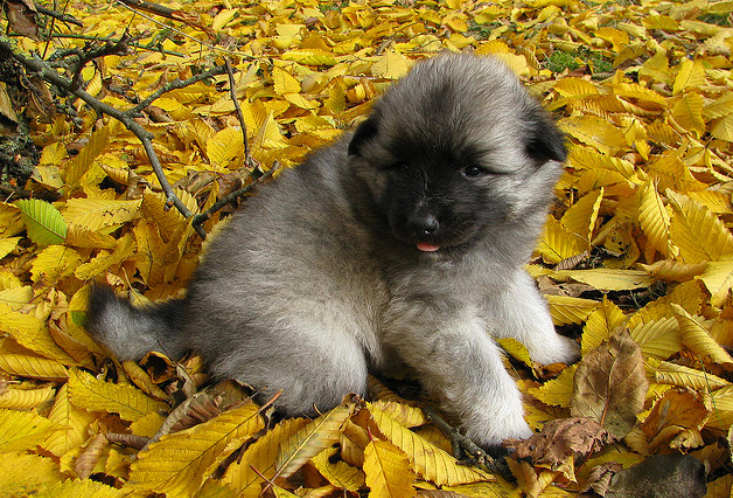
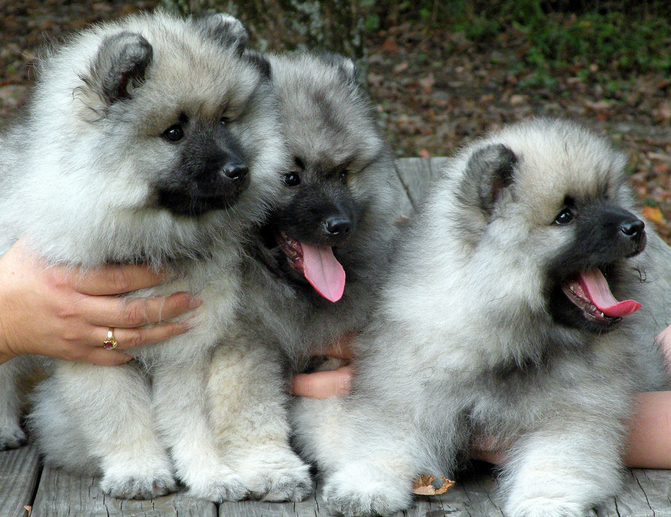
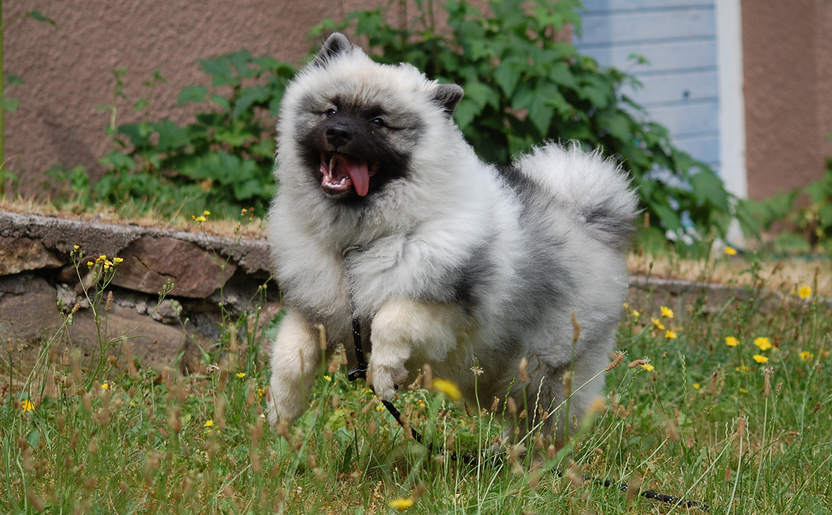
Keeshond (Wolfspitz) photos:
.png)
.png)
.png)
.png)
Read also:
- Mittelspitz (medium-sized Spitz, German Spitz)
- Dutch Shepherd (Herder)
- Schapendoes (Dutch Shepherd Dog, Schapendoes)


Add a comment