
Canadian Sphynx
If we talk about unusual cats, then Canadian Sphynx Definitely falls into this category. It truly has many unique characteristics, including appearance, personality, and care. Overall, it's not a pet for everyone.
Content
History of origin
The name of these cats conjures up something ancient and legendary, but in fact, Canadian Sphynxes are a relatively young breed. They began to be bred in the late 1970s, not in Egypt, as the name "Sphynx" suggests, but in Toronto, Canada. Having found hairless kittens, they began crossing them with shorthaired cats. This resulted in the birth of this unusual breed. In 1966, a domestic cat named Elizabeth gave birth to kittens in Canada. One of the kittens was completely bald and was named Prune. The kitten and its mother were acquired by Regard and Jania Bawa, who saw potential in them and began developing a new breed. They were soon joined by a second couple, Keyes and Rita Tenhove.
Initially, Canadian Sphynxes were called "moonstone cats," later "hairless Canadians," and only recently were their name determined to be the Canadian Sphynx. Little information remains about the breeding program's work with couples. The number of cats at that time was also small, and they died more often than their furry counterparts. As a result, the "experimental breed" status previously assigned to them by TICA was revoked. But the enthusiasts did not give up.
In the early 1970s, representatives of the new breed moved from Canada to San Francisco, and two catteries in the United States joined the breeding effort. In 1978, a pair of Sphynx cats was acquired by a Dutch doctor, Hugo Hernandez. The hairless cats then made their way to the other continent. In 1980, two more hairless kittens were discovered in Toronto. Apparently, they were descendants of Prune. When they grew up, they were sent to Holland to Dr. Fernandez for breeding. In 1975, in Minnesota (USA), a common cat gave birth to several litters, each containing hairless kittens. The kittens were acquired by the Stardust cattery in Oregon. All Sphynx cats carried the hairlessness gene, which was recessive and was believed to cause certain developmental abnormalities. After unsuccessful matings of two hairless cats, the breeder began crossing them with Devon Rexes.
Thus, Canadian Sphynxes were simultaneously bred in the United States and Holland, using the Devon Rex breed. In 1998, the Canadian Sphynx was officially recognized by the CFA, and just four years later, a championship class was opened for them. Today, there are frequent reports of hairless kittens being born from normal cats. Such individuals are often used by renowned catteries in their programs to expand the Canadian Sphynx gene pool.
Video review of the Canadian Sphynx cat breed:
Appearance and standards
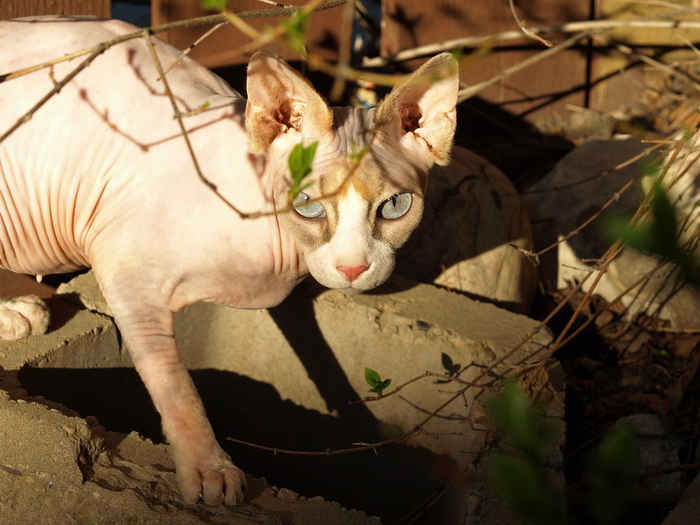
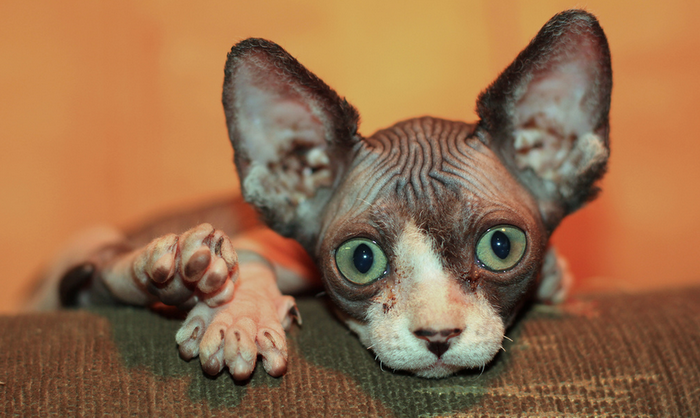
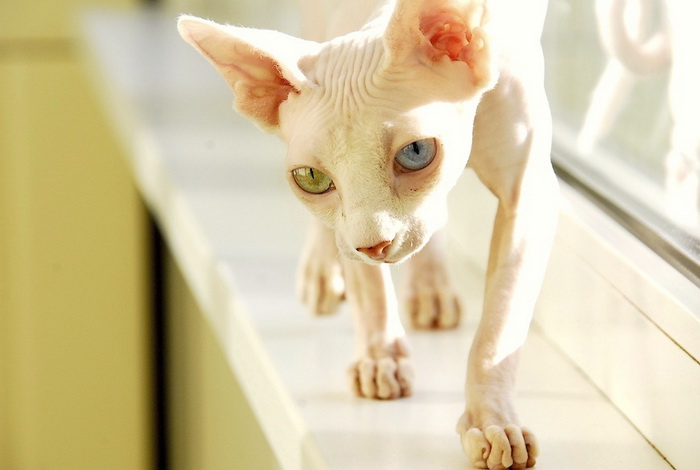
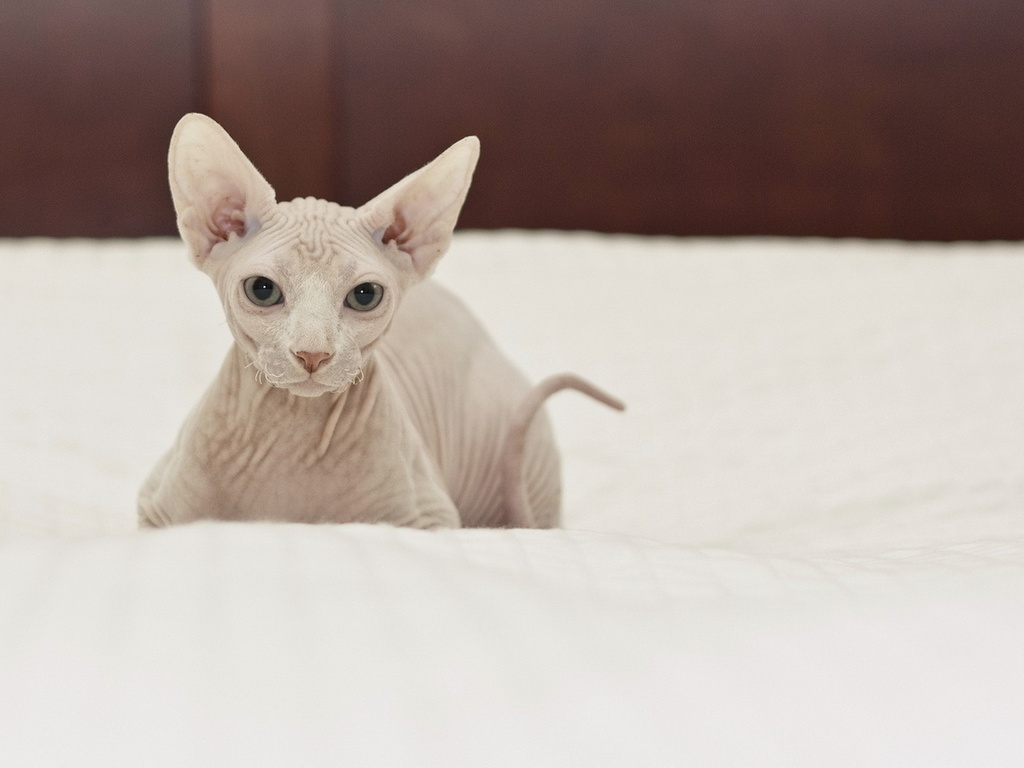
Let's start with the fact that the Canadian Sphynx is a hairless cat. Yes, that's right. Its so-called fur consists of very short hairs, creating a suede-like effect. And considering that cats have a higher temperature than humans (37.5-39°C), you can imagine the unusual sensation you'll experience when stroking this hot, suede-like creature. Add to the overall impression, a very unusual face, with simply enormous ears and eyes. This is a Sphynx cat in person.
Head and muzzle
The head is small, shaped like a modified wedge with rounded corners. It is much longer than it is wide. The cheekbones are prominent, and the stop from the nose to the forehead is noticeable. The ears are very large, wide at the base, and set well apart. The eyes are large and expressive, set at a slight angle. The distance between them is slightly greater than the width of the eye. The color should match the skin tone and can be any color.
Body, paws, tail
Canadian Sphynxes are medium-sized. Their bodies are rounded, strong, and muscular, with fine, elegant bones. The chest is broad and the belly is rounded. The limbs are elongated, slender, and strongly muscled. Due to the massive chest, the front legs are set wide apart. The paws are oval with long toes. The tail is whip-like, long and thin, with a tuft at the tip.
Coat, skin and color
Canadian Sphynx cats are allowed to have a minimal amount of invisible down on their skin, giving it a suede-like appearance. The muzzle may have short fur, but whiskers are preferred. Slightly furred ears at the base on the outside are also acceptable.
The skin is elastic, forming folds on the forehead, neck, and limbs. It can be any color or pattern from the list of colors. You can find lilac and blue, red and beige, fawn and tabby Sphynxes. Even more surprising is that their skin can tan in the sun, which enhances pigmentation.
Character and psychological portrait
While most cats are known for being solitary creatures, the same cannot be said of Canadian Sphynxes. They are sweet, friendly, and inquisitive creatures by nature. They simply adore being the center of attention and become very attached to their people. They enjoy being petted, held, taken to bed, played with, and so on. They will follow you around the house, sticking their noses into your owner's tools, your bowls, and your children's toys. And everywhere they go, they'll find something they think deserves to be tucked away in a secluded corner.
In general, Canadian Sphynxes are a very intelligent breed and are easier to train than others; they understand individual words and many simple phrases such as “no.”
Canadian Sphynxes are extremely affectionate and good-natured. They often choose one family member as their favorite, but are friendly with everyone. They even get along well with dogs. Another characteristic of these cats is that they love to swim and are completely unafraid of water, or at least tolerate it well. They are perfect for families with children and for the elderly. They are popular with people with cat dander allergies.
Character flaws in Canadian Sphynxes are most often the result of improper upbringing of the little Sphynx, lack of proper attention and other mistakes of the owners.
Canadian and Don Sphynx: differences
Talking about which breed is better – Don Sphinx There's no need to tell the difference between the two cats—both are beautiful, but you can still spot the differences. To the uninitiated, unfamiliar with these animals, the differences might be nonexistent, but they are there. And if you look closely, it's not hard to spot them.
The main difference between the Donskoy and Canadian Sphynx is their nationality. As you can tell, the Canadian Sphynx originates from Canada, while the Donskoy breed is native to Russia. Our cats have a progressive hairlessness gene, so furry representatives of this breed are not found in nature. This is another difference between the Canadian and Donskoy Sphynx, as the Canadian Sphynx is not completely hairless. Males of this breed have fairly thick fur on their paws, tail, and face, but they lack whiskers, unlike the Donskoy cats, which have curly or broken whiskers.
In terms of size, the difference between the Donskoy and Canadian Sphynx is insignificant. They are both approximately the same size and height. However, there is a distinct difference in head structure. The Donskoy has a wedge-shaped head, with a prominent brow and cheekbones.
The differences between the Donskoy and Canadian Sphynx are most pronounced not in appearance, but in their physical and mental endurance. For example, the Donskoy is generally healthier and has a higher pain tolerance. Mentally, they are also stronger—male and female cats are resilient and relatively even-tempered, which cannot be said of their Canadian counterparts.
Canadian and Don Sphynx cats also differ in their personalities and attitudes toward their offspring. Russian representatives of the breed are considered the most caring fathers. They have been observed to truly develop warm, familial feelings for their litter. Generally, they are intelligent, affectionate, docile, and quite friendly creatures. Canadian Sphynxes are generally more reserved and blunt. These cats are said to have a mind of their own. However, as with anything else, any differences are merely generalizations about the breed. Much depends on the individual characteristics of the pet, its living conditions, and the overall atmosphere in the home.
If the differences between the Donskoy and Canadian Sphynx are just academic for you and you simply like the breed, then buy a kitten, regardless of its variety. After all, both are affectionate, loving, and get along well with people and other pets.
Reviews of the breed
If you analyze the reviews of Canadian Sphynxes left by owners, you can confidently say that this breed is not for everyone.

By nature, Canadian Sphynxes are good-natured, sweet, and playful, with rare exceptions. Due to lack of attention, improper training, and improper socialization, they can become aggressive, fearful, or nervous.


These cats' appearance is, to put it mildly, unique and not everyone will appreciate it. Many are disturbed by the discovery that Sphynx cats' secretions, known as sweat, can leave their mark on clothing, bedding, and furniture.


Some representatives of the breed are absolutely not clean and after every trip to the toilet they have to literally wipe their bottoms.

Most often, sphinxes get along well with other pets, except for small rodents, birds and similar animals.

They often treat small children with tenderness and love.

Almost all the downsides of owning a guinea pig relate to grooming. Not everyone is prepared for regular cleaning of their eyes, ears, and skin.

Without dividing into pros and cons, let's try to create a composite image of the Canadian Sphynx based on its most striking qualities:
-
good-natured and moderately calm cats;
-
They are very attached to their owner and friendly to all family members;
-
require complex regular care;
-
sensitive to maintenance conditions, do not tolerate drafts;
-
exotic appearance;
-
Representatives of the breed are smart and quick-witted;
-
They don't have fur, so most allergy sufferers don't react to them;
-
Sphynxes have a fast metabolism, so they eat more than other cats and need only high-quality food;
-
in summer you should be careful that they do not get sunburned;
-
The breed is susceptible to many diseases, especially skin diseases.
Content
There's a common misconception that Canadian Sphynxes need to be kept in "hothouse" conditions, but this is a bit exaggerated. These cats are indeed heat-loving, but they thrive at normal room temperatures. If it gets cold, they can be dressed according to the weather. What Sphynxes don't like is drafts. Toys and a play structure will help keep them active.
Naked cats prefer to sleep in a secluded place, so various cat houses are often to their liking.
Outdoor walks are possible, but only during warm, windless weather and, of course, after all necessary vaccinations. Sphynxes are usually trained to walk on a harness. Free-roaming is dangerous due to their lack of the necessary skills for outdoor life and the lack of proper immunity.
Care
Canadian Sphynx cats are very demanding in terms of grooming. While their hairlessness is a major advantage, it's also a disadvantage, as the skin of these hairless cats is very sensitive and requires special attention. Furthermore, Sphynx cats, unlike most other breeds, sweat.
Skin care
Sphynxes need to be bathed frequently, due to the presence of special glands that secrete a brownish secretion to varying degrees. It is recommended to bathe Sphynxes with special shampoos, followed by a conditioner that moisturizes well and prevents flaking. After bathing, the skin should be dried thoroughly with a towel.
Between baths, to remove any secretions, wipe the skin with baby wipes or a soft, damp towel. Pay particular attention to the folds, tail, and skin between the toes. On average, Sphynx cats need to be bathed once every three weeks. If not, the skin becomes covered in a brown secretion, which remains on objects and surfaces wherever the cat goes.
Eye, ear and oral hygiene
Canadian Sphynx cats don't have eyelashes, so their eyes are prone to getting dirty. They need to be cleaned regularly using a weak chamomile infusion or special lotions. Cotton wool should not be used for this procedure, as its fibers can remain on the cornea and cause irritation.
Large ears also get dirty much faster than those of other breeds and need to be cleaned every two weeks. Cotton swabs are not recommended, as they don't allow for deep cleaning and can contribute to clogging. Special cleaning lotions are available for sale; they are applied directly to the ear canal. These lotions soften the wax and are removed after the animal shakes its head.
The oral cavity isn't a weak point for this breed, but it's a good idea to accustom your kitten to a toothbrush from an early age. Brushing gently removes plaque and prevents tartar buildup. This is especially important for cats fed a natural diet rather than dry food. Good behavior during grooming can be rewarded with treats. Regular trimming of claws, trimming only the tips, is recommended. However, this doesn't eliminate the need to train your cat to use a scratching post. Even a short manicure can be used on a new sofa.
Nutritional Features
It's best to feed Canadian Sphynx cats a balanced, super-premium or holistic diet. It's best if it's specifically formulated for hairless breeds. Diets for active indoor cats are also suitable.
When choosing dry food, consider the animal's age, sex, health, and physiological state (pregnancy, neutering, lactation). Sphynxes have an excellent appetite, due to their increased metabolism. They should be fed frequently, three to four times a day, in small portions, and care should be taken to ensure they do not overeat. Sphynxes are prone to obesity.
Canadian Sphynx cats have a very sensitive digestive system, so table food and food of questionable quality are strictly contraindicated. Drinking water must be freely available. It is also recommended to grow grass for cats, a source of vitamins and microelements. Raw, frozen beef or rabbit can be given occasionally.
Health and life expectancy
In terms of health, it's fair to say Sphynxes have their weaknesses. For example, they catch colds easily. Therefore, drafts should be avoided. Their immune system is much weaker than that of many other breeds, especially outdoor cats. Furthermore, the breed is associated with a long list of hereditary diseases, which breeders strive to eliminate by all means, preventing sick animals or carriers of "unhealthy genes" from being bred.
- A shortened lower jaw leads to an underbite. It is often accompanied by curvature or underdevelopment of the tail vertebrae, dwarfism, hypothyroidism, and growth retardation;
- Microphthalmos is a general term used to describe cases of abnormal eye development that result in loss of visual acuity:
- Congenital entropion is a condition in which the outer edge of the eyelid turns inward, constantly irritating the cornea. It rarely resolves with age and is usually corrected with surgery.
- Nipple hyperplasia is primarily observed in females over one year old. The nipples become enlarged and cysts form. These cats often experience weak labor and a lack of milk, and kittens are often born nonviable.
- Cysts and neoplasms of the mammary glands. Mostly seen in tortoiseshell cats.
- Various skin diseases are very common. They can appear spontaneously, seasonally, or accompany estrus.
- Cutaneous vasculitis, or inflammation of the blood vessels in the skin, is usually treatable, but relapses are possible.
- Congenital underdevelopment of the thymus gland, or kitten sleep syndrome. Kittens with this defect live for a few days.
- Gingival hyperplasia. Often caused by a weakened immune response and associated with conjunctivitis.
- Hypertrophic cardiomyopathy – another unpleasant disease that leads to the death of kittens.
In addition to congenital ailments and a predisposition to certain diseases, Sphynx cats can suffer from illnesses caused by improper housing, feeding, or care. They can have internal and external parasites. Fleas don't linger on Sphynx cats, but their lack of fur is no obstacle to many types of mites that live in the skin. Routine vaccinations are essential for protection against dangerous infectious diseases.
The question of how long Canadian Sphynxes live can be answered with statistical data – average life expectancy is 13 years. But it is worth understanding that the lifespan of a Canadian Sphynx largely depends on the individual characteristics of the animal and the conditions in which it is kept.
Knitting
If you've decided your cat needs to give birth, it's time to consider mating your Canadian Sphynx and all the associated complications. Sphynxes mature early. Don't be surprised if your cat's first heat begins just six months after birth. The onset of heat is easily noticeable by changes in your pet's behavior. Your cat may become more affectionate or, conversely, display unprecedented aggression.
It's important to know that a Sphynx cat in heat is not a reason to mate. After all, a six-month-old cat is still physically a baby. Technically, a cat can give birth, but the risk of producing non-viable offspring is quite high. Furthermore, the new mother may also develop health problems. For these reasons, mating during her first heat is officially not permitted.
Canadian Sphynx males mature sexually slightly later than females. The first signs of heat appear at eight months of age. This is also too young for males to mate, as they are not yet physically mature. Signs of puberty can be detected by their behavior: they become more assertive and aggressive. They may also begin marking their territory.
Physically, a cat can be considered ready for mating after 2-3 heat cycles. The ideal age is 1.5-2 years. By this time, Canadian Sphynx cats are fully developed.
Don't forget that you need to vaccinate and deworm your dog before mating. This should be done well in advance—at least 14 days before the expected mating.
Preparing a Canadian cat for mating involves observing certain hygiene rules, such as nail trimming. However, it's best to avoid washing your pet. Cats have an excellent sense of smell, and the natural scent of their partner is one of the factors that attracts animals of different sexes to each other.
The ideal time for mating is the third day after the onset of estrus. Typically, the matched pair is left together for several days, as a single mating does not guarantee fertilization of the female cat's eggs.
A Canadian Sphynx's pregnancy lasts 63 days. The first signs of pregnancy can be seen in the third week after mating. These are primarily behavioral changes. A little later, physical signs will begin to appear:
- swelling of the nipples;
- abdominal enlargement;
- increased appetite.
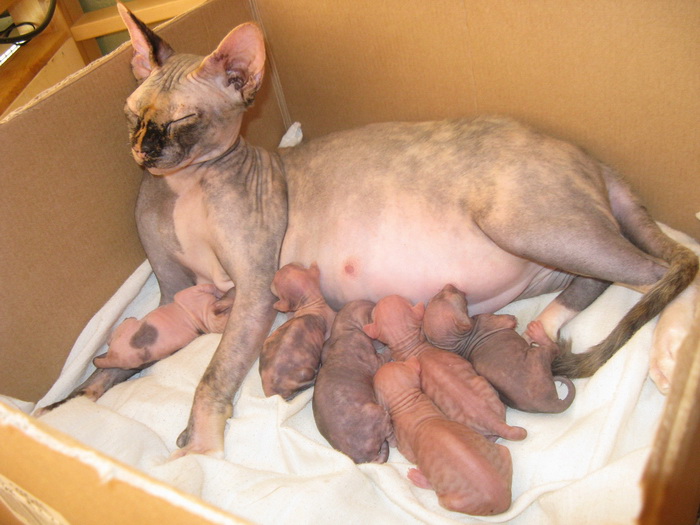
Canadian Sphynx cats are quite fertile; a female can give birth to a litter of up to 12 kittens.
In general, mating a Canadian Sphynx is similar to the mating methods used for cats of other breeds.
Choosing a kitten and price
After making the final decision to buy a Canadian Sphynx, it's important to choose a qualified breeder. While it's possible to buy kittens without papers, "from hand-me-downs," such kittens are often the result of accidental matings. This means there are no guarantees of health or subsequent support. Furthermore, there's a chance the kittens are not purebred and are the result of an accidental mating with another breed. When choosing a kitten, it's important to look at its parents, their achievements, and the conditions they were raised in.
Given the unique nature of the breed, the price of Canadian Sphynx kittens is quite high. If you buy a kitten from a cattery, a pet-quality kitten will cost an average of $500. Show-worthy animals, as well as those intended for breeding, can cost significantly more.
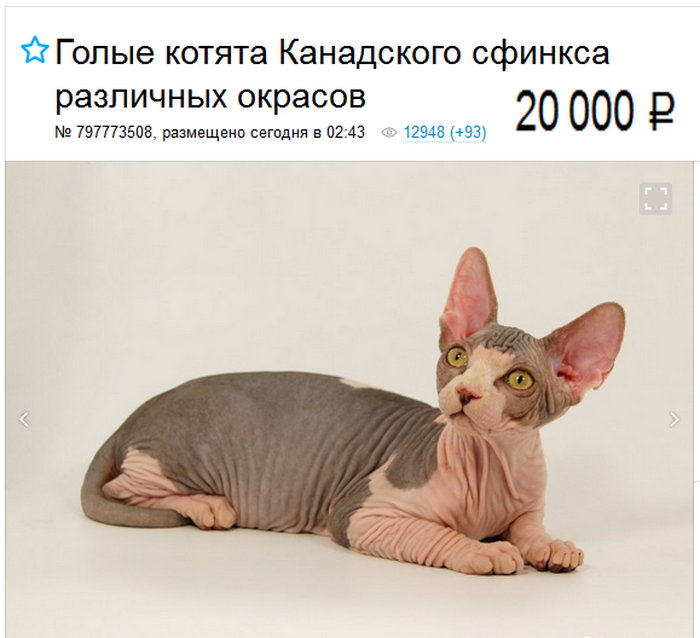
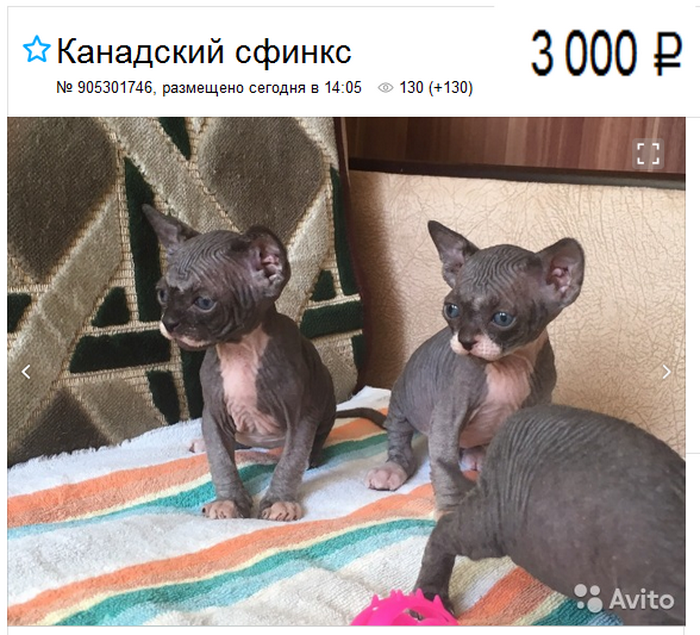
Kittens bought from hand without documents cost on average 3-5 thousand rubles.
A puppy can be taken to a new home only after routine vaccinations and deworming at 3 months of age. These babies are already socialized, trained to use a litter box, scratching post, and specific food. They are less likely to have behavioral problems.
Photos
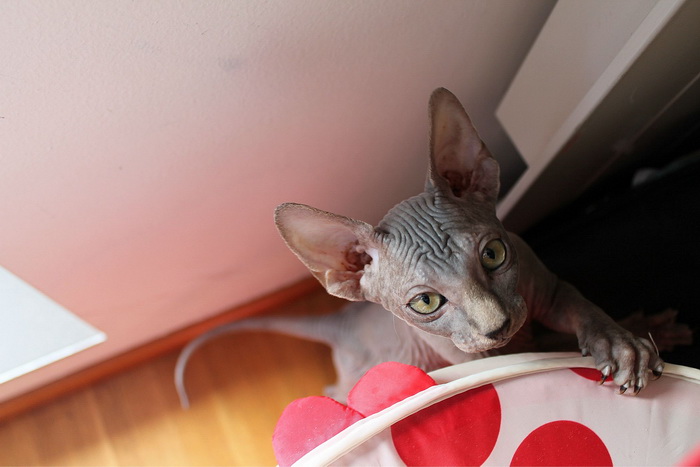
Photos of Canadian Sphynx cats:
Read also:


Add a comment