
Kanaani (Canaani): cats and cats
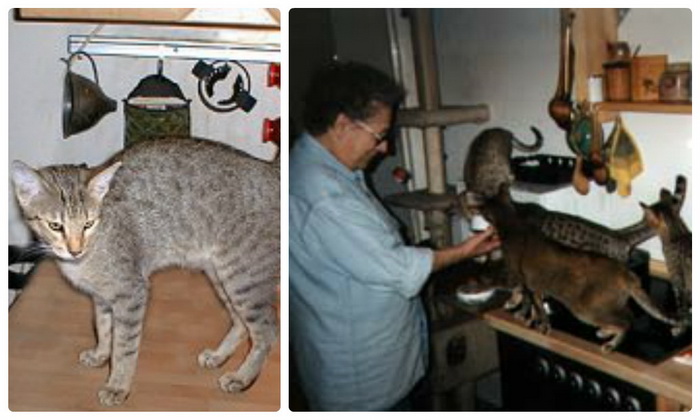
Canaanite or Canaanite The Libyan Cat is a young experimental cat breed. Several breeds were involved in its development, but the foundation was a cross between a domestic cat and a wild Libyan cat. This undoubtedly influenced its appearance and, to some extent, its character. Some felinologists believe the breed's origins are in Israel, others in Germany, and both are correct in their own way.
Content
History of the breed's origin
The origin story of this breed is very brief. It was developed by Israeli resident Doris Polachek, giving Israelis another reason to be proud. The Canaani breed is one of the few that combines the bloodlines of both domestic and wild cats, specifically the Libyan.
Doris had three cats at home, all of whom were neutered. So, it's hard to say she dreamed of breeding them. But one day, she came across a wild Libyan cat whose appearance simply captivated her. However, the cat's temperament was feral, which upset her. She then decided to get his kittens, hoping they would be just as beautiful, but also affectionate, domesticated, and tame.
Her experiment was a success, but the kittens also disappointed her with their personalities—exactly like their father's. So, further breeding continued on a professional level. Doris read a ton of literature and attempted to crossbreed her male cat and the grown mixed-breeds with cats of other breeds.
Bengal, Abyssinian, and Oriental cats also participated in the breeding process. Interbreeding was permitted until 2008. The new Canaani breed, with "experimental" status, was registered with the WCF in 2000. A standard was developed. In Israel and Germany, the Canaani is considered quite rare, and outside of these countries, it is virtually impossible to find. Doris, a German citizen with an apartment, lived and worked for a long time in her own studio and workshop in Jerusalem. This is where the Canaani's "dual citizenship" comes from, and the first cattery of this breed was named "Ha Jeruschalmi."
Appearance and standards
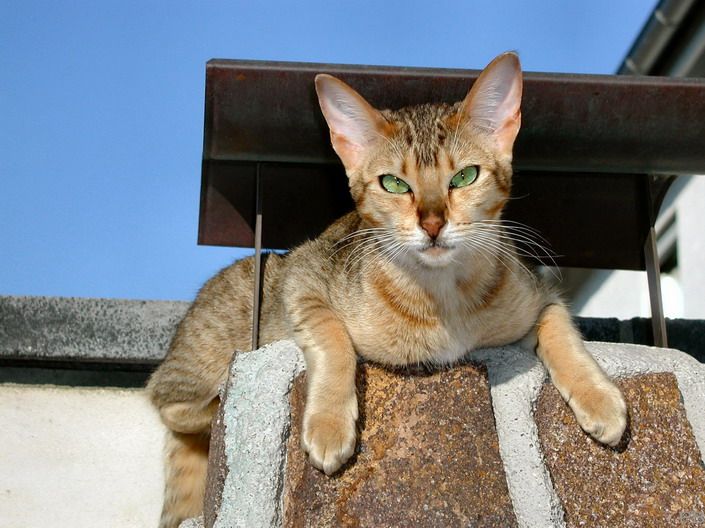
Canaani gives the impression of being the independent and agile cat she truly is. Her slightly elongated form and long legs give her an unusually elegant appearance, while her coloring and the expression of her green eyes hint at her wild heritage. As Doris intended, Canaani became a miniature version of the Libyan cat with a gentler disposition.
Head and muzzle
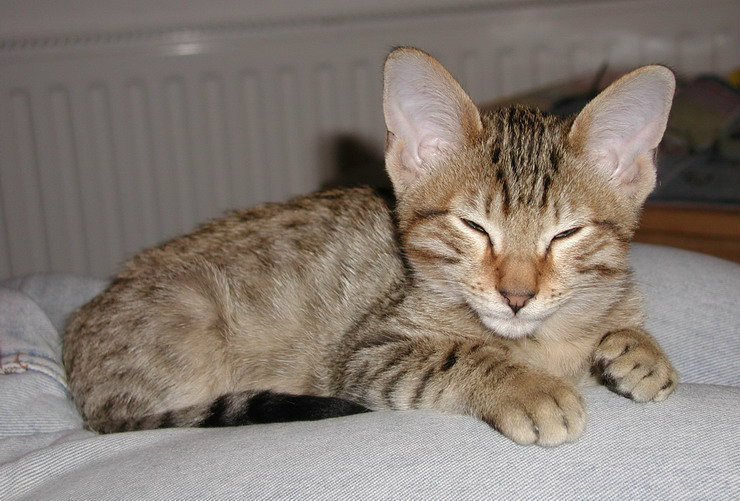
The Canaani's head is a wide triangle, set on a slender, long neck. The forehead is slightly convex, with prominent cheekbones and a strong chin. Between the ears, the skull is flat, as is the muzzle. The Canaani's ears are wide at the base, large, and pointed upward, with tufts visible at the tips. The distance between the ears should correspond to the width of the ear. The eyes are set wide apart and almond-shaped, with a very expressive gaze.
Eye color is only allowed to be green or yellow-green in adult cats.
Body, paws, tail
The body is medium to large in size, athletically built, muscular, elegant, and strong. In movement, the Canaani strongly resembles its ancestor, the wild cat. Its limbs are slender and fairly long, allowing it to leap impressive distances and conquer heights. Its paws are oval-shaped, small, and graceful. Its long tail ends in a pointed tip.
Coat and color
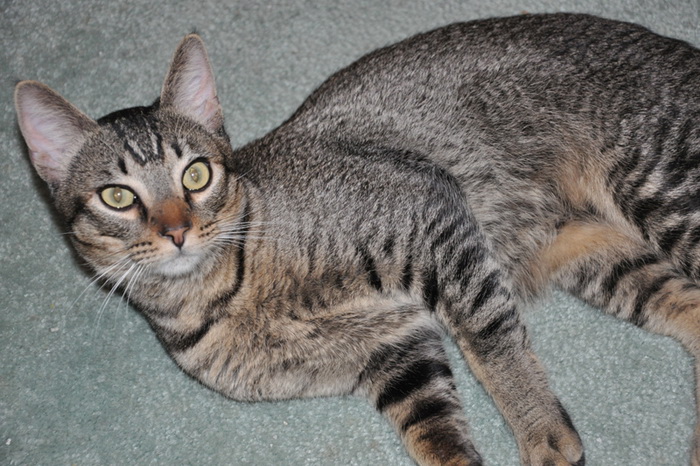
The short, close-lying coat has a coarse texture. The undercoat is sparsely developed. The hairs should have a ring of ticking, but not too intense, allowing the spotting pattern to remain consistent.
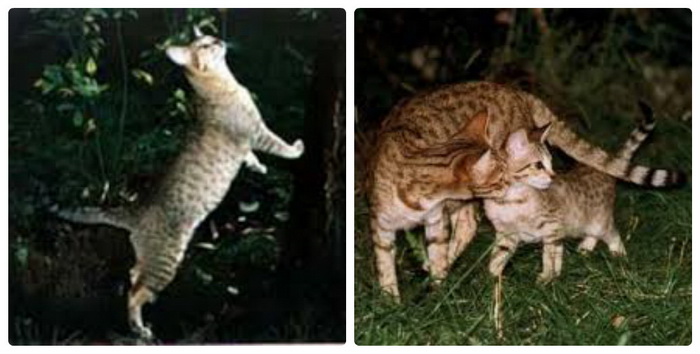
Canaani cats inherited their coloring from their wild ancestors—a light beige or cinnamon-colored background with brown or coffee-colored spots. Their coat is unique, combining both a spotted and ticked pattern.
The standard recognizes two types of tabby color:
- marble
- spotted.
The spots can be either diagonal or horizontal. A distinctive feature is the collar around the neck. The Canaani's throat and chin are white or cream, and its belly is spotted on a beige background. The end of the tail has several bands.
The character of cats and male cats
The Canaani cat's personality reflects traits of both domesticated cats and its wild ancestors. It's a freedom-loving, self-sufficient, and independent cat. It thrives in homes but adapts well to any family, treating all members equally.
When a Canaani cat is in a good mood, she readily plays and cuddles, purring loudly. Cohabitation with other animals depends largely on the personality of the neighbor, and this is very difficult to predict.
The Canaan is suitable for people who are often away from home for long periods. It's also an ideal cat for those who value independence and a wild spirit. Despite their aloofness and demonstrative attitude toward their family, showing who's boss, they are quite a peaceful and tolerant animal. However, they certainly won't put up with bad behavior.
Canaani cats are intelligent and quickly understand what people want from them. If you think you need to show your pet who's boss, this isn't the time. This is a rather vindictive creature and will resist anything they don't like out of spite. Therefore, if you need to train your Canaani to use a litter box or scratching post, don't use force. Instead, try a more relaxed, playful approach. Reward your cat with praise and treats for every good behavior. With this approach, your cat will usually be willing to comply and do what you ask.
But things aren't always so smooth. Sometimes, achieving mutual understanding requires patience. So, if you've decided that your cat will be a Canaani, be prepared for a "war" for the little wildcat's heart. But if you win, your prize will be a reliable, affectionate, and endlessly loyal friend.
One of the most important aspects of raising a Canaanite is early socialization. Therefore, when choosing a pet, be sure to clarify this point with the breeder. Otherwise, you risk acquiring an unsociable and unsociable animal that constantly hides from people.
Maintenance and care
Canaans are large, active cats, so living in a small apartment isn't for them. They require a lot of space and love to conquer heights, which they do with ease thanks to their strong paws. They prefer to spend some of their free time outdoors, free to roam, and to exercise their hunting instincts. Canaans are freedom-loving cats—it's important to remember that!
The Canaani is best suited for a family with its own home, as the wild side of these creatures tends to thrive outdoors. They may feel uneasy in urban areas, but this can be overcome if you're willing to take them for frequent walks.
If you've decided to get a Canaan for your apartment and are ready to take her for walks, yes, please. Now be prepared for her wild nature to yearn for freedom. Therefore, the main rule is to always walk her on a leash. Otherwise, she'll run away and you might never find her again.
This breed doesn't require any special grooming. They're excellent at self-care and don't require bathing. However, to improve the appearance and quality of their coat, brushing at least once a week is recommended. Eyes and ears should be cleaned only as needed.
It's difficult to find the right balance when it comes to bathing. On the one hand, Canaani cats require outdoor walks and get dirty quickly, while on the other, their natural protective coat, which protects them from infections, is washed away. Experts recommend bathing Canaani cats only when they're really dirty, but it's important to stick to a mandatory three-month interval, regardless of how dirty they are.
Nutrition and health
They aren't picky eaters, but a complete, super-premium or holistic diet for active cats is the optimal choice. Kittens up to one year old are fed three times a day, with the food selected according to their age. After 8-9 years, they can switch to a senior cat diet. Canaans aren't prone to overeating and lead an active lifestyle, so free-feeding is acceptable.
There is no data on breed-specific diseases or potential health issues. This is due to the breed's very young age. However, this does not mean the animal cannot suffer from a variety of other infectious and non-infectious diseases if not properly managed and fed. Life expectancy is 13-15 years.
Choosing a kitten and price
The Canaan is a very rare cat breed. A handful of catteries registered in Germany, the USA, and Israel are dedicated to its development. Unfortunately, even at international shows, representatives of the breed are rarely seen. It is no longer registered with any major international organization other than the WCF. Kittens can cost up to 1,000 euros.
Photos
Photos of Kanaani (Canaani) cats:

Read also:


Add a comment