
When and what vaccinations should kittens receive?
You've adopted a small, fluffy pet and dream of it growing up into a gorgeous adult cat. Why not make your wish come true? It's all in your hands. This article will help you understand how and what vaccinations your kitten needs to grow up healthy and pleasing to its owner. These kitten vaccination recommendations will be useful for both inexperienced owners and professional breeders.
Content
- 1 Preparation
- 2 Types of vaccines and their properties
- 3 Charts and combination charts
- 4 Special situations
- 5 Practical advice - preparation and side effects
- 6 At what age are kittens ready for vaccinations?
- 7 Vaccination rules
- 8 What vaccinations does a kitten need?
- 9 Kitten after vaccination
- 10 How much do kitten vaccinations cost?
Preparation
Before vaccination, kittens must be dewormed. And no matter how domesticated the kitten you've adopted, neglecting this procedure is highly discouraged. Why is this? In short, worm eggs can be brought in on the soles of shoes or from the hallway, inadvertently infecting your pet.
Previous illnesses and parasitic infestations can significantly weaken the immune system, and vaccination may result in insufficient antibody production. This means that even a cat vaccinated the day before can become ill. Vaccinating a cat infected with helminthiasis can have serious consequences, including death.
10 days after the first deworming It will need to be repeated, as the product only kills adult larvae, leaving the eggs and larvae intact. Within 10 days, a new generation of young larvae will form from the remaining larvae. worms, which have not yet managed to lay new eggs.
After waiting 8-10 days after the last use of the anthelmintic drug, you can give the first vaccination.
When choosing an anthelmintic drug, you should pay attention to well-proven drugs:
- Caniquantel (for kittens from 3 weeks of age).
- Febtal (for kittens from 3 weeks).
- Profender (drops for pets from 5 weeks of age).
- Milbemax (for kittens not earlier than 6 weeks of age).
Angelmintics can be in the form of drops, tablets, or injections – the choice is yours.
Types of vaccines and their properties
-
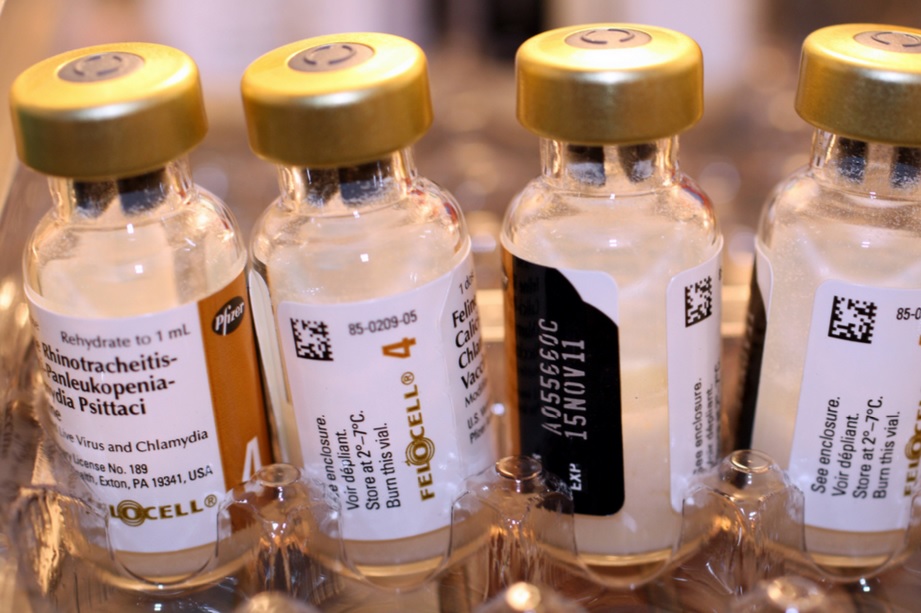
Live modified vaccinesThey activate a strong immune response and are often used in the basic regimen (for panleukopenia, herpesvirus, and calicivirus). They are recommended for kittens over 8 weeks old.
-
Inactivated vaccines with adjuvants(e.g. leukemia, rabies) - less reactive, suitable for sensitive animals.
-
Recombinant vaccines(a rare category on the market) contain only genetic fragments of the virus and are safe for immunocompromised individuals.
-
Polyvalent vaccines— with one injection, you get protection against several diseases. It's convenient, reduces stress, and reduces the risk of reactions.
-
Monovalent vaccines— for specific situations (for example, at an exhibition a separate allergen strain is needed).
Charts and combination charts
Typical vaccination schedule for kittens
| Age | Vaccine | Comment |
|---|---|---|
| 6–8 weeks | Herpesvirus, calicivirus, panleukopenia (combined) | First immunization, the start of primary protection |
| 9–10 weeks | Repeated complex vaccination | Considering the disappearance of maternal antibodies |
| 12 weeks | Complex + rabies vaccine | Supplement to the basic scheme |
| 14–16 weeks | Vaccine against viral leukemia | Recommended for kittens that go outside or with other animals |
| 16–18 weeks | Leukemia booster vaccination, rabies supplement | Needed in case of high risk |
| 1 year | Revaccination of all drugs | To maintain immunity |
| Annually | Rabies and leukemia revaccination (if required) | Some immunities last for two to three years. |
Additionally (if necessary):
-
Chlamydia- in case of respiratory complications
-
Felinosis(Staphylococcus) is a rare variant
-
Skin vaccines- ringworm, dermatophytosis (may be needed when socializing your pet)
Special situations
-
Preparing for a trip abroad:
A checklist is required for entry of animals: rabies, leukemia, and sometimes calicivirus. Rabies vaccination must be administered no later than 21 days before departure. -
Participation in exhibitions:
Veterinarians may require up-to-date vaccinations at the event, especially for respiratory diseases. If planning a show, the vaccination schedule is adjusted for 12 weeks of age for shows at 14 weeks. -
For kittens from shelters or abandoned:
Any such kitten should begin the vaccination schedule immediately, even if previous injections are unknown. A repeat program should begin with the first injection.
Practical advice - preparation and side effects
-
Before vaccination:
— Examination: pulse, temperature, gastrointestinal tract
— Treatment for worms in 10–14 days
— Elimination of stress and changes in routine -
Storage of vaccines:
— Maintain the temperature regime: +2…+8 °C
— Avoid re-freezing wet vaccines
— Careful transport: thermal container, instructions + passport -
After the procedure:
- Apply cold to the injection site, follow-up for 30 minutes
— Light diet, a week without exercise
— Monitor appetite, temperature, and behavior—weakness is possible for up to 48 hours. -
Side effects:
- Mild fever, lethargy, refusal to eat
- Swelling, itching at the injection site
— Rare reactions: facial swelling, vomiting — you need to contact a clinic
At what age are kittens ready for vaccinations?
If you ask at what age kittens should be vaccinated, you'll inevitably hear that you shouldn't rush, as this could weaken their fragile immune system. And the desired effect of creating artificial immunity after vaccination may never be achieved.
If you're concerned about your kitten's health and wondering at what age kittens should be vaccinated, wait until they're at least two months old. This is when deworming and subsequent vaccinations are appropriate.
After passing the initial vaccination, a booster vaccination is required three weeks later. Make sure the same vaccine is used as for the initial vaccination. After this, the kitten should be kept indoors for 14 days, closely monitoring its diet and keeping it away from other animals. Quarantine is necessary because it takes two weeks for the furry little one to develop immunity to the infection.
By the way, at the same time, you can ask for additional vaccinations for your kitten – against feline chlamydia.
The next vaccination will be given to a growing pet at the age of one year, after which revaccination will need to be carried out annually.
If your kitten is already quite mature—6 months old—and you've decided to vaccinate them, there's no need to booster them in three weeks. By this age, your pet's immunity is already strong enough, so you can repeat the procedure in a year.
Important: all vaccination details must be recorded in the medical passport.
Vaccination rules
Before heading to the vet or vaccinating yourself, make sure your puppy is completely healthy and feeling great. Make sure he has:
- had a healthy appetite;
- body temperature did not rise above 38-39 degrees;
- there was no coughing or sneezing;
- Deworming was carried out.
Even after taking these precautions, it's best to consult a veterinarian. They'll conduct a professional examination and advise, taking into account not only the kitten's age but also its individual characteristics, on when the best time to give it its first vaccination is.
In addition, vaccination rules must be followed:
- Only absolutely healthy kittens can be vaccinated.
- Do not vaccinate an animal under 8 weeks of age.
- Make sure the vaccine has not expired.
- Do not give injections to a kitten that is stressed – escaping from your hands, meowing loudly, etc.
- You cannot vaccinate your pet during the period of teething.
- After completing a course of antibiotics, vaccination can only be done after 2 weeks.
- Never give an injection to a pet after contact with a sick animal.
- If a cat has had surgery, it cannot be vaccinated for 3 weeks.
- After vaccination, the pet can be operated on 21-25 days later.
What vaccinations does a kitten need?
This naturally raises the question of what vaccinations a kitten needs and why they are needed. All preventative vaccinations are conventionally divided into two groups: mandatory and optional.
The presence of the first ones in a kitten will be checked before visiting an exhibition or traveling by plane or train, and they are also necessary for a successful mating.
Mandatory vaccination is carried out against several infectious diseases at the same time: panleukopenia, calicivirus, rhinotracheitis (and chlamydia, if desired).
Thanks to the use of complex vaccines Immunity is developed against several dangerous diseases simultaneously. The vaccine is given again after 21-28 days. This helps the baby develop a more robust immunity to the vaccinated infections. The vaccination procedure is repeated once a year. The most common vaccines are:
- Multifel-4;
- Leucoriphelin;
- Nobivac Triket;
- Vitafelvak;
- FEL-O-VAX, .
From rage
A vaccine against this contagious and deadly disease dangerous disease The vaccine should be administered to your pet one month after the initial booster shot. This vaccination is mandatory for kittens. A single injection is given, followed by a booster shot a year later with the same vaccine. Private practices typically use the Nobivac Rabies vaccine, while public veterinary clinics use a free domestically produced vaccine.
Additional (optional) vaccinations are given:
- From microsporia, trichophytosis.
This vaccination is aimed at preventing the occurrence of ringworm. The vaccines used are Trimivac, Vakderm, Polivak-TM, and some others. Animals are vaccinated one month after the rabies vaccine. Revaccination is performed once a year.
- From chlamydia.
Sometimes included in a comprehensive vaccine against calicivirus, panleukopenia, and rhinotracheitis, these vaccines are administered with the breeder's consent. To prevent this disease, which can also infect humans, cats are commonly vaccinated with the following:
- Katavac Chlamydia;
- Multifel-4;
- ChlamyCon;
- Felovax-4;
- Vitafelvak.
Kitten after vaccination
If you're wondering how your kitten is behaving after vaccination, you're probably expecting a comprehensive answer. But no one can give you a definitive answer. It all depends on your kitten's individual characteristics.
As a recommendation, keep an eye on your kitten's condition. If the little whiskered one is happy and cheerful, there's no reason to worry. It's also okay if the kitten is a little lethargic for a day. However, it's a different matter if more than a day has passed since the vaccination and the kitten's condition remains unchanged or, worse, complications arise:
- vomit:
- diarrhea;
- numbness in the paws.
This is a reason to immediately consult a veterinarian. Only a veterinarian can identify complications after a kitten's vaccination and take steps to eliminate the problem. It's also important to know that no vaccination guarantees 100% prevention of illness.
After the injection, the kitten may experience:
-
slight fever (up to 39 °C)
-
weakness, drowsiness
-
single refusal of food
-
swelling or mild itching at the injection site
To minimize the consequences:
-
choose high-quality veterinary drugs
-
administer the vaccine during daylight hours and in a good mood
-
cold compress and light regimen for 24–48 hours
-
If the reaction lasts more than 3 days, contact the clinic.
How much do kitten vaccinations cost?
The cost of immunization depends on a number of factors, and the price of the medication is often irrelevant. For example, if you vaccinate a kitten in the countryside, the procedure will be significantly cheaper than a similar service in a regional city. Vaccination in the capital will be even more expensive, and it's best not to mention prices in European countries.
Therefore, if you want to vaccinate your kitten, call all the possible organizations that specialize in this matter. This way, you're sure to find a more suitable option.
Any questions? You can ask our website's staff veterinarian in the comments below, who will answer them as quickly as possible.
Read also:


Add a comment