
What is considered a normal body temperature for a cat?
To know if your pet is sick, you need to know what their normal temperature is. Each animal species has its own temperature range. Some are higher, others lower. It can also fluctuate among pets of different ages and even breeds. So, what's considered a normal temperature for a cat? take the temperature cat at home independently and correctly?

Content
Physiological parameters in cats and normal body temperature
Let's start with the most basic physiological indicator: temperature. In a healthy animal, it can depend on:
- gender;
- Breed and body size (the larger the cat, the lower its body temperature). However, a Sphynx cat's body temperature will be higher than that of its furry counterparts (due to the fact that they have to independently "adjust" to their environment);
- age;
- environment (mainly from its temperature);
- time of day (it rises in the evening, because the animal expends energy during the day).
A normal body temperature for cats ranges from 38 to 39 degrees Celsius (100.4 to 102.5 degrees Fahrenheit). However, in babies, it's slightly higher, ranging from 38.5 to 39.5 degrees Celsius (100.5 to 102.5 degrees Fahrenheit). In newborns, it can reach as high as 40.5 degrees Celsius (104.5 degrees Fahrenheit), but it's best not to use thermometers on these little ones unless absolutely necessary.
But to know what your pet's temperature is, you need to know how to take a cat's temperature at home correctly. There's nothing complicated about this procedure, rather, it's rather unpleasant. You'll need:
- a thermometer (you can use a mercury one, but an electronic one will be faster, which is important when measuring an animal's temperature),
- Vaseline (but you can replace it with some kind of fatty cream, ideally without fragrances, you can use baby cream),
- a towel or blanket (to tuck in a particularly unruly pet).
It's unlikely you'll be able to handle this alone unless you're experienced. It's best to ask someone to help. One person will hold the animal steady, while the other holds the thermometer and takes readings. Now let's move on to the actual measurement technique.
How to take a cat's temperature
- The animal must be restrained. For calmer cats, it's enough to press them firmly to a horizontal surface (floor, table, bed), grasping them firmly by the scruff of the neck and pelvic area. For cats with a strong personality, it's best to wrap them in a bath towel or blanket, leaving the rectum uncovered. The restrainer must remain calm, not panic, and not loosen their grip under any circumstances, otherwise the cat will break free, bite, and scratch.
- Lubricate the tip of the thermometer with Vaseline or greasy cream.
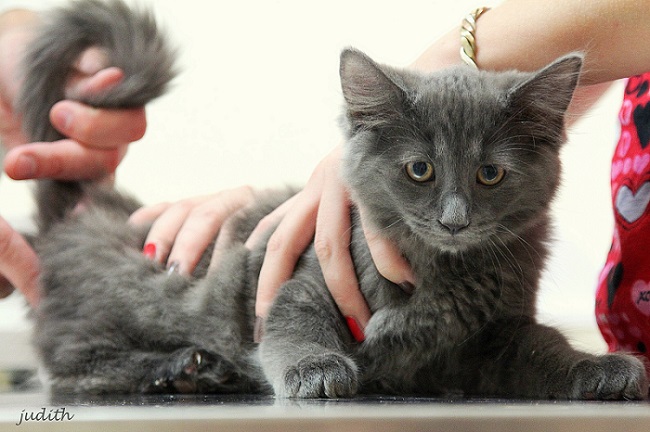
Lift the cat's tail and gently but firmly insert the tip of the thermometer into the pet's rectum (to a depth of one to two centimeters maximum). Remember that a cat's temperature (like that of other warm-blooded domestic animals) is measured rectally. Avoid inserting the thermometer too deeply or too forcefully to avoid injury. Time the thermometer—three to five minutes is sufficient. If you're using an electronic thermometer, remove it after the beep.
After removing the thermometer, be sure to disinfect the tip with a disinfectant (at least vodka or an alcohol-based solution). It's advisable to have a separate thermometer for your pet, not one that will be used by people.
As you can see, taking a cat's temperature at home is not at all difficult. This will allow you to notice when your pet has a fever. But what does a rise in temperature indicate?
Why does a cat's body temperature rise?
There are several reasons why a cat's body temperature rises:
- Overheating. Especially if it's hot outside, an increase in body temperature is the body's defense mechanism. This is how your pet regulates its own heat exchange, releasing excess heat into the environment. So, make sure your cat isn't in outside in the heat Without the opportunity to hide in the shade and drink clean, cool water. And keep an eye on the room temperature. Cats often overheat indoors, too.
- After exercise, after feeding, and during pregnancy. This means your pet is completely healthy and there's no cause for concern. The temperature will rise slightly (no more than a degree, called a low-grade fever), and the cat will behave as usual: cheerful and with a good appetite.
- An inflammatory process in the body. Fever is the main symptom of inflammation. Therefore, if you don't notice any external changes in your pet, but the temperature has risen, seek immediate veterinary attention. It's especially dangerous when the fever is accompanied by a cough. runny nose, frequent or, conversely, rare breathing, vomiting or diarrheaThis often indicates an infectious disease or a serious inflammatory process.
Increased temperature after sterilization, vaccination
Fever after surgery isn't always a reaction to the procedure. Yes, a cat's temperature may rise slightly in the first 24 hours after spaying. This is, after all, a "shock" for the body, as it tries to recover and defend itself. However, if the thermometer reads above 40 degrees Celsius (104 degrees Fahrenheit), the cat becomes lethargic, apathetic, refuses food and water, and constantly lies down or hides, then contact a veterinarian immediately or have a veterinarian come to your home. This condition may indicate the onset of inflammation, and antibiotic therapy may be necessary.
A temperature spike may also be observed after vaccinations. If it's mild (about 1 degree above the upper limit of normal), don't panic. This is completely normal. The immune system has begun to work, fighting off the pathogens introduced with the vaccine. A low-grade fever can last up to three days. However, if the temperature is extremely high, it's best to consult a veterinarian to rule out (or confirm) any underlying medical condition and begin treatment promptly.
Why does a cat's temperature drop?
A cat's body temperature doesn't always rise; it can also drop. This is also a worrying symptom, as the body's metabolic processes slow down significantly. Such a drop can be caused by hypothermia or poisoning. In any case, it's advisable to consult a veterinarian to rule out serious health issues.
What to do if your cat's temperature rises
If your cat's temperature is abnormal, do not rush to bring it down without consulting a veterinarian.
- If it's elevated (slightly), it's a sign that the body's immune system has begun to "work." It needs time to fight the fever. But if the fever persists for a long time or is high, it needs to be brought down.
- Self-administering fever medications can lead to death. Yes, death. Because the familiar aspirin and paracetamol (and medications containing them) damage the renal tubules.
- Remember the dosage. Cats are smaller than humans, so the dosage should be calculated based on their weight.
Therefore, any treatment should only be prescribed by a veterinarian after an in-person examination. It may require not only antipyretics and antispasmodics (to reduce the temperature more quickly), but also other medications (antibiotics, antivirals, immunostimulants, cardiac and respiratory support, and others).
So, a normal temperature for cats is considered to be one that ranges from 38 to 39 degrees; if it is within these limits, then there is no need to worry.
You can also ask our website's staff veterinarian a question, who will answer them as quickly as possible in the comments box below.
Read also:


-550x428.jpg)


8 comments
Anya
My cat has a temperature of 38. Please tell me if this is normal. I just measured it while he was lying on his back. Please tell me, I'm very worried.
Daria is a veterinarian
Hello! What's your pet's age (is it higher in younger animals than in older ones)? What's their gender (physiology is also important)? Has there been any physical activity or stress? A temperature of 38 isn't a fever, so there's definitely no need to bring it down. Also, look at the pet's general condition. Did you use a mercury thermometer or an electronic one? Rectally, as recommended?
Lyudmila
Hello. My cat gave birth three weeks ago. She has one kitten. But after giving birth, she has had almost constant diarrhea and even vomited once. She eats poorly and breathes very rapidly. Sometimes she screams as if she is suddenly in pain. She is not a purebred. We live in a rural area, it is a long way to the vet, and she does not travel well. She screams and her fur starts to fall out. What is wrong with her? Please tell me.
Dasha is a veterinarian
Hello! Is her temperature normal or elevated? How was the birth? No complications? Is there any suspicious vaginal discharge? Did you feel her belly? Is it painful? What are you feeding her? How is the kitten acting? Does the mother allow him to approach her? The cat has had diarrhea every day for the past three weeks (so why didn't you immediately raise the alarm, but waited almost a month)? What have you given her so far (in 95% of cases, owners first try to "cure" her themselves, and when all else fails, they seek veterinary help)?
Elena
Could you please advise? We found a kitten (it's freezing outside). His temperature is 39.2°C (102.2°F). Should we be concerned? His stool is normal, but he's not eating well and is thin. He must have been outside for a few days. He looks like a Maine Coon and weighs about 3 kilograms.
Dasha is a veterinarian
Hello! His temperature is normal (normal range is up to 39.5°C). Warm him up, preferably take him to the vet for a checkup (he's a foundling, after all; he could have caught a cold or a cold, or maybe he picked up ringworm while outside). Otherwise, observe him for a couple of days, and if all is well, deworm him. This could be why he's so thin and has a poor appetite. Perhaps he was living with someone else and ate different food, which is why he's reluctant to eat at yours (the food isn't right)?
Valeria
Hello! My cat's eyes are rolling back in his head, like they're opening their third eyelids. His temperature was 102.5 degrees Fahrenheit (39.5°C). His stool is loose. He also periodically makes grunting sounds. He was vaccinated two weeks ago. The vet gave him an amoxicillin shot, but it didn't help. What could be wrong?
Dasha is a veterinarian
Hello! What kind of diagnosis is this—an open third eyelid? Your temperature is within normal limits. If you consulted a veterinarian, didn't they tell you the diagnosis? They saw your pet, listened to her, and felt her; it's easier for them to make a diagnosis than for me based on your description. What exactly is bothering you? Is it the eye or diarrhea? Or is her breathing unusual? It could be the structure of her muzzle. My cat sometimes grunts in her sleep (as if she's snoring)—it's just the way her nasopharynx is structured; she doesn't have any wheezing in her lungs. Therefore, yours also needs to be auscultated.
And was the antibiotic administered only once? Surely there's a course of treatment (at least 5 days). What's the indication? Was it loose stool or was it the eye that was causing them concern? Could you describe the situation in more detail?
Add a comment