
How to get rid of fleas on a cat and kittens
Pets often suffer from external parasites. Fleas are the most common, and they can be found even in cats that never leave their homes. Unlike most other ectoparasites, fleas remain active year-round. They cause severe discomfort to their victims, can lead to malnutrition and stunted growth, and also serve as an intermediate host for various pathogens. Therefore, cat owners should know how to deal with these microscopic insects.

Content
Flea as a biological species
The flea (Siphonaptera) is a wingless arthropod, a member of the order Siphonaptera. Its cutting, piercing, and sucking mouthparts allow it to easily pierce skin, and its laterally flattened body allows it to move quickly through thick fur. Of the arthropod's six legs, the two hind legs are longer and better developed, enabling it to jump 20 cm high and 40 cm long.
The parasite feeds on blood and lymph, is extremely resilient, and can survive without food for over a year. When exposed to favorable conditions, such as on an animal's body, Siphonaptera begins to feed and reproduce rapidly. A female insect can lay over three hundred eggs per day, which hatch into a colony of bloodthirsty young within two weeks.
Why are fleas dangerous?
Any ectoparasites pose a health risk to animals, and fleas are no exception. They can cause damage to a cat's skin and fur: the animal experiences intense itching, scratches, and the fur can lose its shine and even fall out. Flea bites can also cause allergies in cats (there's even a condition called atopic flea dermatitis, which is caused by the body's reaction to the insect's saliva).
In young kittens and older and weakened cats, fleas can cause anemia, which in severe cases can be fatal due to blood loss. These insects transmit dangerous diseases such as helminthiasis, salmonellosis, brucellosis, hepatitis, and feline panleukopenia (distemper).

Signs of fleas in cats
Typically, the first sign that a cat has fleas is its restless behavior: due to severe itching, the animal constantly scratches itself, rubs against furniture and corners, and tries to bite out the parasite with its teeth.
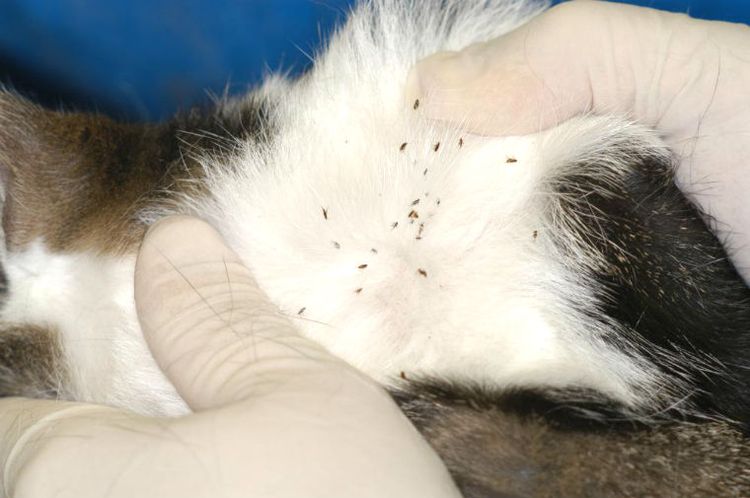
Upon examination, small wounds and scratches may be visible on the cat's skin. In advanced cases, infection can lead to pustules or abscesses. Despite the parasite's small size, it can be seen with the naked eye, most often on the head and neck. Sometimes, flea eggs, which look like small white grains, can also be seen.
You can detect fleas on your cat with a simple test: comb your cat over a light-colored surface (such as a sheet of paper). The small, dark clumps that appear after combing are flea droppings.
How to get rid of fleas
To rid your cat of fleas, you can use veterinary products containing insecticides (substances that act as nerve agents on insects) or repellents (substances that repel parasites with their scent). There are several types of these products.
Shampoos
Using flea shampoos is simple: apply the amount of product indicated in the instructions to the cat's fur, dampened with warm water, and lather it all over the cat's body, avoiding the eyes, mouth, and nose. After 3-5 minutes, rinse thoroughly with running water. Veterinarians consider the following shampoos to be the most effective:
- Permethrin (active ingredient - synthetic pyrethroid),
- Bars - based on clove extract,
- Beaphar - based on margosa extract,
- Green Fort - based on geranium oil.

Drops
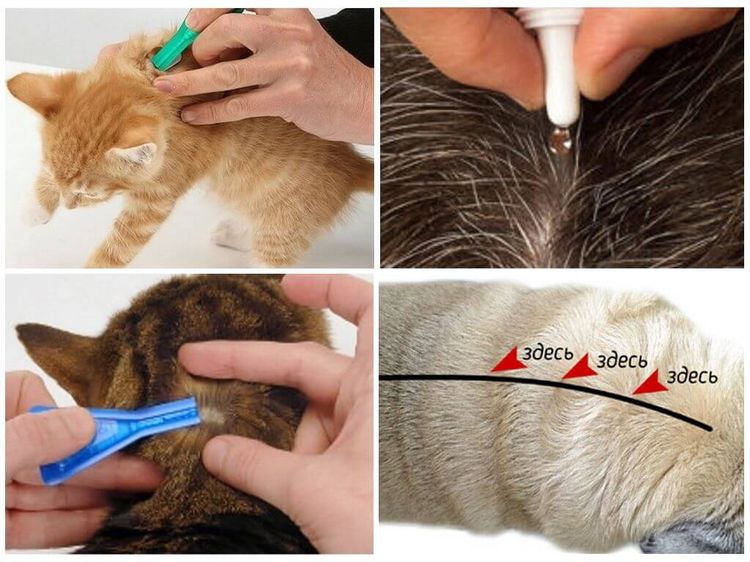
The product is applied to the withers and spine area. Within 1-2 days, the toxic substance it contains is distributed throughout the fur, providing a long-lasting insecticidal or repellent effect on ectoparasites. The best insectoacaricidal drops:
- Advantage - active substance Imidacloprid.
- Dironet Spot-on - active substance Praziquantel.
- Frontline - active substance Fipronil.
- Kiss - active ingredient Fipronil.
- Beaphar - active ingredient: Margosa extract.
Aerosols
Aerosols are considered the fastest-acting and most effective flea control products, but they must be used with caution, carefully observing the dosage and avoiding contact with the eyes and respiratory tract. It is recommended to put a protective collar on the cat before applying the aerosol. After the spray has completely dried, thoroughly comb the cat's fur to remove dead parasites. Bayer Bolfo, Frontline, Vitomax Platinum, and Trixie BioLiberat aerosols are used for male cats.
When using any antiparasitic product, it is essential to strictly follow the instructions. It is recommended to use a smaller dose the first time to avoid an allergic reaction. Do not use different insecticides simultaneously, even if each is considered safe.
Collars
This flea protection device is a flexible strip of fabric, silicone, or plastic impregnated with an insecticide. The collar lasts from two to six months. Veterinarians consider the following models to be the best flea collars: Beaphar, Trixie, Palladium Pet Line, AnimAll VetLine, Hartz, Ultra Guard.
Ultrasonic flea repellents have recently become available—they are pendants that are hung around the animal's neck. They are considered completely safe, but their effectiveness has not been sufficiently studied.

Folk remedies
Many people prefer folk remedies for fleas, as they are harmless to animals. Here are several recipes for removing fleas from cats at home.
- Recipe 1: Mix equal parts 3% vinegar, triple cologne, and camphorated alcohol. Spray the cat's fur liberally with this mixture, wrap the animal's body tightly in plastic wrap, and let it sit for 10 minutes. Then remove the wrap and brush the cat thoroughly.
- Recipe 2: Grate baby soap, pour boiling water over it, and simmer for a few minutes until a gel-like consistency forms. Add an egg yolk, some grated onion, and calendula infusion to this mixture. Apply the mixture to the cat's body, wrap it in oilcloth or plastic wrap, leave it on for 20 minutes, then rinse with warm water.
- Recipe 3:Pour 1 tablespoon of dried wormwood into a cup of boiling water and simmer for 10 minutes. Rub this decoction into your cat's fur 2-3 times a week.
- Recipe 4:Dissolve table salt in warm water (approximately 1 kg of salt per 5 liters of water). Place the cat in this salt bath up to its neck for 10 minutes, then rinse thoroughly with running water.
Prevention of infections
The best protection for a cat against ectoparasites is living indoors without being allowed outside. However, if your pet occasionally goes outside, it's best to let them out only in your own yard or walk them on a leash to prevent them from coming into contact with other cats, especially strays.
After the owner or other family members have come into contact with other people's animals, even if these animals appear healthy, they must wash their hands with soap.
Cat bedding should be replaced or washed as often as possible. Since fleas can be brought into an apartment on shoes or clothing, it is recommended to perform a wet cleaning at least once a month using insecticidal acaricidal products designed for indoor use.
How to treat a cat for fleas: video
Read also:


Add a comment